ICC

ICC Refers Italy to Assembly of States Parties Over Failure to Surrender Libyan War Crimes Suspect 

By: Elihu Weiss 

Impunity Watch News Staff Writer 

THE HAGUE, Netherlands – On January 26, 2026, Pre-Trial Chamber I of the International Criminal Court (ICC) formally referred Italy’s non-compliance to the Assembly of States Parties (ASP). The referral stems from Italy’s failure to arrest and surrender Osama Elmasry Njeem, a senior Libyan official wanted by the ICC for war crimes and crimes against humanity.

Osama Elmasry Njeem arrives at Mitiga International Airport in Tripoli, Libya, on January 21, 2025, after being released from Italian custody and flown home aboard an Italian government aircraft. Photo Courtesy: The Tripoli Post  

Njeem served as chief of Libya’s judicial police and reportedly ran the Mitiga detention facility near Tripoli. The ICC issued a sealed arrest warrant against him on January 18, 2025, alleging crimes including murder, torture, rape, sexual violence, enslavement, and persecution committed against detainees held at Mitiga from at least February 2015 onward. Many of the victims were migrants and refugees. 

Italian anti-terrorism police arrested Njeem at a hotel in Turin on January 19, 2025. Two days later, he was released. Italian authorities cited procedural grounds, stating that the Rome Court of Appeal had not validated the arrest because it was awaiting approval from the Minister of Justice. Njeem was then flown back to Tripoli aboard an Italian government aircraft. The ICC was not notified before his release. The Italian interior minister also ordered Njeem’s expulsion on national security grounds, a justification the ICC later found unsupported. 

On October 17, 2025, Pre-Trial Chamber I found that Italy had failed to comply with its obligations under the Rome Statute by not executing the warrant and by not consulting with the Court. The Chamber noted that Njeem was returned to Libya as a free man, not handed over under any formal process. On January 26, 2026, the Chamber referred the matter to the ASP. Italy was invited to appear before the ASP Bureau on April 1, 2026, to explain how it intends to cooperate going forward. 

Italy is a founding member of the ICC. Former Prime Minister Giuseppe Conte called the episode “a humiliation,” and opposition leaders demanded accountability. Italy’s refusal to carry out an arrest warrant for a suspect accused of crimes against detained migrants and refugees, some of the world’s most vulnerable people, undermines the Court at a moment when it already faces U.S. sanctions and repeated failures by member states to execute warrants. For victims of the abuses at Mitiga, the referral offers little immediate relief. The suspect is free, and the Court’s only remaining enforcement tool is political pressure from other states. 

For further information, please see: 

ICC – Referral by the Presidency of the International Criminal Court of Italy’s Non-Compliance to the Assembly of States Parties – 29 Jan. 2026 

ECCHR – Italy Thwarts Arrest of Alleged War Criminal – 31 Jan. 2025 

FIDH – Italy’s Failure to Surrender Libyan Suspect to the ICC Is a Breach of Its Rome Statute Obligation – 23 Jan. 2025 

UPI – ICC Accuses Italy of Non-Compliance in Libyan General’s Torture Case – 2 Apr. 2026 
ICC Disqualifies Prosecutor Karim Khan from Duterte Case, but Proceedings Will Continue

By: Tiffany D. Johnson 

Impunity Watch News Staff Writer 

THE HAGUE, Netherlands – Judges at the International Criminal Court (ICC) have disqualified Chief Prosecutor Karim Khan from the case against former Philippine president Rodrigo Duterte, citing a “reasonable appearance of bias” tied to Khan’s prior representation of Filipino victims of Duterte’s anti-drug campaign. The Appeals Chamber’s ruling, issued on October 2 and made public on October 15, removes Khan from the ICC’s highest-profile active prosecution but leaves the case intact under Deputy Prosecutor Mame Mandiaye Niang. 

Court spokesperson Fadi El Abdallah emphasized that “this disqualification has no impact on the case itself,” and that the Office of the Prosecutor’s work “continues to be led by the Deputy Prosecutor.” 

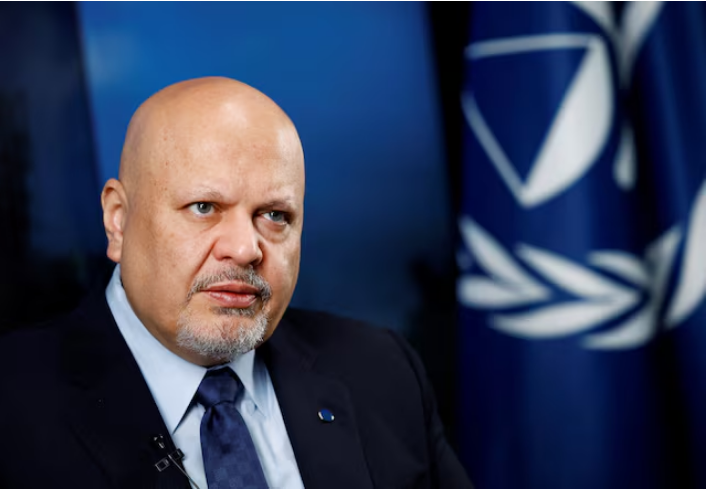
International Criminal Court (ICC) Prosecutor Karim Khan attends an interview with Reuters in The Hague, Netherlands January 16, 2025. REUTERS/Piroschka van de Wouw/File Photo Purchase Licensing Rights

Background 
Duterte, who served as president from 2016 to 2022, was arrested in March under an ICC warrant alleging crimes against humanity for thousands of extrajudicial killings committed during his “war on drugs.” He has denied the charges, calling his arrest unlawful and maintaining that he is medically unfit to stand trial. 

In August, Duterte’s defense team, led by Nicholas Kaufman, petitioned to disqualify Khan, arguing that the prosecutor’s prior legal work on behalf of victims before joining the ICC created a conflict of interest. Before his election as ICC Prosecutor in 2021, Khan had represented the Philippines Human Rights Commission and a group of victims in submissions identifying Duterte as a suspect. The defense argued this earlier advocacy rendered him incapable of impartiality. 

Khan countered that his former representation created no conflict and urged the Chamber to reject the motion. The five-judge Appeals Chamber, however, unanimously ruled that a fair-minded observer could conclude there was a reasonable appearance of bias under Rule 34(1)(c) of the Rules of Procedure and Evidence, which bars participation by anyone whose prior functions could “adversely affect the required impartiality.” 

Court’s Decision and Next Steps 

The Chamber’s decision followed similar findings earlier this year, when Khan was ordered to recuse himself from the Venezuela investigation because of family connections to counsel for that government. Khan has also been on administrative leave since May pending an unrelated United Nations inquiry into alleged sexual misconduct, which he denies. 

With Khan’s removal, the Deputy Prosecutor Niang—who has himself faced U.S. sanctions linked to the ICC’s probe of alleged war crimes in Gaza—will continue leading the Philippine investigation. The Office of the Prosecutor reaffirmed that the case “advances solely on the strength of independently gathered evidence,” including witness statements, cooperation from states, and information from civil society. 

Significance 

The disqualification of a sitting ICC Prosecutor from an ongoing case is unprecedented, raising questions about leadership ethics and institutional credibility. Yet the decision also demonstrates the Court’s willingness to apply its own impartiality standards rigorously, even at the highest level. 

For victims of the Philippine drug war, the ruling provides reassurance that the proceedings will continue unaffected and that the Court remains committed to pursuing justice “impartially and independently.” 

As the case moves forward under Deputy Prosecutor Niang, the episode underscores the ICC’s central challenge—upholding global accountability while preserving confidence in the integrity of those who prosecute it. 


For further information, please see:  

Al Jazeera – ICC/ Mame Mandiaye Niang, Will Now Replace Khan – Oct. 15, 2025 

Euro News – ICC removes chief prosecutor from Duterte case over perceived conflict of interest – Oct. 15, 2025 

The Hill – ICC disqualifies chief prosecutor from Duterte case over perceived conflict of interest-Oct. 15, 2025 

Rappler – Prosecutor’s removal from Duterte case has ‘no impact’ – ICC – Oct. 15, 2025 

Reuters – Exclusive: ICC judges disqualify ICC prosecutor Khan from Duterte case, court document shows – Oct. 14, 2025 


ICC Rejects Israel’s Appeal Against Arrest Warrants for Netanyahu and Gallant

By Christina Bradic

Managing Editor of Impunity Watch

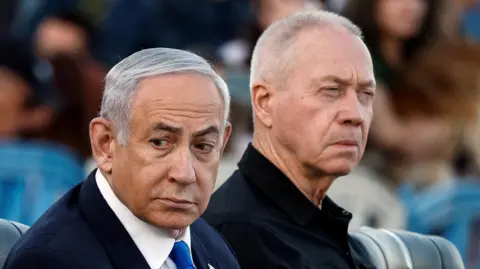
The Hague, Netherlands – The International Criminal Court (ICC) has rejected Israel’s appeal against the arrest warrants issued for Prime Minister Benjamin Netanyahu and Defense Minister Yoav Gallant, reaffirming that the matter raised “was not an appealable issue.” The decision, delivered by the ICC’s Appeals Chamber, marks another procedural loss for Israel as it continues to contest the Court’s jurisdiction over alleged crimes committed during the war in Gaza.

Reuters October 31, 2024. Benjamin Netanyahu (L) and Yoav Gallant (R) attend a ceremony at an army base near Mitzpe Ramon, Israel.

The warrants, first authorized by Pre-Trial Chamber I in November 2024, allege that Netanyahu and Gallant bear individual criminal responsibility for war crimes and crimes against humanity under Articles 7 and 8 of the Rome Statute. The Prosecutor’s Office, led by Karim A. A. Khan KC, claims the two officials oversaw policies that resulted in intentional attacks on civilians and the use of starvation as a method of warfare. Israel, a non-party to the Statute, has repeatedly argued that the ICC lacks jurisdiction because the State of Palestine does not meet the criteria of statehood under international law.

In its latest ruling, the Appeals Chamber underscored that Israel’s appeal sought to contest a prior interlocutory finding rather than a final decision. The judges held that “issues of admissibility or jurisdiction may only be raised through established procedural channels” and that Israel’s filing did not meet that threshold. While the Chamber’s reasoning was narrowly procedural, the outcome effectively preserves the status quo—Netanyahu and Gallant remain subjects of outstanding arrest warrants enforceable by ICC member states.

Legal observers note that the Court’s ruling reinforces the autonomy of the Prosecutor and the Pre-Trial Chamber to proceed with cases involving non-member states when crimes are alleged on the territory of a State Party. In 2021, the ICC determined that its territorial jurisdiction extends to Gaza, the West Bank, and East Jerusalem following Palestine’s 2015 accession to the Rome Statute. That determination remains a cornerstone of the ongoing proceedings, despite diplomatic pushback from Israel and the United States.

Reactions to the ruling were sharply divided. Israeli officials denounced the decision as “an assault on sovereignty,” while human rights groups welcomed it as a reaffirmation of judicial independence. “This outcome demonstrates that even powerful states cannot unilaterally shield their leaders from accountability,” said one Hague-based legal expert, noting that procedural formalism often masks deeper questions about global inequality in international justice.

The rejection also raises questions about enforcement. Neither Israel nor the United States is obligated to cooperate with the ICC, and previous attempts to execute warrants against sitting heads of state, such as Sudan’s Omar al-Bashir, have faced political resistance. Still, the ICC’s position signals its intent to uphold jurisdictional consistency, even amid geopolitical pressure.

As proceedings move forward, the Court is expected to revisit admissibility and complementarity issues, including whether ongoing Israeli investigations preclude ICC intervention. For now, the ruling underscores a familiar tension in international criminal law: between law’s universality and the limits imposed by state sovereignty.

For further information, please see:

Associated Press (AP News) – ICC prosecutor says Netanyahu arrest warrant should remain as Israel jurisdiction challenge is heard – July 15, 2025

The Guardian – ‘Reward for terrorism’: Israeli politicians unite to condemn ICC arrest warrant for Netanyahu – November 21, 2024

International Criminal Court (Official) – Situation in the State of Palestine: ICC Pre-Trial Chamber I rejects State of Israel’s challenges – November 21, 2024

JNS – ICC rejects Israeli appeal of Netanyahu, Gallant arrest warrants – October 18, 2025

Le Monde (English edition) – US warns ICC member states to drop proceedings against Israel – July 10, 2025

Middle East Eye – ICC rejects Israel’s appeal to cancel Netanyahu’s arrest warrant – October 18, 2025

TRT World – ICC rejects Israel’s bid to appeal over arrest warrants for Netanyahu and Gallant – October 17, 2025

United Nations – International Criminal Court issues arrest warrants for Israeli officials – November 22, 2024

WAFA (Palestinian News Agency) – ICC rejects Israel’s second appeal against arrest warrants for Netanyahu and Gallant – October 18, 2025

International Criminal Court Holds First In-Absentia Hearing: The Case of Joseph Kony and the Lord’s Resistance Army

By: Tiffany D. Johnson 

Impunity Watch News Staff Writer 

THE HAGUE, Netherlands – On September 9, 2025, the International Criminal Court (ICC) opened a landmark evidentiary hearing against fugitive Lord’s Resistance Army (LRA) leader Joseph Kony, in what has become the Court’s first-ever in-absentia proceedings. Kony, who has evaded capture since his indictment in 2005, faces 39 counts of war crimes and crimes against humanity for atrocities committed in northern Uganda and neighboring states. 

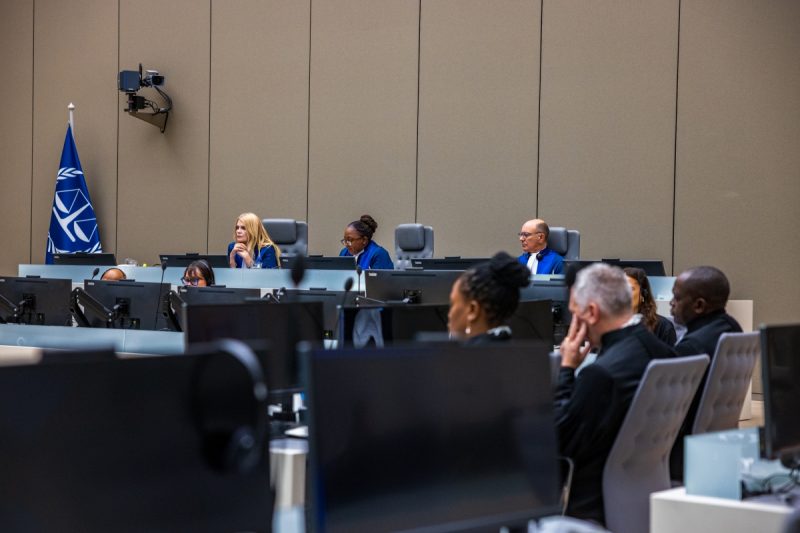
Image shows Judge Althea Violet Alexis-Windsor (Presiding Judge), Judge Iulia Motoc and Judge Haykel Ben Mahfoudh.
Photo credit © ICC-CPI. The confirmation hearing in the case The Prosecutor v. Joseph Kony opened on 09 September 2025 at 9:30 (The Hague local time) before Pre-Trial Chamber III of the International Criminal Court (ICC). Pre-Trial Chamber III is composed of Judge Althea Violet Alexis-Windsor (Presiding Judge), Judge Iulia Motoc and Judge Haykel Ben Mahfoudh.

Background 

Kony founded the LRA in the late 1980s, leading a violent campaign of abductions, child soldier recruitment, sexual enslavement, and mass killings that terrorized Central Africa for decades. The ICC issued its first arrest warrants against Kony and senior LRA commanders in 2005, charging them with crimes including murder, rape, enslavement, and the conscription of children under 15. While several commanders have since been captured or tried domestically, Kony has remained at large despite multinational efforts to arrest him. 
 
Until recently, ICC procedure required the accused to be physically present. However, Rome Statute amendments and judicial interpretation now allow in-absentia proceedings when suspects remain fugitives but have been given reasonable opportunity to appear. The Kony case is the first to invoke this expanded procedure. 

Prosecution, Defense, and Victims 

The Office of the Prosecutor (OTP) argued that proceeding without Kony was essential to preserve fragile evidence and to recognize victims who have waited nearly two decades for judicial acknowledgment. The charges, brought under Articles 7 and 8 of the Rome Statute, allege crimes against humanity and war crimes tied to widespread and systematic attacks on civilians. 
 
Although Kony was not present, the Court appointed standby defense counsel to safeguard his procedural rights. Counsel raised concerns about the challenges of mounting a defense without the accused’s participation, including difficulties contesting evidence or questioning witnesses. 
 
At the same time, hundreds of victims have registered to participate in the case, and several survivor testimonies were heard in the opening days. Victim representatives stressed that the proceedings are not only legal milestones but also critical for community healing and truth-telling. 

Judicial Developments 

The judges of Pre-Trial Chamber II ruled that in-absentia hearings were justified under the Rome Statute, citing Article 63(2) (which allows proceedings without the accused in exceptional circumstances) and recent amendments permitting such hearings when fugitives have been given a reasonable opportunity to appear. They emphasized that Kony has been under an active ICC arrest warrant since 2005, has repeatedly failed to surrender, and therefore cannot indefinitely block justice by evasion. 

 The charges against Kony include crimes against humanity (Article 7) and war crimes (Article 8), encompassing murder, enslavement, rape, and the conscription of children. While judges stressed that any final conviction and sentencing would still require Kony’s physical presence, they determined that preserving evidence, hearing victims, and formally recording proceedings outweighed further delay. Early sessions included documentary evidence, NGO reports, and expert testimony on the LRA’s command structure and Kony’s personal role in ordering atrocities. 

Significance 

The Kony in-absentia proceedings represent a historic expansion of the ICC’s toolkit for combating impunity. For victims, the hearings provide long-delayed recognition and an official record of the crimes. For international justice, the case raises important debates about how to balance fair-trial rights with the imperative to ensure accountability, even when suspects remain beyond the Court’s reach. 
 
As the hearings progress, the ICC’s handling of Kony’s case may set precedent for addressing other long-term fugitives and will test whether international criminal law can adapt without compromising legitimacy. 

For further information, please see:  

ICC opens war crimes hearing against Ugandan rebel Joseph Kony | ICC News | Al Jazeera 

International Criminal Court holds hearings on charges against Joseph Kony | AP News 

Justice must not be delayed: ICC holds hearing in absentia against Joseph Kony | Coalition for the International Criminal Court 

Q&A: Understanding Joseph Kony’s ICC Confirmation of Charges Hearing | International Federation for Human Rights 

Uganda: Victims demand justice as the International Criminal Court opens historic Kony hearing in absentia | International Federation for Human Rights 

International Criminal Court holds hearings on charges against Joseph Kony | AP News

First American ICC Case: What is Going on in Venezuela?

By: Alessa Rodriguez

Impunity Watch News Staff Writer

CARACAS, Venezuela – Venezuela is a rarely talked about South American country handling corruption and instability that is impacting its people so much that the ICC has been investigating the government since 2018. It is currently being led by Nicolas Maduro, and since his presidency the country has been repressing its citizens from speaking up as to the conditions of their country. Six ICC countries have asked the prosecutor to investigate the potential crimes in Venezuela, the first time countries have jointly asked for an investigation into another ICC member country and one of the first cases in the Americas region.

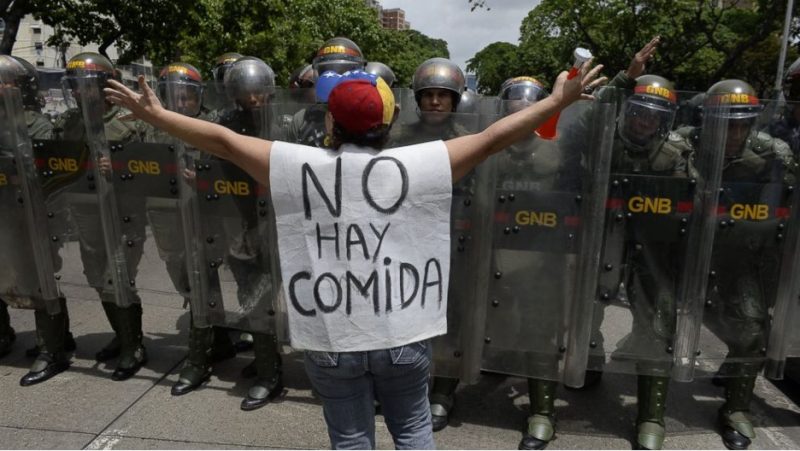
Protestor wearing sign saying “there is no food.” Photo Courtesy of AFP/Getty Images.

The violations and crimes being alleged are part of a widespread and systematic attack against the population. The allegations include crimes against humanity of imprisonment or other severe deprivation of liberty; torture, rape, and other forms of sexual violence; persecution against identifiable groups on political grounds by civilian authorities, members of armed forces, and government supporters.

Such commanders and superiors should have known about the crimes and did not take measures to prevent or repress them, they may have committed the abuses and covered them up, allegations say. Between 2016 and 2019 police and security forces killed nearly 18,000 people for alleged resistance to authority, the people were seen as government opponents, so agents executed them during raids after anti-government protests. The UN has also concluded that the authorities and pro-government groups had committed the violations, amounting to crimes against humanity.

In April 2021, the Human Rights Watch documented new cases, alleging that there is a pattern of systematic abuses that have led to international inquiries. A court filing from June of that year concluded that the authorities were unwilling to investigate or prosecute the cases because the domestic government had shielded people from criminal responsibility and that those proceedings have not been conducted independently. It has been determined that the Judiciary, Venezuela’s Supreme Court, has stopped functioning as an independent branch of government and is complicit in the abuses.

As of now, there is still no real conclusion to the investigation, nor has there been any trials.


For further information, please see:

Council on Foreign Relations – Instability in Venezuela – 6 Jan. 2023

Human Rights Watch – News – Venezuela: ICC Investigation Opens – 3 Nov. 2021

ICC – Investigations – Venezuela – Situation in the Bolivarian Republic of Venezuela – Feb. 2018