Children Chained in Hostel by Father in South Africa

By: Danielle L. Cowan (Gwozdz)
Impunity Watch Senior Desk Operator, Africa

PRETORIA, South Africa – A South African man has been accused of keeping his children chained in a hostel room for eight years has been held in police custody.

Article 2 Picture
Children chained by father (photo courtesy of Daily Sun)


The South African man is 50-years-old. He appeared in court in Alexandra, a township north of Johannesburg and has been charged with child neglect. He was arrested on Friday. The man’s 46-year-old wife also was involved.

The children he chained are of the ages of 14, 18, and 24. Each child shows signs of abuse and injuries on their ankles and wrists.

The police found the children after the 24-year-old escaped, allegedly also mentally ill, police state. He escaped when his parents left the hostel.

The children were freed on Friday after the eldest child escaped. The children were brought to a hospital. The father claims he had to chain up the eldest son because of the mental illness.

The father stated that the eldest child “becomes very violent so I had to keep him chained in the house.”

Neighbors described the living conditions of the home as “appalling.”

A resident of the hostel of nine years stated she was “shocked” when the story was released. “I live right next door to them but I never saw or heard the kids. I see Emmanuel leaving for work. He makes sure his room is always locked.

The father further reported that the reason he locked up the other children is because the world was dangerous and he did not want them killed.

After the children were released from the hospital, they were taken to a place of safety.

When other residents heard of the locked-up children, cops had to stop them from attacking the 50-year-old father.

The police stated that the “room was full of dirty stuff lying everywhere. There was no room to walk in the passage and the children were kept in the back in a dark corner.”

For more information, please visit:
BBC News – South Africa man ‘chained children for years’ – 3 June 2014
Sowetan Live – Alex man held for locking his children up for 8 years – 2 June 2014
News 24 – Parents lock up children for 8 years – 2 June 2014
National Headlines – SA man ‘chained children for years’ – 3 June 2014
Daily Sun – KIDS LOCKED UP FOR 8 YEARS! – 2 June 2014

Colombia’s Presidential Election Rests on the Question of How to End the Nation’s 50 Year Old Conflict

by Mridula Tirumalasetti
Impunity Watch Reporter, South America

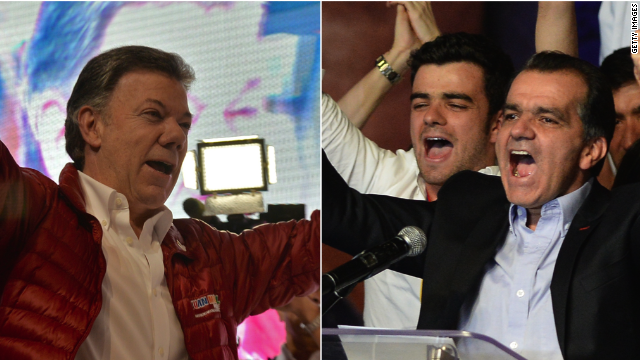
Presidential candidate Óscar Iván Zuluaga is pictured above before a crowd of supporters (photo courtesy of The Wall Street Journal)

BOGOTÁ, Colombia – Colombia’s presidential candidate, Óscar Iván Zuluaga won the first round of voting on May 25 with 29.3 percent of the votes, ahead of President Juan Manuel Santos with 25.7 percent. Zuluaga will face Santos on June 15 in a run-off vote. In order to avoid a run-off vote in Colombia, Zuluaga would have had to win more than 50 percent of the votes. Polls show this has been the nation’s tightest election in years.

The most pressing issue of the campaign has been how to end the country’s 50-year conflict with the Revolutionary Armed Forces of Colombia, or FARC, a conflict which has claimed more than 215,000 lives. Santos has been negotiating with FARC in Cuba, and announced on May 16 that they had reached an agreement on three out of the five points, including land reform and political participation by the FARC. These negotiations have been said to bring the end of the fight against illegal drugs closer than ever.

Right-wing Zuluaga, who is backed by former President Álvaro Uribe, favors more of a military solution rather than peace talks. Zuluaga initially promised that, if elected, he would immediately suspend peace talks with FARC but has since softened his stance in exchange for Conservative Party leader, Marta Lucia Ramirez’s support in the run-off vote. Zuluaga has agreed to give FARC a chance to declare a ceasefire. In a speech after the first round of voting, Zuluaga said “The President of the Republic cannot and should not be manipulated by the FARC, the biggest drug cartel in the world today.” Zuluaga promised “a full-frontal assault on terrorism.” Santos has criticized Zuluaga’s acceptance of the idea of peace talks as hypocritical and “politicking.”

“Zuluaga’s triumph [in the first round] shows there’s an important part of society that doesn’t back the Havana talks,” said Alejo Vargas, who is a professor of political science at the National University. Some voters want a more firm approach when dealing with FARC. Voter Jhon Serrato said “You can’t just give them what they want, while they kill people.” Another voter, Lena Sanchez Rodriguez said “The office of the president has gotten weaker in the last four years” and “Santos doesn’t have a strong enough hand to deal with delinquents.”

Other voters such as Mariana Giraldo, support the Santos administration and the peace process. Giraldo said, “If there was a peace deal we would have more diplomatic agreements with other countries.”

A voter poll on Thursday, the first since Sunday’s first round of voting, showed Santos leading by one percent over Zuluaga. Still, almost 20 million of the 33 million registered voters did not vote. Additionally, approximately 800,000 voters voted a blank ballot in order to protest both of the candidates.

For more information please see:

Al Jazeera – Zuluaga wins first round of Colombia election – 25 May 2014

The Wall Street Journal – Colombia President Santos to Face Zuluaga in Runoff Vote – 25 May 2014

Bloomberg – Zuluaga Leads Santos Ahead of Colombia Presidential Runoff – 26 May 2014

Reuters – Colombia’s Zuluaga softens on FARC peace talks ahead of run-off vote – 29 May 2014

Police Retaliate Against Protestors Who Gathered to Mark the One-Year Anniversary of Taksim Square

ISTANBUL, Turkey- The Turkish government sent 25,000 police officers to disperse crowds of protestors who gathered in central Istanbul to mark the one-year anniversary of Turkey’s largest anti-government protest in decades.

Riot police circled the perimeter of the square and hundreds of plain-clothed police carrying batons patrolled the area.

Turkish police were told to use any force necessary to deter protestors, including tear gas.

Police blocked off all roads and stopped public transport to the Gezi Park area and Taksim Square hoping to quell protestors who came to mark the one-year anniversary.

More than 10 protestors have been arrested by police, who were told by the Turkish government to “do whatever is necessary from A to Z to stop the protestors”.

In 2013, protestors, mostly environmentalists, descended on Taksim Square to protest the Turkish government’s, under the rule of Prime Minister Tayyip Erdogan, plans to take away the adjoining green space of Gezi Park and turn it into a shopping mall.

The protestors staged a peaceful sit-in for several days to fight for the green space because it was one of the only parks left in central Istanbul. Erdogan had the police forcefully remove the protestors, and this use of violence brought tens of thousands of protestors to Taksim Square for two weeks before police could finally regain control of the space.

The subsequent months of unrest after the protest resulted in dozens of deaths at the hands of Turkish police who were given permission by Erdogan and the government to use “violent force” if necessary.

This past week, despite preemptive action by police, hundreds of protestors showed up shouting phrases such as “Resign murderer Erdogan” and “Everywhere is Taksim. Everywhere is resistance”.

Elif Cetinkaya and her family stood across the street from the square, quietly protesting by wearing T-shirts with the faces of those killed in the 2013 protest.

“Why did so many people have to die to save this park?” Cetinkaya said. “We are here to mourn their loss and show that we stand firm, no matter what obstacles they erect,” Cetinkaya said.

Police helicopters flew overhead and police officers fired water cannons and tear gas on the protestors, who huddled together en masse, hoping to read a statement and lay flowers at Taksim Square to honor the dozens of deaths.

Several news stations reported that tourists lugging suitcases, who had no idea the protest anniversary was occurring, got caught in the tear gas and frantically ran for cover shielding their eyes and dropping their belongings in the streets.

Prime Minister Erdogan, who has faced a more recent divided faction over his attempts to block popular websites such as YouTube and Twitter, urged his people, particularly young people, to avoid the demonstration and further demonstrations, saying the movement that began in 2013 against his government was founded by “terrorist organizations” that “manipulated our morally and financially weak youth to attack our unity and put our economy under threat”.

“Don’t fall for these games. This is not about environmentalism. There is no sincerity or honesty here” Erdogan said.

For more information see:

Al Jazeera- Police use tear gas on Turkish demonstrators– 1 June 2014

Haaretz- Facing 25,000 Police Officers, Turkey Activists Mark Gezi Protest Anniversary– 31 May 2014

Jerusalem Post- Turkish Police Fire Tear Gas at Activists Marking Taksim Protests– May 31 2014

TIME- Police Tear Gas Protestors On Taksim Square Anniversary– 31 May 2014


China Sentenced 55 People in Stadium Trial

By Hojin Choi

Impunity Watch Reporter, Asia


XINJIANG, China – A Chinese court sentenced 55 people for terrorism, separatism, and murder at a sports stadium. The sentence was handed down before a crowd of more than 7,000 spectators in the prefecture of Yili, a part of Xinjiang Uyghur Autonomous Region. Three of the defendants were sentenced to death.

The accused held on the back of pick-up trucks, dressed in orange jumpsuits and surrounded by security forces. (CNN)

The open trial follows a spike in widespread fear of terror attacks and increasing tensions across the country. In October, five people were killed and at least 40 injured by a car rushing into crowds of innocents on busy streets in Beijing. In March, a group of men armed with long knives invaded a train station in the city of Kunming and murdered 29 people, and  injured at least 130 others at the scene. In early May, some 39 people were killed and almost 100 injured by a terror bombing  in Xinjiang.

Chinese authorities believe these terror attacks were carried out by a separatist group formed with Uyghurs, an ethnically Turkic Muslim minority group native to the Xinjiang region. The ruling Communist Party declared an anti-terrorism campaign to strike hard any “violent terrorism, separatism, and religious extremism.” Li Minghui, Deputy Party Secretary of the prefecture of Yili, said they must “resolutely strike criminals … and boost the confidence and will to fight for all ethnicities among the masses.” The Xinjiang police launched a crackdown on the extremist groups that has resulted in 200 arrests of suspected terrorists so far.

Uyghurs have complained for a long time about pervasive discrimination in favor of Han, the Chinese majority ethnic group. The alleged discrimination includes employment, education, housing, and religious freedom restrictions. The Chinese government believes that Uyghurs are trying to form an independent state called East Turkestan.

Human rights organization Amnesty International described the “deplorable” proceeding as a “show trial.” William Nee, China Researcher of Amnesty International, said the recent terror attacks and disregard of human lives must be held to account. However, “speedy show trials will not deliver justice for the victims. Hastily sentencing people after unfair trials will only exacerbate tensions in the region,” said Mr. Nee.

The regional Communist Party leader announced before trial that the suspected criminals should be “severely punished.” According to Amnesty International, this places all of the defendants at risk of torture while they are detained.

According to Reuters, the trial was originally reported by the official Xinhua news, a state-operated press agency, but links to the news appear to be disconnected at this time.

For more information please see:

Reuters – China sentences 55 in Xinjiang mass trial – 28 May 2014

CNN – 55 sentenced before 7,000 onlookers at terror ‘show trial’ in Chinese stadium – 29 May 2014

CNN – China train station killings described as a terrorist attack – 2 March 2014

Aljazeera – China sentences 55 in mass stadium trial – 29 May 2014

BBC – China sentences 55 people in Xinjiang stadium – 28 May 2014

Amnesty International – China: Shameful stadium ‘show trial’ is not justice – 29 May 2014