YANGON, Myanmar – During President Thein Sein’s inauguration speech, the new president promised “sweeping democratic reform, and vowed to respect the role of the media.” One year later all signs indicate that President Sein is keeping his promise. Last month an article was published in the Yangon weekly Health Journal which described the poor living conditions prisoners faced in local jails.
Weekly newspapers are available for purchase from roadside shops in Yangon. (Photo Courtesy of Reuters)
The article explained that prison authorities attempted to cure an outbreak of scabies by having prisoners take their clothes off as prison employees wiped the naked inmates with medicine-laden brooms. Not only did the article raise alarming ethical questions about the treatment of prisoners but also displayed the poverty of both the nation’s prisons and healthcare system.
Zaw Thet, who wrote the article, was a political prisoner until last January. He explained “in the past it would’ve been a very dangerous thing to publish… it wasn’t allowed.” In the past journalists had been threatened, jailed, blacklisted, and beaten for writing articles the government did not want published.
While the government continues to censor reporting about “sensitive subjects” such as politics, censorship has ended on many subjects. Journalists are free to write on topics such as health, entertainment, fashion, and sports. Many reporters are interested in testing the recently gained limited freedom to find out what other topics the government will allow them to write about.
Thiha Saw, chief editor of a news weekly called Open News, said he’s now able to write freely about fires, murders, and natural disaster. He explained at various times in the past each had been prohibited.
Media groups who have been exiled in the past are interested at the prospect of returning to Myanmar. However, these groups hesitant to ensure that the current regime will not change its views on censorship in the future.
Aung Zaw, founder of the Irrawaddy news website based in Thailand, escaped Myanmar in 1988 after a popular uprising was “brutally crushed” by the previous government. After making his first trip back to Myanmar Zaw explained “it is our dream to publish a publication or online magazine inside Burma.”
The government has further promised to end censorship altogether once the parliament passes a new media law later this year. The legislation, which is currently being drafted, would allow Myanmar’s independent press to publish daily for the first time in decades.
By Carolyn Abdenour Impunity Watch Reporter, Middle East
BENGHAZI, Libya – On Monday, 5 March, thousands of Libyans gathered in the former rebel capital of Benghazi to bury the bodies of 157 civilians and rebel fighters government officials discovered in a mass grave on Friday. The officials unearthed the largest grave yet in the desert town of Bin Jawwad, a major battleground for the country’s 2011 civil war.
Libyan men carry coffins of victims discovered in the mass grave. (Photo Courtesy The Houston Chronicle)
Omar al-Obeidi, head of the new government-run missing person’s office, reported that officials began excavating bodies on Friday and completed the excavation on Sunday. So far, officials have identified 80 bodies. He added that all the bodies are from eastern Libya, and the youngest victim was a 17-year-old boy.
Most of the victims died between February and March 2011 from gunshot wounds and rocket strikes. Some people died via execution, and rocket attacks severely disfigured others.
Al-Obeidi noted that before his office opened the graves to identify the bodies, it obtained a fatwa from the Mufti, Sheikh al-Sadiq al-Gharyani, and permission from Attorney General Abdelaziz al-Hassadi.
Spokesperson for the Ministry of Martyrs, Wounded and Missing Persons Osama Swail stated the government would return the identified bodies to their families for proper funerals. Mr. Swali commented that two of his brothers were identified in the mass grave.
Presently, a forensic team is collecting DNA samples and photographs from the unidentified bodies in an attempt to match this information with DNA samples the ministry holds for missing persons throughout the country.
Libyans mourned for the deceased by holding a “Martyrs’ Parade” on Monday. The procession began in Bin Jawwad, passed through the city of Ajdabiya, and ended in Benghazi. Government officials escorted a caravan of 23 trucks carrying wooden coffins, each draped in a tri-colored Libyan flag, through the country’s eastern cities. Libyans held a traditional Islamic prayer service in honor of their fallen “martyrs” in Benghazi’s Tahrir Square after the delivery of coffins ended.
Mohammed al-Darnaway came to Tahrir Square to bury his two brothers. He asserted, “The revolutionaries of Zintan must hand over Seif al-Islam [Gaddafi’s son] immediately for trial.” Al-Islam remains in custody of a militia composed of former rebel fighters.
Benghazi resident Mahar al-Maghrabi also expressed anger at his new government for taking almost three months to recover the bodies, including the body of his brother, a 23-year-old rebel fighter. He said, “They knew about this grave, and they should have worked quicker to excavate the bodies…This is unacceptable.”
The International Criminal Court (ICC) issued an arrest warrant for Sudan’s defense minister, Abdul -Rahim Mohamed Hussein, for 41 counts of crimes against humanity and war crimes allegedly committed in Darfur.
Sudan’s Defense Minister Abdul-Rahim Mohamed Hussein (Photo Courtesy of Sudan Tribune.)
Hussein is wanted for actions taken during the time of August 2003 to March 2004 in Darfur, where rebels have fought government forces and allied militiamen since 2003. Hussein was Sudan’s interior minister at the time when attacks were made upon the towns and villages of Kodoom, Bindisi, Mukjar and Arawala in West Darfur.
The ICC said “there are reasonable grounds to believe that Mr. Hussein is criminally responsible for 20 counts of crimes against humanity (persecution, murder, forcible transfer, rape, inhuman acts, imprisonment or severe deprivation of liberty and torture) and 21 counts of war crimes (murder, attacks against civilian population, destruction of property, rape, pillaging and outrage upon personal dignity.)”
The court continued, explaining that “Mr. Hussein made essential contributions to the formulation and implementation of the common plan…through his overall coordination of national, state and local security entities and through the recruitment, arming and funding of the police forces and the Militia/Janjaweed in Darfur.”
The court has at least six other cases involving Darfur. Sudanese President Omar al-Bashir is wanted for war crimes, crimes against humanity and genocide, while Sudanese government official Ahmad Harun, Janjaweed leader Ali Kushayb, and rebel leaders Abdallah Banda, Saleh Jerbo and Abu Garda also face war crimes charges. However, Sudan does not recognize the ICC and refuses to hand over suspects.
The government in Khartoum was quick to dismiss the ruling, reiterating that Sudan is not a signatory to the Rome Statute, the ICC’s founding treaty.
“We are not concerned with the court and the decisions that come out of it,” foreign ministry spokesman Al-Obeid Marwih said. “We, like the United States and Russia, are not signatories to the Rome Statute governing the court.”
Sudan’s Minister of Information Sana al-Awad said Sudan was equally unconcerned with this latest arrest warrant. “The court has become a political tool and not one that seeks justice,” she said. “Sudan considers the arrest warrant an outcome of lobbying by anti-Sudan groups in the U.S. It is an unjustifiable allegation.”
Marwih suggested that the timing of the warrant was meant to coincide with the “recent victories” of Sudan Armed Forces (SAF) against the rebels in Blue Nile, South Kordofan and Darfur. “The court’s decision is more of a message to the rebellion than it is to frustrate the armed forces,” he said.
Meanwhile, the Prosecutor of the ICC, Luis Moreno-Ocampo, urged the international community to find “the final solution” for the problem of impunity in Darfur, where he says war crimes have continued despite the various arrest warrants.
“I think we did something complicated – we investigated the crime, we collected the evidence, we clarified the responsibilities,” Moreno-Ocampo told reporters at UN Headquarters. “But our effort is not enough if the crime is not stopped.”
The case against Hussein will be Moreno-Ocampo’s last involving Darfur before his tenure as ICC Prosecutor ends in June.
The United Nations (UN) estimates as many as 300,000 people have been killed and almost 3 million people have been displaced from their homes as a result of the conflict.
BEIJING, China – A 32 year old mother, an 18 year old boy and a middle school student each died after setting themselves on fire in protest of Chinese rule in Tibet over the past three days.
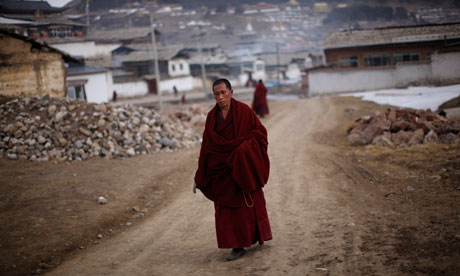
The recent string of self-immolations has largely been carried out by Buddhist monks who felt that the Chinese Government suppresses their religion. (Photo courtesy of the Guardian).
The three protesters lit themselves on fire in separate incidents in two different provinces in China’s restive Northwestern region.
The first of the weekend’s immolations took place on Saturday, when a student set herself on fire at a vegetable market in Gansu province’s Maqu county. The girl died at the scene.
Radio Free Asia reported the girl to be “in middle school.” London-based group, Free Tibet, later identified her as 20 year old Tsering Kyi.
Free Tibet quoted the student as saying before she died that Tibetans were burning themselves in Aba, a town in Sichuan province as well as in other areas under a widespread security clampdown by the Chinese authorities.
According to Tibetan exiles, unidentified market-goers threw stones at the girl’s burning body.
On Sunday, in an apparently uncoordinated second incident a 32 year old woman by the name of Rinchen lit herself on fire in front of a police station in Aba prefecture in Sichuan province. The act was especially symbolic to Tibetans because, like many police stations in heavily Tibetan populated areas in China, the station was by the main gate to a Buddhist monastery. China is rapidly expanding its security presence in Tibet and neighboring Xinjiang and it has become a common practice for the government to build police stations inside or next to Buddhist monasteries in order to maintain closer control over Tibetan religious leaders.
The particular monastery that Rinchen chose is known as the Kirti Monastery and is significant because it has been central to a recent string of protests and more than twenty self-immolations undertaken by Tibetans in protest of Chinese rule. Rinchen reportedly quoted a Tibetan monk, who is currently exiled in India, calling for the return of the Dali Lama and freedom for Tibet.
According to Free Tibet, Rinchen was the mother of four children.
The third self-immolation was carried out by an 18 year old boy identified by Free Tibet as Dorjee, who set fire to himself in the town of Chara in Sichuan province on Monday.
According to a Tibetan in exile in India, Dorjee set himself on fire and then marched from a nearby bridge to a government building, where he collapsed and died.
Local authorities refused to comment on any of the three incidents.
Tibet has been ruled by China since 1950, when Chinese troops occupied the region. The Chinese Government claims that the self-immolations have been carried out by “terrorists.”
The back-to-back immolations took place on the eve of the annual opening of the Chinese Parliament. This year’s parliamentary session is expected to effect the transfer of power to a younger generation of leaders within the Chinese communist party. The planned transfer has put much of the government in a heightened state of alert and has led to a sizable increase in China’s security presence in its restive northwestern region.
In addition to the enhanced security ahead of this year’s Parliamentary session, security is traditionally bolstered in Tibetan-populated areas in March, which marks the anniversaries of the 1959 uprising, which sparked the flight of the Dali Lama, and the anti-government protests that took place in the regional capital of Lhasa in 2008.
Human rights activists claim that China’s attempts to tighten its grip on the region merely exacerbates the problem by alienating the indigenous Tibetan populous.
Last Thursday, the regional government ordered authorities inside Tibet to increase control over mobile phones and the internet, both of which are already monitored in the region and have reportedly even been blocked completely in some areas.
Foreign journalists are largely banned from entering the region. Therefore the recent increase in censorship makes events in the region even more difficult to independently confirm.
Human rights activists and Tibetan exiles claim that the Chinese Government oppresses Tibetans and that it is deliberately undermining Tibetan religion and culture. The Chinese Government rejects this, claiming that China has improved the Tibetan economy and improved the lives of people in a “backward” region.
By Adom M. Cooper Impunity Watch Reporter, Middle East
MANAMA, Bahrain– The UN human rights office in Geneva, Switzerland stated that on Thursday 01 March 2012, the Bahraini government had formally requested that the visit of the special rapporteur on torture be delayed until mid-July. The investigator, Juan Mendex, had originally been scheduled the visit the Gulf island nation from 8 March to 17 March. The Bahraini government has also imposed restrictions on groups attempting to monitor reforms inside the nation, clearly desiring to keep all foreign influence away from its citizens.
Anti-government protesters at a demonstration organized by al-Wefaq in Manama.(Photo Courtesy of Reuters)
While the protests and violence continues, three international human rights groups were informed last week by the Bahraini government of new restrictions on visiting the nation. Human Rights Watch (HRW) and Amnesty International stated that Bahrain’s Human Rights and Social Development Ministry told them that new rules limited them to five-day trips and those trips must be arranged through a Bahraini sponsor.
Hassiba Hadj Sahraoui, a regional Amnesty deputy director, shared these words in a statement concerning the situation.
“Regrettably, we have cancelled the fact-finding visit to Bahrain as the new five days limit imposed by the Bahraini authorities for visits by international human rights organizations is a serious impediment. The Bahraini authorities have repeatedly stated their commitment to undertake human rights reform and to cooperate with human rights organizations. These new restrictions contradict such commitment.”
The UN also released a statement concerning the inability to enter and inspect the nation. A spokesman for the office of the UN High Commissioner for Human Rights, Xabier Celaya, stated that Mendez would express his regrets to Bahraini representatives in meetings this week concerning the “last minute postponement.”
“Mr. Mendez will seek to secure new dates as he remains very committed to undertaking this important visit. Bahrain is still undergoing major reforms and wants some important steps, critical to the special rapporteur’s mandate, to be in place before he visits so he can assess the progress that Bahrain has made to date.”
Bahrain is ruled by the Sunni Muslim al-Khalifa family and has been under tremendous pressure to institute political and rights reforms since the violent crackdown on the uprising. Bahrain’s Minister for Social Development, Fatima al-Balooshi, told the UN Human Rights Council this week that the kingdom had learned important lessons from the demonstrations and protests against the government.
“Mistakes were made. Serious wrongs were committed. We believe we are on the right track.”
The road leading up the delay of Mendez’s visit is rather peculiar one. In January, Bahraini officials told a number of human rights organizations that they should delay trips to the country until after 22 February 2012, the date that the government had set for a review of the changes in the way the country functioned as a whole. This included changes for the police, the judiciary, the educational system, and the media. Also, as recommended by the Bahrain Independent Commission of Inquiry (BICI), a body of international legal experts, the reforms included the payment of compensation to torture victims and a process of national reconciliation. The recommendation from the BICI came in November 2011.
On Thursday 01 March 2012, the Bahraini government said that it needed as many as 20 more days to complete its plans for implementing the recommendations of the BICI. The BICI reported that demonstrators and protesters, who come primarily from the majority, non-ruling Shia population, had suffered from systematic torture to elicit confessions that were subsequently used in military trials.
The ruling, minority Sunni Muslim community in Bahrain has been under pressure from the non-ruling, majority Shia Muslim community to change the rules on the appointment of government officials. The Shia community believes that if they had more officials, more policies would better serve their interests. The Sunni ruling party has been very reluctant to allow this to occur. Thus, demonstrations and protests have occurred across the Gulf island nation.
The Bahraini government has moved swiftly to control any widespread, anti-regime movement. It has even strengthened its tourist visa restrictions, after some Western activists took part in anti-government demonstrations last month that marked the first anniversary of the uprising on 14 February 2012. Bahraini police officers allowed the main parties, led by the al-Wefaq group, to hold a rally inside the nation’s capital of Manama last week.
On Thursday 01 March 2012, Wefaq released a statement concerning the situation.
“Many villages were repressed brutally by security forces, leaving at least two people seriously injured. One of the injured had been hit in the head by a tear gas canister, while another had sustained injuries from shotgun pellets.”
Inspired youth protesters and activists have regularly held demonstrations in Shia districts, although Bahraini police usually quell any momentum using armored vehicles, teargas, and stun grenades. The Bahraini government has repeatedly reported that the youth protests are rioters simply causing chaos with no aim of political objectives. Until the voices of the majority are genuinely heard and addressed, it seems that the suffering and violence will continue. The continued denial of human rights groups into the country projects the message that the rights of those not in power do not matter.