Lawlessness in Egypt an Issue of Concern

By Tyler Yates
Impunity Watch Reporter, Middle East

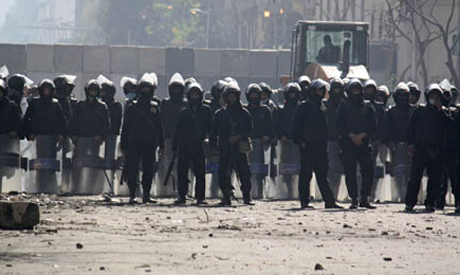
CAIRO, Egypt — The revolution that changed Egypt is nearly a year old, and a growing security problem has many wondering if Egyptian security forces are complacent about or complicit in the mayhem around them.

Egyptian security forces are drawing criticism for a rise in violent crime (Photo courtesy of Ahram Online).

There has been an unprecedented rise in violent crimes since 2011, which has largely been attributed to prison breakouts and a lack of police.

The brazenness of the violence is also troubling. Seven men went into a bank robbery shooting in January; the same day, three men stormed an armored car and made off with $500,000.  A few days later, there was a surreal scene as families lined up outside of a Cairo morgue to watch the procession of coffins carrying the 74 people killed in the Port Said soccer melee.

Historically, Egypt has been safer than many Western countries, but this trend has changed.

Earlier this month groups of American and South Korean tourists were kidnapped in the Sinai peninsula by Bedouin tribesmen.

Currently, at least 20 Jordanian nationals are trapped in the Ras Sidr area in the governorate of south Sinai.  “They can’t move because the road is being blocked by tires set on fire by Bedouin protesters demanding the release of Sinai prisoners,” said an Egyptian interior ministry source.

This increase in violent crime has taken police by surprise, as many city neighborhoods seem to slip fervently out of their grasps.

“We keep reading about crimes that never before existed in our community,” said Mohamed Radwan, the owner of a Cairo gift shop.  “After so many years of financial frustration under [President Hosni] Mubarak,  a certain class of people is willing to do anything for more money, even if that means killing people while robbing them.”

It appears that many of the criminals feel that Egyptian security forces are too busy confronting political issues to seriously deal with crime or provide security.

Ironically, the crime and unrest have brought a sense of equality to some Egyptians as both poor and rich share concerns over security. “We got used to burglaries and attacks and assaults in our poor neighborhoods,” said Soad Mahmoud, a Cairo street vendor. “But I see this everywhere now, cars getting stolen and people murdered for money in places that once used to be the safest.”

The Egyptian police have consistently made statements saying that the situation is under control, however the almost daily incident reports continue to bring criticisms of the security forces.

For more information, please see:

Al Jazeera — Jordanians “trapped” in Egypt’s Sinai — 26 Feb. 2012

Philadelphia Inquirer — Brazen crimes add unease to Egypt — 26 Feb. 2012

Boston.com — Egypt: Tribesmen kidnap 3 Korean tourists in Sinai — 10 Feb. 2012

Al Jazeera — Security in Egypt’s Sinai a cause for concern — 05 Jan. 2012


Police Clash with Aysén Protestors Across Chile

by Emilee Gaebler
Impunity Watch Reporter, South America

SANTIAGO, Chile – The Aysén region of Chile continues to experience unrest as local residents rebel against the government in an attempt to get better health care access, fuel subsidies, education programs and infrastructure improvements.

Police detain a protestor supporting the Aysén cause, in Santiago on Thursday. (Photo Courtesy of The Santiago Times)

On Thursday, February 23, about 400 protestors in the Aysén area clashed with police when their week long blockade of the southern highways was not dismantled.  Police also clashed with protestors in the capital city of Santiago on Thursday.   A group of over 1,000 people, mainly students, were demonstrating in support of the Aysén cause.

In both instances, the Chilean police forces used tear gas and water cannons in dispersing the groups.  As reported by the Santiago Times, the protest in Santiago was the third one this week and was markedly different; there were hardly any signs and no chanting.  Instead, the group, immediately upon entering the square, began to throw rocks at the buildings and the armored police cars surrounding them.

The Aysén protest movement began last Friday when negotiations with the government broke down.  The Aysén region is in southern Patagonia and is a rural area that largely subsists on the tourism industry.  The cost of living in the area is disparately high in comparison to those living in urban areas.  Local leaders had been in talks to get higher government investments in the area.

The uprising is led by the Social Movement for the Aysén Region (MSPRA) which is a collaboration of labor, environmental and student organizations.  The week-long blockade of the highways is significantly slowing the tourism industry as well as causing reported food shortages.  Residents are describing the situation as a war zone

“Tonight is a night of terror like every night, because this is turning into a war. It’s not just clashes anymore but a war where rocks fly, pellets fly, Molotov cocktails fly, buckshot flies. There are all kinds of things outside our homes,” was a statement by an unidentified resident to NTN24 News.

On Friday the protest expanded into the fishing industry as well.  Roughly 200 local fishermen blockaded the North Route 9 of the Magallanese strait and access to the Punta Arenas airport.  They were demonstrating their solidarity with the overall Aysén movement as well as protesting against proposed amendments to the fishing and aquaculture laws which favor “big business” over local production.


For more information, please see;

NTN24 News – Aysén Protestors Clash with Chilean Police – 24 February 2012

The Santiago Times – Chile’s Local Fishermen Add More Roadblocks in Aysén Protests– 24 February 2012

The Santiago Times – Aysén Protest Fails to Make Waves in Chile’s Capital – 23 February 2012

The Guardian – Clashes with Police in Santiago over Aysén Region – 21 February 2012

European Court Rules That Migrants Intercepted at Sea Cannot Be Expelled

By Alexandra Halsey-Storch
Impunity Watch Reporter, Europe

STRASBOURG, France–On Thursday, February 23, 2012, the European Court of Human Rights ruled that, “it is a violation for states to collectively expel migrants intercepted on high seas.”

Migrants rescued at sea (Photo Curtesy of The United Nations)

In 2009, the subjects of the case, 11 Somali and 13 Eritrean nationals, boarded a boat and left for Italy in search of a better life. They were part of a larger group of about 200 migrants, including pregnant women and children. Just outside of Italian territorial waters, south of the Sicilian island of Lampedusa, Italian military vessels picked the migrants up and took them to Tripoli, Libya’s capital. There, they were handed over to Libyan authorities who incarcerated them for at least several months.

This procedure was arranged by then-Italian President, Silvio Berlusconi and Libya’s then-dictator, Moammar Ghadafi, in an effort to “stem the huge tide of immigration to Italy.”  Under this course of action, about 1,000 migrants were “forcibly returned to Libya by the Italian Cost Guard,” according to the United Nations.

The attorney for the African migrants alleged that this bi-lateral agreement between the two countries violated Article 3, Article 4 of the Protocol Number 4, and Article 13 of the Geneva Convention thereby violating their human right to seek political asylum. The European Court of Human Rights agreed.

The Court Opinion recognized that, through the bi-lateral agreement, Italy attempted to alleviate some of the problems associated with a great influx of migrants; however, the Court went on to articulate that a State is not absolved of its “obligation not to remove any person who would run the risk of being subjected to treatment prohibited under Article 3 in the receiving country.”

Article 3, which governs civil armed conflict, prohibits members of the armed forces from engaging in “violence to life and person, in particular murder…mutilation, cruel treatment and torture” against civilians and innocent bystanders.

Looking back to the “situation prevailing in Libya” at the time migrants were forced there in 2009, the Court determined that they could have been subjected to the aforementioned Article 3 prohibitions. Moreover, bringing the African migrants to Libya exposed the migrants to the “risk of arbitrary return to their countries of origin,” also in violation of Article 3. The Court determined that in 2009 Somalia remained a place of “widespread insecurity” and individuals in Eritrea “faced being tortured and detained in inhuman conditions merely for having left the country.”

The court also ruled that a country is not permitted, under Article 4 of Protocol Number 4, to collectively expel migrants captured at sea, iterating that, “we have long expressed alarm at the interception and collective expulsion of migrants, often risking their lives on the high seas, without opportunity for an individual examination of their cases.”

The United Nations High Commissioner for Human Rights, Navi Pillay, “cheered” the Court’s decision and called on “all states to recognize and respect the fundamental rights of all migrants, which are guaranteed by international law.” She also encouraged states to consider “human rights and protections enshrined by international law” when writing migration policies and laws.

For more information, please visit:

The United Nations – Rights of Migrants Upheld by European Court – 24 Feb. 2012

European Court of Human Rights – Hirsi Jamaa and Others v. Italy – 23 Feb. 2012


Disabled and Police Clash in Bolivia Over Subsidies and Establishing an Integrated Role in Society

by Emilee Gaebler
Impunity Watch Reporter, South America

LA PAZ, Bolivia – Yesterday police and a crowd of protestors clashed in the Plaza Murillo, the center of the national government.  Roughly 50 disabled individuals ended a 1,000 mile protest walk at the Plaza Murillo and were met by police barricades.

Police and protestors clash in Plaza Murillo. (Photo Courtesy of Voxxi)

Upon entering the Plaza the group attempted to pass the barricades and the police stepped in to stop them.  Some of the protestors used their wheelchairs, canes and crutches to fight the police.  Pepper spray was used to disperse and end the riot.

La Razón, a daily news agency in Bolivia, reports that four protestors were detained by police and roughly 10 of the disabled had minor injuries from the confrontation.  The police report that about 10 officers were also injured.

The group began the protest on the 15 of November, roughly 100 days ago, in the streets of Trinidad, Bolivia.  Along the way the protestors were fed and given places to sleep by families in the towns they passed through.

The protestors sought to draw attention to a government statute, passed on the 5th of November, that kept monthly payment subsidies, to those disabled, at roughly $130 US.  The demand of the group was that payment be increased to $400 US; a more appropriate amount which they could viably live on.  They also want to establish a more integrated place in society for those with disabilities.

The march was especially symbolic as it claimed for those disabled a strong political identity just like any other social group.  They specifically chose to end the march at Plaza Murillo as that is where other groups typically gather for protests.

“Why not us?  It is a public space and like everyone we all have the right to protest,” said Camilo Bianchi, a leader of the group.

Living in Bolivia as a disabled individual is not an easy life.  Most of the buildings throughout the nation are not handicapped accessible and there is a strong prejudice that continues to exist against them.  Most who are disabled find it impossible to work or to attend school.

“It’s very hard to be a person with a disability. Even our own husbands abandon us because they feel ashamed of us. I look after my four children alone, washing and ironing clothes for people, and doing whatever I can,” said Domitila Franco, one of the protestors.

The group has now declared that 10 individuals will begin a hunger strike in an attempt to gain governmental acquiescence to their demands.  The government’s defense of its actions yesterday centered on the theory that the group had been “infiltrated” by other political activists.  This presented too great of a threat to the Plaza as a public forum and thus police barricades were erected.


For more information, please see;

BBC News – Bolivia’s Disabled Clash with Police Over Subsidies – 24 February 2012

Bolivia Weekly – Disabled Battle Police in the Street – 24 February 2012

The Guardian – Disabled Protestors Clash with Police in Bolivia – 24 February 2012

La Razón – Tras la Violencia, Discapacitados Ingresan en Huelga de Hambre – 24 February 2012

Activist Warned to End Plan to Develop Peaceful Protest Website

By: Jessica Ties
Impunity Watch Reporter, Asia

BEIJING, China –China’s state security police have warned pro-democracy dissident, Qin Yongmin, that he is not to continue his work on plans for a website aimed at promoting peaceful change in the nation.

Qin Yongmin has been threatened by police to end the creation of a website calling for peaceful change in China (Photo Courtesy of Radio Free Asia).


Qin was release from prison in November 2010 after serving a twelve year prison term following a conviction for subversion which resulted from his role as co-founder of the China Democracy Party and attempt to have the new party registered.

Since his release, he has been on twenty-four hour surveillance by officials and has been subjected to routine searches of his home and confiscation of his belongings.

In April, Qin was subjected to two home searches in a two week period during which he was threatened and verbally abused by authorities who also confiscated articles written by Qin and notebooks.

This week, Qin reported that he was surrounded by police while leaving a computer store and taken to a police station.

While at the police station, a police officer informed Qin that they had information that he had “…been posting articles overseas and giving interviews to journalists, and that this was against Article 82 of the national security law, and that they were going to punish me for that.”

Qin had intentions to launch a website called “Peaceful Transition Advice” which would be hosted overseas but was told by authorities but he was absolutely forbidden to create the website.

According to Qin, “[t]hey said that if I launched it in the morning, they would arrest me in the afternoon, and that they would pursue the harshest kind of punishment for me.”

The police officer also informed Qin that they were alarmed by a meeting he had held at a restaurant with several political activists.

According to Qin, the meeting was held on the second floor of the restaurant and the police “…took over the entire third floor.” He also reports that he was warned by police that no matter where he went or who he was with, they would know about it.

China’s dissidents have been under increased pressure from authorities since the Nobel Peace Prize was awarded to imprisoned democracy activist Liu Xiaobo.

Prior to the twelve year sentenced leading to his November release, Qin had been jailed twice before for his political activism. He served an eight year sentence for “anti-revolutionary propaganda and subversion” in 1981 for his involvement in the pro-democracy movement.

Four years later he was sentenced to two years of hard labor in a re-education through labor camp for a writing a document entitled “Peace Charter”.


For more information, please see:

Radio Free Asia –  Activist Warned Over Website – 20 February 2012

Asia News – Qin Yongmin, Cofounder of the China Democracy Party Freed Today – 29 November 2010

Human Rights in China – Police Search  Qin Yongmin’s Home – 28 April 2011