UN Panel Lists Syrian Officials to Investigate

By Carolyn Abdenour
Impunity Watch Reporter, Middle East

DAMASCUS, Syria – On Thursday, 23 February, the United Nations (“U.N.”) panel announced it delivered a sealed list naming Syrian officials, including President Bashar Assad, whose actions may merit investigation by the U.N. High Commissioner for Human Rights to Geneva.  The U.N.-appointed Independent International Commission of Inquiry on Syria found the country “manifestly failed” to protect its citizens.

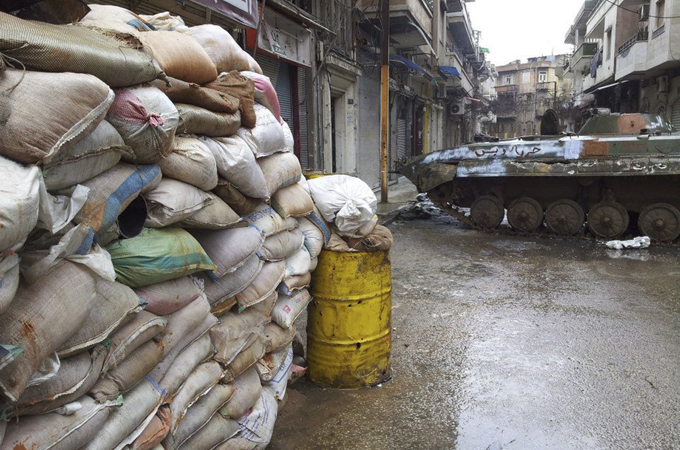
Homs has sustained its 20th straight day of shelling. (Photo Courtesy Al Jazeera).

The U.N. panel issued a report documenting reliable evidence exists to hold commanding officers and high-level government officials responsible for ordering security forces to commit crimes against humanity and gross human rights violations.  Since protests began in March 2011, security forces have killed approximately 8,000 people.  The U.N. Human Rights Council will meet in Geneva next week to review the panel’s report.

Brazilian professor Paulo Sergio Pinheiro, leader of this panel of experts, added the list includes armed opposition groups that committed gross abuses “not comparable in scale and organization with those carried out by the state.”

The U.N. panel relied on information from human rights activists and Syrian army defectors to compose the list because Syria denied the U.N. panel’s request to enter the country.  The government believed the panel exceeded the UN mandate and ignored official information.

The panel’s report asserts the ruling Baath Party’s National Security Bureau initiated the systematic arrest or killing of citizens by translating government policies into military operations.  The report also notes the country’s intelligence and security agencies “were at the heart of almost all operations.”  Furthermore, it describes how Shabbiha, informal pro-government militias, received funding and arms from businessmen.

Moreover, the report highlights the Syrian army and government ordered security forces to shell residential communities, kill unarmed women and children, and torture wounded protesters receiving hospital care.

The international community has sought avenues to support Syria’s citizens.  U.N. Secretary General recently expressed his desire for his humanitarian chief to negotiate access to Homs in Syria.  The U.N.’s top human rights official previously asked the International Criminal Court to review the situation in Syria.  This week the International Committee of the Red Cross requested a cease-fire in the worst affected areas to aid trapped and wounded victims.

UK Foreign Secretary William Hague noted the European Union could tighten its sanctions against Syria further.  “It is a deeply frustrating situation that people have been dying in [the] thousands…that the Assad regime has continued to act seemingly with impunity – but I think we can agree to a wider set of measures across a large group of nations,” he said.

For further information, please see:

Al Jazeera – UN Report Says Syria Committing War Crimes – 23 Feb 2012

BBC – UN Panel Draws Up Syria Crimes Against Humanity List – 23 Feb 2012

Haaretz – Assad, Top Syria Officials Could Face Crimes Against Humanity Charges, UN Report Says – 23 Feb 2012

San Francisco Chronicle – UN Panel Draws Up List of Syria Leaders To Probe – 23 Feb 2012


Deadly Train Crash in Argentina Highlights Concerns for the Public Rail System

by Emilee Gaebler
Impunity Watch Reporter, South America

BUENOS AIRES, Argentina – Yesterday, a packed commuter train, on the Once line, crashed into the end of the train station.  Workers and rescue personnel have spent the last 24 hours freeing those still trapped in the crumpled train.  The death toll from the accident currently sits at 50 people, including 3 children.

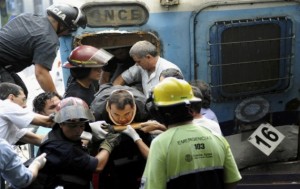
Rescue workers extricate a passenger from the crash. (Photo Courtesy of International Business Times)

Close to 600 passengers were injured.  Hospitals in Buenos Aires have been overwhelmed both with working to give aid to those injured and with attempts to reunite family members trying to find loved ones.

Today, in remembrance of the accident, flags across the country were flown at half-mast.  They will fly at half-mast tomorrow as well.  Identification of those who were killed as well as those injured has been slow.  Many have been noted on the lists as “name unknown.”

Mirta Soria, is looking for her 19-year old niece who she believes was on the train.  She thinks that her niece’s wallet was lost in the accident and now she is either in a hospital or morgue.  Soria has been searching throughout the night.  “I am tired, and just have to keep going. I am waiting, and waiting, hoping that she is here,” she said.  A similar sentiment that hundreds of others continue to echo.

Rescue workers had to use vaseline and oil to pull passengers out of the crumpled cars and apart from each other.  As reported by the Boston Globe, it took hours for workers to pull out over a hundred people from one area of the train where they had been compressed into a few square feet of space.

Initial reports indicate that the train’s operator had difficulties with the brakes on the train throughout the morning.  The accident occurred when the train came into the station and was not able to stop.  It slammed into the barrier wall at the end of the line still going at almost 20 miles per hour.

Two cars were essentially folded into each other during the accident.  Passengers recounted that the windows broke and the tops of the train cars separated from the floors.  People were thrown out of their seats and into each other.  The train was extensively overcrowded as it was a rush-hour commuter train.  The Transportation Minister notes that during peak hours each train roughly carries 1200 to 1500 people.

The high death toll makes this the worst train accident in Argentina since February 1 in 1970, when 200 people were killed as two trains collided at full speed.  In the last 2 years there have been five other accidents involving the public transportation system in Argentina.


For more information, please see;

Boston Globe – Argentine Train Crash Toll at 50, Hundreds Injured – 23 February 2012

Mail Online – Train Crash in Argentina Kills 49 and Leaves Hundreds More Injured After Brakes Fail at Busy Station – 23 February 2012

Huffington Post – Argentina Train Accident Kills at Least 40, Injures More than 500 – 22 February 2012

BBC Mundo – La Realidad del Sistema Ferroviario de Argentina – 22 February 2012

Mayor Bloomberg Supports NYPD Surveillance of Muslim Students Throughout Northeast

By Brittney Hodnik
Impunity Watch Reporter, North America

WASHINGTON, United States – For the past four to five years, the New York City Police Department (“NYPD”) has engaged in surveillance of Muslim students who have committed no crimes.  The Associated Press announced this week that the NYPD has followed Muslim students enrolled in colleges and universities all throughout the Northeast.  The ACLU, college representatives, and students all think that the surveillance is completely unwarranted and inappropriate, amounting to a violation of the students’ rights.

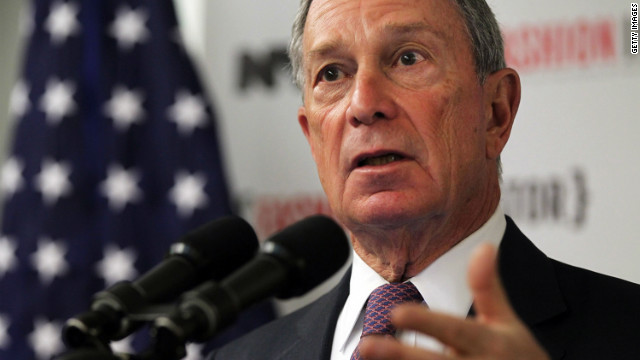
Mayor Bloomberg supports the NYPD's surveillance of random Muslim students at Northeast colleges and universities. (Image courtesy of CNN)

The Associated Press revealed these secret programs, explaining that the NYPD worked with the CIA to monitor Muslims at schools, restaurants, shops, and even places of worship.  The Associated Press also reports that the NYPD put undercover officers in Muslim student associations in colleges in the city.

At first, the report only detailed surveillance of schools within the city limits such as City College, Brooklyn College, and St. John’s University along with at least five others. 

Now, documents show that there has been extensive surveillance at campuses all over the Northeast, not just limited to New York.  Many of the SUNY schools (including Albany, Buffalo, and Stony Brook) were observed along with private universities such as Syracuse University, Clarkson University, and Rutgers University in New Jersey.  Even the ivy-leagues Yale, Columbia, and the University of Pennsylvania were not spared the watching eye.

The Huffington Post reported about Adeela Khan, a student at the University of Buffalo, who was a victim of NYPD’s surveillance.  After logging into her email and forwarding a message about an upcoming Islamic conference to fellow members of her Muslim group at school, the NYPD created a file.  The file was marked “SECRET” in large red letters and went all the way to Commissioner Raymond Kelly’s office, according to The Huffington Post.

Yale President Richard Levin described the surveillance as “antithetical to the values” of Yale University and those of the nation, reported CNN.  Newark Mayor Cory Booker said he would never have condoned the investigation had he or anyone in his police department known it was going on.  The Associated Press reports that he finds the investigations “deeply offensive.”

However, New York Mayor Michael Bloomberg on Tuesday supported the NYPD’s surveillance.  After serious uproar from school presidents and civil rights groups, the mayor struck back defending the department.  “We have to keep this country safe,” he told reporters.

According to CNN, Bloomberg went on, “If people put things on websites and make them available to everybody, of course the NYPD is going to look at anything that’s publicly available in the public domain . . . And given we’ve had a dozen people arrested or convicted of terrorist acts who’ve come from similar organizations, we have an obligation to do so.”

Even after Bloomberg’s statements, Booker’s sentiments were not the same in New Jersey.  “We really want to be clear: This type of activity is not what the Newark PD would ever do,” Booker told the Associated Press.  New Jersey Governor, Chris Christie also refused to support the NYPD investigations, telling the Associated Press that it is “disturbing” and that he did not know it was going on.

Reportedly, student groups were specifically chosen because they tend to attract young Muslim men, a demographic that terrorist groups frequently target.  So what do the students think?

Tanweer Haw, chaplain of the Muslim Student Association at Syracuse University spoke with The Huffington Post.  He said, “I see a violation of civil rights here . . . Muslim students want to have their own lives, their own privacy and enjoy the same freedoms and opportunities that everybody else has,” he said.

However, some students do not share the same feelings of violation.  Ali Ahmed a student at City College understands the NYPD’s concern, according to The Huffington Post.  Ahmed was part of a white water rafting trip where an undercover officer accompanied the group to monitor its actions.  “I can’t blame them for doing their job.  There’s lots of Muslims doing some bad things and it gives a bad name to all of us, so they have to take their due diligence,” he told The Huffington Post.

In addition, Khan, the female college student who was targeted for forwarding an email is undecided on the issue.  She told The Huffington Post, “It’s just a waste of resources, if you ask me.  I understand why they’re doing it, but it’s just kind of a Catch-22.  I’m not the one doing anything wrong.”

Mayor Booker seemed to sum up one side of the argument in a statement emailed to media: “If this is indeed what transpired, it is, I believe, a clear infringement on the core liberties of our citizenry.  I strongly believe that we must be vigilant in protecting our citizens from crime and terrorism but to put large segments of a religious community under surveillance with no legitimate cause or provocation clearly crosses a line.”

The problem really puts into question the American values that Muslim students are here to enjoy.  With opinions on both sides of the spectrum, it will be interesting to see what else transpires.  The constant struggle to find a balance between safety and freedom will continue.

For more information, please visit:

Associated Press — Newark Mayor: NYPD Muslim Files ‘Deeply Offensive’ — 22 Feb. 2012

The Huffington Post — NYPD Spied on Muslim Students at Yale, All Over the Northeast — 22 Feb. 2012

Newark Patch — Update: NPD Had No Knowledge of Muslim Surveillance, Booker Says — 22 Feb. 2012

CNN — New York’s Bloomberg Defends City Surveillance of Muslims — 21 Feb. 2012


Yemen Elects Only Candidate on Ballot

By Carolyn Abdenour
Impunity Watch Reporter, Middle East

SANAA, Yemen – On Tuesday, 21 February, Yemen elected the U.S.-backed Vice President Abed Rabbo Mansour Hadi as President of Yemen.  However, Mr. Hadi was the only candidate on the ballot.  Mr. Hadi’s election ends the 33-year rule of President Ali Abdullah Saleh and a year of turmoil after Yemenis ousted Mr. Saleh.

Voters vote for the only candidate on the ballot. (Photo Courtesy of BBC)

Dayfallah al-Shami from the Houthis’ leadership council said, “These are not real elections, it is just formalizing the American-backed [Gulf Cooperation Council] initiative which aimed to control the Yemeni revolution…It is just a reproduction of the same regime.”

Although Mr. Saleh agreed to resign from office with full immunity from prosecution once the country elected a new president, his strong tribal and family connections continue to influence the nation.  His sons and nephews, for example, command the country’s security agencies and military units.

Before the election, Mr. Saleh addressed Yemenis to encourage them to vote.  In his address, Mr. Saleh said, “I will remain with you as a citizen loyal to his country, people and nation…and will continue to serve the country and its just issues.”

After Mr. Hadi voted for himself, he said, “This is a qualitative leap for modern Yemen…There will be big political, economic and social change.”  He added, “Elections are the only exit route for the crisis which has buffeted Yemen for the past year.”

During Tuesday’s elections, Yemen’s Election Commission stopped voting in nine of 301 districts due to chaos.  Nine people died from election violence where southern separatists called for an election boycott in southern Yemen.  A bomb threat also moved Mr. Hadi’s polling station at the last minute.  Furthermore, four soldiers and four civilians, including a child, died in clashes between security forces and election opponents throughout the country.

In the Aden province, a series of explosives blasted near the polling place.  Abdel-Aziz Yehiya, the province’s election commission head, also reported that unidentified gunmen captured 44 of the 800 ballot boxes and set them on fire.  Yemeni officials suspect al Qaida members took the ballot boxes.

After Yemenis voted amid the tight security, young men rode in taxis holding their inked thumbs that signified they voted out the taxi’s windows.  Other demonstrators displayed their red-dyed thumbs to protest the elections and remember the uprising’s causalities.

Sanaa voter Bushra al-Baadany reported, “I am voting for Hadi as a new leader instead of Saleh because I want change…If Hadi is like Saleh, we are ready to have another revolution.”

For further information, please see:

Reuters – Saleh’s Deputy Takes Power In Yemen Vote As Sole Candidate – 22 Feb 2012

RT – Yemen Elects New Leader In Walkover Election – 22 Feb 2012

BBC – Yemen Violence Mars Poll To Replace Ali Abdullah Saleh – 21 Feb 2012

San Jose Mercury News – Yemeni Vote Elevates Vice President, Ends Saleh’s 33-Year Rule – 21 Feb 2012


Malian Refugees Fleeing Tuareg Rebellion

By Tamara Alfred

Impunity Watch Reporter, Africa

The International Committee of the Red Cross (ICRC) says fighting between the Malian armed forces and the Azawad National Liberation Movement (MNLA) has displaced 60,000 people within Mali, not including those who have fled to neighboring countries.

Meanwhile, the UN says that more than 44,000 Malian refugees have crossed into Mauritania, Niger and Burkina Faso.  The majority of the refugees are fleeing the fighting in the north of the country, but others are seeking shelter from ethnic tension and violent demonstrations in cities in the south.

“This is the worst human rights crisis in northern Mali for 20 years,” said Gaetan Mootoo, Amnesty International’s researcher on West Africa.  “The rule of law has been markedly absent in this part of the country for years, and the region could be plunged into chaos if the fighting continues.”

Starting on January 18, dozens of soldiers and fighters were killed in clashes between the Malian armed forces and the MNLA, a Tuareg armed opposition group who says it is fighting for the independence of northern regions in Mali.  The Tuareg rebels began by attacking various army garrisons in the north of Mali.  Violent demonstrations then spread to several southern cities.  Those marches were organized in reaction to what protesters viewed as a “timid” reaction by the authorities against the rebellion, but many degenerated into rioting.

The resurgence in fighting follows two years of relative peace between the government and the Tuareg.

Following the initial attacks, photographs circulated showing the corpses of Malian soldiers with their hands tied behind their backs, prompting the authorities to accuse the MNLA of carrying out extrajudicial executions.  The MNLA denied the allegations, saying the photos were fabricated.

Amnesty International has called for MNLA to reveal the names of any captives they are holding and to allow the Red Cross access to them.  The human rights organization has also asked Malian authorities to charge or release four people, including two women, who were arrested in the northern town of Kidal for their alleged support of the MNLA.

During various demonstrations, the Malian security forces have failed to prevent mobs from attacking homes and properties owned by Tuaregs and other ethnic groups, including Arabs and Mauritanians, living in the capital.  As a result, thousands of Tuaregs and others, targeted because of their lighter skin color, have begun fleeing the country.

Sinegodar, a village located approximately 12 miles from the Mali border, has seen the largest influx of refugees – around 9,000.  Many of the refugees in Sinegodar come from Menaka, a town in northeastern Mali which was first attacked by the rebels on January 17.  Many of the refugees travelled on foot or on donkeys and had not eaten for several days.

“Many of the new arrivals are sleeping in the open and have little access to shelter, clean water, health service and food,” said UNHCR spokesman Adrian Edwards.

“As the influx continues, our teams are stepping up assistance for refugees who have taken refuge in makeshift shelters in villages bordering Mali,” UNHCR spokesperson Melissa Fleming said in a news release.  “Humanitarian assistance is all the more critical because the Sahel region is facing a severe food crisis due to several years of drought.”

Mali’s political parties have jointly called on the government to hold a forum for peace and reconciliation as a way to end the rebellion, while President Amadou Toumani Toure has sought to keep the country from further eruptions.

For more information, please see:

BBC News – Mali: UN warning over refugees fleeing Tuareg rebellion – 18 February 2012

Amnesty International – Mali: Violence in North Causing a Human Rights Crisis – 16 February 2012

BBC News – In pictures: Malians flee Tuareg rebels – 16 February 2012

AllAfrica.com – Mali: Fifty Thousand Flee As Political Parties Call for Dialogue – 10 February 2012