“Uncle SMS” Receives 20 Years in Jail for Text Messages

By Greg Donaldson
Impunity Watch Reporter, Asia

BANGKOK, Thailand – Ampon Tangnoppakul, a retired truck driver was sentenced to 20 years in prison on Wednesday under Thailand’s controversial lese majeste laws for sending text messages offensive to Thailand’s monarchy. The sixty-one year old Tangnoppakul was known by his family and friends as “Grandpa” but now is known as “Uncle SMS” throughout the country.
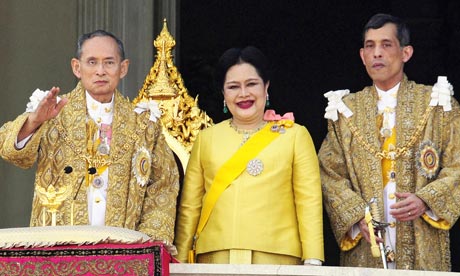
King Adulyadej, Queen Sirikit, and Crown Prince Vajiralongkorn (Photo Courtesy of AFP)

The court ruled that the text messages sent to the then-prime minister’s private secretary defamed, insulted, and threatened King Bhumibol Adulyadej and his wife Queen Sirikit. However, the contents of the messages were not presented in court and remain unknown to the public. One of Uncle SMS’s lawyers, Poonsuk Poonsukcharoen, explained that Uncle SMS received five years in jail for each text message.

Since Uncle SMS was arrested last August he has proclaimed his innocence. In court on Wednesday Uncle SMS explained that he does not know how to send text messages, his phone was being repaired at the time the messages were sent, and he does not know Somkiat Krongwattanasuk (the then-prime minister’s secretary) or his cell phone number.

When reviewing the charges the court found that Uncle SMS’s defenses could not be proven and therefore were irrelevant according to the Bangkok Post.  For example, the court decided it could not determine whether or not Uncle SMS knew how to send text messages or if he knew Mr. Krongwattanasuk’s phone number.

Uncle SMS also claimed that someone could have counterfeited the phone’s IMEI (International Mobile Equipment Identity) number to frame him. Two experts were brought into the trial to testify about the possibility of falsifying an IMEI number. One expert testified that an IMEI number could not be forged while the other expert said it was possible. The court found that Uncle SMS could not prove his cell phone number was tampered with and therefore the court did not accept his IMEI defense.

Critics of the lese majeste laws point to the speech the King gave on his birthday in 2005 to support their claim that such convictions are unjust. In the speech the King said “actually, I must also be criticized. I am not afraid if the criticism concerns what I do wrong, because then I know… But the King can do wrong.”

The tightening of lese majeste laws is also expanding to the internet. According to Human Rights Watch, Information and Communication Technology (ICT) minister Anudith Nakomthap said the ministry told Facebook to block accounts with lese majeste content. Over 60,000 URLs were blocked in October and November and government officials have warned that those who “like” offensive material to the King on Facebook could also be prosecuted under lese majeste laws.

For more information, please see:

Bangkok Post – The Saga of ‘Uncle SMS’ – 27 November 2011

The Guardian – Thai Facebookers Warned Not To “like” Anti-Monarchy Groups – 25 November 2011

AFP – Thai Man Gets 20 Years for Anti-Royal Texts 23 November 2011

New York Times – 20-Year Sentence for Text Messages Against Thai King – 23 November 2011

A New Report Implicates Russian Authorities in Magnitsky’s Death

By Greg Hall
Impunity Watch Reporter, Europe

GUERNSEY, Britain – Hermitage Capital has released a 74-page report allegedly proving that Russian police murdered Sergei Mag­nit­sky and explaining in detail how the Russian police carried out the murder.  The report, called, “The Torture and Murder of Sergei Magnitsky and the Cover Up by the Russian Government” also shows how Russian authorities have consistently lied and tried to cover up Magnitsky’s death. The document contains pictures and other documents showing how Russian officials arrested, tortured, and eventually killed Magnitsky.

Funeral of Sergei Magnitsky (Photo courtesy of RIA Novosti)

“This report shows irrefutable doc­u­men­tary evi­dence of the roles of spe­cific high level offi­cials in the false arrest, tor­ture and mur­der of Sergei Mag­nit­sky and the cover-up that fol­lowed. This is a unique record of the injus­tice that was done to Sergei Mag­nit­sky, and it also lays bare the inner work­ings of the cor­rup­tion inside the Russ­ian crim­i­nal jus­tice sys­tem,” said a Her­mitage Cap­i­tal spokesman.

The report contains photos of Magnitsky just hours before he died.  The photos reveal deep lacerations and bruises believed to be caused by being beaten by rubber batons.  It also contains a Russian internal report from Matrosskaya Tishina showing that Fikhret Tagiev authorized the use of the rubber batons and then ordered the closure of any further probe eight days after Magnitsky died.

The report also contains documents revealing Magnitsky’s repeated requests for medical attention.  According to the report, he wrote at least seven letters to top Russian officials in different agencies requesting medical attention but his requests were never granted.  The time, place, and other circumstances surrounding Magnitsky’s death were also fabricated by the detention center officials, according to the report.  Finally, the report also shows how Russian officials refuse to open an investigation despite the Kremlin’s human rights council admitting Magnitsky was beaten before he died.

The report concludes that the Russian government failed to investigate Magnitsky’s death and the ensuing cover up in an impartial and independent way.  In fact, the “investigation” of his death was conducted by the very same authorities that arrested Magnitsky. Russian authorities have absolved anyone of wrongdoing and have even promoted and granted state honors to some of those individuals.  None of the people that Magnitsky accused of tax fraud, torture and unlawful arrest have been prosecuted.

Magnitsky was originally arrested in 2009 by Russian authorities on charges of tax evasion.  He died nearly a year later at age 37.  It is believed that Russian authorities withheld necessary medical care that could have saved his life.  Magnitsky accused Russian authorities of withholding and stealing Hermitage fund documents as part of scheme to pocket hundreds of millions of dollars.  If true, this would have been the largest known tax refund fraud in Russian history.

The United States retaliated by banning certain Russian officials from entering into its country as a result of the alleged human rights violations.  Russia responded by blacklisting several United States authorities on alleged similar grounds.

The report was the result of a private investigation believed to be funded by the British-based investment fund Hermitage Capital Management, for which Magnitsky worked before his arrest.

For more information, please see:

Law and Order in Russia – The Story Behind the Largest Tax Fraud in Russian History – 28 November 2011

The Moscow Times – Magnitsky’s Deadly Beating Documented – 28 November 2011

Voice of America – Report: Russian Lawyer Beaten to Death in Jail – 28 November 2011

Congolese Elections Proceed Despite Fears of Violence and Fraud

By Zach Waksman
Impunity Watch Reporter, Africa

KINSHASA, Democratic Republic of Congo – Despite an ongoing threat of further bloodshed, elections took place in the Democratic Republic of Congo, the world’s least developed country, Monday to determine the constitution of the war-torn country’s government.  Attacks over the weekend killed at least nine people, forcing the cancellation of some campaign events.

Voters waited hours on Monday for election materials to arrive at polling stations in some locations, such as this one in Kinshasa. (Photo courtesy of the Associated Press)

Monday’s elections were only the second in which the entire country was eligible to vote.  Up to 32 million Congolese waited out delays that marred the proceedings as officials struggled to deliver materials to the polls.  In some places, polling stations opened late, while others were so remote that helicopters were deployed to bring ballots.  Though polls were supposed to have closed, they may remain open to allow all to vote because some of them never opened.

The ballots themselves were a problem in many locations.

“It was not really a ballot paper – more like a broadsheet newspaper,” said the BBC’s Will Ross, reporting from the capital, Kinshasa.  “For the national assembly election in central Kinshasa there were 13 pages packed with candidates’ faces.”

The 500-member parliament had more than 18,000 candidates running for seats.  In some districts, the candidates were listed by number and by name, a requirement for a country where a third of the adult population can neither read nor write.  As a result, some voters brought slips of paper filled out by relatives to provide their chosen politician by number.  Even with this assistance, the numbers did not always match the names.  Problems such as this lead watchers to believe that the election’s legitimacy could be delegitimized.

“It’s like leading an animal to the slaughterhouse. It doesn’t realize until it gets there what is in store for it,” said Jerome Bonso, coordinator of the Coalition for Peaceful and Transparent Elections. “They led us into this election. The population was not prepared for it. And now there is a real risk of conflict when the results come out.”

Eleven candidates are running for a five-year term as president, including incumbent Joseph Kabila, who has been accused of attempting to rig the election in his favor.  The son of Laurent Kabila, the man who overthrew longtime dictator Mobutu Sese Seko, Kabila has seen his popularity decline since his election in 2006; Mobutu’s son is one of his opponents.  United Nations observers have reported that his backers have employed multiple underhanded tactics, including stuffing ballot boxes and voter intimidation and bribery.

Despite the questions of how free and fair the elections may be, U.S. Rep. Jim McDermott (D-WA) and MP Jeremy Lefroy (Conservative – Stafford) considered the number of registered voters and registered candidates “a triumph for democracy” in an opinion piece for the Huffington Post.   But that alone is not enough.

“Often the biggest mistake made in peace-building is the belief that, when emerging from conflict, a good election will solve everything,” they added.  “But regular and sound elections are only a first step. Free and fair elections are crucial, but it is what happens between elections that is most important.”

For more information, please see:

BBC — DR Congo Votes Amid Delays and Violence — 28 November 2011

Huffington Post — Congo at a Crossroads — 28 November 2011

Jakarta Globe — DR Congo Votes after Campaign Marred by Violence — 28 November 2011

New York Times — Millions Vote in Congo Despite Fears of Violence — 28 November 2011

Star Tribune — Violence, Late Ballots in Congo May Mar Vote in Sub-Saharan Africa’s Biggest Nation — 28 November 2011

Yemeni President Cedes Power; Declares Amnesty for ‘Follies’ During Unrest

By Tyler Yates
Impunity Watch Reporter, Middle East

SANA’A, Yemen — Yemeni President Ali Abdullah Saleh has declared general amnesty for people who committed abuses during the uprising and political crisis that began in Yemen 10 months ago.

Yemeni President Saleh, having been granted personal immunity, announces amnesty for 'follies' committed during civil unrest (photo courtesy of National Yemen).

Last week, Saleh ceded power to the vice president, however, as his opponents point out, he has yet to step down or stop making decisions.  This has led to some confusion as to what his new role is now that he has supposedly stepped down as president.

Saleh’s opponents have called on him to stop making decisions that affect the country.

The amnesty of those who “committed errors during the crisis” does not extend to the parties responsible for injuring Saleh in a bombing at the presidential palace in June.

Saleh did not give extensive details about his offer of amnesty, but many think that it is meant to pardon his own forces that are accused of killing protesters during the many months of bloody unrest.

Yemeni lawmakers have already agreed to grant Saleh and other government officials immunity from prosecution as part of the power sharing arrangement that led to Saleh’s ceding of power.

There is a presidential election scheduled for 21 February, but currently Vice President Abed Rabbo Mansour al-Hadi is the only candidate.   This is the result of of a deal between the ruling party and the opposition.

Despite political progress, Yemen’s armed conflicts are ongoing.  Fighting in the northern Saada Province between Houthi rebels and the government was renewed on Sunday resulting in at least 25 dead.

Human Rights Watch (HRW) released a report on Friday which noted that Yemeni troops have killed at least 35 civilians in the city of Taiz since 21 October, when the United Nations Security Council issued a statement calling on Saleh to end human rights violations in Yemen.

The Yemeni opposition has demanded that the United Nations Security Council adopt recommendations contained in the HRW report.  The recommendations include an asset freeze and travel ban on President Saleh and other civilian officials.  They also ask the Security Council to disassociate itself from the agreement that offers Saleh immunity for serious violations of international human rights and humanitarian law in exchange for leaving office.

“The army’s indiscriminate shelling in Taizz shows President Saleh’s brazen disregard for the lives of Yemeni civilians right up to the time he signed a deal to transfer power,” said Joe Stork, deputy Middle East director at Human Rights Watch. “Because President Saleh’s signature is only as good as the actions that follow, concerned governments and the UN Security Council should still impose targeted sanctions until these unlawful attacks stop and hold Yemeni authorities accountable.”

The United Nations Security Council is scheduled to meet early this week.

For more information please see:

Al Jazeera — Yemen’s Saleh decrees ‘general amnesty’ — 27 Nov. 2011

Al Sahwah — Yemeni protesters demands Security Council to adopt HRW’s Recommendations — 27 Nov. 2011

New York Times — Power Ceded, Yet President of Yemen Declares Amnesty — 27 Nov. 2011

Ocala — New Turmoil as President Comes Back to Yemen — 27 Nov. 2011

Amnesty — Yemen: immunity deal would be ‘hammer blow’ to human rights victims — 24 Nov. 2011

Arab League Unveils Sanctions on Syria, Hoping to End Violence Against Protesters

By Adom M. Cooper
Impunity Watch Reporter, Middle East

CAIRO, Egypt–On Sunday 27 November 2011, The Arab League approved a set of sanctions to impose immediately on Syria, a move that it hopes will pressure the government to cease its eight-month crackdown on pro-democracy and anti-regime protesters.

Protesters in Deir Balaba supporting the continued demonstrations in the city of Homs. (Photo Courtesy of NYT)

Qatari Prime Minister Sheikh Hamad bin Jassim Al Thani reported at a press conference in the Egyptian capital that 19 of the League’s 22 member nations had approved the sanctions, leaving only three member states in opposition. The sanctions include: cutting off transactions with the Syrian central bank, a stop to Arab government funding for projects within Syria, a stop to trade exchange with the Syrian government, and a travel ban on Syrian officials.

Sheik Hamad expressed these sentiments during the press conference, reiterating that the Arab League desire a regional solution and do want foreign intervention.

“Today is a sad day for me, because we still hope our brothers in Syria will sign the document of the protocol and stop the killings, and to release the detainees and withdraw its military from Syrian districts. The position of the people, and the Arab position, is that we must end this situation urgently. We are trying to prevent any foreign intervention into Syria. All the work we are doing is to avoid this interference.”

Syria, one of the founding members of the Arab League, responded immediately and called the sanctions a betrayal of Arab solidarity. The Syrian state television described the sanctions as “unprecedented measures aimed at the Syrian people.”

The Arab League had previously set a Friday 25 November 2011 deadline for Syria to permit human rights monitors into the country and withdraw tanks from the streets or face sanctions. The ultimatum did not elicit a satisfactory and substantial response from Syrian officials, prompting the Arab League to convene and agree on which sanctions it would impose.

Iraq and Lebanon, two nations that are neighbors to Syria, abstained from the vote. As Syria’s second-biggest trading partner accounting for 13.3% of Syria’s trade, Iraq claimed that an economic blockade would not be practical with Syria.

Iraqi Deputy Foreign Minister Labeed Abbawi shared these words with Reuters about Iraq’s decision to abstain.

“Iraq has reservations about this decision. For us, this decision will harm the interests of our country and our people as we have a large community in Syria.”

The United Nations estimated that approximately 3,500 people have died since the pro-democracy and anti-regime protests began earlier this year in March. Turkey, which attended the Arab League’s meeting as a visitor since it is not an Arab state, declared that it would nonetheless act in accordance with the Arab League’s sanctions. Turkish Prime Minister Ahmet Davutoglu shared these sentiments about the developing situation and concern for the thousands of civilians that have lost their lives protesting for change.

“When civilians are killed in Syria and the Syrian regime increases its cruelty to innocent people, it should not be expected for Turkey and the Arab League to be silent. We hope the Syrian government will get our message and the problem will be solved within the family.”

While the Arab League was announcing these sanctions, activists and protesters continued to display their displeasure and desperation for change. According to the Syrian Observatory for Human Rights, a UK-based opposition group, in the city of Homs on Sunday 27 November 2011, security forces loyal to the government were matched up against army defectors.

“Violent clashes occurred this morning between Syria’s regular army and groups of deserters in the region of Talbiseh. Two troop transporters were destroyed. The regular army is using heavy machineguns in its operations in Talbiseh, four civilians have been wounded.”

While nations around the Arab world attempt to force change upon Syria, many inside Syria fear that the sanctions will only further exacerbate the situation. The Local Coordinating Committees, a group that leads the anti-government demonstrations, supported a collective move to pressure the regime, but feared that the government would find avenues to evade the restrictions.

A 23-year-old Damascus student, who did not wish to be identified for fear of reprisal, shared these words about the sanctions.

“I think it is time the world realized that economic sanctions are not affecting anyone but the Syrian people. Those who couldn’t afford buying bread, now can’t afford even smelling bread.”

It appears that the interests of those involved in the demonstrations and protests might further be harmed by these sanctions, even though they are designed to do precisely the opposite.

According to Al-Jazeera correspondent Nisreen El-Shamayleh, who is currently reporting on the situation from the neighboring nation of Jordan, quoted the Syrian Revolution General Commission (SRGC) that 26 individuals lost their lives on Sunday 27 November 2011. The SRGC is part of the Syrian National Council, another opposition group.

Syria continues to uphold its ban on international journalists, making it impossible to report facts on the ground. Reports coming out of Syria cannot be independently confirmed and verified.


For more information, please see:

Al-Jazeera – Arab League Approves Syria Sanctions – 27 November 2011

BBC – Syria Unrest: Arab League Adopts Sanctions in Cairo – 27 November 2011

Reuters – Arabs Impose Sanctions On Syria Over Crackdown – 27 November 2011

NYT – Arab League Punishes Syria Over Violent Crackdown – 27 November 2011

Ahram – Cracks Emerge Before Arab Vote on Syria Sanctions – 27 November 2011

CNN – Arab League Proposes Sanctions Against Syria, Including Freezing Assets – 26 November 2011