Impunity in Argentina Coming to an End With Life Sentence for Alfredo Astiz “Angel of Death”

by Emilee Gaebler
Impunity Watch Reporter, South America

BUENOS AIRES, Argentina – Alfredo Astiz was convicted last Wednesday, along with 15 other men, for crimes against humanity committed during Argentina’s 1976-1983 dictatorship.  Astiz, who was nicknamed the “Angel of Death” for his innocent good looks, was a symbol of the brutality experienced during the dictatorship.

Alfredo Astiz faces forward as his life sentence is read aloud. (Photo Courtesy of CBS News)

Other officers convicted with Astiz were Jorge Acosta “The Tiger,” Antonio Pernias and Ricardo Cavallo.  Twelve men, including Astiz, Acosta, Pernias and Cavallo were sentenced to life in prison.  Four others were sentenced to 18-25 years in prison.  The 22 month trial has been applauded by human rights activists as a huge step towards justice and truth in what has been termed Argentina’s “Dirty War”.

During the trial 79 survivors of the Naval Mechanics School, known as ESMA, testified.  ESMA was one of Argentina’s primary torture and killing centers during the 6 year military dictatorship.  Argentinian men and women were kidnapped, brought to the center, detained, tortured and killed.  It is estimated that of the 5,000 people kidnapped and brought to ESMA, only 200 survived.

Astiz was a young naval officer for ESMA who posed as an innocent civilian desperately searching for his brother who had disappeared.  He was able to infiltrate the group the Mothers of Plaza de Mayor in this way.  Three founding members of the group, Azucena Villaflor, Esther Ballestrino and Maria Ponce were all kidnapped and killed by Astiz.

He is responsible for the killings of two French nuns in 1977, Alice Domon and Leonie Duquet.  He was convicted in 1990 in absentia by French courts for these two murders.  Other European nations requested his extradition over the years including Spain, Sweden and Italy.  As well, he has been charged with the disappearance of Rudolfo Walsh, an investigative journalist and guerilla fighter during the war.

Most of the victims from ESMA were never found.  The junta soldiers often utilized firing squads.  Another method commonly used was the practice of drugging people, loading them onto planes and then dropping them, still alive, into the Atlantic Ocean.  Human rights organizations estimate that 30,000 people were killed in all of Argentina during the short 6 year period of the dictatorship.

In 1983, when the dictatorship finally fell, many junta officials were arrested, but in 1987 an Amnesty Law was passed.  This law permitted many of those who had committed grievous crimes against humanity to escape prosecution.  Astiz was one of those who benefited from this law.  He tried to live a normal life but was often harassed in the streets by those who recognized him for his crimes.

In 2005 the Argentinian Supreme Court revoked the Amnesty Law at the urging of then-President Kirchner and paved the way to Astiz’s recent conviction.  Kirchner’s wife, the current President of Argentina, Cristina Fernandez has also supported the trial and conviction of these men.  Kirchner and Fernandez met when they were both student activists during the Dirty War.  Several of their friends were victims who “disappeared” during this time.

Astiz has claimed that the trials are unjust and illegitimate prosecution promulgated for the political leverage they will give to Fernandez.  His unrepentant opinion on the trial is that “the government doesn’t hesitate in its revenge against the people who combated terrorism.”

When the sentence was read Astiz showed almost no emotion, he stared forwards and lightly brushed a patriotic ribbon pinned to his lapel.  His sister, Lucrecia Astiz, objected to the sentence expressing outrage that Astiz is being held responsible for his actions as he was only 23 and simply followed the orders given to him.

Earlier, in a 2008 interview with Tres Puntos magazine, Astiz showed no remorse for his actions during the war.  He bragged that he was the best trained man in Argentina to kill politicians and journalists.  He also stated that he didn’t betray the Mother of Plaza de Mayor because he never was one of them.

During the trial, Astiz seemed to thrive on shocking those present.  On the first day he entered the courtroom with the book “Return to Kill.”  ­­During the trial he continually called the trial a “lynching.”  Then, on the last day of the trial he handed the judges a copy of Argentina’s constitution with instructions that it be given to the Argentinian Supreme Court.

Hundreds of family members of those who disappeared into ESMA stood outside the courthouse as the sentences were read.  Many wept and others danced in the streets when the convictions came out.

“Ole, ole they will have the same fate as the Nazis, wherever they go we will find them,” was chanted loudly.

For more information, please see;

BBC News – Argentina “Angel of Death” Alfredo Astiz Convicted – 27 October 2011

Buenos Aires Herald – French Foreign Minister Says Astiz Sentence is an “Honor to Argentina” – 27 October 2011

Christian Science Monitor – Argentina’s “Blond Angel of Death” Convicted for Role in Dirty War – 27 October 2011

International Business Times – “Angel of Death” Sentenced to Life in Argentina – 27 October 2011

New York Times – Argentina: 12 Given Life Sentence for Crimes During Dictatorship – 27 October 2011

Reuters Africa – Life Sentence for Argentine Blond Angel of Death – 27 October 2011

CBS News – Argentina’s “Angel of Death” Sent to Prison – 26 October 2011

Peaceful Protest Turns Deadly

By Greg Donaldson
Impunity Watch Reporter, Asia 

JAYAPURA, Indonesia – On October 19, 2011, approximately 1,000 Papuans gathered for a peaceful pro-independence rally in the Papua provincial capital. However, the demonstration turned violent as Indonesian police and the army arrived and fired warning shots to disperse those in attendance.

Police arrested 300 people following what started out as a peaceful protest (Photo Courtesy of Reuters)

Witnesses explained that people either began running or immediately surrendered by putting their hands up. Approximately 300 people were arrested. Upon arrest detainees were ordered to take their clothes off and stood in their underwear while police reportedly beat them with pistols, canes and batons.

The army and police pursued those who ran into the nearby wooded area and made several more arrests. It has been confirmed that at least three people died during the crackdown while the Australian Broadcasting Company reports that six people died during the incident. Of the three confirmed dead, witnesses established two of them were shot by the army or police.

Daniel Kadepa, a twenty-five year old law student was shot in the head as he ran away from soldiers. Yakobus Samansabra had bullet wounds to his torso reportedly in the back. The Indonesian Government denies the deaths took place near the rally and were caused by bullets. Instead the government claims the injuries and deaths were caused by a sharp object.

Everyone who was arrested at the event has been released with the exception of six individuals. Five of those individuals are charged with treason and one is charged with possession of a sharp weapon.

Human Rights Watch has called on President Susilo Bambang Yudhoyono for the “immediate establishment of an independent investigation into the deaths of the protestors and the ongoing violence in Papua.”

John Baransano, a Protestant minister in Jayapura who was present at the rally, cries for international help. “I call on the churches around the world to care about this. I’m calling for an intervention for us because today’s events show that we need a transitional government and this needs to happen to help the people of Papua,” he said. “We are now in a dangerous situation and we’re calling for a UN intervention to help us.”

The government appears prepared to resolve its differences with the Papuans. On Thursday President Yudhoyono told cabinet members “we have tried to solve the problem using a security approach, but that did not work. Now we will focus on the prosperity of our brothers and sisters.”

Many believe a dialogue between the two parties is essential to ending violence in the region.

For more information, please see:

Jakarta Globe – Activists Call for Dialogue on Papua’s Future – 30 October 2011

Australia Broadcasting Company — Video Shows Aftermath of Papua Crackdown — 28 October 2011

Human Rights Watch – Indonesia: Independent Investigation Needed Into Papa Violence – 28 October 2011

Jakarta Post – Govt ‘Not to Use Force’ to End Violence – 28 October 2011

Kenyan Airstrike Hits Somali Refugee Camp, Killing Five and Injuring Dozens More

By Zach Waksman
Impunity Watch Reporter, Africa

JILIB, Somalia – Kenya’s efforts to find members of the hardline Islamic group Al-Shabab went slightly offline on Sunday.  During an air raid over Jilib, a coastal town in southern Somalia, a bomb fell on a refugee camp that is home to more than 7,500 people.

Kenyan troops approach the Somali border in order to find and eliminate members of the militant Al-Shabab organization, which Kenya holds responsible for a series of kidnappings within its borders. (Photo courtesy of Agence France-Presse)

Medecins Sans Frontieres (MSF or Doctors Without Borders), an aid organization that participates in the camp’s operations, five people, including three children, had died so far and another 45 had been hospitalized due to wounds sustained from shrapnel.  Due to the bombing activities, MSF has temporarily withdrawn its staff from the area.

“So today the nutrition clinic and cholera centre are closed,” explained mission leader Gautam Chatterjee.  “We will re-open as soon as things are a bit safer for our staff there.”

The strike was aimed at an Al-Shabab camp that was also located in Jilib.  Based on intelligence that a senior official was present, several aircraft flew overhead.  The refugee camp bombing was an accident due to an errant bomb.  Kenya confirmed the attack on the Shabab base, but denied harming the refugee camp.

Major Emmanuel Chirchir, a spokesman for the Kenyan military, said: “We bombed an al-Shabab camp, killed 10 and wounded 47. We are sure about this assessment, no collateral damage, no women, no children.”

Chirchir initially denied claims that the military had bombed the camp.

“MSF is being used by al-Shabab [for propaganda purposes],” he told the BBC program Focus on Africa.  The military later admitted that civilian casualties may have been incurred, but not due to the airstrike itself.  Instead, a vehicle filled with ammunition and high explosives caught fire during the raid.  In trying to escape, the driver brought it into the refugee camp, where it exploded.  The resulting blast was deemed the cause of civilian casualties from his perspective.

MSF’s departure is another setback for humanitarian aid in Somalia, a conflict-ravaged East African country that has not had a stable government for more than 20 years.  Six areas presently under Al-Shabab control are in a state of famine, as declared by the United Nations.  But while the present skirmishes continue, the prospects of delivering much-needed aid are slim.

“The new escalation in fighting and insecurity along the Kenya-Somalia border risks increasing the suffering for civilians already devastated by drought and conflict,” another aid organization, Oxfam, said in a statement it issued last month. “The situation in Somalia is increasingly alarming.”

Al-Shabab has promised reprisals against the invaders.

“Kenya has brutally massacred civilians already displaced by hardship … We will ensure that Kenya mourns more than we did,” said Sheikh Abukar Ali Ada, a regional Al Shabab official.  “They cowardly killed around 15 civilians. We will similarly target them and take revenge.”

Though it has some backing from the Somali government, Kenya has no timetable for withdrawal other than saying that it will leave when it feels safe again.

For more information, please see:

Al Jazeera — Somali ‘Civilians Killed’ in Kenyan Air Raids — 31 October 2011

BBC — Kenya Air Raid in Somalia Jilib Town ‘Kills Civilians’ — 31 October 2011

Daily Nation — Death Toll in Kenya Raid in Somalia Rises to Five — 31 October 2011

Daily Nation — Kenya, Somalia Seek Support for War on Al Shabaab — 31 October 2011

Garowe Online — Kenyan Air Strike in Somalia ‘Kills Five and Wounds Dozens’ — 31 October 2011

New York Times — Aid Group Says Refugee Camp in Somalia Was Hit by Airstrike — 31 October 2011

Mere Hours After Egypt Apparently Secured a Ceasefire, Israel Launches Air Strike In Gaza

By Adom M. Cooper
Impunity Watch Reporter, Middle East

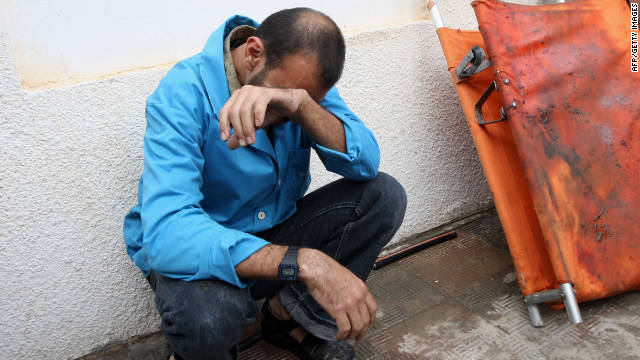
GAZA CITY, Gaza–Just hours after Egypt had been mediating a truce between Israel and Palestine, Israel has launched a fresh air strike on Gaza, east of Rafa. Seven members of Islamic Jihad’s armed wing were killed, bringing the Palestinian death toll to 11. The Islamic Jihad movement in Gaza had reported that it had accepted a ceasefire prior to the attacks. The recent spike in violence came as funerals were being held for two Palestinians killed in Israeli airstrikes overnight.

A Palestinian man grieves outside of a hospital in Rafa, Gaza. (Photo Courtesy of CNN)

On Saturday 29 October 2011, at least 10 people were killed in Gaza and southern Israel.

Hamas, the Islamic militant group that controls and governs Gaza, has made efforts to enforce the agreed-upon ceasefire since the latest round of cross-border airstrikes and rocket attacks in August, which saw both sides endure casualties. The confrontation in August was precipitated by a deadly attack north of Eilat that claimed the lives of eight Israelis. In that situation, the attackers crossed the border into Israel from Egypt. But Israeli officials claimed that the attack was organized and facilitating by another militant group in Gaza, the Popular Resistance Committees, and immediately eliminated its senior commanders in an airstrike.

Abu Ahmad, the spokesman for the movement’s armed wing Al-Quds Brigades, shared these sentiments about the developing situation.

“The Islamic Jihad has responded positively to the truce effort, while it reserves its right to react to any aggression by Israel.”

Ahmad also claimed that several of the dead were senior commanders of the organization. They included Ahmed al-Shiekh Khalil, a leader of one of the Islamic Jihad brigades. Khalil had four brothers who were activists in the movements. All of them were killed in operations conducted by the Israeli army.

Israeli Prime Minister Binyamin Netanyahu placed the onus on Hamas, the governing body in Gaza, for the violence that has occurred and expressed Israel’s resolve to defend itself.

“The Hamas rules Gaza, he is responsible for Gaza, he is responsible for preventing the firing from Gaza, and for keeping the calm in Gaza, even if the attackers are the Islamic Jihad. It is not worthwhile for anybody to test our determination to invoke the government’s defense principles. We will prevent every attempt to shoot at Israel and we will hurt everyone who nevertheless succeeds at doing so. We have no desire to see deterioration in the situation, but will defend ourselves according to these principles.”

An Israeli military official reported that on Sunday 30 October 2011, three rockets were fired at its territory after the ceasefire deadline had passed. The official claimed that two of the rockets were intercepted by Israel’s Iron Dome missile defense system and the other crashed into southern Israel, but did not result in any casualties or substantial damage.

Al-Jazeera correspondent Cal Perry, who is reporting from Al Shojaya in eastern Gaza, shared this viewpoint on what is currently happening between the two Middle Eastern nations.

“We heard Islamic Jihad spokesperson saying that they were going to give 48 hours both to Egyptians and the Israelis to work out some kind of an agreement. But as late as Sunday afternoon, there has been further air strike bringing into question if anyone is going to be able to stop the recent spate of violence.”

This latest flare-up between the ever-feuding nations came less than two weeks after the return of a captured Israeli soldie, Sgt. First Class Gilad Shalit, who had been held incommunicado in Gaza for more than five years by Hamas. Israel had freed 477 Palestinian security prisoners in exchange for the soldier and is set to release some 550 more prisoners in a deal that has significantly bolstered Hamas’s stance.

Hamas is reportedly largely committed to the rather fragile ceasefire that first came into effect after Israel’s three-week military offensive in Gaza that came to a close in January 2009. It is alleged that smaller groups such as the Islamic Jihad and the Popular Resistance Committees are not committed to a ceasefire.

UN Secretary-General Ban Ki-moon condemned rocket fire from Gaza and called for it to stop, according to CNN.

“We hope that both parties will fully respect the calm as brokered by Egypt and urges maximum Israeli restraint following the killing of a reported 10 alleged militants.”

The international community can keep imploring the two sides to come to a truce that has clout and can last. But until that actually occurs, civilians will be the ones who really pay the price and will continue to do so with no foreseeable end in sight.


For more information, please see: 

Al-Jazeera – Israel Launches Fresh Air Strike In Gaza – 30 October 2011

BBC – New Israeli Air Strike Into Gaza After ‘Ceasefire’ – 30 October 2011

CNN – Islamic Jihad Announces Gaza Cease-Fire – 30 October 2011

The Guardian – Gaza Militants Agree to Truce After Nine Killed in Israeli Air Strikes – 30 October 2011

Reuters – Gaza Violence Simmers After Truce Announced – 30 October 2011

NYT – Israeli Drone Strike Kills Militants In Southern Gaza – 29 October 2011

Libyan Militias Terrorize Qaddafi Supporters, Force Refugee Relocation

By Tyler Yates
Impunity Watch Reporter, Middle East

TRIPOLI, Libya — More than 100 militia brigades from the city of Misrata have been operating outside of any official duty since Tripoli fell in August.  Members of these militias have reportedly engaged in torture, aggressively pursued enemies all over the country, and detained and shot individuals being held in detention.

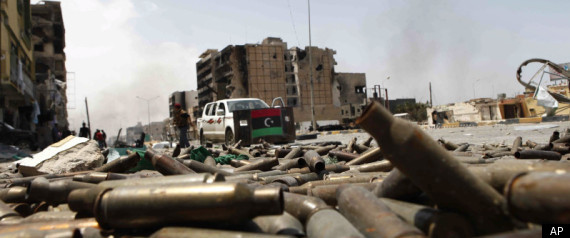
Bullet shells litter a besieged street of Misrata (Photo courtesy of the Huffington Post).

Currently, these militias are preventing the entire displaced town of Tawergha from returning home.  They believe that this city was sympathetic to Qaddafi and provided him avid support.

Now that the war in Libya has come to an end there are calls for accountability and reconciliation.  Groups such as the Misrata militias are showing how difficult this will be.

In western Libya, anti-Qaddafi militias have looted and burned the homes and schools of tribes that supported the deposed dictator.

Other militias from around Zuwara have been looting property as compensation, which they feel they deserve for damages suffered during the war.

The recent execution of the 53 pro-Qaddafi supporters at a hotel in Sirte was apparently under the control of the Misrata militias.

Similarly, it was a Misrata militia that apparently captured and then killed Qaddafi while he was in their custody.  Details of how and why his death occurred are still unknown.

The Misratans have made it clear that they detest anyone who supported Qaddafi during the conflict.

Misrata withstood a two-month siege from Qaddafi’s forces with almost daily attacks that left around 1,000 of its citizens dead. The city now is a shell of its former self with collapsed, charred buildings highlighted by the blight of ubiquitous bullet-holes.

The militia is focusing a large amount of its anger on Tawergha, a town of approximately 30,000 located just south of Misrata.  Residents from both cities say that residents from Tawergha took up arms to fight for Qaddafi.  The Misratans claim that these volunteers are guilty of raping and pillaging, though they have yet to produce any evidence, claiming that the victims are too embarrassed to come forward.

Most Tawerghans fled their town as Misratan fighters advanced on it between 10 August and 12 August.  Witnesses and victims have provided credible accounts of the Misratan militias shooting and wounding unarmed Tawerghans and torturing detainees, in a few cases to death.

In the city of Hun, located about 250 miles from Misrata, Benghazi militias have begun protecting about 4,000 Tawerghan refugees.  They say that the Misratans are hunting the Tawerghas all over the country.

Representatives of the National Transitional Council (NTC) have issued statements, agreeing with the Misrata militias, saying that no Tawerghans should return home.  Ibrahim Yusuf bin Ghashir, one such representative, said: “We think it would be better to relocate them somewhere else.”  He added that the rape allegations “cannot be forgiven and it would be better to resettle them far away.”

The unforgiving plan of not allowing refugees to return home is not limited to Tawerghans.  The Misratans have made it clear that any group that supported Qaddafi will not be tolerated.

HRW has called the forced resettlement and abuses of the refugees a crime against humanity, a charge that is made more egregious by the fact that the much of the reasoning given for the Libyan war was to end such treatments by the Qaddafi regime.

The stories of abuses committed by these militias post- war have been pouring in through various human rights organizations. They are equally horrific, and have invited international condemnation and calls for the NTC to initiate investigations and bring the offenders to justice.

The NTC says it has plans to open investigations into any post-war abuses, but it has yet to offer specifics or respond directly to the allegations of the crimes committed by the militias published in a report by HRW.

For more information, please see:

Raw Story — Libya militias accused of ‘revenge attacks’ — 30 Oct. 2011

CNN — NTC will investigate allegations of crimes against pro-Gadhafi forces, official says — 30 Oct. 2011

Reuters — Cycle of revenge hangs over Libya’s fragile peace — 30 Oct. 2011

Human Rights Watch — Libya: Militias Terrorizing Residents of ‘Loyalist’ Town — 30 Oct. 2011

Human Rights Watch — The Murder Brigades of Misrata — 28 Oct. 2011