Egypt in Flux After Killings of Christians at Maspero Rally

By Zach Waksman
Impunity Watch Reporter, Middle East

CAIRO, Egypt – The Egyptian revolution that galvanized the “Arab Spring” that dominated headlines for much of the summer approached a new flashpoint Sunday, as the military fired on Coptic Christians who were marching toward Maspero.  At least 25 people were killed.  This incident further eroded public confidence in the military, which has acted as a temporary ruling body since former President Hosni Mubarak was deposed in February.

Thousands gather at Cairo’s Abbasiya Cathedral to mourn the victims of the crackdown on Coptic Christians. (Photo Courtesy of Daily News Egypt)

It was not supposed to be like this.  Eight months ago, Egyptians celebrated as the military refused to follow orders from Mubarak to fire on protesters against his regime.  Since Mubarak’s abdication of power, the provisional ruling council has been under near constant fire for general incompetence in governing and its efforts to retain power now that they are in charge.

The march took place in response to a Muslim attack on a church in the Aswan province that the government did not investigate in the aftermath.  After stones were thrown back and forth between the Christian activists and observers, the military intervened by firing tear gas and live ammunition into the crowd of about 2,000 peaceful demonstrators.  Human Rights Watch believes that at least 17 deaths were the result of being run over by armored vehicles.  State-run television said that the Coptic Christians, who make up about 10 percent of Egypt’s population of about 85 million, were attacking the military and called for civilians to fight back against the demonstrators.  The Minister of Information has since retracted those statements, attributing them to the announcers being under “emotional stress.”

Regardless of why the riot took place, it does not reflect well on the Egyptian provisional government, the Supreme Council of the Armed Forces (SCAF).

“This [incident] reflects an unprecedented failure in running the country during the transitional period,” said Egyptian political analyst Khalil al-Anani. “Since 11 February, the country has been going from worse to worst.  If the military stays in power for much longer, the country might head towards more violence, and social peace will be in jeopardy.”

In response to Sunday’s shootings, Finance Minister Hazem el-Beblawi resigned from his position, saying that it was time for a different way of thinking. The resignation comes as the Coptic community called for a three-day fast to mourn those who died in the violent crackdown.  Thousands attended mass at the Abbasiya Cathedral to honor the dead.  Several Muslims also attended as a show of solidarity.  The ceremony doubled as a protest for the living, who expressed frustration at the military’s response.

A Coptic lawyer who spoke on condition of anonymity said, “Every event that takes place in Egypt against Copts is never investigated properly. Why did they open fire on peaceful protesters while they did not against those who attacked the Israeli embassy?”

The SCAF has called for an investigation of the incident.  But in making that decision, it blamed the conflagration on “efforts by some to destroy the pillars of the state and sow chaos” and said it would “take the necessary measures to restore the security situation.”  What that means is uncertain, as the government did not explain why it opened fire on the protesters.  As of Monday, Egyptian news organizations said that at least 15 people were in custody and facing questioning about their involvement as instigators of the riot.

That an investigation will happen at all may be good news for the Egyptian people, “who feel that military has not been interested in finding out who is behind the events of Sunday night,” according to Al Jazeera’s Sherine Tadros.  The Coptic community remains skeptical, as it has long been the victim of various forms of discrimination by the government, even before Mubarak fell.  Since then, the SCAF has done nothing to make practicing their religion easier or bring perpetrators of acts against Christians to justice

To columnist Karina Kamal, Sunday’s crackdown indicates that the SCAF does not plan to ease tensions between the two religions.  “[T]he military has given a clear sign that Copts are easy targets,” she said.  “We have reached the climax… We will either have a civil war or rational people will be able to take the country in the right direction.”

For more information, please see:

Al Jazeera — Egypt Army Seeks Probe into Cairo Clashes — 11 October 2011

BBC — Egypt Minister Hazem el-Beblawi Quits over Coptic Clash — 11 October 2011

Al-Masry Al-Youm — Maspero Violence Raises Questions about Military’s Fitness to Run Egypt — 10 October 2011

Daily News Egypt — Thousands Mourn Victims of Maspero Violence; Church Blames ‘Infiltrators’ — 10 October 2011

Egyptian Gazette — Maspero Probe States; Egypt Copts Angry — 10 October 2011

Human Rights Watch — Egypt: Investigate Violence against Coptic Christians — 10 October 2011

New York Times — Copts Denounce Egyptian Government over Killings — 10 October 2011

ARGENTINEAN CASE IN THE FINAL PHASE OF TESTIMONY MAY FINALLY PROVE KIDNAPPINGS AND MURDERS OF THE DIRTY WAR

By Paula Buzzi
Impunity Watch Reporter, South America

BUENOS AIRES, Argentina — A trial in Argentina that began in late February of this year and is now in its final phase of testimony may finally prove the strategic  plan to carry out approximately 500 baby abductions adopted by the nation’s military leaders during Argentina’s Dirty War.

Victoria Montenegro was abducted as a newborn during Argentina's Dirty War. (Photo Courtesy of The New York Times).

The recent Dirty War trials are uncovering a painful time in Argentina’s history, a period of military dictatorship rule between 1976 and 1983 when around 500 babies were abducted and thousands of left-wing activists were murdered at the hands of the government. Efforts to locate the “disappeared” from this period have been on going by the grandmothers (”las abuelas de Plaza de Mayo”) and the now adult children of those murdered who question their own identity.

One of the accused in the case is Jorge Rafael Videla. Videla headed the military during Argentina’s dictatorship and is now being accused of spearheading the kidnapping operation which redistributed babies from left-wing mothers to military officials. He is among the 11 officials on trial for 35 acts of “illegal appropriation of minors.”

Victoria Montenegro, 35, is a daughter of the Dirty War who was abducted by a military colonel when she was a newborn. She was raised by Lt. Col. Hernán Tetzlaff, the man who killed her biological parents. Although Tetzlaff confessed to the murder in 2000, it was not until after her recent testimony in trial that Montenegro was finally able to accept the truth and shed the name he had given her.

Like many others who were abducted as babies, Montenegro was constantly lied to by her military parents and received a strong ideological education. “I grew up thinking that in Argentina there had been a war, and that our soldiers had gone to war to guarantee the democracy,” she stated. “And that there were no disappeared people, that it was all a lie.”

Thanks to more government support, advanced technology and a growing genetic data bank, the total number of recoveries as of August is 105.

The trial is shedding light on many mysteries surrounding the Dirty War, including a possible connection between some Dirty War crimes and the Argentinean Catholic Church which supported the military government at the time. Church officials in Argentina and at the Vatican have declined to comment on allegations of possible involvement.


For further information, please see;


The New York Times – Daughter of ‘Dirty War,’ Raised by Man Who Killed Her Parents – 08 October 2011

CNN – Argentina Presses Forward with Human Rights Trials – 06 October 2011

Reuters – Argentina Nixes Extradition in 1970s French Nun Case – 04 October 2011

The Guardian– Child of Argentina’s ‘Disappeared’ Fights for Right to Keep Adoptive Name – 23 September 2011


Syrian Government Warns International Community Against Supporting Newly-Formed National Council

By Adom M. Cooper
Impunity Watch Reporter, Middle East

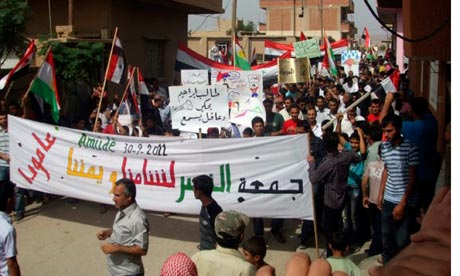
DAMASCUS, Syria–Authorities from President Bashar al-Assad’s regime have warned the international community that it will retaliate against any country that chooses to formally recognize the recently established Syrian National Council (SNC). The SNC is compromised of individuals opposed to al-Assad’s rule and its formation was announced on Monday 03 October.

Anti-regime protesters in the province of Qamishli. (Photo Courtesy of The Guardian)

The formation of the SNC has been met with encouragement by many Western nations, including the United States and France. But the international community has yet to offer the SNC any sort of formal recognition, unlike Libya’s Transitional Council (NTC), the council established by Libyan warriors who overthrew Muammar Qadhafi.

Activists and officials in the international community have come to the consensus that there are few differences between the SNC and NTC.

The SNC has formally rejected the use of foreign military intervention, but has urged the international community to “protect the Syrian people.” Chairman Burham Ghalioun stated that the group was an “independent group personifying the sovereignty of the Syrian people in their struggle for liberty.”

Walid al-Moualem, the Syrian foreigner minister, released the following statement at a news conference broadcast by Syrian national television on Sunday 09 October.

“We will take tough measures against any state which recognizes this illegitimate council.”

In the latest occurrences of violence on the streets of Syria, activists claimed that security forces opened fire on tens of thousands of mourners at a funeral of a prominent Kurdish opposition figure, Meshaal Tammo, on Saturday 08 October. As a result, the security forces killed at least seven individuals, according to the London-Based Syrian Observatory for Human Rights.

Moualem detailed Meshaal Tammo as a “martyr” killed by “terrorists,” insinuating that he was targeted because he chose to oppose foreign intervention in Syria. The Tammo family has blamed Syrian authorities for his death. He was expected to play a pivotal role in the SNC.

Turkey has condemned the assassination of Tammo as well as attacks on other leading opposition figures in Syria. Tammo was gunned down on Friday 07 October in the northern town of Qamishli and his funeral became a mass rally with more than 50,000 demonstrators calling for the end of al-Assad’s rule, various activists groups have reported.

The Turkish foreign ministry released a written statement on Saturday 08 October, which contains the following excerpt.

“We strongly condemn the attempts aiming to suppress the Syrian opposition and the increase in attacks targeting main representatives of the opposition. Turkey is deeply sorry for the loathsome assassination of Tammo, as well as the wounding of prominent dissident Ryad Seif who was injured after being beaten on Friday in Damascus.”

CNN reported that on Sunday 09 October, Syrian police were preventing Turkish citizens from entering Syria at the border town of Nusaybin, a few kilometers north of Qamishli where Tammo was killed, due to increased tensions in the area. Turkish Prime Minister Tayyip Erdogan has claimed that he plans to impose sanctions on Syria and has launched military exercises in the Hatay province, where Syria has a longstanding territorial stake.

Meanwhile, Syrian foreigner minister Moualem went on further to criticize European countries, singling out Germany and Switzerland, noting that protesters had attacked Syrian embassies. He claimed that if they did not meet their obligations to protect foreign missions, Syria would respond in a similar fashion.

Protesters have stormed Syrian diplomatic properties in the German cities of Berlin and Hamburg. The Syrian mission in United Nations building in Geneva also fell victim to protesters on Friday 07 October.

The Syrian foreign minister made these statements while speaking at a joint news conference with ministers from five Latin American countries. The ministers from these countries had come to show their support for al-Assad’s regime.

“If they are not committed to implementing this Geneva Convention agreement and provide security for our missions, we will treat them the same way. The West will not attack Syria because no one will pay the bill. The West chose economic sanctions to starve our people, under the pretext of protecting human rights.”

The government in Damascus has kept promising reforms, but chosen to increase crackdown on the protesters and civil unrest, blaming the activity on armed gangs. Some 2,700 are believed to have lost their lives since the protests began in March.

The ban on international journalists inside Syria continues and reports cannot be independently verified.

For more information, please see:

Al-Jazeera – Syria Warns Against Recognizing Opposition – 09 October 2011

BBC – Syria Warns Against Recognizing New Opposition Council – 09 October 2011

CNN – Syria Warns Against Recognizing Opposition Council – 09 October 2011

Reuters – Syria Warns Against Recognition of Opposition Council – 09 October 2011

The Guardian – Syria’s Protesters Turn to Facebook to Expose ‘Citizen Spies’ – 08 October 2011

NYT – Leading Syria Opposition Figure Killed, and Another Publicly Beaten – 07 October 2011


Cameroon’s Presidential Election Tainted by Fraud

By Carolyn Abdenour
Impunity Watch Reporter, Africa

YAOUNDE, Cameroon – Sunday’s presidential election in Cameroon was marked with apathy as long-standing President Paul Biya’s main opposition party accused the ruling party of fraud.  Mr. Biya faced twenty-two challengers in the election.  The Supreme Court of Cameroon will announce election results within two weeks.

Polling station in Yaounde.  (Photo Courtesy of Africa Review)
A woman at a polling station in Yaounde. (Photo Courtesy of Africa Review)

Although the election was generally peaceful, the government reported an unknown gunman killed two gendarmes (members of a military force charged with police duties) at a polling station in the Bakassi peninsular.  Nigeria recently handed control of this oil-rich peninsular to Cameroon after an international court ruling.

Social Democratic Front (“SDF”) official, John Fru Ndi, reported “disorder” and “intimidation” at polling stations, with some people unable to vote while others voted multiple times.  SDF Secretary General Elizabeth Tamanjon said, “”We actually caught some people voting three times . . .. How could such a thing happen?”

To prevent people from voting more than once, poll station workers stamped people with an indelible ink.  However, Mr. Fru Nidi reported this ink easily washed off.  Moreover, at the polling station several people were told that someone had already cast a ballot on their behalf.  The BBC reported it was common for polling stations to have stacks of unclaimed ballots.

On Saturday, Sani Tanimou, general secretary of Elections Cameroon (“Elecam”), said voters must be duly registered and present their national identity cards at polling stations from 8 a.m. to 6 p.m. to receive a ballot.  However, some polling stations remained opened after official voting hours concluded because they only opened at 4 p.m.  Voters also did not vote because they could not locate their polling station or their names were not listed on the voter list.  Other voters chose not to vote because the ballot was skewed widely towards Mr. Biya.

Government officials deny the fraud speculations.  Mr. Biya said, “The world is not a perfect place, but let’s be positive, for there has been no intention of fraud.  We’re for transparency and free elections.”

Without high voter turnout and a single opposition candidate, many people expect a Mr. Biya victory.  The opposition parties argue the government restricted their campaigns by limiting their funding and media airtime.  Previous presidential candidates, former government officials, and two women composed Mr. Biya’s opposing candidate pool.

Approximately 7.5 million people registered to vote, but less than 40% of these eligible voters participated in the election.  Cameroon also installed 79 voting stations in 33 countries for the 25,578 voters living overseas.

For example, a man carried 21 voter cards at the Mbangum market in the northwest regional capitol.  The polling station did not allow him to vote because they lost the voter list.  They eventually found the list in the man’s bag.

For further information, please see:

Africa ReviewCameroon Vote Count Starts as Paul Biya Poised for Win10 Oct 2011

Atlanta Journal-Constitution2 Troops Killed in Cameroon on Election Day 10 Oct 2011

BBCCameroon Election: SDF Accuse Paul Biya’s CPDM of Fraud10 Oct 2011

Business GhanaCameroon Incumbent President Paul Biya Certain for Another Term10 Oct 2011

Nobel Peace Prize Winner Still in Prison

By Greg Donaldson
Impunity Watch Reporter, Asia

BEIJING, China – A year after becoming the first Chinese citizen to win the Nobel Peace Prize, Liu Xiaobo still finds himself incarcerated. Prior to being awarded the peace prize, Mr. Liu was arrested and sentenced to eleven years in prison for his work which demanded political and legal reform in China.

Liu Xiaobo was detained by Chinese officials and unable to accept the 2010 Nobel Peace Prize at the ceremony last December (Photo Courtesy of AFP)
Liu Xiaobo was detained by Chinese officials last December and did not attend the 2010 Nobel Peace Prize Awards Ceremony (Photo Courtesy of AFP)


One year later human rights groups are again calling for Mr. Liu’s release. Several organizations have reported that Xiaobo has only been allowed to leave prison once and that was to attend his father’s funeral.

In addition to Mr. Liu’s imprisonment, his wife Liu Xia has been placed under house arrest at the couple’s home in Beijing even though she has not been charged with any crime. When Mr. Liu was awarded the peace prize last year reporters attempted to speak with Ms. Liu at her apartment but were denied by government security guards.

Amnesty International reports that Ms. Liu has had very limited contact with people outside of her apartment since February and in an online chat with a friend explained that she felt miserable and her entire family is being held hostage.

Conflicting reports exist about the visitations Mr. Liu has received while being detained. Amnesty International stated that Mr. Liu has been able to meet with his wife twice since January according to unofficial reports. However, other sources explain that Mr. Liu was not given any visitation rights until last month after he was visited by his brothers.

Monthly visits to imprisoned family members are protected by Chinese law.

Human rights groups are appealing for international support to release Mr. Liu. In a telephone interview with the New York Times, Nicholas Bequelin, a researcher for Human Rights Watch explained “The only thing that would force the government to reassess the decision is if there was some strong international pressure on China in this case, but the pressure is not there.”

He continued “There’s no incentive for the government to revisit this decision. We’re talking about a climate where standing defiantly against the West is reaping more political awards than collaborating.”

Others outside of the Liu family have been affected by Mr. Liu’s winning of the peace prize including the country of Norway. Prior to awarding the peace prize, the Chinese embassy in Oslo warned that diplomatic ties between China and Norway would suffer if the Nobel Peace prize was handed to “a criminal.”

Following the awarding of the peace prize China imposed additional import controls on Norwegian salmon. These controls have reportedly led to a sixty-one percent decrease in salmon sales to China and thousands of salmon rotting in Chinese warehouses.

For more information, please see:

New York Times – 3 Human Rights Groups Call for Release of Imprisoned Chinese Nobel Laureate – 7 October 2011

Asia One News — One Year After Nobel, Silence Shrouds China Dissident — 6 October 2011

The Independent – Norway’s Salmon Rot as China Takes Revenge for Dissident’s Nobel Prize – 6 October 2011

Radio Free Asia – Nobel Laureate Granted Family Visits – 4 October 2011