Violent Murders of Two French Tourists in Argentina Remain Unsolved

by Emilee Gaebler
Impunity Watch Reporter, South America

 BUENOS AIRES, Argentina – Recent events in the Northern Province of Salta have shocked the traveling community.  Questions regarding the safety of visiting Argentina are being raised as a predominant concern in the wake of two violent murders. 

Police stand guard at the entrance to the trail where the bodies were discovered (Photo Courtesy of Sina)
Police stand guard at the entrance to the trail where the bodies were discovered. (Photo Courtesy of Sina)

The bodies of two French tourists were found near hiking trails in the San Lorenzo hills last Friday.  A couple from Chaco was walking in the area, when they stumbled upon the bodies in a ravine just off the trail.  The bodies were identified as Moumni Houdop and Cassandre Bouvier.  Both women were French citizens around 30 years old.

The women were shot execution style, one in the back of the head and the other in her back.  Their clothes were ripped and both bodies had lacerations on them.  One of the bodies showed signs of sexual abuse.  The women had arrived in Salta on July 11 and checked into a hostel where they intended to stay until July 19.  They were last seen at their hostel on the 16th of July.

Police authorities have stated the belief that the women were most likely held for a number of days before being murdered.  The inability to account for the two women’s whereabouts, for a number of days, and their backpacks remaining at the hostel indicate that a kidnapping is likely.  It was released that the bodies were found roughly 48 to 72 hours after being shot.

José Hinojosa, the policeman in charge of Salta police press releases, stated that roughly 80 officers immediately and thoroughly searched the crime scene for evidence but were hindered by the hilly terrain, approaching night and cold temperatures.  Forensic authorities have verified that DNA evidence was recovered from the bodies.  Tests are being run and it is possible that the results will point officers towards those who so viciously committed these murders. 

French authorities noted that they wanted “those who are responsible to be identified and tried.”  The governor of Salta, Juan Manuel Uturbey, promised that authorities were working to “clear up this appalling crime immediately.”  At this point, two suspects have been brought in for questioning but no arrests have been made.  So far, no motive for the murders has been revealed. 


For more information, please see:

 The Argentina Independent – Two French Tourists Murdered in Salta – 30 July 2011

 CNN World – Argentinian Authorities: 2 French Tourists ‘Viciously’ Killed – 31 July 2011

 France 24 – Two French Tourists Killed in Northern Argentina – 1 August 2011

 MercoPress – Argentine Police on the Track of Two French Tourist Packers Killed in Salta – 1 August 2011

CNN World – Argentinian Authorities Arrest Second Suspect in Tourist Murders – 3 August 2011

FORMER EGYPTIAN PRESIDENT HOSNI MUBARAK PLEADS NOT GUILTY IN HISTORIC TRIAL

By Adom M. Cooper
Impunity Watch Reporter, Middle East

CAIRO, Egypt–From behind the bars of a holding cell, former Egyptian President Hosni Mubarak remained defiant. The 83-year-old man listened to the charges of corruption and complicity in the unlawful killing of protesters against him and gave a simple, yet potent answer.

Former President Mubarak during his trial. (Photo Courtesy of Reuters)

“I have not committed any such crimes.”

Premeditated murder, the killing of protesters, the failure to use his power and resources to stop the mistreatment of civilians, and collusion with other government officials in the misuse of state funds all included the charges against Mubarak.

The proceedings took place in a temporary court at the Police Academy of Cairo and were shown on live television. A trial for the former Egyptian leader has been one of the crucial demands and desires that united protesters since 11 February, the day that Mubarak’s regime collapsed. Some 3,000 soldiers and police officers were drafted with the sole purpose of maintaining order at the police academy for the first day of the trial.

Mubarak was flown to Cairo from Sharm el-Sheikh, the Red Sea resort where he has resided since being removed from power. Due to recent health complications, including treatment since April for a heart condition, there was speculation that Mubarak would not actually appear in court. But he did appear and was wheeled into the cage from where he observed the proceedings. Mubarak’s two sons, Gamal and Alaa, accompanied their father inside the defendants’ cage, both donning white prison robes.

When the presiding judge, Ahmed Refaat, requested that Mubarak identify himself, the former leader responded and slightly raised his hand from the horizontal position that he was situated on the bed of the cell.

“Yes, I am here.”

Mubarak’s lawyer, Farid el-Deeb, made numerous requests to the court on behalf of Mubarak. Arguably, the most noteworthy request was to summon some 1,600 witnesses to testify, including Field Marshal Mohamed Hussein Tantawi, Mubarak’s longtime defense minister.

Sherine Tadros, an Al-Jazeera correspondent, shared these sentiments about this request from el-Deeb.

“El-Deeb asked for Tantawi-who is also the defense minister and effectively the person running this country right now-to become a witness within this trial. He said it was Field Marshal Tantawi who has been in control of this country since 28 January 2011. I think it raises a lot of questions about the proceedings of this trial, how many others serving still-within the government, within the authority, within that structure-are going to be implicated in what is going on.”

Some 800 people were killed and approximately another 6,000 wounded in the 18 total days of protests that overthrew Mubarak’s seemingly everlasting regime. His trial represents a very tangible victory of sorts for all of those involved in the region-wide uprisings that have been dubbed the Arab Spring.

The image of Mubarak sitting behind bars and listening to the charges is certainly a surreal feeling for many Egyptians as well as those in other Middle Eastern countries. One of the protest leaders, film-maker Ahmed Rasheed, told BBC correspondents that people across Cairo had cluttered around televisions in shops and cafes, watching and debating as the trial was broadcast.

“I was quite overwhelmed to see the scene taking place. I was very pessimistic about this. I didn’t believe he was going to show up in court.”

The trial will resume on 15 August 2011.

Public demonstrations and riots continue to occur in Egypt. Before the trial began, scuffles broke out between hundreds of supporters and opponents of Mubarak. Hundreds of white-clad police and riot police armed with shields and helmets intervened to stop the demonstrators from throwing stones and bottles at one another.

It is evident that the Arab Spring has a long way to go in order to be viewed as a holistic success. But perhaps the beginning of Mubarak’s trial is just the kinetic energy that it needed to secure healthy change throughout the region.

For more information, please see:

Al-Jazeera-Mubarak pleads ‘not guilty’ at Cairo trial-03 August 2011

BBC-Mubarak trial: Egypt’s ex-president denies all charges-03 August 2011

CNN-Ailing Mubarak wheeled into courtroom cage for trial-03 August 2011

NYT-Mubarak on Trial, in Stark Image of Arab Upheaval-03 August 2011

Israeli Court Orders Extradition of Srebrenica Massacre Suspect

By Terance Walsh
Impunity Watch Reporter, Europe

JERUSALEM, Israel – A district court in Jerusalem on Monday ruled that Aleksandar Cvetkovic, a Bosnian Serb, should be extradited and tried in a Bosnian court for war crimes he committed in one of the worst massacres of the former Yugoslav republic’s 1992-1995 war.

The Bosnian-born Aleksandar Cvetkovic, who served in the Bosnian Serb army during the war, immigrated to Israel in 2006 with his Jewish wife and children.  (Photo courtesy of European Jewish Press)
The Bosnian-born Aleksandar Cvetkovic, who served in the Bosnian Serb army during the war, immigrated to Israel in 2006 with his Jewish wife and children. (Photo courtesy of European Jewish Press)

Cvetkovic was part of an eight-man firing squad that killed approximately 1,000 Muslim Bosnians at Branjevo farm in July 1995.  Evidence in the extradition reports indicates that Cvetkovic made use of an M-84 machine-gun to speed up the killings.  The 42-year-old Cvetkovic has denied the charges against him, maintaining that he was a driver for the Bosnian Serb forces but did not participate in the massacre.

The killings were part of the Srebrenica massacre, what news sources call the “worst atrocity on European soil since World War II,” which was led by Gen. Ratko Mladic and left over 8,000 Muslim men and boys dead.

In 2006, Cvetkovic immigrated to Israel.  He obtained Israeli citizenship through his Jewish wife and resided in Carmiel prior to his arrest.  If he is convicted, he will not be allowed to serve his prison sentence in Israel because the crimes of which he is accused pre-date his immigration.

The extradition process began in January this year.  Israeli authorities arrested and arraigned Cvetkovic and held him in police custody because of “the enormity of the danger posed to the public.”

Judge Amnon Cohen decided to extradite Cvetkovic and imposed several conditions on the government of Bosnia and Herzegovina, including holding Cvetkovic in a separate, secure detention wing during his arrest, and maintaining his security if he is convicted and sentenced to a prison term.

Furthermore, the Bosnian government must allow Cvetkovic regular visits by consular representatives of the Israeli embassy in Bosnia and Herzegovina.  If Cvetkovic is convicted, the Bosnian court must impose a sentence in accordance with that prescribed by the European Court of Human Rights.

The UN war crimes tribunal in The Hague has sentenced fourteen Bosnian Serbs in connection with the Srebrenica massacre.  A Bosnian war crimes court that was set up in 2005 to assist The Hague has jailed twelve and acquitted seven who were alleged to have participated in the Srebrenica massacre.

Cvetkovic will have thirty days to appeal the Israeli Supreme Court’s decision to extradite him.  Israeli officials said that the extradition appeals process might take two years.

For more information, please see:

Al Jazeera – Israel to Extradite Citizen Over Srebrenica – 1 August 2011

European Jewish Press – Israel to Extradite Serb Accused of Srebrenica Role – 1 August 2011

Jerusalem Post – Court Rules to Extradite Bosnia Massacre Suspect – 1 August 2011

Haaretz – Israeli Man Arrested for Alleged Involvement in Bosnia Genocide – 18 January 2011

ICTJ World Report Issue 3 August 2011

ICTJ World Report Issue 3 August 2011

ICC rejects European suggestions that Gaddafi remain in Libya as part of peace plan

By Greg Hall
Impunity Watch Reporter, Europe

THE HAGUE, Netherlands – The International Criminal Court (ICC) in The Hague recently issued arrest warrants for Libyan leader Muammar Gaddafi, as well as his son Saif al-Islam, and his military intelligence chief, Abdullah Senussi. International prosecutors have accused the three of crimes against humanity, including killing civilian protestors during Libya’s Arab Spring.

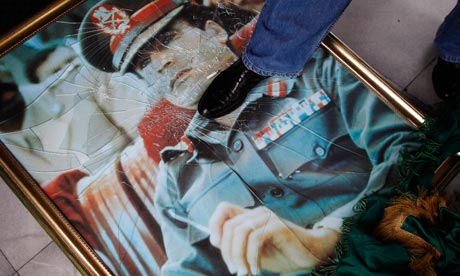
A member of staff at the Libyan embassy steps on a portrait of Muammar Gaddafi, who the ICC says must be arrested. (Photo courtesy of Reuters)

The ICC dismissed suggestions by Britain and France to allow Gaddafi the opportunity to stay in Libya as part of a negotiation to entice Gaddafi to step down from power.  The ICC said that Gaddafi could not be allowed to escape justice. “He has to be arrested,” said Florence Olara, spokeswoman for the court’s chief prosecutor, Luis Moreno-Ocampo.

Olara said the decision to seek justice had been made in the UN, adding that the ICC’s arrest warrants were “legal facts” which “cannot go away”.

The court is accusing Gaddafi of crimes against humanity and of ordering attacks on civilians during an uprising against him held in February of this year.  As a result of the orders issued by Gaddafi, thousands of civilians are believed to have been killed in the attacks.

ICC presiding judge Sanji Monageng said there were “reasonable grounds to believe” that Gaddafi and his son were “criminally responsible as indirect co-perpetrators” for the persecution and murder of civilians in Libya.

“We are extremely happy that the whole world has united in prosecuting Gaddafi for the crimes he has committed,” rebel council spokesman Jalal al-Galal told Reuters news agency from the rebel stronghold Benghazi. “The people feel vindicated by such a response.”

Libya has not accepted the ICC’s decision to call for Gaddafi’s arrest.

Mohammad al-Qamoodi told a Tripoli news conference the court was “a tool of the Western world to prosecute leaders in the third world”.

He added: “The leader of the revolution and his son do not hold any official position in the Libyan government and therefore they have no connection to the claims of the ICC against them.”

For more information please see:

Guardian – Gaddafi can’t be left in Libya, says international criminal court – 26 July 2011

Huffington Post – The Prosecutor v. Muammar Gaddafi — and a Step Closer to Justice – 26 July 2011

BBC – Libya rejects ICC arrest warrant for Muammar Gaddafi – 28 June 2011

Herald Sun – Libya rejects ICC’s arrest warrant for Muammar Gaddafi – June 27 2011