NIGERIAN POLICE RAID “BABY FACTORY” AND FIND 32 TEENAGE GIRLS

by Tamara Alfred

Impunity Watch Reporter, Africa

LAGOS, Nigeria —  On Saturday, May 28, in the southeast city of Aba, Nigerian police took into custody 32 young women and a doctor during a raid on The Cross Foundation, believed to be a so-called “baby factory.”  The girls, aged between 15 and 17 years old and usually poor or desperate teenagers with unplanned pregnancies, were reportedly being kept locked up and forced to get pregnant.  There are reports that some had come to the clinic believing it was an adoption agency.  Upon selling their babies to the doctor, the newborns were then resold for illegal adoption or to be used for ritual witchcraft.

The girls would sell their babies to the head of the clinic, who would then resell the newborns for anywhere between 100,000 naira ($640) to one million naira ($6,400).  According to the BBC, male babies were more prized and sold for a higher price.  After the sale of the newborns, the girls were given approximately $170 by the clinic owner.

Buying or selling of babies is illegal in Nigeria and can carry a 14-year jail sentence.  The proprietor of The Cross Foundation, Dr. Hyacinth Orikara, is currently being questioned and is likely to face charges of child abuse and human trafficking.  Dr. Orikara is currently denying all charges, saying it was only a foundation to help teenagers with unwanted pregnancies.  The young women will either be charged or handed over to the National Agency for the Prohibition of Trafficking in Persons for further investigation.

Human trafficking is ranked the third most common crime in Nigeria behind economic fraud and drug trafficking.  The United Nations estimates that at least 10 children are sold across the country each day.  Some children are bought for use as labor in plantations, mines, or factories, while others are sold into prostitution.  Others are used in witchcraft rituals believed to bring riches to families.  Many are also sold in illegal adoptions.

“We have so many cases going on in court right now,” Ijeoma Okoronkwo, the regional head of the National Agency for the Prohibition of Trafficking in Persons, told AFP.  “There is a problem of illicit adoption and people not knowing the right way to adopt children.”

A few news agencies reported that some young children were also found at the clinic.  It was not known if they were related to the girls.

For more information, please see:

Reuters – Nigeria police break suspected baby-trafficking ring – 2 June 2011

CNN – Nigerian police free 30 girls in alleged ‘baby industry’ – 2 June 2011

BBC News – Nigeria ‘baby farm’ girls rescued by Abia state police – 1 June 2011

Global Post – Nigeria: “baby factory” raided, 32 pregnant girls rescued – 2 June 2011

AFP – Nigerian ‘baby factory’ raided, 32 teenage girls freed – 1 June 2011

Human Trafficking on the Rise: Smuggling ring uncovered in Mexico City as 12 officers are arrested in Arizona

By Brittney Hodnik
Impunity Watch Reporter, North America

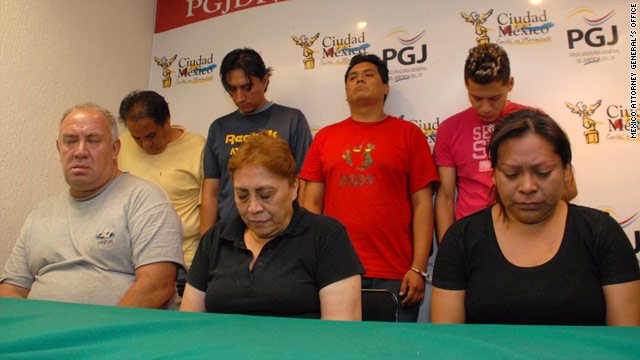
MEXICO CITY, Mexico – The recent arrests of twelve law enforcement officers in the state of Arizona illustrates the disturbing human trafficking epidemic.  Three of the officers allegedly conspired to smuggle and transport drugs and humans.  This “new slavery” continues south of the border, as Mexico City police recently freed 62 victims from a forced prostitution ring – many of whom were trafficked from almost 300 miles away.

Image courtesy of CNN International
Suspects arrested in Mexico City. Image courtesy of CNN International

Last week, a study performed by Mexico’s Human Rights Commission showed that human trafficking numbers in Mexico City may be worse than anyone anticipated.  CNN reports that in the last year, only3 convictions resulted out of a mere 40 investigations conducted for human trafficking by the police.  10,000 women are reportedly victims each year.  According to Eva Reyes, investigation coordinator and a partner in the study, the issue is not so much the number of victims, but rather the lack of investigation by Mexican authorities.  “The authorities are not investigating, nor are they asking witnesses,” Reyes stated.

The Human Rights Commission report  indicated that because these women “are not achieving access to judicial resources . . . the large majority of these incidents remain in impunity.”  As of 2003, human trafficking was not illegal in Mexico, but authorities used immigration and organized crime statutes to prosecute wrongdoers.  The United States has lent minimal assistance to help curb the trafficking.

Last Monday, Mexico City police freed 62 females from forced prostitution; one of which was only 13 years old.  According to Hispanically Speaking News, authorities have detained seven people – five men and two women ranging in age from 19 to 62 – for their connection to the crime.

Traffickers kidnap and coerce their victims into the human trafficking ring, often from cities far away from the capital.  As reported by CNN, one victim claims two men approached her in Oaxaca and offered her a “more comfortable life,” so she went with them.  Oaxaca is about 288 miles away from Mexico City which has become the hub of human trafficking in Mexico.   Coercion is the most common tactic used by traffickers to recruit victims.  Many traffickers go largely unnoticed because of the overwhelming population of the city – about 21 million people.

The practice continues to happen because the authorities have not made it a priority.  The stigma attached to prostitution overshadows the “victim” connotation.  The victims are “seen as people who are doing it freely [and] that is the first obstacle to justice,” said Reyes.  The arrests in Arizona will hopefully bring attention to the atrocity of human trafficking and its prevalence in both Mexico and the United States today. 

For more information, please see:

CNN International — Study Finds ‘Alarming’ Human Trafficking Figures in Mexico’s Capital — 27 May 2011

CNN Justice — Documents Detail Accusations Against Arpaio’s Employees After Sting — 27 May 2011

Hispanically Speaking News — 62 Victims of Forced Prostitution in Mexico City Rescued by Police — 26 May 2011

Wide Angle — Dying to Leave — 25 September 2003

Former Prosecutors, State Department War Crimes Officials Affirm Satellite Sentinel Project Findings of Apparent War Crimes in Abyei

Satellite Sentinel Project Press Release
Originally Published June 1, 2011

WASHINGTON – A bipartisan group of former civilian and military officials has affirmed the Satellite Sentinel Project’s (SSP) analysis of visual evidence that the Government of Sudan allegedly committed war crimes during its occupation of the disputed region of Abyei.

The officials include two former US State Department Ambassadors-at-Large for War Crimes, David Scheffer and Pierre Prosper; David Crane, the former Prosecutor of the Special Court for Sierra Leone; and Michael Newton, the former Senior Advisor to the US Ambassador-at-Large for War Crimes.

SSP issued a report on May 29, which documented visual evidence of war crimes by the Government of Sudan in Abyei. The project has conveyed this evidence to the UN Security Council and to the International Criminal Court. The Government of Sudan has stated that the Satellite Sentinel Project has no evidence of war crimes.

Statements in Support of SSP’s Findings

David Scheffer, former US State Department Ambassador-at-Large for War Crimes:

“The evidence derived from SSP satellite imagery of the assault on and destruction of much of Abyei town reveals actions that appear to violate the principles of military necessity, proportionality, and distinction – primary pillars of the laws of war. The armed clashes between SPLM/A troops and SAF troops in mid-May, about which further reporting contradicts the account of the UN Secretary-General’s Special Envoy for Sudan, would not justify this type of military action by SAF troops against Abyei or its civilian population. Furthermore, the presence of tens of thousands of civilians in Abyei and the apparently systematic actions of SAF forces to assault those civilians, destroy their homes and food storage areas, and finally route them from the town constitutes violations, at a minimum, of critical protective provisions of the Fourth Geneva Convention of 1949 and the Second Additional Protocol of 1977, both of which bind the Government of Sudan and its military forces as a state party. They may also constitute crimes against humanity given the magnitude and apparent systematic character of destruction and forced displacement of civilians in Abyei. The SSP satellite imagery provides critical ‘eyes-on’ evidence of illegal military conduct that merits further investigation. There may come a point where the U.N. Security Council will need to consider expanding its original 2005 referral of the Darfur situation to the International Criminal Court to such actions in central Sudan, particularly if the Sudanese authorities do not punish those military and civilian leaders responsible for these atrocity crimes and if further violations of the laws of war and international humanitarian law continue. If Sudan President Omar Hassan Amad al Bashir, who has been indicted for atrocity crimes in Darfur by the International Criminal Court, is responsible for the assault on Abyei, that fact alone would provide an excellent basis on which to consider expanding the Court’s jurisdiction.”

Pierre Prosper, former US State Department Ambassador-at-Large for War Crimes:

“The images of destruction are horrifyingly similar to what we have seen too many times in the past in Sudan. The Government of Sudan is clearly engaged in a continued pattern of systematic atrocities and violations despite the North-South agreement. The imagery provided by the Satellite Sentinel Project contains evidence of actions by Sudan Armed Forces that may well constitute war crimes and crimes against humanity. It is time for the United States and international community to put into place a serious and concerted action plan to end the abuses in Sudan once and for all.”

David Crane, former Prosecutor of the Special Court for Sierra Leone:

“Governments who unleash their armed forces against civilians in an intentional military operation to kill, disrupt and destroy for whatever purpose are committing violations of international criminal law. At a certain time in our past such actions, though reprehensible, were largely left unaccounted for. A great deal of the 20th Century is replete with examples of such, but no more. Through political, legal, and practical advances, such governments can no longer justify, explain away, or be absolved of action which are war crimes and crimes against humanity. With the advance of modern technology, particularly those technologies that were once unavailable to nongovernmental organizations, and the proliferation of social media, these governments can no longer sweep such actions “under the rug”. To put it more bluntly, they “cannot get away with it”. As a former international Chief Prosecutor, such work done by the Enough Project and Harvard, shows credible evidence of international crimes, actionable crimes which the world cannot, must not ignore. The tragedy of Abyei Town reflects all that is wrong with the regime of Sudan and those who rule there. The bright red thread of international criminal law is politics. It is time for politicians and diplomats to act to stop the killing, the rapes, the horror that is Sudan.”

Michael Newton, former Senior Advisor to the US Ambassador-at-Large for War Crimes:

“The Satellite Sentinel Project (SSP) has provided irrefutable and nearly immediate evidence of the new wave of crimes committed against the civilian population in and around Abyei town. The Bashir government has taken a page from its Darfur playbook by waging war once again on civilians and their property. No government or international organization can plausibly plead ignorance or misinformation in the face of the photographic evidence available online and in the SSP report. There is no conceivable basis under the laws and customs of war for the deliberate razing of civilian homes and the theft or destruction of supplies provided by the generosity of other governments to help the population with its urgent requirements. The Security Council should exercise its Chapter VII authority to immediately mandate an independent team of international experts that can assess the scope of the crimes committed in Abyei and preserve the testimony of witnesses before they can be silenced by the Government of Sudan. The Bashir regime needs to be clearly reminded that the right of collective self defense permits other nations to respond to the pleas for assistance from a newly independent Government of Southern Sudan. By logical extension, the ongoing International Criminal Court investigation into events in Darfur should expand to encompass crimes committed in Abyei as well. It is clear to me that Abyei belongs in a newly formed Southern Sudan. The population should be allowed to freely determine its own future even in the face of regime tanks that continue to trample across Abyei because of the deliberate destruction of Abyei town. The war criminals in Khartoum should have no remaining pretense of moral authority in support of efforts to forcibly hold onto Abyei. Moreover, any influx of ‘settlers’ from the north should be seen as culprits complicit in the crimes of the regime rather than peaceful civilians building a community.”

###

About the Satellite Sentinel Project

The Satellite Sentinel Project combines satellite imagery analysis and field reports with Google’s Map Maker to deter the resumption of full-scale war between North and South Sudan. Not On Our Watch provided seed money to launch the Satellite Sentinel Project. The Enough Project contributes field reports and policy analysis, and, together with Not On Our Watch and our Sudan Now partners, pressures policymakers by urging the public to act. UNOSAT analyzes satellite images and collaborates with Google and Trellon to design the web platform. Harvard Humanitarian Initiative provides research and leads the collection, human rights analysis, and corroboration of on-the-ground reports that contextualizes the imagery. DigitalGlobe provides satellite imagery and additional analysis.
PROTESTERS IN SYRIA STRUGGLE TO HAVE THEIR VOICES HEARD

By Adom M. Cooper
Impunity Watch Reporter, Middle East

DERAA, Syria– In furtherance of the trend calling for freedom across the Middle East, protesters in Syria are doing whatever they can to make their voices heard. In Syria, the voices cry for the ouster of President Bashar al-Assad. The recent eruption of distaste with the government galvanized after revelations that Syrian authorities had apparently tortured and murdered a 13 year-old boy last month near the protest hub of Deraa.

Protesters hold up a picture of Hamza al-Khatib (Photo courtesy of BBC)

Human rights groups have estimated that more than 1,000 people have been killed in Syria since the protests began in March. But the bruised and mangled body of Hamza al-Khateeb has served as a new lightning rod for the masses of Syria. After family relatives had received the body, wounds were found consistent with those of electric shock devices and cable whippings as well as bullet wounds. On 28 May, hundreds of protesters chose to ignore the perpetual military siege of Deraa. One protester relayed this message to an Al-Jezerra correspondent:

“It was the people of Deraa who started this revolution and the people of Deraa will not stop. Despite their anger, people are still insisting on facing this barbarianism with peaceful protests. Despite the tears in our eyes, we are facing them with smiles on our faces, because we know we are right.”

But the death of al-Khateeb created a real rise in the protesting. On 29 May, Syrian forces killed two people and wounded many more in the central towns of Rastan and Talbisa. Tanks backed these military forces as they moved through the two cities, searching houses for protesters in an attempt to quell the outbreaks. Residents of both towns said that basic utilities such as water and electricity were cut early Sunday morning as the troops, tanks, and helicopters moved in.

Rastan, a town known for its agricultural prosperity, is located on the main northern highway leading from Damascus to Aleppo. Talbisa is located near the major city of Homs.

The European Union has announced sanctions against Syria on 23 May. US President Barack Obama said in his speech on the Middle East earlier this month that al-Assad needed to cease the killing and lead a peaceful route to democracy or “get out of the way.” President al-Assad had promised changes in response to the protests much like changes that have occurred in Tunisia and Egypt. But to date, the Syrian population has seen no more than the 45 year-old ruler lift emergency laws while still banning all opposition and political freedoms since 1963.

For more information, please see:

BBC  Syria: Restive town ‘surrounded’ by tanks 29 May 2011

Bloomberg  Syrian Death Mount After Army Helicopter Attacks; Eight Killed in Homs 29 May 2011

The Jerusalem Post  At least 8 killed as Syrian protesters defy gov’t crackdown 29 May 2011

Reuters  Eleven killed in wider Syria military push: lawyer 29 May 2011

American Arrested In Thailand For Blog Post

By Greg Donaldson
Impunity Watch, Asia

BANGKOK, Thailand — Lerpong Wichaicommart, an American citizen, was arrested last Tuesday for defaming the Thai King through the use of his blog. Wichaicommart, who also goes by “Joe Gordon,” is accused of posting a link to the book “The King Never Smiles,” written by American journalist Paul M. Handley and published by Yale University Press. The book, which is banned in Thailand, takes a critical look at the actions of King Bhumibol during his reign.

King Bhumibol Adulyadej (Photo Courtesy of BBC News)

Furthermore, in an interview with the New York Times, Tharit Pengdit, the director of Thailand’s Department of Special Investigation, said “He violated the law by writing articles and posted them on a website.”

Wichaicommart has been charged with lèse majesté, inciting unrest and disobedience of the law in public, and disseminating computer data which threatens national security. Lèse majesté prohibits anyone from defaming, insulting or threatening the king, queen, or crown prince. The debate about the recent aggressive enforcement of the law is expected to heat up this summer as parliamentary elections take place July 3.

Over twenty Department of Special Investigation officers arrested Wichaicommart at his house in Nakhon Ratchasima, confiscated his desktop computer and mobile phone, and transferred him to department headquarters in Bangkok for interrogation. Wichaicommart’s friends brought a land deed worth over 1.7 million baht as bail to release Wichaicommart but the court denied bail, citing that this was a serious case concerning national security, and that the accused might tamper with evidence reported the Thai-language prachatai.com news website.

Prior to his arrest, Wichaicommart taught English to children. Wichaicommart was born in Thailand but settled in Colorado more than thirty years ago. Wichaicommart never planned on returning to Thailand he said, but chose to come back to his hometown to receive treatment for an illness after the death of his wife.

BBC’s Rachel Harvey said free speech advocates claim the law is being misused to silence legitimate debate. Charges have also been brought against a Thai academic who has publically called for the reform of monarchy, and a prominent opposition politician who is a leader of the anti-government “red shirt” movement. A BBC correspondent said that approximately 2,000 web addresses are being blocked by state censors for containing links or references deemed offensive to the monarchy.

While the U.S. Embassy is still gathering information on the charges, an official from the embassy visited Wichaicommart in prison and told him the embassy will try to help him as much as possible.

For more information, please see:

BBC Asia-Pacific — Thailand arrests US citizen for ‘insult to monarchy’ 27 May, 2011

New York Times — American Arrested for Insulting Thai King 27 May, 2011

Asian Correspondent — American arrested in Thailand for posting link on blog [updated] 27 May, 2011

Prachatai — A Thai with American citizenship arrested for lèse majesté and denied bail 27 May, 2011