Banned Cluster Bombing Adds to Heated Border Tensions

David L. Chaplin II
Impunity Watch, Asia

PREAH VIHEAR, Cambodia – A day after the United Nations security council urged the two sides to exercise restraint, there have been further clashes on the disputed border with Cambodia and Thailand.

Thailand, Cambodia trade accusations of cluster-bomb use

Maria Luiza Ribeiro Viotti, the current head of the Council, called on both sides “to display maximum restraint and avoid any action that may aggravate the situation”.

On Monday, Cambodia’s Foreign Minister Hor Namhong and Thailand’s Kasit Piromya appeared before the United Nations Security Council to set out their respective positions.

Sunai Pasuk, a representative for Human Rights Watch in Thailand, says the U.N. will provide a forum for debate over the clashes, and could help determine human rights violations.

“But the basis for conflict resolution is still within bilateral process,” noted Sunai. “A presentation at the U.N. Security Council will be an opportunity to both Thailand and Cambodia to further allegations of human rights violations to international laws as the use of cluster ammunitions can only be resolved with independent observation of the affected area.”

“Members of the Security Council urge the parties to establish a permanent ceasefire and to implement it fully,” she said.

Both countries have accused the other of using banned cluster bombs in the fighting.

The conflict had intensified around the 900-year-old Preah Vihear temple.

The temple is home to four days of clashes this month in which 11 people died.

Both sides have claimed the UN statement supports their position. Cambodia went into the meeting calling for a permanent ceasefire, and Thailand, which regards the dispute as a purely bilateral issue, welcomed the UN’s decision not to become more actively involved.

In 1962 the grounds of the temple itself were awarded to Cambodia by the International Court of Justice, but it is the 4.6 sq km of nearby territory, a main access route, and remains in dispute.

Thailand has blamed the UN decision to list the temple as a World Heritage site in 2008 for inflaming the current tensions.

The armies of both governments remain on alert as thousands on both sides were forced to flee their homes.

In Thailand, Prime Minister Abhisit Vejjajiva says the temple should be de-listed as a United Nations Scientific and Educations Organization World Heritage site.

Mr. Abhisit says doing so and scrapping a proposed Cambodian management plan would defuse the border conflict. However, Cambodia is expected to oppose the idea.

By the time the armies of Thailand and Cambodia end their battle for Preah Vihear, an 11th century temple on the border between the two countries, there may be nothing left to fight over, as many reports have it.

For weeks, there have been protesting in Bangkok, espousing hate speech against Cambodians and issuing a set of extremist demands that include a Thai boycott off the UNESCO World Heritage Committee and the use of military force to evict Cambodian villagers from the disputed area.

It isn’t clear yet whether the U.N. Security Council will take up the conflict, and if it does, how quickly it will proceed.

For more information, please see:

TIME – Thailand and Cambodia’s Battle for an Ancient Temple – 7 February 2011

Voice of America – Thailand, Cambodia Border Fight Moves to UN – 11 February 2011

Financial Times – Thailand accuses Cambodia of fresh attack – 15 February 2011

U.N. Sanctions Libyan Officials and Calls for ICC Investigation

By Daniel M. Austin
Impunity Watch Reporter, Africa

U.N. Security Council votes for sanctioning Libya. (Photo courtesy of Montreal Gazette).

NEW YORK CITY, United States of America – On Saturday, members of the United Nations Security Council voted unanimously to impose sanctions on Libyan leader Col. Muammar el-Qaddafi, members of his immediate family, and high ranking officials in his regime for their role in the violent crackdown on government protesters. The council also approved a measure to investigate possible international war crimes and crimes against humanity for the unlawful killing of civilians over the last few weeks.

Contained in the resolution are several key provisions which ban international travel for Libyan government officials as well as a directive to freeze the assets of Libya’s leaders. Specifically, this declaration is directed at Mr. el-Qaddafi, his four sons, his daughter, and 10 prominent government officials.  Furthermore, this resolution provides for an arms embargo against the Libyan government.

According to the United States representative to the United Nations, Susan Rice, this resolution sends a “clear warning to the Libyan government that it must stop the killing.” The United Nations estimates that more than 1,000 civilians have been killed in attacks throughout the country since the uprising began.

Initially, Security Council members disagreed about whether to refer Mr. el-Qaddafi and other officials to the International Criminal Court for prosecution. However, the atmosphere changed when the Libyan delegation and its U.N. representative Abdurrahman Shalgam sent a letter to the Security Council president, Ambassador Maria Luiza Ribeiro Viotti of Brazil supporting the war crimes investigation by the ICC. Mr. Shalgam’s voice was crucial in helping this portion of the resolution pass.

This was only the second time the U.N. Security Council has recommended a member nation be investigated by the International Criminal Court for possible war crimes or crimes against humanity. The quickness with which this resolution was taken up and passed was surprising. Reports from the U.N. Security Council chambers claim the representative are deeply concerned about violence directed at civilians and members were focused on drafting a resolution that effectively deals with this crisis.

Saturday’s resolution comes a day after the United States government unilaterally froze billions of dollars of assets belonging to the Libyan government as well as property belonging to several Libyan officials. According to President Barack Obama, he signed the executive order because the violence and instability has become “an unusual and extraordinary threat” to the security of the United States and their foreign policy objectives.

For more information, please see:

BBC — Libya: UN Security Council votes sanctions on Gaddafi—27 February 2011

New York Times — Security Council Calls for War Crimes Inquiry in Libya – 26 February 2011

The Telegraph — We must stand ready to intervene in Libya – 27 February 2011

Voice of America News– UN Security Council Imposes Sanctions on Libyan Leaders – 26 February 2011

Former Serbian Official Convicted For War Crimes In Kosovo

By Christina Berger
Impunity Watch Reporter, Europe

THE HAGUE, Netherlands — A former senior Serbian police official was convicted Wednesday by a UN tribunal for his part in the “campaign of terror” against Kosovans in 1999. The International Criminal Tribunal for the former Yugoslavia (ICTY) sentenced Vlastimir Ðorðevic to 27 years in prison for crimes against humanity and war crimes.

During the conflict in 1999, Ðorðevic was an assistant internal affairs minister and the head of the public security department–the equivalent of chief of police in many countries–as well as a close aid to former Yugoslav president Slobodan Milosevic. Ðorðevic was found guilty of taking part in a “joint criminal enterprise” in 1999 along with officials such as Milosevic in order to change the ethnic balance of Kosovo by engaging in a “widespread campaign of terror and violence.”

This campaign of terror included murdering, deporting, and forcibly transferring ethnic Albanians, many of which were civilians. The court found Ðorðevic to be responsible for the murder of “not less than 724 Kosovo Albanians” who were murdered by Serbian forces. The court found that “[i]n the large majority of cases the victims, including many women and children, were civilians, who were unarmed and not in any way participating in any form of armed conflict.”

Ðorðevic asserted that he had no control over the responsible Serbian forces and instead he oversaw operations geared toward the “terrorists” of the Kosovo Liberation Army. The court rejected these claims, finding that Ðorðevic’s participation in the joint criminal enterprise was “crucial to its success” and that Ðorðevic exercised “effective control” over the Serbian police forces who committed the crimes.

The court cited examples to show that the Serbian police forces’ conduct was not part of any police operation to find and arrest terrorists. In March of 1999, Serbian polices forces shot and burned 114 men and boys. On that same day in another city, the police killed 45 members of one family. Serbian police forces also lined up 19 women and children and shot them.

Ðorðevic was also found responsible for the mass deportation and forcible transfer of over 200,000 Kosovo Albanians, though according to the court that number is a conservative estimate and the true numbers are likely much higher. The presiding judge stated that “Kosovo Albanians left Kosovo because they were specifically ordered to do so by Serbian forces, or because the conduct of Serbian forces caused them to leave, in particular by shelling, shooting, killing and by burning houses and other buildings in their villages, towns and cities.”

Additionally, the court found that Ðorðevic played a “key role” in concealing the killings of Kosovo Albanians. Ðorðevic directed a coordinated operation to remove evidence of the killings committed by Serbian forces by transporting the bodies in trucks and burying them in mass graves. In 2001, 744 individuals were exhumed from a mass grave near Belgrade.

The ICTY has indicted 161 persons for serious violations of humanitarian law committed in the former Yugoslavia from 1991-2001. Proceedings against 125 have concluded. Ðorðevic is the eighth former senior Serbian official to be tried by the tribunal, and the sixth to be convicted.

Following Ðorðevic’s conviction on Wednesday, Amnesty International called on Serbian officials to continue investigating. The Director of Amnesty International’s Europe and Central Asia Programme said, “Amnesty International welcomes the conviction of Vlastimir Ðorðevic, but calls on the Serbian authorities to redouble their efforts to ensure that all police officers and others suspected of the murder of ethnic Albanians and involvement in the cover-up operation, are brought to justice.”

For more information, please see:

AMNESTY INTERNATIONAL — Serbia must pursue others after Kosovo murders conviction — 24 Feb. 2011

UN NEWS CENTRE — UN tribunal convicts former Serbian police official for crimes in Kosovo — 23 Feb. 2011

ICTY PRESS RELEASE — Vlastimir Đorđević Convicted for Crimes in Kosovo — 23 Feb. 2011

AFP — Serb police general gets 27 years for Kosovo ‘terror‘ — 23 Feb. 2011

BBC — Serbian police chief jailed over Kosovo murders — 23 Feb. 2011

UPDATE – Protests Gain Strength in Yemen and Bahrain

By Eric C. Sigmund
Impunity Watch Reporter, Middle East

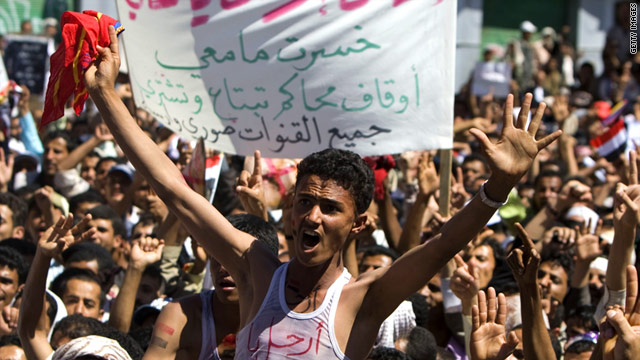
MANAMA, Bahrain – Tens of thousands of Bahrainis continue to hold Pearl Roundabout in the heart of country’s capital, weeks after small bands of protesters took to the streets demanding political reform.  Anti-government rallies continue to draw large numbers despite last week’s clashes with security forces that left at least seven dead.   Friday’s protests brought out over 100,000 people into the streets of Manama. In a move to appease opposition forces, the King has reshuffled his cabinet and promised to reduce housing loans by 25 percent.   The King pledged “to engage in this new process” and “move away from polarization.”  The military has also been ordered to stand down.  Despite these moves, tensions between Sunni and Shiite groups continue to rise. 

Protests Continue in Bahrain and Yemen (Photo Courtesy of CNN)

Moderate Shiites have been at the forefront of the protests in Bahrain. The protests represent a challenge to Sunni minority currently in power.  While pressure from citizens has caused the King to shake up the country’s leadership, opposition leaders contend that the changes were “superficial” and unlikely to bridge the gap between the two groups.  The government also released 308 political prisoners.  Direct talks between Sunni and Shiite parties however, continue to be untenable.  “This change is very superficial and doesn’t send good messages—it’s a case of old habits die hard as they’re patronizing the opposition to accept minimal change. The people are too sophisticated for this now: it won’t work,” states Ebrahim Sharif, director of the National Democratic Action Society.  Until opposition forces realize meaningful reforms, protests will likely continue within Bahrain.

Protests in Yemen rage on in spite of violent crackdowns by security forces as citizens seek the resignation of President Ali Abdullah Saleh.  The protests have been led largely by students and 27 people have lost their lives since the protests began in the country.  The President contends that he has received support from sheikhs and local officials and has resisted any move to divest him of power.   The government has been silent about the death of protesters but the President has announced that he will not run for re-election at the end of his term. 

Yemen continues to suffer high rates of unemployment, government corruption and lacks many substantive political freedoms.   And while protesters continue to battle for freedom and political reform, the country faces another battle for survival against Islamic militants and al-Qaeda.  With the government and the population split, the current situation presents a prime opportunity for Islamic terrorists to recruit additional fighters and solidify their power in tribal and less developed regions of the country.   Commenting on this risk, one protestor criticized the government’s propagation of the terrorist threat to acquire foreign aid to combat terrorism stating that “we are here to show the world that [President Saleh] is the terrorist.”

For more information please see:

CNN World – Bahrain King Reshuffles Cabinet As Opposition Leader Returns – Feb. 26, 2011

CNN World- Tribal Groups Joining Protests against Yemeni President – Feb. 26, 2011

International Business Times – Huge Anti-Government Protests Sweep across Yemen – Feb. 26, 2011

The Wall Street Journal – Protests Build Again in Bahrain – Feb. 26, 2011

Venezuelan Students End Hunger Strike

By Patrick Vanderpool
Impunity Watch Reporter, South America

Venezuelan students on hunger strike (photo courtesy of Latin American Herald Tribune)

CARACAS, Venezuela – A student-lead hunger strike that lasted for 23 days has finally ended. The hunger strike, which grew from 9 to 80 university students, was in support of people that the protesters argued were political prisoners.

The protesting students had also been calling for a discussion of the cases by the Organization of American States (OAS) and arguing for a visit from that regional body, something that the administration of Venezuelan President Hugo Chavez has so far blocked.

Lorent Saleh, one of the leaders of the protesters, stated that “today we are completing 23 days since we started a promise we made to fight for liberty and democracy, and for those who find themselves behind bars for thinking differently than this regime.” According to Saleh, the protesters and the Venezuelan government had reached a number of agreements, including medical attention for some prisoners, freedom for other prisoners and the creation of a round-table with authorities to discuss other demands that the protesters have.

According to Juan Pio Hernandez, a member of the Link the Americas organization, which has been a staunch supporter of the protesters, “the regime of Hugo Chavez agreed to free seven of the 27 political prisoners held under false criminal charges.”

The hunger strike drew significant attention from the United States. As the strike continued to snowball to its ultimate number of 80 students, the U.S. State Department called Hugo Chavez’ government to help end the starvation. The U.S.’s interference; however, was not taken kindly by all parties involved.

Venezuelan Foreign Minister Nicolas Maduro rejected the statements made by the U.S. government, accusing them of meddling in Venezuela’s internal affairs. “Venezuela doesn’t need any protective guidance from nobody, of neither instance,” said Maduro.

The students announced that while the hunger-strike is over for the moment, their ‘Operation Freedom’ is not over and that they would continue to keep a vigil at the OAS headquarters in Caracas.

For more information, please see:

Latin American Herald Tribune – Venezuela Students End 3 Week Hunger Strike – Political Prisoner Released – 23 February 2011

Wall Street Journal – Venezuelan Student Protesters End Hunger Strike – 22 February 2011

Fox News Latino – Venezuela Student Hunger Strike Gains Momentum – 18 February 2011