HRW Call For International Intervention in Mogadishu

by Laura Hirahara
Impunity Watch Reporter, Africa

Armed fighters from the militant group Hizbul Islam line up in Somalias capital Mogadishu; Photo courtesy Reuters
Armed fighters from the militant group Hizbul Islam line up in Somalia's capital Mogadishu; Photo courtesy Reuters

MOGADISHU, Somalia- The New York based organization Human Rights Watch (HRW) has released a report on the war-torn capital of Somalia, Mogadishu, citing heightened violence between Somalia’s Transitional Federal Government (TFG) and the Islamic militant group al-Shabaab .  In this report, HRW has called upon the international community to intervene in Somalia to prevent further civilian casualties and stop the flow of refugees out of the country.

Somalia has existed without a central government since 1991 when President Mohamed Siad Barre was removed from power.  In 2006, Ethiopian military forces entered Mogadishu to oust an Islamic court coalition which was controlling the city.  Since then, violence has steadily escalated, leading to all out war-fare in the streets of Mogadishu and mortar and rocket fire attacks within the city limits.

Al-Shabaab, which claims ties to al-Qaeda, has launched two major offenses against the TFG, both in May and then again over August and September of last year.  Currently, the TFG, which is the internationally recognized government of Somalia, controls only portions of the capital city.  The TFG has support from nearly 8,000 African Union peacekeeping troops but battles have been brutal and often amount to small gains and losses.  Frank Langfitt, reporting from Mogadisu for NPR stated “This morning. . .the African Union took about 70 yards and they expect that later tonight al-Shabaab will try to take back that 70 yards.”

In the midst of this fighting, thousands of civilians in Mogadishu are either leaving their homes or becoming victims of the conflict.  Though Somalis have been fleeing to refugee camps in Kenya since 1991, the recent conflict has prompted everyone who can afford to leave Mogadishu to make the journey across the border.  The International Committee of the Red Cross reported this last January that it received a record number of patients with war related injuries in 2010, amounting to over 2,300 injured.  HRW claims that both sides are responsible for massive civilian deaths which they believe may amount to war crimes.  Said  Rona Peligal, deputy Africa director at Human Rights Watch, “The world has for too long ignored the appalling cost to civilians of the fighting in Mogadishu. . .An international commission of inquiry is urgently needed to investigate war crimes committed in Somalia by all sides.”

For more information, please see;

Bloomberg- War Crimes Investigation Needed in Somali Capital, Civil Rights Group Says14 Feb., 2011

Bikyamasr- End War Crimes in Mogadishu15 Feb., 2011

NPR- On the Front Lines in Somalia14 Feb., 2011

Argentina Protests Washington Over Plane Incident

By R. Renee Yaworsky
Impunity Watch Reporter, South America

BUENOS AIRES, Argentina—On Monday, Argentina declared that it intends to lodge a formal protest against Washington, D.C.  The protest stems from an incident that occurred last week, wherein Argentine officials say they confiscated undeclared weapons, spy equipment, and drugs from a U.S. military aircraft.  The authorities claim they seized almost 1,000 cubic feet of such cargo.

The aircraft involved is a U.S. Air Force C-17 transport plane.  The plane was searched by Argentine customs officials last Thursday at the Ezeiza International Airport.  According to Argentine officials, it had landed with experts ready to engage in a routine hostage rescue training exercise—something they consider a ruse to bring the undeclared items.  A U.S. Special Forces team had been invited into the country to give the training course to Argentina’s federal police.

Argentina’s President Cristina Kirchner’s administration announced that they would be lodging the protest with Washington, D.C. in order to request that it help investigate what they called the Air Force’s attempt “to violate Argentine laws by bringing in hidden material in an official shipment.”  The South American country has categorized the cargo seized from the plane as “sensitive material,” stating Sunday:  “Among the material seized, which the State Department makes no reference to, are from weapons to different drugs, including various doses of morphine.”

Machine guns, ammunition, and spy equipment were listed as some of the items found on board.  Argentine officials said that these had not been properly declared in a manifest submitted by the U.S. embassy.

After the incident, the assistant U.S. Secretary of State for Western Hemisphere Affairs, Arturo Valenzuela, telephoned Argentine Foreign Minister Hector Timerman to complain about the way that Argentine officials handled the search of the plane.  Timerman’s response was:  “Argentine law must be complied with by all, without exception.”

U.S. officials have denied any wrongdoing, and one explained:  “We do respect their laws; we do respect their sovereignty.”  The official said every gun was declared but extra gun barrels were seized because they were not marked with matching serial numbers.

Relations between Argentina and the United States have been strained lately, and President Obama recently decided not to visit Argentina during his first trip to Latin America next month.

For more information, please see:

Washington Post-Argentina, US tangle over military material-14 February 2011

AFP-Argentina seizes illicit cargo on US military plane-14 February 2011

Buenos Aires Herald-US gov’t releases docs detailing bilateral agreement in US plane case-14 February 2011

Illegal Logging Could Threaten Uncontacted Tribes

By Patrick Vanderpool
Impunity Watch Reporter, South America

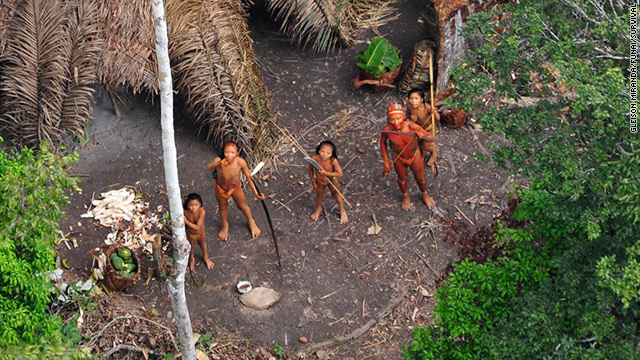
Recently photographed uncontacted tribe in Western Brazil (photo courtesy of CNN)

BRASILIA. Brazil – An indigenous rights organization has released what it says are photos of an uncontacted tribe in Brazil that is threatened by the logging across the border. Survival International, the group responsible for the photographs, released them in hopes that it would draw public attention to the illegal logging activities that threaten the tribe’s land.

The photographs show members of an uncontacted Brazilian tribe that is likely to get drawn into conflicts with Peruvian tribes who are fleeing their homes because of the logging. One photo shows five tribe members, some in red tribal paint, standing in front of a hut and looking upward. One man is holding a bow, and another, younger person, holds a machete. Foods including bananas, papayas and cassava can be identified near the tribe members.

In a written statement, Stephen Curry, a Survival International Director, stated that “the illegal loggers will destroy this tribe.”  “It’s vital that the Peruvian government stop them before time runs out. The people in these photos are self-evidently healthy and thriving. What they need from us is their territory protected, so that they can make their own choices about their future.”

Loggers in Peru are forcing indigenous tribes from Peru into Brazil, where, according to Survival International, “the two groups are likely to come into conflict.” Several nongovernmental organizations have urged Peru to act against the logging for years, but those groups have say that not enough had been done yet.

For years, Peruvian officials have denied the existence of these indigenous peoples while they continue to allow exploration of the lands for resources. One advocate for indigenous tribes stated that the publication of these photos “is necessary to reaffirm that these peoples exist, so we support the use of images that prove these facts.”

For more information, please see:

New York Times – Isolated Amazon Tribe Threatened by Logging, Group Says – 13 February 2011

Boston Globe – Uncontacted Tribes in the Amazon – 12 February 2011

CNN – Group Releases Photos on Uncontacted Tribe to Raise Awareness – 1 February 2011

As Egypt Celebrates, Algeria Simmers

By Daniel M. Austin
Impunity Watch Reporter, Africa

Clashes between Algerian Security Forces and Protesters. (Photo Courtesy of The Telegraph).

ALGIERS, Algeria –  On Saturday, February 12, thousands of Algerian police officers in riot gear clogged the streets of the capital to prevent pro-democracy demonstrators from marching on the city’s main square. The protesters, inspired by events that have taken place in Egypt and Tunisia are demanding significant government reforms.  During clashes with Algerian security forces several hundred protesters were arrested or detained. As of Saturday evening, police officers were still patrolling the streets and dozens of armored police vehicles had sealed off the city’s main square.

Demonstrators gathered in May First Square in central Algiers shouting for President Abdelaziz Bouteflika to leave office. The demonstrators were contained by a large contingent of police officers armed with truncheons. Reports vary on the number of protestors involved in the demonstration from several hundred to several thousand. One observer claimed that the government had mobilized 30,000 police officers as a show of force to ensure any popular revolt would be stomped out. Along with the demonstration in Algiers, protest marches also took in other cities throughout Algeria including Annaba, Constantine and Oran.

The demands of protesters in Algeria are similar to what was asked for in Tunisia and Egypt. Specifically, the demonstrators want President Bouteflika to leave office, an end to the State of Emergency that has been in place for more than 19 years, and democratic elections. 

The government of President Bouteflika has been attempting to break this popular uprising using tactics similar to what was seen in Egypt. In particular, aggressive police tactics and violence against protesters as well as journalist have been reported. Protestors claim as many as 500 people have been arrested in the capital city alone. Further, several hundred demonstrators were detained in other cities throughout the country.  Additionally, the government has limited or shut down access to the internet including Facebook attempting to limit the protester’s ability to organize using social media.

Similar to Egypt, Algeria suffers from high unemployment, rising food prices, a lack of housing and disconnect financially and socially between the average Algerian and the class of people who rule the country.  Political corruption and poverty are rampant in this North Africa nation even though Algeria has oil resources and holds the eighth largest supply of natural gas in the world.

For more information, please see:

Al Jazeera — Algeria protesters push for change – 12 February 2011

Bloomberg — Algeria Detains 100 Protesters During Algiers Sit-In – 12 February 2011

New York Times – Security Forces Halt Protest in Algeria – 12 February 2011

Reuters — Algeria police stifle Egypt-inspired protest — 12 February 2011

The Telegraph—Algeria Shuts Down internet and Facebook as Protest Mount – 12 February 2011

Hungary Faces Mounting Criticism Over New Media Law

By David Sophrin
Senior Desk Officer, Europe

BUDAPEST, Hungary – A recently adopted Hungarian federal law that establishes certain standards among the nation’s journalists has begun to face mounting criticism from a number of political forces both domestically and abroad.

The new law “requires the media to meet vague standards of ‘balance’, ‘human dignity’, and ‘mortality’.”  Additionally, the statute authorizes the Fidesz political party to “force journalists to disclose their sources.”

Opposition to the statute has steadily grown since its passage this past December over fears that the law will severely curb freedoms of the press both in Hungary and abroad.  Hungarian civil rights leaders have accused this law of being a political ploy by the Fidesz party to increase their control over the media.  A number of fellow European Union members have also publicly voiced their opposition to it.

The Council of Europe’s Commissioner for Human Rights, Thomas Hammarberg, noted that the law constituted the “establishment of a politically unbalanced regulatory machinery with disproportionate powers and lack of full judicial supervision.”  Soon after its passage the European Commission determined that the media law was not in line with wider European legal norms.  These criticisms have largely dominated Hungary’s current reign as the EU President.

In response to the criticism, notably from the EU, Hungary has announced that it will propose changes in the future to the media law.  It has also announced it will be holding meetings with the European Commission this week to formulate those amendments.

COLUMBIA MISSOURIAN – Global Journalist: Hungary faces free-press criticism – February 11, 2011

AP – Hungary offers changes to media law to EU, a major step in dispute overshadowing presidency – February 10, 2011

THE BUDAPEST TIMES – Media law talks in Brussels Monday – February 8, 2011

BBC – EU-Hungary row over media law cools down – February 2, 2011

FINANCIAL TIMES – Hungary media law falls foul of Brussels – January 11, 2011