Argentina Admits To Malnutrition Deaths Among Poor

By Patrick Vanderpool
Impunity Watch Reporter, South America

Buenos Aires, Argentina – Argentine Government officials admitted to an increased number of deaths among the country’s poor of indigenous people due to malnutrition and  promised government action to minimize the problem. Reports of malnutrition deaths stemmed from a joint study conducted by London’s Imperial College and the University of Harvard in Boston showing that Argentina, Chile and Venezuela topped the list of overweight people in Latin America.

The Argentine Government has faced criticism for not doing enough to ease poverty among the country’s non-European population. Critics of President Cristina Fernandez de Kirchner earlier called for more vigorous measures to pursue the government’s poverty reduction programs.

Jose Manuel Urtubey, Governor of the northern province of Salta, said in a television interview that at least five children had died of malnutrition in 2010 and officials recorded another death this year. According to Urtubey, most of these deaths are of indigenous children. The governor warned that more malnutrition cases might be present in isolated indigenous communities that may not have extensive contact with individuals or organizations outside of their group.

Fatalities included an 18-month-old toddler and a 3-year old female child; both of whose deaths were initially attributed to infections. A third case of another 18-month-old toddler, reported to have died due to “septic shock caused by malnutrition,” brought great attention on malnutrition deaths.

The Argentine media was in an uproar after learning of the deaths. The Salta and Buenos Aires media quoted the father of one of the toddlers, who said he lost his child on a day when he returned from work in the woods to find there was nothing at hand that he could feed the children. According to the father, “there are some days when we manage to have a meal to eat and days when we don’t…on that day we had nothing to eat.”

For more information, please see:

Spero News – Argentina: Missionaries Address Malnutrition and Sexual Abuse of Children – 7 February 2011

UPI – Argentina Admits to Malnutrition Deaths Among the Poor – 7 February 2011

Merco Press – Argentine Aborigine Children Die of Malnutrition and Poor Sanitary Conditions – 6 February 2011

Update: Basarwa Bushmen in Botswana Granted Water Access

By Laura Hirahara
Impunity Watch Reporter, Africa

GABORONE, Botswana- The Basarwa Bushmen who live in the Kalahari Game Reserve in central Botswana have been awarded the right to access existing water wells and drill new wells by an appeals court who called the government’s actions “degrading”.  This comes almost ten years after the government sealed wells in the Bushmen’s ancestral lands and barred them from digging new wells.  The Bushmen, who have been in a legal battle with Botswana’s government since 2002 when they were evicted from their land, see this ruling as a victory.  The government argued during the appeal process that allowing the Bushmen to use and create water wells in the reserve is incompatible with the preservation of Kalahari wildlife despite allowing vacation lodges to be built in the area and most recently awarding a three billion dollar mining contract to Gem Diamonds.  After this decision in late January, Jeff Ramsay, a coordinator for the Botswana Government Communications and Information System, said, “We are a nation that is governed by the rule of law and always have been. Of course we will respect the decision of the courts.”

Since the Botswanian government sealed the wells in the Kalahari, the population of Bushmen has declined.  Those that remained in the reserve have survived by rainwater and melons or making the long journey from their homes to taps and other water sources outside of the reserve.  Said Basarwa resident and advocate Amohelang Segotsane, “I am happy with the judgment but not completely happy. . .[the g]overnment was supposed to give us water without going through the legal process.”

For more information, please see;

BBC- Botswana Bushmen Win  Back Rights to Kalahari Water– 27 Jan., 2011

NY Times- Bushmen Win Water Rights– 27 Jan., 2011

AP- Botswana Court Gives Kalahari Bushmen Water Rights– 27 Jan., 2011

Impunity WatchBotswana’s Bushmen Denied Access to Water24 Jan., 2011

Indigenous Protesters Ousted from Easter Island Hotel

By R. Renee Yaworsky
Impunity Watch Reporter, South America

Last year, police shot pellet guns at protesters.  (Photo courtesy of Arizona Daily Star)
Last year, police shot pellet guns at protesters. (Photo courtesy of Arizona Daily Star)

EASTER ISLAND, Chile—On Sunday, police officers raided a luxury hotel on Easter Island to evict indigenous individuals who had been occupying the building.  The occupants have been protesting the loss of their ancestral lands on Easter Island to tourists and other non-indigenous residents who visit the island to view its famous ancient monolith statues.

Chilean police drove the last of dozens of indigenous Rapa Nui protesters from the Hangaroa Eco Village and Spa hotel, one of the last strongholds captured by them in protest last year.  Members of the Hitorangi clan have remained on the grounds since August of last year and insist that the property was illegally taken from their illiterate grandmother.  They claim that the notoriously cruel dictator General Augusto Pinochet illegitimately sold their grandmother’s land to the Schiess family.  The protesters also argue that there are plans to develop Easter Island to cater to non-indigenous people, and their ancestral lands will be lost.

The police raid on the hotel came just two days before the protesters were scheduled to go to court and discuss ownership of the property.

According to Rodrigo Gomez, the protesters’ lawyer, about 50 armed police officers raided the hotel in order to oust the last 5 inhabitants.  Gomez called the incident “utterly irregular and illegal.”  The Save Rapa Nui website has reported that a Chilean judge had previously refused to allow police to evict the hotel’s occupants.

Last December, over 20 people were wounded by pellet guns shot by police as they tried to scatter Rapa Nui protesters.  Last month, James Anaya of the United Nations spoke out in defense of the Rapa Nui, asking Chile’s government to “make every effort to conduct a dialogue in good faith with representatives of the Rapa Nui people to solve, as soon as possible, the real underlying problems that explain the current situation.”

The Rapa Nui protesters who were squatting in the hotel were arrested by police and then let go to await a court hearing.

Easter Island (officially called Rapa Nui) is a Unesco World Heritage Site and was annexed by Chile in 1888.  It has a population of approximately 4,000.

For more information, please see:

Today Online-Police evict last of Easter Island protesters-7 February 2011

BBC-Police evict Rapa Nui clan from Easter Island hotel-6 February 2011

Herald Sun-Easter Island squatters evicted-6 February 2011

Unprecedented Internet shutdown in Egypt sparks fears of technology abuse

By Polly Johnson
Impunity Watch Reporter, Africa

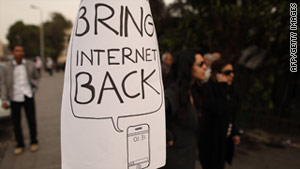
A protesters sign asked that the Egyptian government restore the Internet, which it did last Wednesday. (Photo Courtesy of CNN/Getty Images).
A protester's sign asked that the Egyptian government restore the Internet, which it did last Wednesday. (Photo Courtesy of CNN/Getty Images).

CAIRO, Egypt – On January 28, a week into Egypt’s ongoing protests, President Hosni Mubarak’s government ordered Internet service providers to sever all forms of communication, including Internet access, mobile networks and SMS. Though the Internet was restored as of last Wednesday, the blackout marked an unprecedented Internet milestone.

Egypt’s economy and society rely heavily on the Internet. A think-tank based in Paris, the Organization for Economic Cooperation and Development, estimated that the Internet blackout cost Egypt’s economy about ninety million dollars.

More concerning, however, is the notion that a country as technologically advanced as Egypt was able to shut down all communications as quickly as it did. James Cowie, co-founder and chief technology officer of Renesys, an IT company in New Hampshire, told the Los Angeles Times, “Over a period of about 20 minutes, it’s as if each of the primary service providers started pulling the routes that lead to them. It wasn’t like a simultaneous withdrawal.

“There are private companies of varying sizes that own and operate their own infrastructure. But it seems they got a call so they turned it off,” Cowie said.

“What we are seeing in Egypt is a frightening example of how the power of technology can be abused,” said Timothy Karr, a campaign director for Free Press, an advocacy organization, said.

Such swift action brings to mind oppressive regimes such as that of North Korea, which forbids its citizens from accessing the Internet at all.

Even during the recent uprising in Tunisia, only specific services and websites were blocked.

And it seems that the United States aided with the shutdown. According to an article by Karr, a U.S. company based in Sunnyvale, Calif., Boeing-owned Narus, sold Telecom Egypt “real-time traffic intelligence” equipment, which may have been used by Mubarak’s regime to sever all communications. The equipment is more commonly known as Deep Packet Inspection (DPI), technology that allows network managers to track content from users of the Internet and mobile phones.

Most disturbing about DPI technology, according to Karr, is that “[c]ommercial operators trafficking in Deep Packet Inspection technology to violation Internet users’ privacy is bad enough; in government hands, that same invasion of privacy can quickly lead to stark human rights violations.”

For more information, please see:

Arutz Sheva – Egypt’s Internet Crackdown ‘Had US Help’ – 6 February 2011

Information Week – Egypt Takes $90 Million Hit From Internet Blackout – 3 February 2011

Los Angeles Times – Egypt may have turned off the Internet one phone call at a time – 29 January 2011

Huffington Post – One U.S. Corporation’s Role in Egypt’s Brutal Crackdown – 28 January 2011

Telegraph – How Egypt shut down the internet – 28 January 2011

Protest After The India Army Killed A Young Villager

David L. Chaplin II
Impunity Watch; Asia

SRINAGAR, India – Protest erupted Saturday in northern Indian-administered Kashmir, in a village, after the Indian army killed a young student in his twenties late Friday night.

Villagers carry the body of Manzoor Ahmad Magray who was shot dead by the Army when he walked into an ambush it laid for militants in Handwara town of north Kashmir on Saturday. Photo: Nissar Ahmad

Villagers carry the body of Manzoor Ahmad Magray who was shot dead by the Army when he walked into an ambush it laid for militants in Handwara town of north Kashmir on Saturday. Photo: Nissar Ahmad

The family of the victim alleged the boy had been taken out of his home by the soldiers and his body was found early Saturday.  But, the Indian army said the man was shot after he walked into an ambush it laid after getting specific information about movement of militants in the area.

Mohammad Shafi Rather, district magistrate the death occurred, told CNN that a murder case has been registered against the army unit, and an investigation has been ordered into the killing of the man, identified as Manzoor Ahmad Magray.

Television footage showed thousands of people marching in the streets on Saturday to voice their anger. Residents assembled and staged a protest shouting pro-freedom slogans as the villagers carried the man’s body to a highway and laid it there, blocking traffic.

It was only after the district magistrate promised an investigation; the villagers took the body to a graveyard for burial.

The Indian army issued a statement Saturday morning regretting the man’s death, but maintaining that “the troops had adhered to standard operating procedure (SOP) in the incident.”

The army’s statement said Magray had walked into the ambush along with another individual. After being challenged to surrender, the two started running away, at which point the troops opened fire.

“We deeply and sincerely express our heartfelt condolences to the bereaved family on this incident,” said Lt. Col. J.S. Brar, a Srinagar-based defense spokesman.

Relatives of Magray rejected the army’s statement that the young man had refused to stop and charged that he had been killed “in cold blood”.

“Torture marks were visible on the body of Magray. There was only one bullet wound in the lower part of the leg,” said Shabir Ahmad, a relative.

Security forces have been accused by human rights organizations of extrajudicial killings and acting with impunity.

“How can one not condemn the death of 21-year-old Manzoor at the hands of the Army late last night? Another needless death in a bloody Kashmir,” Mr. Abdullah posted on Twitter.

Separatist organizations too condemned the killing, saying that security forces had not changed their policy of “killing innocents in Kashmir”.

A long summer of pro-independence unrest was sparked in Indian administered Kashmir last year by the killing of an 18-year-old boy in police action in the capital, Srinagar.

“Over 120 innocent persons have been killed by the security forces during the last [few] months but action has not [been] taken [on] any person so far,” she said, adding that the way the government was responding to such cold-blooded murder reflected its insensitivity towards human tragedies.

Anti-India sentiment runs deep in Muslim-majority Kashmir, a Himalayan region split between India and Pakistan.

Chief Minister Omar Abdullah condemned the killing and said it could have been avoided had his suggestions at the Unified Headquarters been taken seriously.

People’s Democratic Party (PDP) president Mehbooba Mufti regretted that while the count of the dead, comprising mostly youngsters, kept mounting, the government was busy deceiving people, filing mere FIRs.

For more information, please see:

CNN – Protest follows killing of man in Kashmir village – 5 February 2011

Voice of America News – Kashmiris Protest Army Shooting – 5 Fedruary 2011

The Hindu – Protests rock Handwara after killing of youth by Army; Omar upset – 5 February 2011