By Eric C. Sigmund Impunity Watch Reporter, Middle East
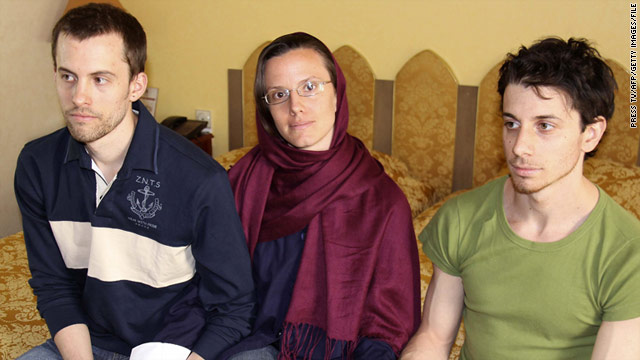
TEHRAN, Iran – Proceedings began today in the Revolutionary Court in Tehran for the three American hikers arrested in Iran on July 31, 2009. The three reportedly crossed an unmarked border into Iran while hiking in the mountainous region of Iraqi Kurdistan. 32 year-old Sarah Shourd, was released back to the United States on bail for health concerns but has been called back to Iran for the trial. The other two hikers, Shane Bauer and Josh Fattal, both 28, have been detained since their arrest over 18 months ago. Their lawyer, Masoud Shafii, reported yesterday that a judge had denied his request to visit his clients on the eve of trial.
Trial Begins for Shourd, Bauer and Fattal (Photo Courtesy of CNN)
The U.S. government has repeatedly called for the release of Bauer and Fattal and this event has hardened the U.S.’ stance towards Iran. The trial comes at a time when tensions between the two countries are at a high due to continued failure of nuclear program talks. Human rights groups have loudly criticized the arrest and detention of these three U.S. citizens and demanded their release. Other notable figures have also been prohibited from seeing the proceedings including Swiss Ambassador Livia Leu Agosti who has close relations with the United States.
No evidence has been supplied by the government of Iran to support its allegations. The hiker’s lawyer has predicted that the three will not be convicted; “I’m pretty sure they won’t be convicted because [the trial] doesn’t have any legal justification.” Shafii noted that the issue of spying is “irrelevant” but said the hikers could be conviction for illegal entry. Their entry into the country was inadvertent however, since the border was unmarked remarked Shafii. The change of illegal entry carries a penalty of up to three years in prison.
Shourd did not respond to the court’s request to appear today. Iranian officials have said the trial will continue and that she will be tried in absentia. It is reported that Bauer and Fattal both pled “not guilty” as the trial began. Their lawyer also put in a plea of “not guilty” for the absent Shourd.
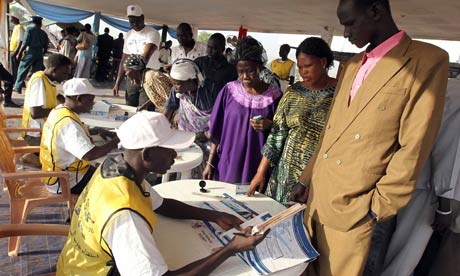
South Sudanese in Line to Vote (Photo courtesy of Mohamed Messara/EPA)
KHARTOUM, Sudan- In a matter of days the results of Sudan’s referendum vote to decide whether South Sudan should be independent of North Sudan will be announced. With preliminary polls showing an almost unanimous vote from the South Sudanese in favor of succession it is expected that the referendum will pass. Following the relatively peaceful voting process, questions now loom as to whether the North and South will be able to transition peacefully and negotiate bilateral resource sharing agreements until South Sudan is truly independent.
Even before Sudan gained independence from British colonial powers and Egyptian rule it was embroiled in civil war. Fighting between the North and South regions persisted for decades, lasting from 1955-1972 and again from 1983-2005. Finally, in 2005 a Comprehensive Peace Agreement (CPA) was brokered between the North and South which created an interim government with an option to extend the CPA in six years or vote for succession. Within a few years of the CPA, it became clear to leaders in both the North and South that neither would be willing to agree to the CPA long-term, prompting the vote.
Since the vote and the expectation that South Sudan will become an independent nation, concerns are growing over issues of citizenship, boundary demarcations, oil resources and how South Sudan will function as a government. One of the more immediate problems facing the split between the two regions is that fact that tens of thousands of South Sudanese are currently living and working in the North. Many occupy civil servant positions, working in several capacities including law enforcement. Some expect the North Sudan government in Khartoum, led by Omar al-Bashir, to simply revoke the Sudanese citizenship of all South Sudanese living in the North which could create conflict as thousands of people are displaced. The CPA, which would provide a roadmap in the coming years for agreements between the two countries, has no provisions for such citizenship issues.
Causing unrest for the international community is how both regions will handle their oil concerns and interact with one another in splitting natural resources . Since the U.S. sanctioned Bashir’s government in the North, Asian countries have been the primary investors and buyers of Sudanese oil. U.S. President Barack Obama has pledged to lift the sanction aimed primarily at the North if Bashir follows the steps outlined in the CPA. This could open the region to Western investment and oil exportation, something it has not seen in years.
Additionally, the business of transporting and refining oil between the North and South has become increasingly complex. Approximately sixty percent of the oil wells are in South Sudan but all the pipes run into the North and the South currently depends on the North to refine and sell its oil. Adding to this, there is also no consensus on whether the oil rich state of Abyei, which straddles the contested border between the two regions, will become part of North or South Sudan. In order to gain oil independence, South Sudan has plans to build a pipeline to Kenya which would allow it to export its oil independent of the North but a plan like that will take years to complete. With oil being the primary source of revenue for Sudan, it is doubtful that the North will be willing to give up its interest in Southern oil. Both countries will need to focus on peaceful negotiations that allow for resource sharing.
Focusing solely on South Sudan, many wonder if a new government in the region will be able to meet the needs of a country. Until now, the South Sudan People’s Liberation Movement (SPLM) has operated as a resistence movement seeking to protect and promote minority rights. The ethnic and religious diversity of South Sudan’s population has made it the target of the North, which routinely excluded minority concerns. While a vote to split from the North would end this, some fear that infighting and the inability to act as a government will plague the South. The South will need to focus on infrastructure, social services and providing proper diplomacy and foreign policy to guide its new government.
While the split seems like the next natural step for Sudan it also shows the implications of a history of human rights abuses and civil war. Co-founder of Global Brief and the Head of the Counsel Assistance Unit of the ICC Sam Sasan Shoamanesh, writing for The Huffington Post, stated
Anyway you ‘cut’ it, the Sudanese story is a continuing tragedy, and a ‘yes’ vote is yet another example of the scars created by the nation’s war torn and tortured modern history. What is incontestable is that the people of Sudan of all ethnic and religious stripes deserve a more dignified existence, nestled in the security and promise of peace and prosperity. If at this stage, secession is the only means of realizing these necessities, then it is perhaps a mal nécessaire, which history will have to accept.
By R. Renee Yaworsky
Impunity Watch Reporter, South America
CARACAS, Venezuela—After spending a year behind bars, a Venezuelan judge has been granted house arrest by a Venezuelan court. The judge’s imprisonment and sentence have been harshly criticized by human rights defenders, who consider her a political prisoner. She has only been released from prison now because she has cancer and needs treatment. Originally, President Hugo Chavez had called for the judge to serve the maximum sentence of 30 years in prison.
Maria Lourdes Afiuni, the judge, was imprisoned back in December of 2009 and faced charges stemming from her decision to free a banker who later jumped bail and absconded to the United States. The banker, Eligio Cedeno, had been accused of breaking currency controls. Afiuni was charged with abusing her authority.
Jose Amalio Graterol, Afiuni’s attorney, commented on the court’s decision last week to transition the judge from imprisonment to house arrest. Graterol expressed his opinion that the change is a step in the right direction because he intends to prove that Afiuni is not guilty of any crime. Graterol told Globovision, a television station in Venezuela with a reputation for opposing President Chavez, that Afiuni is being given house arrest so she can receive a hysterectomy and recover from surgery. “They realized they were carrying out a death sentence against her,” the attorney said, referring to the judge’s poor health.
Human rights groups have said that the judge’s case sheds light on problems regarding the independence of Venezuela’s judiciary. The Government, however, argues that her detention is the result of suspicions concerning Cedeno (the fleeing banker).
Afiuni has defended herself by stating that she acted lawfully by releasing Cedeno because he had been imprisoned for three years without a trial, which exceeds the legal limit. Opponents of President Chavez regard Afiuni as a political prisoner and count her case as just one of several where the Government has overruled sound judicial procedure.
By Patrick Vanderpool Impunity Watch Reporter, South America
Rescuers Ready Helicopters for Hostage Release (photo courtesy of Colombia Reports)
BOGOTA, Colombia – Piedad Cordoba will travel to Brazil Monday to pick up the Brazilian helicopters and personnel involved in the planned release of five FARC hostages.
On her twitter account, the former Senator said “Friends, we are working out the latest details of the releases. Monday at noon the operation begins and I will leave for Brazil.” According to the Red Cross, the first actual release is planned to take place on Wednesday.
Red Cross delegate to Colombia Christophe Beney told members of the press that Red Cross members and Cordoba will first pick up council member Marcos Vaquero in the southern Colombia and return him to the city of Villavicencio. On Friday, the helicopters will pick up council member Armando Acuña and marine Henry Lopez and bring them to Florencia.
Police major Guillermo Solorzano and soldier Salin Antonio Sanmiguel, the last two hostages, will “hopefully” be picked up the following weekend and be brought to the city of Ibague before Monday. “If there’s no surprises, this will be the order of the operation,” Beney said.
The release is a victory for freedom, not for the FARC. According to some media outlets, some people think that if the FARC kidnapped these people then they should not gain any publicity by setting them free. However, this view “demonstrates a lack of understanding of both kidnapping and the significance of political kidnapping.”
To publicize the release with continuous reporting only strengthens democratic institutions and denigrates the FARC, according to other media outlets.
By Daniel M. Austin
Impunity Watch Reporter, Africa
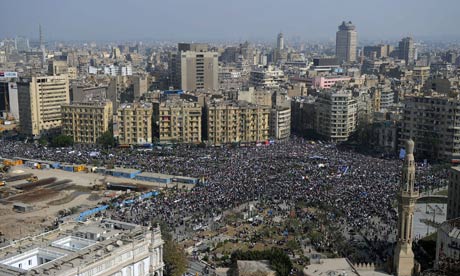
Egyptian Protesters in Tahrir Square. (Photo Courtesy of The Guardian).
CAIRO, Egypt -On Friday, February 4, hundreds of thousands of people streamed into Tahrir Square to protest against Egyptian President Hosni Mobarak. The Friday protest, billed as “Departure Friday” follows two days of bloody clashes between anti-government demonstrators and pro-government supporters. The violence has left dozens of people killed and hundreds more injured. As President Mobarak clings to power, the international community is contemplating what to do next.
The Friday protest marks the 11th day of demonstrations and many in Tahrir Square do not plan on leaving until President Mobarak is removed from office. Organizers of the protest were hoping to turn out one million demonstrators but initial estimates are closer to two hundred thousand. Reports from Tahrir Square claim the atmosphere is festive, with less violence than has been seen in the past couple of days. The composition of the protesters cuts across social, economic, and religious lines. There is a mix of upper and middle class Egyptians as well as people with more moderate means. Additionally, the protesters include both Muslims and Christians.
The 11 days of protest have seen a mix of peaceful demonstrations as well as bloody clashes between anti-government supporters and Mobarak sympathizers. One reason for Friday’s calm atmosphere in Tahrir Square is due to the Egyptian army’s renewed presence. The army, which initially asserted itself during the first few days of the protest, then fell back as the pro and anti government factions clashed, has once again reasserted itself creating a security perimeter around the square. The army’s security barrier has helped to limit clashes between the opposing parties and create a more organized and safer environment.
Although Tahrir Square, also known as Liberation Square, has been the focus of intense media coverage, other acts of civil disobedience and protest have taken place in cities through Egypt including Giza and Alexandria.
Estimates vary widely on the number of people injured and killed since the demonstrations began. Anti-government protesters wounded in the clashes have received medical treatment from both the Egyptian military as well as make shift hospitals that have sprung up in mosques around Tahrir Square. The Egyptian health minister claims that eight people have been killed and over eight hundred others have been wounded. On the other hand, the United Nations estimates that more than 300 people have been killed throughout Egypt while 4,000 people have been injured since the protests began on January 25.
INTERNATIONAL RESPONSE
The response from the International community to this crisis has been restrained. The United States, Spain, France, Italy, Germany and England have expressed concern for the safety of protesters while at the same time calling on the Egyptian government to make necessary reforms. Unfortunately, difficult questions about how quickly President Mubarak should leave office and who should step into his position still remain. Several days ago, President Mubarak claimed he would not seek re-election in September of 2011; however this concession has not appeased the protesters who are looking for him to leave office immediately.
As the situation in Egypt has become more intense, the international community has become more forceful with its words. The United States, who initially claimed support for President Mubarak, has been working hard to get out in front of this crisis. President Obama has recently made statements calling for political reforms to take place “now”, but he has been careful not to call for President Mubarak to step down immediately. Similar sentiments have been echoed by the leaders of other nations, including several European countries that sent a letter to the Egyptian President asking him to create a transitional government.
Furthermore, news outlets are reporting the United States is trying to broker a deal where President Mubarak will step down and his Vice President Omar Suleiman would assume power. The plan would call for Vice President Suleiman along with Egypt’s military leadership to form a transitional government until elections can be held. Conversely, other media outlets claim that the United States has already offered this suggestion and it has been rebuffed by the Egyptian President. Questions remain about whether Mr. Suleiman or the Egyptian military would want to break away from President Mubarak. The ties between the Egyptian President, his leadership team, and the Egyptian military continue to be tested. These ties will become further restrained as the protesters in Tahrir Square plan a march on the presidential palace.