UN SPECIALIST INVESTIGATES HIGH RATES OF RAPE AND ASSAULT IN INDIAN COUNTRY

By Erica Laster                                                                                                                       Impunity Watch Reporter, North America

CHEROKEE, United States – On Friday, Rashica Manjoo stopped in Cherokee, North Carolina to discuss action to be taken against those that physically and sexually assault Native American women. As the special rapporteur for the United Nations on violence against women, Manjoo plans to report her findings to the United Nations Human Rights Council. 

Matilda Black Bear discusses her experience with domestic violence and the unavailability of support for women.  Photo courtesy of Indian Law.
Matilda Black Bear discusses her experience with domestic violence and the unavailability of support for women. Photo courtesy of Indian Law.

According to the Department of Justice, one out of every three Native American women are raped during their lifetime.  Three of four will become the victims of a physical assault.

Matilda Black Bear, a 64-year-old Cherokee native, is more than familiar with violence against women.  Over 30 years ago at the age of 26, Matilda entered into a relationship with a man that quickly turned violent.  “In the ’70s there were no services for victims, let alone any laws to hold perpetrators accountable,” recalls Tillie. “I went to the police and to the judges and they didn’t know what to do with me.”

The Indian Civil Rights Act limits tribal courts sentencing authority over Indians who have been accused of sexual and domestic violence against women.  Further, non-Indians are protected from sentencing by Indian Nations which are prohibited from exercising jurisdiction over non-Indian offenders.

Terri Henry, Councilwoman for the Eastern Band of Cherokee Indians believes, “The right to be safe and live free from violence is a human right that many in this country take for granted—but not Native women, who are beaten and raped at rates higher than any other population of women in the United States.”

Advocates have expressed the need to push for greater jurisdiction, services for survivors of domestic and sexual violence, funding and federal support. 

This past Friday, Attorney General Eric Holder announced the formation of the Violence Against Women Federal and Tribal Prosecution Task Force.  In an attempt to change the rates at which Native American women experience violence in their communities, the Task Force has been directed to complete a trial manual and discuss “best practices” for prosecuting those accused of violence against women in Indian Country.

Holder stated that, “The creation of the Violence Against Women Tribal Prosecution Task Force has been a priority for me since my visit with tribal leaders last year, and I believe it is a critical step in our work to improve public safety and strengthen coordination and collaboration concerning prosecution strategies with tribal communities.”

Citizen-Times – UN Studies Domestic Violence in Cherokee – 29 January 2011

Indian Law – UN Expert Investigates Violence Against Indian Women – 28 January 2011

Cherokee One Feather – DOJ Attempting to Combat Violence Against Indian Women – 25 January 2011
Update: Political Standoff in Ivory Coast Continues

By Daniel M. Austin
Impunity Watch Reporter, Africa

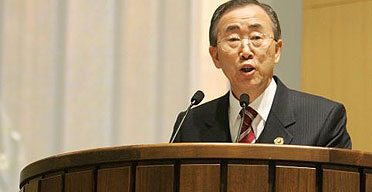
Mr. Ban Ki-moon address the AU Conference. (Photo Courtesy of The Guardian).

 ADDIS ABABA, Ethiopia – On Saturday, United Nations Secretary General Ban Ki-moon called on African nations to support the people of Ivory Coast as the political conflict between former President Laurent Gbagbo and President-elect Alassane Ouattara drags on.  Furthermore, the Secretary General noted that a recount of the voting would be a “grave injustice and set an unfortunate precedent.” Additionally, he stressed the importance of Mr. Gbagbo handing over power in a peaceful and ordered manner.

Mr. Ban Ki-moon commented on the political stalemate in Ivory Coast while delivering remarks at the 16th Annual African Union (AU) summit. During this conference, members of the pan-African body formed a committee that would help to bring the political crisis to an end. Specifically, the AU is going to set up a panel of five African leaders who will help broker an end to the crisis by drawing up a settlement that will be binding on both presidential candidates. The panel will be led by Kenyan Prime Minister Raila Odinga. Members at the conference are striving for a peaceful solution but have not ruled out using force to remove Mr. Gbagbo.

Secretary General Ban Ki-moon comments come at a time when African leaders appear split on how to resolve the crisis in Ivory Coast. Some African leaders, like Uganda’s President Yoweri Museveni claim there was a rush to declare Mr. Ouattara the new president while other leaders believe that a vote recount is appropriate before any action is taken to oust Mr. Gbagbo.

The United Nations, the African Union, and several other world powers recognize Mr. Ouattara as the winner of the November election and believe Mr. Gbagbo should cede power peacefully. Since the election results were announced, Mr. Gbagbo has clung to power by claiming the election was plagued by fraud and the results are unreliable. Since the voting ended there have been numerous protests as well as violent clashes between supporters of the two candidates.  Mr. Ouattara remains holed-up in a hotel on the outskirts of the capital Abidjan while Mr. Gbagbo continues to control the country’s security forces and the state run media. The hotel remains guarded by U.N. peacekeepers.

For more information, please see:

AFP — Ivory Coast ballot recount ‘grave injustice’: Ban – 30 January 2011

BBC Africa – UN’s Ban urges solidarity over Ivorian election crisis – 30 January 2011

KBC News — UN supports Africa’s mediation efforts in Ivory Coast – 30 January 2011

Reuters Africa — UN chief urges Africa to be firm against Gbagbo—30 January 2011

Rights Group Claims Chavez Is Using Judiciary Against Foes

By Patrick Vanderpool
Impunity Watch Reporter, South America

CARACAS, Venezuela – According to a prominent human rights organization, President Hugo Chavez is using Venezuela’s judiciary to persecute his political opponents and to crack down on media critics and curtail the power of labor unions. In its annual report, Human Rights Watch condemned what it called “the Venezuelan government’s domination of the judiciary and its weakening of democratic checks and balances” last year.

The human rights group also posed warnings that Chavez’s control over judges and prosecutors has led to “a precarious human rights situation.” According to the New York based organization, “judges may face reprisals if they rule against government interests,” citing Judge Maria Afiuni’s arrest shortly after she ordered the release of a high-profile banker who opposed Chavez’s government.

Chavez  was critical of Afiuni’s decision to free Eligio Cedeno, who was accused of corruption and fled to Florida soon after his release in late 2009. Chavez demanded that Afiuni, who is facing charges of abuse of authority and “favoring evasion of justice,” receive the maximum sentence of 30 years in prison.

Chavez adamantly denies having undue influence over the courts, insisting that the legal system remains autonomous and free from political influence. Other members of the president’s ruling party echoed Chavez’ sentiments about the Venezuelan judiciary, taking issue with the allegations in Human Rights Watch’s report.

According to Silvio Mora, a pro-Chavez lawmaker, “[e]very single one of the branches of government are independent: the judicial branch, the legislative branch and the executive branch.” In the same interview, Mora also claimed that “[e]veryone enjoys total freedom here.”

The accusations about Venezuela’s judiciary come a year after Chavez tightened control over that branch of the government. Many have criticized the move, comparing Chavez to Perez Jimenez, former military dictator of Venezuela, saying that both attempted to silence the news media, used the judiciary to jail adversaries and violated basic freedoms such as protest rights.

For more information, please see:

Associated Press – Rights Group: Chavez Using Judiciary Against Foes – 25 January 2011

Associated Press – Chavez Supporters, Foes Stage Anniversary Rallies – 23 January 2011

NPR – Venezuela’s Chavez Tightens Grip on Judiciary – 27 April 2010

New Human Rights Investigatons Shed Light on Allende’s 1973 Death

By R. Renee Yaworsky
Impunity Watch Reporter, South America

Allendes death was originally ruled a suicide.  (Photo courtesy of BBC)
Allende's death was originally ruled a suicide. (Photo courtesy of BBC)

SANTIAGO, Chile—The first official investigation into former President Salvador Allende’s death has begun. A Chilean judge opened the investigation decades after Allende died in 1973 in the midst of a military coup led by the infamous General Augusto Pinochet. Pinochet’s subsequent dictatorship lasted 17 long years.

The judge’s order is just one of numerous investigations into 726 human rights violations that have yet to be prosecuted. Beatriz Pedrals, judicial prosecutor of the appeals court, explained that these inquiries into human rights crimes will seek “uniformity of criteria; in other words, what has not been investigated, the courts will investigate. This will finally establish what happened.” Judge Mario Carroza, in charge of Allende’s death inquiry, calls his obligation, “more than an important duty.”

Allende, a Socialist president, was democratically elected and then found dead at age 65 by armed forces who had captured the presidential palace. The military troops had attacked the palace for hours using firearms and bombs dropped by air force jets. In a radio broadcast he made as his palace was under attack, Allende predicted: “I will not resign. Placed in this historic juncture, I will pay with my life the loyalty of the people.”

At first, the results of an autopsy pointed to suicide. Allende apparently died from a bullet that was fired into his mouth from a short distance away. The autopsy report surmised that the gunshot wound “could have been made by himself.” But since 1973, many of the deceased president’s supporters have disagreed with the autopsy’s findings, suggesting instead that Allende was murdered by soldiers or snipers. Three years ago, an expert who examined the autopsy report concluded that Allende may have sustained injuries from two separate weapons.

According to Alicia Lira, president of the Association of Relatives of Politically Executed Persons, “Allende was murdered.” During Pinochet’s notorious military dictatorship, 3,000 people vanished or were murdered, and 50,000 were tortured or held captive. Pinochet, 91, died of a heart attack in 2006 while under investigation for a myriad of human rights abuses.

For more information, please see:

Radio Cadena Agramonte-Investigation of Allende Death in Chilean Political Spotlight-29 January 2011

NY Times-Chilean Judge Orders Investigation Into Allende’s Death-27 January 2011

BBC-Inquiry into 1973 death of Chile’s Salvador Allende-27 January 2011

Sonawane’s Murder: Hundreds of Thousands Protest In India

David L. Chaplin II
Impunity Watch; Asia

MUMBAI, India – Thousands of government workers in India have continued to protest against the brutal killing of an official in the western state of Maharashtra. Yashwant Sonawane was burnt to death while investigating a fuel racket.

Mr. Sonawane had apparently tried to prevent a criminal gang from stealing fuel on the Nashik-Manmad highway some 200km (124 miles) from Mumbai, when he was attacked and burnt alive after being doused by kerosene.

Image courtesy of the Times of India

The killing has drawn people’s attention to the issue of corruption, which has been a major concern in the country in recent months after a series of scams, says the BBC’s Sanjoy Majumder in Delhi.

Nine people have been arrested in connection with Tuesday’s murder which has shocked people across India.

The government has blamed the so-called fuel mafia – criminals who steal petrol and mix it with kerosene before selling it, for the murder.

State police have turned their attention toward an oil adulteration mafia within Maharashtra today raiding 200 places and arresting around 180 people after an official was burnt alive while the Centre unveiled steps to reduce scope for diversion of subsidized kerosene. Additional Director General (Law & Order) K.P. Raghuvanshi said in Mumbai.

Hundreds of thousands of government officials are refusing to work in protest at the killing. They held a meeting in the state capital, Mumbai (Bombay), to mourn Mr. Sonawane and demanded that they be given adequate protection while carrying out their duties.

“We will attend office but not work,” GD Kulthe, secretary of the Maharashtra Gazetted Officers Mahasangh, told the BBC. “We are going to present a memorandum demanding strict action against all involved and better protection for government officers.”

The new Petroleum Minister S Jaipal Reddy unveiled steps including re-introduction of a chemical marker in kerosene in six months to eliminate the scope for adulteration of diesel using this subsidized fuel.  He also suggested that states use GPS-based vehicular tracking system for trucks transporting petrol and diesel to track the movement, any route deviations being taken or long stoppages.

Maharashtra Home Minister R.R. Patil said the ‘might’ of the oil mafia is increasing day by day.

“Those who are involved will not be spared and will be given the highest punishment,” he said in Mumbai.

“We have not come across any politician’s name in our investigation. Allegations about NCP leaders being involved have not come to me. If I am given proof, I will take stern action,” Patil said.

Ravindra Dhongade, president of the Maharashtra Gazetted Officers Mahasangh, said, “We have not announced the protest as a strike but we are shunning work to register our protest against this gruesome act which has shaken the government employees.”

The government servants have demanded better protection, a comprehensive probe and strictest possible punishment for Sonawane’s killers.

“Such people should be hanged till death,” said a distraught Maharashtra Government employee. Some others went as far as saying that the killers should also be burnt alive because death sentence would not be enough for the people who have committed such a heinous crime.

More raids are expected in the days to come and the challenge is to maintain the momentum triggered by this mass protest.

Fore more information, please see:

BBC – Indian official Sonawane’s murder prompts mass protest – 27 January 2011

Deccan Chronice – Crackdown against ‘mighty’ oil mafia; 180 held – 27 January 2011

IBN Live – Govt employees protest Sonawane’s murder – 27 January 2011