17 African Leaders Indicted By The ICC

By Laura Hirahara
Impunity Watch, Africa

Post-election violence in Kenya Photo Courtesy Roberto Schmidt, AFP

NAIROBI, Kenya- Last week the International Criminal Court (ICC) indicted a number of Africans from Uganda, Darfur, the DR Congo, and Kenya for genocide, crimes against humanity and war crimes as defined under the Rome Statute. Among those arrested are six Kenyan officials with ties to the 2008 voting violence that affected over half a million Kenyans and Sudan’s president, Omar al Bashir. Bashir has been charged with ten counts, including five counts of crimes against humanity, two counts of war crimes and three counts of genocide. The six Kenyans indicted are all members of the ruling Grand Coalition and have been implicated in the post -election violence of 2008 that left over 1,100 dead, three times as many injured and over 600,000 displaced.

To date, international arrest warrants against Bashir have not been enforced despite travelling to other ICC member African nations and being barred from attending African Union summits. ICC prosecutor Luis Moreno-Ocampo says despite doing the legal work necessary to bring Bashir to justice, he continues to commit crimes in Darfur. In a statement, Moreno-Ocampo said, “The African Union and Arab League are crucial to stop the crimes, alleviate the humanitarian situation and provide stability to the Sudan.” Bashir is not currently in custody.

Among the Kenyans arrested are Deputy Prime Minister Uhuru Kenyatta, Finance Minister Francis Muthaura, the Civil Service and Cabinet Chief and Industrialization Minister Henry Kosgey, currently suspended Higher Education Minister William Samoei Ruto, Head of Operations (KASS FM) Joshua Arap Sang, and former Police Commissioner and current Chief Executive of the Postal Corporation Mohamed Hussein Ali. The indictments against these officials stem from the violence in 2008 that lasted for over a month after their nation-wide election that many fear will be repeated after the upcoming 2012 elections. Said Prosecutor Moreno-Ocampo, “These were not just crimes against innocent Kenyans[.] They were crimes against humanity as a whole. By breaking the cycle of impunity for massive crimes, victims and their families can have justice. And Kenyans can pave the way to peaceful elections in 2012.”

Kenyans who have come forward to act as witnesses against the ICC indicted are already being threatened and face being ostracized from their own communities. In Kenya, a country marked by strong tribal and ethnic divides that correlate to political loyalties, acting against one’s own group is viewed as a serious betrayal. However, many Kenyans wish to avoid the violence of 2008 and those willing will testify that political candidates and public officials spoke at rallies, urging Kenyans to violence as a means to meet their objectives. One young witness [name omitted] said he attended a rally where Samoei Ruto encouraged “[. . . ] the youth [to] prepare for violence, that the women should start crying in public to encourage the men to do violence.”

For more information, please see;

allAfrica.com- Kenya: ICC Has Indicted 17 Africans– 15 Dec., 2010

Afrique en Ligne- Kenya: ICC Strikes Heart of Kenya’s Grand Coalition Cabinet– 19 Dec., 2010

The Christian Science Monitor- Threat to Kenya’s ICC Witnesses: Traitors Will Be Dealt With ‘Ruthlessly’– 15 Dec., 2010

MSNBC.com- Prosecutor: Kenya’s Deputy PM is War Criminal– 15 Dec., 2010

M&C News- International Prosecutor Pushes For Arrest of al Bashir– 9 Dec., 2010
International Committee for the Red Cross Newsletter

ICRC
Regional Delegation for the United States and Canada


Click here to access the following stories from the ICRC December 2010 Newsletter:

  • Afghanistan: A People Trapped Between Sides
  • ICRC Presents Record Field Budget for 2011
  • Interview with Pierre Krahhenbuhl, ICRC Director of Operations
  • ICRC Selection of Photos 2010
  • Announcing the Winners of the ICRC Young Reporter Competition

Guatemalan Fugitive and Former Interior Minister Re-Arrested in Spain for extra-judicial killings

By Erica Laster                                                                                                                       Impunity Watch Reporter, North America

GUATEMALA CITY, Guatemala – Spanish authorities re-arrested Former Interior Minister Carlos Vielmann in Spain on Thursday for the second time this month.  Vielmann is wanted in connection with the execution of prisoners at El Pavon Prison in Guatemala, extrajudicial killings and the murder of case witnesses. Evidence suggests that the murders were not the result of a vicious gun battle, but a carefully staged execution. 

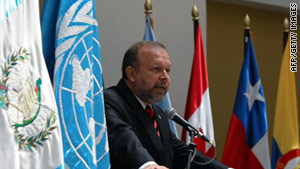
Francisco DallAnese discusses the work of International Commission Against Impunity In Guatemala.  Photo courtesy of CNN.
Francisco Dall'Anese discusses the work of International Commission Against Impunity In Guatemala. Photo courtesy of CNN.

After Guatemalan authorities were unable to capture Vielmann, Spanish authorities arrested him on the basis of a Guatemalan warrant.  40 days later, authorities were forced to release him because of lack of an extradition request.

In 2006, 7 inmates were killed at El Pavon prison immediately preceding a raid where authorities were thought to have discovered corruption among inmates.  Authorities later discover that top officials and prison personnel were involved in illegal and illicit activities including drug trafficking and prostitution.  Guatemalan authorities are also seeking his arrest in connection with the killing of 3 escaped inmates located at El Infiernito prison in 2005.

The UN backed group, International Commission Against Impunity in Guatemala, spearheaded the effort to bring down the former Interior Minister after discovering his involvement.  New photographic evidence shows Vielmann standing next to prison officials the day of the uprising.  Further photographic evidence shows that some prisoners were redressed and moved after being executed.

A report by the Guatemalan Human rights Ombudsman’s Office and new physical evidence tracks the fate of various inmates.  One inmate was shown shot to death with no bullet holes in his clothing, suggesting that he was shot while naked and redressed to cover the execution. 

“There are no super-citizens that are above the law,” says Francisco Dall’Anese, head of the International Commission Against Impunity in Guatemala.  Vielmann was arraigned Thursday after turning himself into authorities, charged with murder, crimes against humanity and released on $132,000 bail.    

For more information, please visit:

CNN – Fugitive Guatemalan Official Re-arrested – 17 December 2010

CNN – Photos Provide Evidence In Guatemalan Killings Case, Officials Say – 15 December 2010

CNN – Spain Re-arrests Ex-Guatemalan Minister – 16 December 2010

According To Justice Minister, Chilean Prison Conditions “Subhuman”

By Patrick Vanderpool
Impunity Watch Reporter, South America

Recent fire at a Chilean prison kills 81 prisoners (photo courtesy of http://morrisonworldnews.com)
A recent fire at a Chilean prison which killed 81 prisoners (photo courtesy of http://morrisonworldnews.com)

SANTIAGO, Chile – Monday, Justice Minister Felipe Bulnes called the overcrowding of Chilean prisons, which lead to the deadliest prison fire in the country’s history, “subhuman.”  Overcrowding in penitentiaries was officially recognized as a primary cause of last Wednesday’s fire that burned part of the capital’s San Miguel Prison and killed 81 prisoners.

The San Miguel Prison currently houses approximately 1,900 people, double its intended capacity.  This overcrowding can be seen in almost every jail in Chile.  Chile’s prison population totals approximately 54,000 people; however, it’s  infrastructure only has the capacity for 34,000 people.

Bulnes was quoted on a Chilean television network as saying, “of course we need more jails, because it would allow us to separate and rehabilitate. With rates of overcrowding like this, conditions are subhuman, an indignity.”  He also admitted the need to purge the Gendarmeria, the Chilean prison service, in response to accusations by inmates’ families that guards regularly accept bribes to bring drugs, cell phones and other prohibited items into the prisons.

Jaime Pincheira, the prison warden Calama, a city in Northern Chile, has denied reports that 500 inmates began a hunger strike Sunday in solidarity with the families of the San Miguel victims.  Pincheira told local reporters that only 200 of the prisoners there are fasting, some 40 percent of the prison population.

In a report on prison conditions last year, Supreme Court attorney Monica Maldonado found that some prisons have potable water only a couple of hours a day, a hundred prisoners share one usually infested toilet and the population in some jails easily doubles their capacity.

President Sebastian Pinera has responded to the recent criticisms and deaths by announcing a $460 million plan to improve conditions for Chile’s prisoners. The plan includes purchasing prefabricated modular prisons for minimum-security inmates to help reduce overcrowding in the country’s prisons.

The courts are currently investigating claims that prison police in San Miguel waited an hour before calling the fire department while 81 inmates suffered burns and smoke inhalation.

For more information, please see:

Global Post – The Story Behind Chile’s Prison Fire – 15 December 2010

Latin American Herald Tribune – Chilean Official: Prison Inmates “in Subhuman Conditions” – 13 December 2010

Associated Press – New unrest at Chile prison where 81 inmates died – 11 December 2010