Game Killing of Afghan Civilians by U.S. Soldiers

David L. Chaplin II
Impunity Watch, Asia

KANDAHARAfghanistan – Andrew Holmes is one of five soldiers accused of killing Afghans for sport. They’re also accused of mutilating corpses and keeping grisly souvenirs as troops allegedly covered up the deaths of their victims. Holmes’ lawyer denies the charges and says he will fight them vigorously.
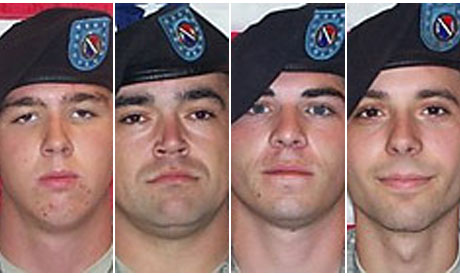
Five U.S. soldiers from the 5th Stryker Brigade accused of killing
Four of five U.S. soldiers from the 5th Stryker Brigade accused of killing

Pfc. Andrew Holmes of Boise, Idaho, faces military officials Monday who will determine if there is enough evidence to court martial him over the premeditated killing of three Afghan civilians.

Afghan President Hamid Karzai was briefed about the Army’s investigation into a “rogue” Stryker platoon in southern Afghanistan while the soldiers were deployed there earlier this year, an Army investigator testified yesterday.

Camero, testifying by phone Monday morning at an Article 32 hearing for Pfc. Andrew Holmes, said that the Army was careful to contain information about the investigation because it didn’t want to inflame the Afghan populace’s sentiment against U.S. soldiers.

“We didn’t want the public to know,” he said.

As one of five U.S. soldiers from the 5th Stryker Brigade accused of killing for sport and staging the deaths to look like legitimate war casualties, Holmes will face an Article 32 hearing at Joint Base Lewis-McChord in Washington.  Spc. Jeremy Morlock was the first of the five to face an Article 32 hearing.

12 U.S. soldiers have been charged in what they called a conspiracy to murder Afghan civilians and cover it up; along with charges they mutilated corpses and kept grisly souvenirs.

Five of the soldiers face murder charges, while seven others are charged with participating in a cover-up.

According to the military documents, the five were also involved in throwing grenades at civilians.

His civilian lawyer, Dan Conway, said his client did not kill any civilian and was ordered by his supervisor, Gibbs, to keep a human finger.

“There is no proof that … Holmes caused or conspired to cause the death of any human being unlawfully,” Conway said.

The Army refuses to comment on any aspect of any of the cases and has sought to limit circulation of evidence, especially since videotaped interrogations of some of the soldiers and alleged written confessions by some soldiers were leaked.

Holmes’ attorney said he plans to put on a vigorous defense of his client, arguing that he killed no one.

“The only way these kinds of allegations can occur is the command is completely derelict in supervising, meaning there involved or there are ignoring that this kind of conduct may be occurring,” Conway said. “And I don’t know which one it is at this point.”

Holmes’ attorney, Dan Conway, pressed Camero, who was part of a team that went to the scene of a related May killing, to gather evidence about the investigation to highlight the Army’s lack of physical evidence from the January incident in which Holmes was involved.

Camero said the decision to visit crime scenes rested with higher-ranking officers who were aware that the location of the January incident was in hostile territory.

For more information, please see:

CNN – Soldier accused of Afghan sport killings faces hearing – 15 November 2010

The News Tribune – Stryker murder scandal details shared  with top level of Afghan Government – 15 November 2010

Boise Weekly – War: More  Testimony in the Holmes Case – 15 November 2010

EU Accuses Seven In Kosovo Organ Trafficking

By Christina Berger
Impunity Watch Reporter, Europe


PRISTINA, Kosovo
— Seven people have been accused of participating in an international organ-trafficking ring by European Union officials. The seven people, including doctors and a former Health Ministry official, have allegedly trafficked kidneys and other organs from impoverished people through a clinic on the outskirts of Pristina.

According to the AP, EU prosecutor Jonathan Ratel said in the indictment that an “organized criminal group” had trafficked persons into Kosovo for the purpose of removing “human organs for transplant to other persons”. Ratel is part of the EU’s rule of law mission, which handles serious crime in Kosovo.

The victims, who mostly came from impoverished areas of Turkey, Russia, Moldova, and Kazakhstan, were promised up to €14,500 ($20,000) for their organs. The organs were then sold to patients around the globe, from Israel to Canada, for between €80,000 and €100,000 ($110,000 and $137,000).

The organ-trafficking ring was first discovered two years ago, but it took time for investigators to learn the extent of the network. EU officials have recently made requests for evidence from Canada, Germany, Kazakhstan, and Turkey.

EU officials allege that the leader of the organ-trafficking ring is Dr. Lutfi Dervishi, who is a prominent surgeon and professor at Pristina University Hospital. His son, Arban Dervishi, ran the clinic. According to prosecutors, Lufti Dervishi recruited a Turkish doctor, Yusuf Sonmez, to perform organ transplants after Dervishi attended a medical conference in Istanbul. Moshe Harel, an Israeli citizen, allegedly identified, recruited, and transported the victims, as well as managed the cash payments before the surgeries. Along with those four, Illir Rrecaj, a former senior Health Ministry official, and two other doctors were also indicted.

The seven people were charged with counts of trafficking in persons, unlawful exercise of medical activity, and abuse of power. They were all released on bail and are not currently in custody.

Allegations have been made in the past that during the war dating back to 1999, the Kosovo Liberation Army kidnapped and killed Serb civilians for organ harvesting. These claims have been investigated, but never proven.


For more information, please see:

NYT — Seven Charged in Kosovo Organ-Trafficking Ring — 15 November 2010

AP — EU in Kosovo probes organ trafficking — 15 November 2010

BBC — Kosovo medics accused of trafficking kidneys — 12 November 2010

AP — EU prosecutor: 7 suspected of organ trafficking — 11 November 2010

Colombia’s High Court Blocks Suit To Legalize Same-Sex Marriage

By Patrick Vanderpool
Impunity Watch Reporter, South America

Colombians show their support for gay rights (photo courtesy of www.queerty.com)

 BOGOTA, Colombia – Colombia’s high court ruled against a lawsuit which would have legalized same-sex marriage in the country by a vote of 5-4.

The lawsuit, which was filed in September 2009, sought to alter the definition in Colombia’s civil code which defines marriage as “a solemn contract through which a man and a woman unite.” 

Felipe Montoya, one of the lawyers who filed the suit, wanted judges to eliminate the phrase “man and woman” from the code, in order to open up the possibility of a same-sex marriage.  The court ruled that the lawsuit was “flawed” and presented in an “irregular manner.”  

Judge Mauricio Gonzalez Cuervo, president of Colombia’s Constitutional Court, said that “nothing is final, and it is possible to insist on civil marriage for same sex couples in front of the court, but with more detailed arguments because this article will play a vital role within Colombia’s constitution.”

The lesbian, gay, bisexual and transgender (LGBT) community is rallying against the Court’s decision, calling it “unconstitutional” and vowing to seek legislation to ensure equality if the Court fails them.  Marcela Sanchez, director of Colombia Diversa, a Colombian organization which represents the interests of the LGBT community, asserts that, as a result of the Court’s actions, “[Colombia] will lose a unique opportunity to achieve a true concept of equality.”

In addition to Colombia Diversa’s criticisms, gay rights advocates in Colombia planned to protest the Court’s ruling on Friday with demonstrations in Colombia’s capital.

In July, Argentina became the first Latin American country to legalize same-sex marriage after legislators passed a bill giving same-sex couples equal marriage rights.  While the attorney’s likely viewed Argentina’s actions as a broader, more progressive attitude toward the issue, Colombia’s Constitutional Court did not sway from their traditional view.

For more information, please see:

CNN – Colombia gay rights groups protest after court’s gay marriage decision – 12 November 2010

Colombia Reports – Court Blocks Gay Marriage – 12 November 2010

Queerty.com – Did Colombia’s Constitutional Court Turn Down The Gay Marriage Lawsuit Because It Was Too Weak? – 12 November 2010

Poor Conditions Lead to Third Prison Riot in One Week

By R. Renee Yaworsky
Impunity Watch Reporter, South America

Brazils prisons are alarmingly overcrowded. (Photo courtesy of LAHT)
Brazil's prisons are alarmingly overcrowded. (Photo courtesy of LAHT)

IRANDUBA, Brazil—On Sunday, a riot in a jail became the third prison riot in a week in Brazil.  The latest riot resulted in three deaths and has sparked debate over possible human rights violations in the nation’s correctional facilities.

The most recent riot occurred in the jail of a police station in Iranduba, a city in the Amazon.  The prisoners became violent in the early hours Sunday in order to protest the poor living conditions they were subjected to.  The protesters were eventually subdued by police officers, but in the wake of the incident, three prisoners were found dead.  It is unknown how many others were wounded, and whether the deceased were killed by rioters or authorities when they moved in to regain control of the facility.

Brazil’s prisons and jails are frequently overcrowded and can lead prisoners to riot and go on organized hunger strikes.  Sunday’s violence arose after the jail became packed with 40 prisoners.  The jail was designed to hold only eight.
Police officer Geraldo Pereira de Oliveira said that, “After the riot, there were negotiations and the possibility of transferring some prisoners is being studied.”

Sunday’s deadly protest is the third of its kind this week alone in Brazil.  On Wednesday, three prisoners were killed by other prisoners in a similar riot, just 19 miles from Iranduba.  Last Monday, 18 prisoners—four of whom were decapitated–died in a riot in the penitentiary complex in Sao Luis.  A correctional officer was also injured by a gunshot wound.  The riot began when prisoners shot the guard while he was conducting an inspection, then took him and five other guards hostage.  The prisoners announced that they were protesting substandard quality of life in the institution.  The prison is currently inhabited by 4,000 prisoners—double the number that the building was constructed to hold.

In each of the three riots, experts and authorities have determined that overcrowding and unsatisfactory living conditions were the primary impetus for the melee.  In Brazilian prisons, gangs vie for control, their violence unchecked by an inadequate number of correctional officers.

For more information, please see:

Latin American Herald Tribune-Third Brazil Prison Riot in a Week Leaves 3 Dead-15 November 2010

Sydney Morning Herald-Three dead in Brazil jail riot-15 November 2010

Telegraph-Brazil prison riot leaves 18 inmates dead-9 November 2010

Lashing and Deportation Punishment for Having Sex in UAE

By Eric C. Sigmund
Impunity Watch Reporter, Middle East

ABU DHABI, United Arab Emirates – The Sharjah Sharia Court in the UAE today sentenced two foreign workers to 100 lashings and deportation for having “unlawful sex.”  This incendiary ruling comes after two immigrant workers, one Filipino and one Bangladeshi, were found to have had sex out of wedlock, a crime under Sharia law.  In addition to deportation and other physical punishments, the Bangladeshi national may also be imprisoned for up to a year for committing adultery. 

Reports indicated that the Filipino worker, a housemaid, invited her boyfriend over to her sponsor’s house on numerous occasions while the family was away in order to have sex.  The two were caught after the housemaid’s sponsor saw the worker’s boyfriend sneaking out of the house.  Both workers are said to have admitted to having sex while the sponsor family was away.

Under Sharia law in the UAE, Muslim immigrants who commit adultery are lashed and deported while non-Muslims immigrants are imprisoned and then deported.  According to reports, both workers are Muslims, however, both may be subject to an additional prison sentence.  Having sex out of wedlock is illegal in the UAE.   Kissing in public is also illegal under Sharia law.

The UAE has come under fire recently for a slew of court rulings sentencing foreign workers to a variety of inhumane and disproportionate punishments for various “illegal” acts.  In August, the UPI documented 8 cases of excessive punishments.  These cases are only illustrative and account for only a portion of the harsh rulings imposed against foreigners in the UAE.  The government in Abu Dhabi has yet to comment on the result of this latest case.  However, for those countries which embrace Sharia law, today’s ruling is simply business as usual.

For more information please see:

ABC News – Couple to be Lashed for Sex Out of Wedlock – 15 Nov. 2010

Emirates 24/7 – 100 Lashes Each for Illicit Lovers – 15 Nov. 2010

UPI – Illicit Couple Sentenced to Lashing in UAE – 15 Nov. 2010

UPI – Continued Cultural Clashes in Dubai, Abu Dhabi – 12 Aug. 2010