Dec. 5th, 2017
Welcome to our weekly summary of Syria Deeply’s top coverage of crisis in Syria.
As part of our Deeply Talks series, Syria Deeply will host a live call next week, examining the recent flurry of diplomatic discussions aimed at setting the stage for a settlement to the nearly seven-year conflict. Keep an eye on your inbox this week for the invitation.
Peace talks: The eighth round of peace talks opened in Geneva last Tuesday, and by Friday, the Syrian government delegation had quit, saying they would not return without a change in the opposition’s stance toward President Bashar al-Assad.
Chief government negotiator Bashar al-Jaafari said there would be “no progress” as long as the opposition did not reverse its call for the removal of Assad before the start of a political transition. The opposition High Negotiation Committee (HNC) adopted this position two weeks ago during their own talks in Saudi Arabia, where they had hoped to form a stronger, more unified front before heading to Geneva.
In a televised interview with the pro-government al-Mayadeen TV, Jaafari later said the government would not engage seriously in peace talks if the statement was not revoked, and said the decision on whether or not to resume negotiations this week was in Damascus’ hands.
The previous day, U.N. special envoy Staffan de Mistura told reporters that negotiations could run until December 15.
Israel strikes Syria: Israel again threatened Syria over Iran’s presence in the country, saying it would not tolerate Iran-backed forces along its border.
Israel fired missiles toward Damascus on Saturday, reportedly targeting a military site near the capital, according to CNN. Syria’s air defense system intercepted two Israeli surface-to-surface missiles but others caused material damage to the military position, according to state-run SANA news agency.
The UK-based Syrian Observatory for Human Rights said the missiles targeted an arms depot near al-Kiswa town south of Damascus, according to the Syrian Observatory for Human Rights. It was not immediately clear whether the Syrian army, Lebanese Hezbollah or other Iran-backed forces operated the warehouse.
“Let me reiterate Israel’s policy,” Israeli prime minister Benjamin Netanyahu said at the Saban Forum, an annual gathering of American and Israeli leaders in Washington hosted by the Brookings Institution.
“We will not allow that regime [Iran] to entrench itself militarily in Syria, as it seeks to do, for the express purpose of eradicating our state.”
Damascus suburbs: Despite being a so-called de-escalation zone, the Eastern Ghouta area in the Damascus suburbs has been under heavy bombardment for more than 20 days. At least 192 people, including 43 children, 21 women and four members of the Civil Defense, have been killed since November 14, according to the Syrian Observatory for Human Rights.
“There has been massive loss of life – hundreds and hundreds have been wounded,” special United Nations humanitarian adviser for Syria, Jan Egeland, said, describing the situation as a “catastrophe.”
“In general, there is no calm in this de-escalation zone. There is only escalation in this de-escalation zone,” Egeland said.
Amnesty International claimed the Syrian government used Soviet-made cluster munitions – which 100 countries have banned – in the Eastern Ghouta, killing at least 10 civilians since November 14.
What’s more, a crippling siege has left as many as 400,000 people trapped in the rebel-held area without access to health and basic living necessities.
Read our Daily Executive Summaries
MOST POPULAR
This Week’s Top Articles
GOVERNMENT & PRO-GOVERNMENT FORCES
A War Within a War: Chechnya’s Expanding Role in Syria
Over the past year, Chechnya significantly expanded its role and foothold in Syria, including funding the reconstruction of major Syrian mosques and deploying highly trained Chechen military forces to some of the toughest front lines.
Opposition Media Activists Face Uncertain Future
The war in Syria significantly increased the number of so-called opposition media activists who documented alleged human rights abuses and war crimes. But as pro-government forces regain control of rebel-held territory, they fear for their future.
Escaping Europe: Why Some Syrian Refugees Have Chosen to Leave
The route from Turkey to Greece was once crowded with Syrian asylum seekers fleeing to Europe. But in recent months some refugees have begun to move in the opposite direction because of what they describe as a rise in anti-Muslim sentiment in host countries.
EDITOR’S PICKS
Community Insight
Ten Experts to Watch on Reconstruction in Syria
Mel Plant, Freelance Journalist Currently
From infrastructure and urban planning to funding and democratic dialogue, in this next installment of our “Experts to Watch” series we highlight 10 experts who focus on the different aspects of reconstruction in Syria.
GOVERNMENT & PRO-GOVERNMENT FORCES
The Troubling Triumvirate Ruling Over Aleppo
Khaled Al-Khateb, Journalist and Former lecturer, University of Aleppo
Almost one year after rebels retreated from Aleppo, the northern Syrian city is now at the mercy of security services, pro-government militias and the Baath party, who are doing little to improve living conditions, writes Syrian journalist Khaled Al-Khateb.
Analysis: No Funds to Foot Syria’s Reconstruction Bill
Mia Bennett, Journalist, Specializes in Covering Syrian Economic Affairs
Although the drive to reconstruct Syria has gained momentum in recent months, the government does not have the funds or strategy to lead the recovery process, writes Syrian journalist Jihad Yazigi.
FIRST LOOK
Upcoming coverage
For our readers in New York, please join us December 6 for News Deeply’s event Advancing Civilian Protection: Human Rights in Times of Upheaval or share this with friends and colleagues in the area.


You Might Be Able To Get Away With Murder In Part Of Yellowstone National Park
By: Sarah Louise Purtill
Impunity Watch Reporter, North America
YELLOWSTONE PARK, U.S. – There is a little known fact about Yellowstone National Park that has captured the interest of many people around the country. Michigan State University law Professor, Brian Kalt, published a paper called “The Perfect Crime” which details how you can potentially get away with murder in a 50 square mile section of Yellowstone National Park in Idaho. Kalt writes that he has always wondered how there was a “forgotten constitutional provision, combined with an obscure statute, that together make it possible for people in the known to commit crimes with impunity.”
Kalt calls it the “zone of death.” It is created by a legal loophole. Before Montana, Wyoming and Idaho became states, Yellowstone National Park was founded in 1872. Although the majority of the park sits in Montana, there are portions that lie in both Idaho and Wyoming. As a national park, Yellowstone falls under federal jurisdiction. Kalt points out that the District Court which hears the issues in Yellowstone National Park sits in Wyoming. This is true despite the fact that Yellowstone also has land in those two other states. Thus, unlike any other District Court in the United States, the District of Wyoming includes land of other states. The zone of death is the 50 square miles of Yellowstone National Park that sits in Idaho.

If someone commits a murder in that section, they are automatically tried in Wyoming. However, the Constitution states that trials should be held in the state where the crime was committed. So, someone may demand the trial be held Idaho. Once there, a local jury would be called to serve on the case. But there is no one who lives in that 50 square mile section of Yellowstone in Idaho. Because that section is federal land, no one is allowed to live there. Unless the murder approves of the trial being held in Wyoming, the trial cannot be held at all.
“The courts may or may not agree that my loophole exists, and in any case this Essay is not intended to inspire anyone to go out and commit crimes,” Kalt concludes. “Crime is bad, after all – but so is violating the Constitution. If the loophole described in this Essay does exist it should be closed, not ignored. In sum, when Congress set up this park and admitted these three states, it made a mistake,” Kalt writes.
“Congress can be forgiven on the park side because Yellowstone was the world’s first national park, and there was no precedent.” He then adds that “But Congress should have known how to set up states, having done it forty times before.”
Kalt argues that there is a solid chance they could get away with murder using your Constitutional rights, but there are still other ways you could be punished.
“If the government could not prosecute you, your victims and their families could sue you. Of course, if they get wind of your Constitutional argument before you leave the scene of the crime, they could just give you a dose of your own medicine, administering vigilante justice with similar impunity.”
Currently, no changes have been made regarding this “loophole” for murder in Yellowstone National Park.
For more information, please see:
Forbes – ICYMI: You Can Get Away With Murder In Part Of Yellowstone National Park – 26 November 2017
Fox News – The Best Place to Commit a Crime in America? Yellowstone National Park – 22 November 2016
Vox – Yellowstone has a 50 Square Mile “Zone of Death” Where You Can Get Away With Murder – 29 October 2016
Vice – There’s a Section of Yellowstone Where You Can Get Away With Murder – 4 August 2016
Brazilians protest proposal for total abortion ban
By: Emily Green
Impunity Watch Reporter, South America
RIO DE JANEIRO, Brazil– On Monday November 13, thousands of women flooded the streets of Brazil in protest of a congressional vote to ban abortion. If enacted, the constitutional amendment would prohibit abortion under any circumstances.

Protestors carried their children along with them as they shouted, “our bodies are ours!” The march reached the Rio state legislature and scuffles with authorities developed. The Police were forced to fire tear gas to settle the crowd.
Right now, Brazil’ criminal code allows abortion for pregnancies that result from rape, as well as pregnancies that endanger the mother’s life. Also, many women have been allowed to abort anencephalic fetuses. Courts found it was traumatic to make women give birth to infants that would certainly die from birth defects after delivery.
Brazil’s Chamber of Deputies, made up of all men, voted 18-1 in favor of this constitutional amendment to further restrict abortions. The only female congresswoman to vote, Erika Kokay, gave the only ‘nay’. If enacted, this amendment would ban all abortions in Brazil and remove any exceptions, including those for victims of rape. Congressman Tadeu Mudalen, in favor of the ban, asserts that “life starts at the moment of conception and therefore should be protected by law.”
However, the victory in this special committee is not binding. Since it is a constitutional amendment, it needs a super-majority in both Congress’ lower house and the Senate to become law. Rodrigo Maia, speaker of the Chamber of Deputies, assures that any ban on abortion without exception for rape won’t pass his chamber.
In Brazil, hundreds of women have died from unsafe abortion in the last few years. Women and girls who do not wish to continue their pregnancies will be forced to continue them against their will or will resort to terminating them clandestinely. Even if the pregnancy threatens their health or results from rape, the law allows no exception. These illegal abortions are dangerous and could lead to prison sentences of up to three years.
Maira Kubik Mano, a Ph.D from the University of Bahia says that “if this bill passes, it will most affect poor, black Brazilian women, as they can’t afford to be treated in clandestine abortion clinics.” The typical profile of women who seek abortions are those who haven’t studied further than high school and have limited access to birth control and sex education. Even with the current restrictive law, wealthy women are the only ones who have access to safe procedures in private clinics.
This demonstration in Rio is just one of several going on in other Brazilian cities. Women carry signs reading “Secular uterus” and “I don’t deserve to bear the child of my rapist.”
For more information, please see:
ABC News – Thousands protest proposal for total abortion ban in Brazil – 13 November 2017
Human Rights Watch – Will Brazil’s Congress Turn Its Back on Women and Girls? – 10 November 2017
Telesur – Brazilian Women Prepare to Protest Full Abortion Ban – 10 November 2017
Vietnamese Student Sentenced to Jail for Anti-government Post
By: Katherine Hewitt
Impunity Watch Reporter, Asia
HANOI, Vietnam – On 25 October 2017, Vietnamese student, Phan Kim Khanh went to trial for spreading propaganda against the Vietnamese government under article 88 of their penal code. He was arrested in March 2017. While his trial only lasted half day, he will be serving 6 years in jail followed by 4 years probation.

Khanh owns two blogs titled “Vietnam Weekly” and “Newspaper of Anti-Corruption.” He also manages several social media accounts and a YouTube channel. The main purpose of these was to expose corruption not to spread propaganda. He pleaded that he didn’t realize that was a crime. Human Rights Watch reported that the Vietnamese Government vaguely interprets many of the countries security provisions to target critics.
The evidence provided in court against Khanh was vague and groundless. The Court accused him specifically of promoting multiparty democracy and press freedom.
Kahn is a well-distinguished university student with multiple honors from both his university’s student association and the Ho Chi Minh Communist Youth League of the Thai Hanoi section. He is also a member of the Young Southeast Asian Leaders Initiative.
This is not the first ‘crackdown’ of dissent in Vietnam. More than 100 people are in jail for freedom of expressions violations. The only crimes that Phan Kim Khanh and the other committed were expressing a political opinion that differed from the government of Vietnam. Human Rights Watch Asia Director says that these claims of propaganda are just “ designed to silence peaceful critics of the Vietnamese authorities.”
For more information, please see:
The Washington Post – Vietnam jails student activist for anti-state propaganda – 25 October 2017
Human Rights Watch – Vietnam: Drop Charge Against Student Activist – 24 October 2017
U.S. Stops Funding for Demining in Cambodia
By: Katherine Hewitt
Impunity Watch Reporter, Asia
PHNOM PENH, Cambodia – Years after the Vietnam War, Cambodia remains littered with mines. Cambodia is ranked as one of the highest countries with unexploded ordnances. Approximately 2 Cambodians die or are injured every week from encountering hidden mines. A large portion is of U.S. origin.
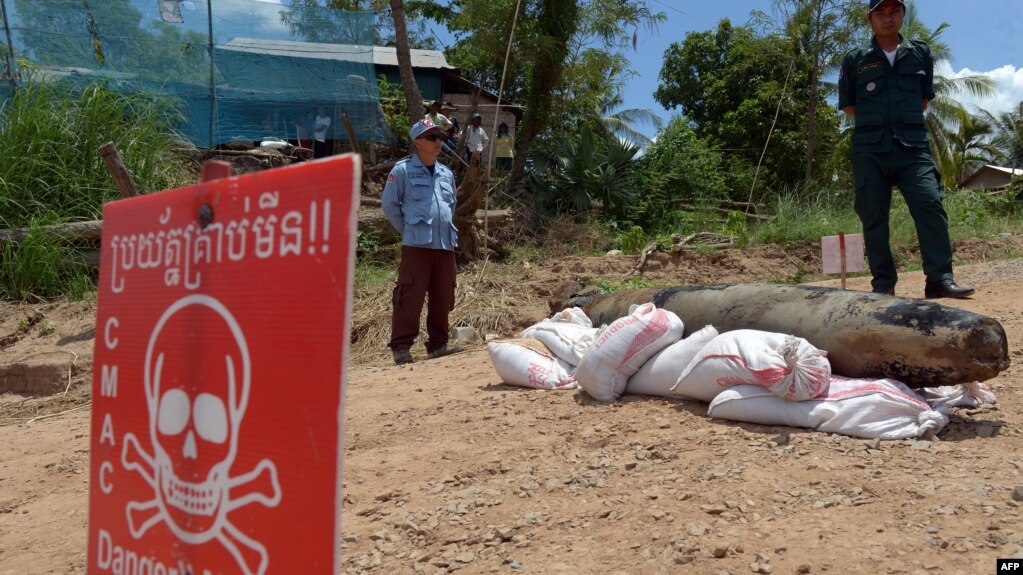
However, on 7 November 2017 the United States announced that it will be cutting $2 million in grant money to Cambodian Mine Action Center (CMAC). This will go into affect next year. For the moment this years efforts will not be affected. No reason was given for why the funding was recalled.
The Director General of CMAC was not aware of any dispute between them or the U.S. Government in how matters were being handled. Even during meetings held in July and early fall with the State Department over the 2018 budget, there were no mentions of cuts. The Director general finds this decision rather disappointing as the U.S. has “a moral obligation and goodwill obligation because they dropped a lot of bombs on the Cambodian people.”
Finding new donors in time to fund next year’s work shall be tricky as this was a last minute decision. The Cambodian Government does not appear to be concerned about the cut in funding for de-mining processes. Hun Sen, the current Prime Minister pledges to support CMAC’s efforts.
This lack of funding will have a huge impact on the work that CMAC does. Up to 300 mine clearing employees could have their jobs impacted. Additionally, this will affect the number of mines that CMAC can reach next year. Which means that less people can be taken out of the way of danger in their day-to-day life. A second issue is that farmland will continue to be rendered useless because of the presence of mines. This means that farmers are limited in the crop size they produce for market. More than 80% of Cambodians rely in this land for their survival.
For more information, please see:
Voice of America – US Demining Cut Provokes Cambodia – 7 November 2017