Matthew Sneed Impunity Watch Reporter, The Middle East
CAIRO, Egypt – A court in Cairo sentenced sixteen men to jail because of their identification as gay. Each received a three-year sentence for being found guilty of “inciting debauchery” and “abnormal sexual relations.” Fourteen of the convictions were handed down on November 26, with two more following on the next day.
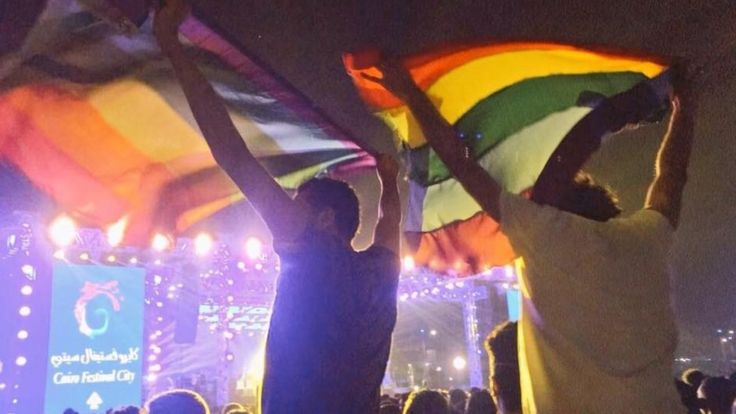
Egypt began a cracking down on LGBT activities following the waving of the rainbow flag at a concert in September. Photo courtesy of Rainbow Egypt
Al-Ahram, a newspaper owned by the Egyptian government, reported that police raided an apartment in Cairo in September. At the apartment, they found the men in “indecent positions” and alleged that the men were engaging in prostitution with other men. “The defendants denied being homosexuals,” reported the paper. The prosecution ordered that the suspects be subjected to medical examinations to determine if they had committed homosexual acts.
The arrests have been part of an increased crackdown on the LGBT community in Egypt following an incident where a rainbow flag was waived during a concert in Cairo. The Egyptian Initiative for Personal Rights (EIPR) stated that at least seventy-five people have been arrested since the rainbow flag was raised on September 22. Of those arrests, ten are believed to be in connection to raising the flag while the rest stem from entrapment through dating apps. In addition, it was reported that at least 5 men received anal examinations.
While homosexuality is not a crime under Egyptian law, officials have used the 1961 prostitution law to charge people they believe engaged in homosexual activities. However, the Egyptian Parliament had proposed a bill that would make same-sex activity illegal. For the first time in the history of the nation, it would define “homosexuality.” Promoting or engaging in same-sex activities could lead to five years in prison and a combination of charges could result in a sentence of up to fifteen years. In addition, the publication of LBGT-friendly material would warrant a three-year sentence.
The U.S. State Department has expressed concerns regarding the actions of the Egyptian Government. One official stated, “We urge countries to uphold and respect their international human rights obligations and commitments,” said the official. “The United States will continue to engage on issues of universal human rights and democracy.”
On November 1, House Minority Leader Nancy Pelosi (D-Calif.) “urged Egyptian House of Representatives Speaker Ali Abdel Aal Sayyed Ahmed to publicly condemn the criminalization bill and the broader anti-LGBT crackdown.”
By: Emily Green Impunity Watch Reporter, South America
CARACAS, Venezuela – Violence in Venezuela has reached startling levels. While the country struggles with economic turmoil and political instability, violent crime continues to increase.
Soldiers stand on an armored vehicle in Venezuela. Image Courtesy of Ricardo Mazalan.
In the five-month period between May and September 2017, there were 520 cases of children and adolescents orphaned by violence in the nation’s capital. It is reported that every day, four children lose one of their parents due to acts of violence in Caracas. The Victim’s Monitor project registry is consistently collecting information on homicides there. Its goal is to characterize crimes, identify patterns of violence and their consequences, and then use them to create public policies to reduce homicides. The “Instinto de Vida” (“Instinct for Life”) is Venezuela’s homicide reduction campaign.
Also during those five months, 755 people died violently in Caracas. Of those, 280 were parents. As a result, women and children are suffering in these violent municipalities. In many cases, it is the breadwinner of the family that is killed and leaves his family in even worse economic conditions. Many children are forced to leave school to find the resources to survive, often during to petty drug trafficking or prostitution.
Additionally, the prolonged grief is hurting society. One psychologist, Manuel Llorens, asserted that murder is more difficult to deal with than natural or accidental deaths, and that it “produces a mixture of pain, anger, impotence and resentment.” He also says that due to the psychosocial consequences, “the social fabric is broken, and spaces for coexistence and consensual solutions for common problems are reduced.”
For the families that do survive, Venezuela’s culture fosters a significant problem with violence against women. The issue is so common that Venezuela has implemented projects to raise awareness about the reality of violence against women. They encourage people to recognize it as a violation of human rights. Statistics show that the abuse of women extends to psychological violence as well as physical.
However, violence is not limited to civilians. Even soldiers have been ordered to avoid traveling at night and refrain from revealing their military IDs. A “radiogram” sent by Venezuela’s military was discovered that reflects concern over soldiers’ safety. In one of the most violent countries in the world, military personnel attract thieves rather than scaring them away.
One retired general, Antonio Rivero, confirmed, “This is a totally contradictory situation. The document admits that not even security officials, who should be armed … are safe in Venezuela.” It is estimated that 282 police, soldiers, guards, and other security personnel have been killed this year. In an effort to keep them safe, soldiers are ordered to avoid places of “dubious reputation,” avoid nighttime risks, and refrain from using cellphones while stopped at traffic lights.
MOSCOW, Russia – FIFA’s anti-discrimination advisers are warning LGBTQ soccer fans that displays of affection at next year’s World Cup games could be met with violence.
In Sochi, Protests Against Russia’s “Gay Propaganda” Law Took Place at the Winter Olympic Games in 2014. Photo Courtesy of Tatyana Makeyeva.
Fare, an anti-discrimination organization that campaigns for equality in soccer, is partnering with FIFA to control fan behavior at the World Cup games next year.
Hate crimes against LBGTQ people in Russia have doubled since the country instituted a law banning “gay propaganda” in 2013. The law has thwarted gay pride marches and allowed gay rights activists to be detained. It is also believed to have incentivized and condoned violence against LGBTQ people.
Similar concerns were raised at the 2014 Winter Olympics Games in Sochi following the enactment of the “gay propaganda” law.
The legislation was deemed illegal by Europe’s top human rights court in June, but Russia says it will not honor the ruling.
“(Offenders) have become more aggressive and less fearful,” said Svetlana Zakharova, a Russian LGBT Network Board Member. “It seems to them that, to some extent, the government supports their actions. Many perpetrators openly talk about their crimes as noble deeds.”
Researchers say that the number of hate crimes that has occurred in the country in recent years is likely to be much higher than documented, as many crimes go unreported or are not investigated or prosecuted.
Homosexuality was decriminalized in Russia in 1993 but remained classified as a mental illness until 1999. Russia was ranked the second least-LGBT friendly nation in Europe, behind Azerbaijan, in 2016.
For the first time in FIFA’s 113 year history, the organization has added a human rights element to its statute.
“If there are any cases of abuse, or even possibility of human rights defenders or journalists being forced into a difficult corner, then according to our statutes and human rights policy FIFA will intervene,” said Federico Addiechi, Head of Sustainability and Diversity at FIFA.
FIFA and Fare will have crowd-monitors at the games. They will be on the lookout for displays of racism, political extremism and homophobia. Matches will be stopped or abandoned if such displays occur and persist.
Fare plans to administer cautionary guides to fans traveling to the tournament. The guides will include information about the current LGBTQ situation in Russia and will advise people to use caution when traveling in areas not considered to be welcoming to the LGBTQ community.
By: Katherine Hewitt Impunity Watch Reporter, Asia
Phnom Penh – The Cambodian Center for Human Rights (CCHR) is a leading human rights organization in Cambodia. It was created in 2002 by Kem Sokha to promote International Human Rights Law and to provide free legal aid to victims. Kem Sokha is also the leader of the opposition party and was recently jailed by the Prime Minister.
On 26 November 2017, Prime Minister Hun Sen called for the Center for Human Rights to be closed down. He accused foreigners of creating the center to push their agendas. He went further to accuse the CCHR of taking orders from foreigners. Sen said that if the CCHR had been created by a person of the Khmer nationality there would be no issue with the organization.
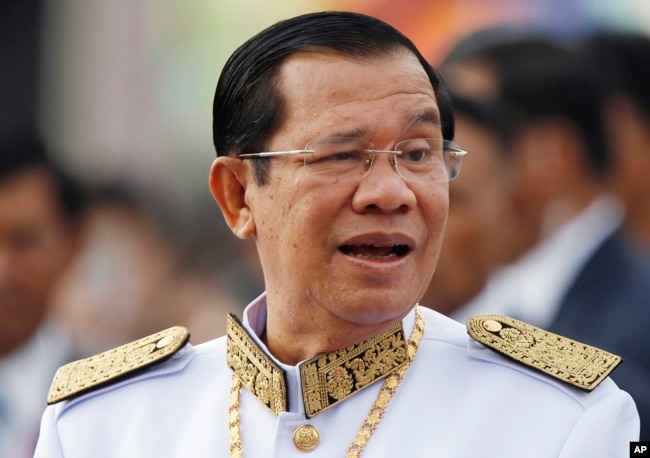
Prime Minister Hun Sen. Photo Courtesy of Samrang Pring.
The Center for Human Rights believes that this is just a stunt pulled by Prime Minister Hun Sen to hold onto power; however, acts like this just draw criticism from the Cambodian people. The director also feels that citizens do not believe the accusations as many people are in favor of the Western political alignment.
The Director put out an official statement that read: “CCHR calls upon the Royal Government of Cambodia to enter into a meaningful dialogue with CCHR representatives in relation to these allegations, in the firm belief that any misperceptions about the nature of CCHR’s work and neutrality could be clarified, and the matter resolved.”
The CCHR indicated that any neutral and impartial investigation would find no evidence of wrong actions.
By: Karina Johnson
Impunity Watch Reporter, North America
WASHINGTON D.C. — On Friday, November 10, the Wall Street Journal published an article stating that Retired Lt. Gen. Michael T. Flynn was allegedly involved in a plan to kidnap a US-resident Turkish dissident on behalf of the Turkish government in exchange for approximately $15 million dollars.
Retired Lt. General Michael Flynn served as national security advisor to the Trump administration for only 24 days before he was asked to resign. Photo Courtesy of Carolyn Kaster, Associated Press.
Fethullah Gulen, a Muslim cleric who has resided in Pennsylvania since 1999, has been blamed by Turkish government officials for the failed coup against Turkish President Erdogan’s administration in summer of 2016. Turkey has requested Gulen’s extradition under the US-Turkey extradition treaty for Mr. Gulen’s alleged role in the coup, but the Department of Justice has so far denied the requests.
Flynn’s company, Flynn Intel Group, was hired in August 2016 by a firm with ties to Turkish government officials to investigate Mr. Gulen and to present the results of the investigation in a short film. While the film project was never completed, Flynn’s company received $530,000 in November, and Flynn himself wrote an opinion piece about Fethullah Gulen published on November 8, 2016, in The Hill.
In a mid-December meeting at the “21” Club in New York, Turkish officials allegedly offered Michael Flynn and his son, Michael Flynn Jr. approximately $15 million dollars to assist in the forcible removal and “extra-legal” extradition of Gulen to Turkey. The alleged plan included discussions of transporting Gulen by private jet to Imrali, a Turkish prison island. This meeting occurred after the Trump administration had named Flynn the next national security advisor.
President Trump asked for Flynn’s resignation as his national security advisor in mid-February 2017, twenty-four days after Flynn’s appointment. Flynn also served for two months in 2014 as the head of the Defense Intelligence Agency before being dismissed by President Obama for insubordination after “failing to follow guidance from superiors.”
Flynn registered as a foreign agent under the Foreign Agent Registration Act (FARA) on March 7, 2017, several weeks after his resignation as national security advisor. Lawfare posits that at the time of his dealings with Turkish officials, Michael Flynn was no longer simply a private citizen lobbying in favor of a foreign government, and whose disclosure of dealings to the Department of Justice would comply with FARA. Since Flynn had already been tapped to serve as national security advisor in the Trump administration, he was a public official “in transition,” and public officials are prohibited from acting as foreign agents under 18 U.S.C. § 219.
Not only was General Flynn an unregistered foreign agent during his dealings with Turkish officials, he received well over the $5,000 maximum for lobbyists, and if the allegations in the Wall Street Journal article are true, Flynn may be charged with conspiracy to kidnap. Even if Flynn intended to instead use his position as national security advisor to return Mr. Gulen to Turkey by legal means, the fact that he was possibly offered $15 million dollars to do so may still constitute egregious felonious conduct. Lawfare states the matter plainly: “It’s no more legal to take $15 million to use your influence as national security adviser to bring about an outcome than it is to kidnap someone.”
The New York Times notes that President Trump’s firing in March 2017 of Former FBI Director James Comey after Comey’s refusal to halt the investigations into Flynn led to the appointment of special counsel Robert Mueller. Robert Mueller has, in turn, led the investigation as to whether associates of President Trump colluded with Russian agents in their efforts to manipulate the 2016 US presidential election.
According to The Wall Street Journal, Flynn’s lawyers earlier had entered into a joint defense agreement with President Trump’s legal team that allowed them to share information surrounding Mr. Mueller’s investigation that would otherwise be subject to attorney-client privilege. As of November 24, Michael Flynn’s lawyers stopped cooperating with White House attorneys defending the President in special counsel Robert Mueller’s investigation.
Flynn’s decision to end cooperation with the White House attorneys may signify that Flynn has entered into plea deal discussions with Mr. Muller’s team, which recently indicted Paul Manafort, Rick Gates, and George Papadopoulos—all three former campaign aides of President Trump.
JustSecurity has compiled a timeline of the Trump administration’s knowledge of the federal investigations into the relationship of Michael Flynn and Turkey.