Report cites hundreds of rapes on Congo-Angola border

By Polly Johnson
Impunity Watch Reporter, Africa

Security forces raped as many as 700 women and girls along the Congo-Angola border (Photo Courtesy of Al Jazeera).

CONGO – Almost seven hundred women and girls were raped along the Congo-Angola border during a mass expulsion of some seven thousand Congolese from Angola in October, according to a recently released United Nations report.

The report was released by the United Nations Children’s Fund (UNICEF) and said that 6,621 people arrived in two territories of Luiza and Tshikapa/Kamonia, in Western Kasi province.

Many of the victims said that they were locked in dungeon-like conditions for several weeks and raped repeatedly.

Separately, doctors conducted examinations of 35 women in the Congolese town of Tembo last week, confirming that they had been raped and left without clothes in the bush along the border.

The reports come after the wave of mass rapes that occurred in eastern Congo between July 30 and August 3 by rebel militiamen.

“What worries us is that rape seems to be becoming endemic in several parts of Congo.  We fear it’s becoming part of the routine,” said U.N. spokesman Maurizio Giuliano said, referring to the recent rapes that occurred in the eastern Kivu province.

U.N. officials call Congo the worst place in the world for sexual violence.  Despite the presence of U.N. peacekeepers, more than 200 women were raped in a single thatched-roof village in eastern Congo a few months ago.

This is not the first time the countries have expelled each other’s citizens. Last year, Angola expelled 160,000 Congolese, while Congo expelled 51,000 Angolans.  Relations have deteriorated between the countries, due in part to offshore oil ownership, Angola’s diamond exports, and closer Congolese relations with Rwanda and Uganda.

Lambert Mende, the DRC information minister, said that the no reports of rape have been reported to authorities.

“We’re not informed. We don’t know, these figures are not confirmed,” Mende said. “There are expulsions, perhaps there are rapes but we have received no complaints and we don’t want to launch a dossier.”

For more information, please see:

Al Jazeera – UN: Mass rapes on Angola-DRC border – 6 November 2010

AP – UN: 700 sexual attacks seen on Congo-Angola border – 6 November 2010

CNN – UNICEF reports sexual violence in the Congo region – 6 November 2010

New York Times – Hundreds Were Raped on Congo-Angola Border – 6 November 2010

Reuters Africa – Hundreds abused during Angola expulsions, U.N. says – 6 November 2010

Uruguay’s High Court Declares Amnesty Law Unconstitutional

By Patrick Vanderpool
Impunity Watch Reporter, South America

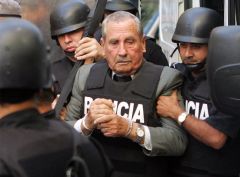
Former Uruguayan Military General Gregorio Alvarez Being Arrested ho his Involvement in Killings UnderJuan Maria Bordaberrys Dictatorship (Photo courtesy of Merco Press)
Former Uruguayan Military General Gregorio Alvarez Being Arrested for his Involvement in Killings UnderJuan Maria Bordaberry's Dictatorship (Photo courtesy of Merco Press)

MONTEVIDEO, Uruguay – Uruguay’s high court recently declared a law providing amnesty for human rights violations committed during the 1973-1985 dictatorship unconstitutional.

The Court’s decision coincides with controversial Congressional efforts to overturn the law, which protects former military and law enforcement officials from prosecution as a result of rights abuses.

The issue most recently came to public attention in the case of Juan Maria Bordaberry, a former “strongman” who is said to be responsible for 20 deaths.  Bordaberry ruled as democratically elected president from 1972 to 1973 and as dictator from 1973 to 1976, but was later sentenced to 30 years in prison for violating the constitution and another 30 years for the extrajudicial killings of 14 people who went missing during his rule.

The court’s decision comes amidst heated legislative debate between the governing center-left regime and the opposition.  The government sent Congress a bill to rescind the Ley de Caducidad (Expiry Law), even though the amnesty was upheld in referendums in 1989 and 2009.

The Expiry Law requires both the executive branch and the Supreme Court to authorize each judicial investigation launched into alleged crimes committed by security force members during the military regime.  The Supreme Court’s ruling on Monday allows an investigation into a case in which Bordaberry was accused by different human rights groups of responsibility for the deaths of 20 people.

The ruling party has justified the new bill, now before the Senate after its approval in the lower house, on the basis of a previous Supreme Court decision from October 2009.  The 2009 ruling marked the first time Uruguay’s highest tribunal had taken a stand against the amnesty law. The case was brought by a veteran human rights activist seeking justice for Communist Party activist Nibia Sabalsagaray, killed in 1974 by government agents.

Proponents of the bill want Uruguayan courts to consider all international human rights conventions signed by the country to be protected by the constitution, a step that would automatically invalidate the Expiry Law.  Opponents of the proposed law, including former Presidents Julio Maria Sanguinetti and Jorge Batlle, say the bill is “an affront to citizens who have upheld the law” and “an attack on Uruguay’s institutions.”

For more information, please see:

Latin American Herald Tribune – Uruguay High Court Declares Amnesty Law Unconstitutional – 4 November 2010

Americas Quarterly – Uruguayan Amnesty Law Unconstitutional – 3 November 2010

Washington Post – Uruguay’s High Court Annuls Dictatorship’s Amnesty – 1 November 2010

UK Military Accused of Abusing Iraqi Detainees

By Christina Berger
Impunity Watch Reporter, Europe

LONDON, England — A lawyer representing more than 200 Iraqi civilians told the high court in London on Friday that the Iraqis suffered systematic mistreatment and torture by British soldiers in a secret prison near Basra. The lawyer called this “Britain’s Abu Ghraib.” These allegations come not longer after secret UK military training aids advocating abuse and even torture were leaked to a newspaper.

Michael Fordham, a lawyer for the former detainees, told the court that the abuse of detainees began when British forces first entered Iraq in March 2003 until they withdrew from Iraq in 2009. According to the New York Times, Fordham claimed the former detainees had experienced “beatings, starvation, sleep deprivation, electric shocks, prolonged periods of nakedness and sexual humiliation by female soldiers, sensory deprivation through the enforced use of hoods, earmuffs and blackened goggles, and exposure to pornographic DVDs.”

The solicitors representing the former detainees submitted video footage which they say substantiate the allegations. The interrogators themselves filmed over 1,200 videos, and 13 of them were submitted to the panel of three High Court judges.

One of the videos, which can be viewed on the Guardian’s website, shows two interrogators screaming obscenities at a detainee. The interrogators ignore the man when he says he has not been allowed to sleep, and that he has not had food or drink in two days. One of the interrogators threatens the man with execution. The lawyers for the detainees claim that the man was beaten severely after he was led away from the camera, as evidenced by the muffled sounds at the end of the video.

The hearing before the high court is expected to last three days, at which time the court will have to decide whether or not to overrule two successive British governments, as well as military commanders, who have previously refused to initiate a public inquiry. Opponents of an inquiry have claimed that past reports of abuse of detainees were individual incidents, the result of a few bad apples as opposed to systemic, command-approved abuse.

Phil Shiner, a lawyer for the former detainees, believes that it’s “nonsense” to claim it’s a case of a few bad apples. He also asserts that people at the highest level of government knew what was going on, and only a public inquiry will shed light on the truth of the matter.

“We want accountability, reparations and an apology,” Mr. Shiner said. “There are lessons that have to be learned.”


For more information, please see:

BBC — Iraqi civilians systematically abused, court hears — 5 November 2010

NYT — British Troops Accused of Abusing Iraqi Detainees — 5 November 2010

GUARDIAN — Iraqi prisoners were abused at ‘UK’s Abu Ghraib’, court hears — 5 November 2010

Ex-President Uribe Subpoenaed

By R. Renee Yaworsky
Impunity Watch Reporter, South America

Uribe will testify against Drummond.  (Photo courtesy of Colombia Reports)
Uribe will testify against Drummond. (Photo courtesy of Colombia Reports)

BOGOTA, Colombia—Former president of Colombia, Alvaro Uribe, has been subpoenaed to testify in U.S. federal court against Drummond, an Alabama-based coal company.  It is claimed that Drummond helped right-wing paramilitaries in their activities, including the murders of at least 116 people.  It is believed that Uribe’s testimony will provide details about significant matters relevant to the civil case.

About 500 plaintiffs in the lawsuit allege that Drummond aided the Colombian Army and the United Defense Forces of Colombia (AUC paramilitaries) in their fight against left-wing guerrillas.  The plaintiffs are speaking out on behalf of numerous relatives whom they say were murdered by the AUC during the years 1999 to 2005.  They are demanding compensation from Drummond for the harm done by this violence.

Terry Collingsworth, the plaintiffs’ attorney, said Uribe will be questioned about the connection between his Army at the time and the AUC, including what knowledge Uribe’s government had about Drummond’s operations.

Plaintiffs claim that Uribe “has direct knowledge of a number of key cases, including until what point the armed forces supported the paramilitary protection of mining properties of Drummond.”  Collingsworth added that one of Uribe’s aides was also working for Drummond during the time period of interest.  Uribe “knows the levels of cooperation between the armed forces and the AUC, specifically in regions like Cesar where Drummond was active,” the lawyer explained.

Drummond’s alleged cooperation with paramilitaries is not the only instance of its kind.  Three years ago, Chiquita, a banana company, said they paid $1.7 million to guerilla fighters; in 2001, Coca-Cola was accused of similar connections.

Uribe was president of Colombia from 2002 to 2010.  He is expected to testify in Washington D.C. on November 22 of this year; however, Uribe has not announced whether he will actually show up for the hearing.  The former president is now employed by Georgetown University in Washington D.C. teaching classes.

For more information, please see:

Miami Herald-Colombia’s ex-leader Alvaro Uribe subpoenaed in U.S. federal court-5 November 2010

Inside Costa Rica-Colombian’s Former President Uribe Summoned to Testify on Killings-5 November 2010

Colombia Reports-Uribe ordered to testify in Drummond case-4 November 2010

Government forces behind Missing Sri Lankan Bishops??

David L. Chaplin II
Impunity Watch; Asia

COLOMBO, Sri Lanka – The Roman Catholic priests of Sri Lanka have been vocal and resilient to the government forces since the country’s civil war that recently ended. As a result of their diligence as leaders of their land, several bishops have gone missing after reported conversations with government officials.

One of six Catholic priests held in detention by the government of Sri Lanka

In the past four years at least two Roman Catholic priests have gone missing after reporting the government troops brutality against the last Tamil offensive, the church says.

The archbishop of Colombo, Malcolm Ranjith, who is soon to become a cardinal, said that attempts were being made to change the demographic make-up of northern and eastern Sri Lanka, which currently have an ethnic Tamil majority.

“This could be a dangerous trend if it is not arrested; unless people are allowed to move in and move out in a proper way without any colonization as such, with or without government approval.”

Kingsley Swampillai, the bishop of Trincomalee and Batticaloa, said one of the priests disappeared after security forces conducted special questioning on him.

Recently Bishop Swampillai along with several of the diocese in the region testified before a commission looking into the governments function and handling of the country’s civil war.

The civil war, which ended just last year, when troops defeated a rebel group called the Tamil Tiger, who raised wide spread tensions over the fight for a separate state.

The conflict, according to the United Nations estimates that up to 100,000 people were killed. And similar numbers disappeared as infighting came to a halt.

The government’s response to the whereabouts of missing priests is that, the commission will promote reconciliation and they have rejected all international calls for an external investigation.

Bishop Swampillai, who heads the main diocese in eastern Sri Lanka, told the commission there were numerous missing and disappeared Sri Lankans whose fate had been unknown for many years now.

The government has not recorded any of the missing cases over recent years.

A timeline and snapshot of the missing bishops include- Rev Father Nihal Jim Brown, who vanished in Jaffna in 2006; and another, Father Joseph Francis, in his late 70s and had “got involved with” the Tamil Tiger militants while living in their heartland.

Bishop Swampillai said Father Francis was among those leaving the war zone in May 2009 and passing through the military checkpoint at Omanthai when people travelling with him saw him taken in for special questioning.

“And then he was no more – nobody saw him thereafter,” the bishop said.

Former wife of a Tamil Tiger official, testifying at the commission hearings in northern Sri Lanka six weeks ago mentioned that Father Francis had vanished.

Most bishops have remained highly critical of the security forces, and more so with the recent trend of events.

“The rights have been violated with impunity by the security forces and by unidentifiable persons and groups especially in the north and east. The situation has worsened by the state sponsorship of paramilitary groups during the height of the war, out of the former militants.”

For more information, please see:

BBC – Sri Lanka bishop accuses forces over missing priests – 4 November 2010

Journalist for Democracy in Sri Lanka – Sri Lanka bishop accuses forces over missing priests – 4 November 2010

CathNews Asia – Lankan bishop accuses sercurity forces – 4 November 2010