1.3 Million Votes Corrupted in Afghan Elections

David L. Chaplin II
Impunity Watch, Asia

In what was a pivotal test for Afghanistan’s inexperienced democracy spell business as usual. Recent evidence of fraud has presented the questionably elected President Karzai with a stained reputation.
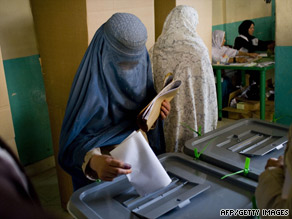
Turnout was 40% amid widespread fraud and voter intimidation

After the devastating announcement on Monday that the Afghanistan’s Independent Election Commission released of ballot-box stuffing and bribery have tainted the vote.

Meanwhile, the UN-backed Afghan Electoral Complaints Commission is investigating more than 4,000 formal complaints.

Since then 1.3 million votes of the total of 5.6 million ballots have been cancelled out because of fraud.  That means about 23 percent of the total votes were tossed out, the election commission said Wednesday.

Afghan President Hamid Karzai pledged to cut corruption and increase transparency after he was re-elected in August 2009 election that was later deemed fraudulent by the United Nations and other vote-monitoring organizations.

More than 220 candidates are being investigated for fraud in the election, turnout for which was around 40%.

More than 2,500 candidates stood for 249 seats in the lower house of parliament, the Wolesi Jirga. Sixty-eight seats have been set aside for women.

The current parliament is stacked with former warlords and power brokers, and many of the candidates in September’s election have ties to Afghanistan’s old elite.

Final results are not expected before the end of the month once poll investigators finish their work.

“Turnout is around 5,600,000, the valid vote is 4,265,347, and the invalid vote is around 1, 300, 000,” Fazil Ahmad Manawi, head of the Independent Election Commission (IEC), said on Wednesday.

Deputy chief of election commission, Zekria Barikzai, cautioned that the number of votes thrown out was similar to the votes thrown out in the presidential election which cast Karzai the victor.  “In parliamentary election some of the powerful local people tried to influence the process,” Barikzai said.

Paul Wood, BBC News, said despite the throwing out of 1.3 million votes, there will probably be no rush by the international community to condemn the election.

Ultimately, the poll’s measure of success will be how it affects the stability of the country. There was widespread intimidation during the vote, with Taliban insurgents threatening people not to take part.

Many observers had hoped that the parliamentary elections would show the Afghan government’s commitment to reforming its corrupt bureaucracy.

“These elections will do little to alter Afghanistan’s system of patronage politics, and will certainly not alter the balance of power,” a Western official, speaking on condition of anonymity, said.

The official said the parliamentary poll represented “politics as usual, just as corrupt and just as violent as last year”.

It is an outcome that NATO and the international community can live with and so these elections will no doubt be judged a success, said Wood.

Afghanistan lacks political parties and parliamentary blocs form according to ethnic or geographical alliances.

Despite weak parties, powerful patronage networks, and entrenched corruption, the Wolesi Jirga (lower house of parliament) acts as a check on the power of President Hamid Karzai.

For more information, please see:

Al Jazeera English –Afghan officials cancel 1.3m votes – 20 October 2010

BBC – Afghanistan rules 1.3m paralimentary votes are invalid – 20 October 2010

CNN World – More than 20 percent of vote thrown out in Afghan election – 20 October 2010

Media Freedom Suffers in Tajikistan

By Eric C. Sigmund
Impunity Watch Reporter, Middle East

DUSHANBE, Tajikistan – The Organization for Security and Cooperation in Europe (OSCE), Europe’s primary human rights body criticized the government of Tajikistan on Monday for its mistreatment of independent media in the country.  OSCE representatives announced that the government has failed to comply with its media freedom commitments by “blocking websites, preventing newspapers from printing and launching tax or prosecutorial inspections” against media providers. 

In a statement to the Tajik government, the OSCE urged the government to re-open foreign and internet media sources.  At least three major regional news websites have been shut down since September 29th.  Internet providers were ordered to block certain websites after the Tajik government issued a directive demanding that restrictions be imposed on those media providers which the government deemed to contribute to unrest in the country.  The Tajik government is currently conducting an intense counter-terrorism offensive against Islamic militants in the country.  One internet provided commented “[w]e are trying to objectively report on the unrest in the east but clearly some officials do not like this. “

The OSCE further noted that government pressure has also resulted in the censor of printing houses, several of which have been forced to stop printing independent newspapers.  Although these organizations report that technical failures are to blame for their decision to stop printing certain papers, the OSCE remains unconvinced and believes that the government used threats of tax inspections to coerce printing houses into submission. 

Representatives from the OSCE stressed the importance of free and open media and encouraged the government to “reverse the ongoing deterioration of the media freedom situation in Tajikistan.”  Tajik authorities however, have denied any wrongdoing and argued that national legislation does not prevent the regulation of internet media.  “As for newspaper” stated a government representative “no newspapers were shut down, while the suspension of some of them is due to purely technical problems.”  Despite international pressure, the government remains unpersuaded by the OSCE’s concerns and may take additional steps to censure and regulate media as it continues its fight against militant forces in Tajikistan.    

For more information, please see:

Moscow Times – Tajiks Urged to Stop Attacks on Free Media – 20 Oct. 2010

Radio Free Europe / Radio Liberty – OSCE Warns Media Pluralism in Tajikistan in Danger – 18 Oct. 2010

Reuters Africa – OSCE Urges Tajikistan to Stop Attacks on Free Media – 18 Oct. 2010

Agence France Presse – Tajikistan Blocks Internet sites Amid Unrest – 11 Oct. 2010

Tibetan students protest Language policy by government


Tibetan students marched against government policy to use Chinese language in class (Photo courtesy of Free Tibet)

By Joseph Juhn
Impunity Watch Report, Asia

BEIJING, China – More than 1,000 Tibetan students marched to protest against unconfirmed government policies to mandate the exclusive use of Chinese language in classes.

The peaceful rally took place in and around Tongren, known as Rebkong in Tibetan, where it has recently witnessed widespread anti-government rioting in the spring of 2008. At the time, scores were arrested and a crackdown waged against Buddhist monasteries, capturing the world’s attention before the Summer Olympics in Beijing that year.

Some monks were to be seen amongst protestors on Tuesday, who, alongside students, shouted “equality of ethnic groups” and “freedom of language,” according to the International Campaign for Tibet. Free Tibet, the London based campaign group, and U.S.-funded broadcaster Radio Free Asia estimated the total number of participants at anywhere from 1,000 to 7,000.

Students from half a dozen schools gathered and marched together, chanting slogans against unconfirmed plans to supplant the use of Tibetans.

One of the teachers who also participated in the march said police did not intervene and students were not penalized by school administrators for partaking in the march.

“The students marched peacefully. Their only demand was for continued use of their mother tongue,” he said.

Although ethnic “Han” Chinese consists of more than 95 percent of Chinese population, there are currently 55 ethnic minority groups officially recognized by the government. Tibetans are one of them. Language, among other things, has been an emotional and complicated issue in Tibetan and other ethnic minority areas under Chinese rule.

While the government defends these policies by saying they aim to spur economic growth in the largely poor areas and better integration, many Tibetans fear the development of their areas and the migration of majority Han Chinese to them could destroy their traditional culture and ethnic identity.

The town’s schools use Mandarin and Tibetan alongside each other, and many teachers said there has not been official orders to switch entirely to Chinese. However, they said there are rumors and unconfirmed reports of a planned change in policy, which authorities never clarified.

“The Chinese are enforcing reforms which remind me of the Cultural Revolution,” another teacher said.

“This reform is not only a threat to our mother tongue, but is in direct violation of the Chinese constitution, which is meant to protect our rights.”

For more information, please see:

The New York Times – China: Tibetan Students March To Protest Education Policies – 21 October 2010

BBC News – Tibetan students in China protest over language policy – 20 October 2010

Kansas City – Tibetan students protest use of Chinese in classes – 20 October 2010

Arrested Rwandan war crimes leader may face rape charges

By Polly Johnson
Impunity Watch Reporter, Africa

Callixte Mbarushimana was arrested last week in Paris and may face rape charges in addition to the charges for war crimes and crimes against humanity. (Photo Courtesy of Human Rights Watch).

PARIS, France – Bringing sixteen years of impunity to an end, Rwandan war criminal Callixte Mbarushimana was arrested last week in Paris and has been charged with war crimes and crimes against humanity. Alleged to have directed more than ten thousand rapes in Kivu in 2009, the International Criminal Court (ICC) prosecutors are seeking to add rape to the list of charges.

His arrest came after the ICC issued a sealed arrest warrant in late September and with the help of French authorities. He faces five counts of crimes against humanity (murder, torture, rape, inhumane acts and persecution) and six counts of war crimes (attacks against the civilian population, destruction of property, murder, torture, rape and inhumane treatment).

Mbarushimana, 47, was a key player in the Democratic Forces for the Liberation of Rwanda (FDLR) and had been living in Paris as the leader-in-exile of the Rwandan Hutu rebel group.

His arrest followed the arrests of FDLR president Ignace Murwanashyaka and his deputy Straton Musoni late last year in Germany. Both are detained and awaiting trial.

The FDLR was established by former guerrillas accused of genocide in the 1994 ethnic slaughter in Rwanda. The group moved to the Democratic Republic of Congo (DRC) and initiated attacks on Rwanda aimed at ousting the government.

Along with the Mai-Mai militia, the FDLR was responsible for the wave of mass rapes that took place in the Walikale region of DRC in late July and early August. A prominent leader of the Mai-Mai militia group was arrested earlier this month for his role in those rapes.

“The arrest of Callixte Mbarushimana sends a strong signal to abusive commanders in Congo and elsewhere that the ICC is at work investigating their crimes and that they will not go unpunished,” said Anneke Van Woudenberg, a senior researcher at Human Rights Watch, in an e-mail to Bloomberg News.

In August, Mbarushimana issued a statement from Paris, where he has been living openly despite being on a United Nations sanctions list, denying that the FDLR was involved in the commission of the wave of mass rapes.

ICC prosecutor Luis Moreno-Ocampo said that one of Mbarushimana’s roles was to “cover up the crimes.”

No date has been set for Mbarushimana to be transferred to The Hague. But his arrest is a significant step.

Moreno-Ocampo called the arrest “a crucial step in efforts to prosecute the massive sexual crimes” that have taken place in the DRC, where more than fifteen thousand cases of sexual violence were reported in 2009 alone.

For more information, please see:

Radio Netherlands – End of the FDLR in Europe? – 20 October 2010

AFP – Rwandan war crimes suspect may face Congo rape counts – 19 October 2010

Independent – Rwandan rebel leader Callixte Mbarushimana is charged – 12 October 2010

World Affairs Blog Network – A Win Against Impunity: Callixte Mbarushimana Arrested in Paris – 12 October 2010

Bloomberg – Congo War Crime Suspect Callixte Mbarushimana Arrested in Paris, ICC Says – 11 October 2010

Kurdish Defendants Denied Rights at Trial

By Eric C. Sigmund
Impunity Watch Reporter, Middle East

ANKARA, Turkey – Kurdish-Turkish relations have grown tense since Monday’s court decision to prohibit Kurdish suspects the ability to respond to prosecutor’s questions in their native language during trial. The ruling comes after a plea by 150 Kurdish detainees currently standing trial for their alleged links to a guerilla terrorist organization within Turkey, to defend themselves in Kurdish.  The suspects asked the court to allow them to respond to questions in Kurdish as an expression of their identity.  The court refused their request fearing such an allowance would grant rights not afforded Kurds in Turkey.

Hundreds of protestors come out to support Kurdish suspects (Photo courtesy of BBC News)

This decision highlights the social and political tensions underlying the Kurdish-Turkish relationship in the country.  Since 1984, Kurdish guerilla groups have killed tens of thousands of Turkish citizens as they seek autonomy from Turkey.  The Turkish government has been relatively successful in suppressing the guerilla fighters, strengthening its resolve to punish rebel fighters and supporters, as well as, the government’s methods of subordinating and managing the Kurdish population.

Responding to criticism stemming from Monday’s court decision, the government claimed that it has been working with the Kurdish minority to grant them more cultural rights, such as the ability to broadcast Kurdish television programs.  The government however, has been hesitant to engage in meaningful dialogue with the Kurdish population over a wider range of social rights.  In particular, the government continues to reject demands by Kurds to include education in Kurdish in state schools.  The government has defended these moves by claiming that such an expansion of rights and liberties could divide the country along ethnic lines. 

Gultan Kisanak, deputy head of the Peace and Democracy Party noted the importance of this trial, stating“[t]his trial will tell us a lot about whether this country wants to improve its democracy and whether it has any intention to solve the Kurdish problem through peaceful means.”   A senior Kurdish rebel commander threatened to end the most recent cease-fire agreement with the government at the end of the month if the government does not take steps to bolster Kurdish rights.  The commander, Murat Karayilan, told a British newspaper that “[w]e will wait another 15 days.  If something positive develops, we will extend the unilateral case-fire.  If there are no concrete steps, we will evaluate developments and do what we have to do to defend ourselves.”

Although there have been a number of skirmishes between Kurdish and Turkish forces since the August cease-fire, there is a growing concern that a resumption of full armed conflict may be imminent.  Observers contend that the government is preparing an intensive campaign to eradicate Kurdish rebel forces throughout the country.  Mr. Karayilan acknowledges that such an initiative may be in the final planning stages but remains firm that “[i]f attacks are carried out, all the Kurdish people will be part of the defense strategy.”   15 days may now be the only thing that stands in the way of a brutal conflict in Turkey.

For more information, please see:

BBC News – Turkish Court Rejects Kurdish Hearing Plea – 19 Oct. 2010

Canadian Press – Turkish Court Refuses to Allow Kurdish Suspects to Defend Themselves in Kurdish Language – 19 Oct. 2010

The Independent – Kurdish Rebels Tell Turkey: Keep Your Promises or Cease-fire is Over – 19 Oct. 2010

Reuters – Turk Court Rejects to Use Kurdish in Trial – 19 Oct. 2010