Suspected Terrorist Financier Arrested in Nigeria

By Daniel M. Austin
Impunity Watch Reporter,  Africa
 

Car Bombing in Abuja, Nigeria on October 1. (Photo Courtesy of AP).
Car bombing in Abuja, Nigeria on October 1. (Photo Courtesy of AP).

ABUJA, Nigeria – On Saturday, October 16, Nigerian State Security Services (SSS) raided the home of Charles Okah, a suspected terrorist. He was taken into custody and is being investigated for allegedly funding terrorist activities. The Nigerian government believes that Okah financed the terrorist attacks that rocked the capital Abuja, on October 1.  The attacks, which occurred near a parade route, killed twelve people and injured dozens more. Okah was arrested in the Apapa district of Lagos, a city in the southern part of Nigeria, referred to as the Niger Delta.

Charles Okah is the brother of Henry Okah, a former commander of the Movement for the Emancipation of the Niger Delta (MEND), the dominant terrorist organization operating in the Niger Delta. Henry Okah is a suspected arms dealer who has supplied weapons to the insurgents operating in the Delta. Okah fled Nigeria for Johannesburg in July 2009 after his release from prison after serving time for gun running and treason charges.  He was arrested shortly after the attacks on Abuja and is facing terrorism charges in South Africa for masterminding the October 1 attack.

Charles Okah’s arrest comes a day after media outlets received an email announcing threats of another terrorist attack against the capital. The Nigerian government is extremely concerned because the October 1 bombing followed a similar pattern. On October 1, MEND militants warned journalists that Eagle Square in Abuja should be avoided. Within an hour of this warning, a series of bombs were detonated in Eagle Square.

Nigerian security officials believe Charles Okah sent the email warning about the attack on Eagle Square. The email was sent from a MEND Yahoo! email account and was signed by nom de guerre of Jomo Gbomo. It is believed that several militants associated with MEND sign their statements with this name including Henry and Charles Okah.

Nigeria is the most populous nation in Africa with substantial oil reserves, particularly in the Niger Delta. Nigeria is competing against Angola to be the largest oil exporter in Africa. Normally a peaceful nation, Nigeria has experienced a wave of tribal differences that have led to flashes of violence. It is believed that the violence orchestrated by MEND militants is attributed to their outrage over policies that allow the central government to collect billions of dollars in oil revenue while the Niger Delta remains impoverished.

For more information, please see:

Canadian Press — Security official: Brother of alleged militant leader arrested over Oct. 1 car bombings –- 17 October 2010.

IOL News.co.za — Another blast warning after court appearance –-17 October 2010.

Macon.com — Another blast warning after court appearance –- 17 October 2010.

Reuters Africa — Nigeria arrests Okah brother after bomb threat: source –- 17 October 2010.
WRONGLY DEPORTED U.S. CITIZEN BRINGS SUIT: DEPRIVED OF RIGHTS AND DUE PROCESS

By Erica Laster                                                                                                                       Impunity Watch Reporter, North America

ATLANTA, United States– The family of Mark Lyttle, a United States citizen of Puerto Rican descent born in North Carolina, brought suit in federal court alleging violations of his Constitutional rights to due process and equal protection.  In December of 2008, an immigration judge entered an order for Lyttle’s deportation after denying him the opportunity to present evidence or deny that he was Mexican.  Lyttle, who speaks no Spanish, was flown to Texas and set off on foot into Mexico where he was quickly picked up and arrested.

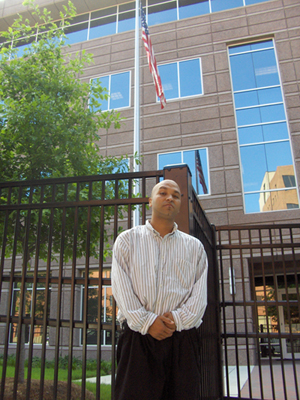
U.S. Citizen Mark Lyttle was wrongly deported, raising questions about procedural rights and due process.  Photo courtesy of the Huffington Post.
U.S. Citizen Mark Lyttle was wrongly deported, raising questions about procedural rights and due process. Photo courtesy of the Huffington Post.

While a patient at a mental facility, Lyttle inappropriately touched a halfway house staffer’s rear and was convicted of a misdemeanor for which he was serving prison time in Atlanta.   State prison officials involved immigration officials after questioning his citizenship status.  The suit claims that “Mr. Lyttle did not understand what he was signing or that he knowingly consented to being deported.”  Officials failed to assign Lyttle an advocate or attorney to represent him despite the fact that his illness and mental disabilities were well known and apparent to those coming in contact with him.

The Legal Director of the North Carolina division of the American Civil Liberties Union, Katy Parker, recently indicated that the lawsuit seeks damages and policy changes to prevent unfounded deportations of other American citizens.  Lyttle statements regarding his Social Security number and his birth place of Rowan County were ignored by officials.  After deportation, Lyttle was forced to wander in the streets for four months, spending his time in shelters or prisons in Mexico, Honduras, Nicaragua and Guatemala.  

Lyttle’s family was not informed that he was in immigration proceedings when they called regarding his release from state prison.  “It’s really scary how you can get on the slippery slope and there are not proper checks and balances, even if you are a U.S. citizen,” Parker was quoted as saying. “In this case, there’s just not adequate protection.”

Lyttle was able to reach the U.S. embassy in Guatemala where officials contacted his family and issued a passport after receiving his citizenship information.

For More Information Please Visit:

Washington Post – Lawsuit: Mentally ill US citizen wrongly deported 13 October 2010

Progressive Pulse – ACLU: Mentally ill man wrongly deported  14 October 2010

Star Tribune – Lawsuit: Mentally ill US Citizen Forced to Wander Central America After Wrongful Deportation 13 October 2010

Warning: Peruvian Pipeline Will Harm Indigenous Peoples

By Patrick Vanderpool
Impunity Watch Reporter, South America  

LIMA, Peru – Survival International, an organization supporting tribal peoples worldwide, has warned the United Nations that a massive oil pipeline set to be constructed in Northern Peru will be very harmful to indigenous peoples living in that area. 

In a letter from Survival International to the United Nation’s Special Rapporteur on the situation of human rights and fundamental freedoms of indigenous people, James Anaya, the organization claims that “permitting companies to operate in this region of Peru flagrantly violates international law.” 

 The letter exhorts the Special Rapporteur to initiate an immediate investigation and to urge Peru’s government to prohibit the companies from working in the area.  The human rights NGO believes that if work on the pipeline proceeds, “some of the world’s most vulnerable citizens could be wiped out.”

Independent from the environmental concerns, there are significant fears that outsiders who enter the Indians’ land to work on the pipeline may introduce new diseases into the indigenous peoples’ population that their bodies are not prepared to fight.  Perenco, a Peruvian gas company, has recently admitted to transporting 50,000 tons of material into this region, the equivalent of ‘seven Eiffel towers.

While the pipeline has not yet been approved by the Peruvian government, there are signs that the pipeline will be given the go-ahead.  Survival’s appeal to the UN comes as the Peruvian government attempts to expel a British environmentalist, Paul McAuley, for speaking out against environmental and human rights abuses in northern Peru.

Survival’s director, Stephen Corry, said, “[t]his is as serious as it gets for indigenous people anywhere in the world. Massive oil operations are planned which will destroy the rainforest and could decimate two tribes.”

The other companies interested in petroleum operations in that region are Spain’s Repsol-YPF and U.S.-based ConocoPhillips, which have applied to cut 282 miles of seismic lines in their bid to find oil.

For more information, please see:

Indymedia.org – UN Warned about Oil Pipeline in Peru – 15 October 2010

Latin American Herald Tribune – Group Says Peru Pipeline will Harm Indians – 15 October 2010

Domain-b.com – Survival International Warns US about Oil Pipeline in Peru -14 October 2010

Survival International – Letter to to the United Nation’s Special Rapporteur on the situation of human rights and fundamental freedoms of indigenous people – 14 October 2010

Opposition Aimed at 2,600 Ordained Boy Monks

David L. Chaplin II
Impunity Watch, Asia

COLOMBO, Sri Lanka – Child rights activists in Sri Lanka have criticized a plan by the prime minister ordain 2,600 boys as Buddhist monks by next May. Prime Minister Jayaratne says the move is designed to advance the ideology of Buddhism  and life the youth out of poverty.


Many Buddhist monks in Sri Lanka are usually ordained at a very young age. Not for nothing next May marks the 2,600th anniversary of Lord Buddha’s enlightenment.

Activists say are adamant over the number and age of the practice of ordaining monks at such a tender age. Reports have surfaced around child sexual abuse in the temples, thought these same accusations are vigorously denied by authorities.

Sri Lanka’s National Child Protection Authority (NCPA) has arrested scores of Buddhist monks for alleged sex abuse of boys in their care in recent years.

Just one monk was convicted on sex abuse charges. There have been numerous allegations of abuse from parents and children.

Mr. Jayaratne  says all the young monks will be looked after by the government

Mr. Jayaratne told BBC News the young monks would be helped financially and funded to go to university. The government also plans to provide financial assistance to their families, he said.

Child rights experts claim this fashion of recruitment steals the youth from young boy, in a country hoping to motivate its population; there are more viable options opponent’s challenges.

“I can’t fully compare it with Tamil Tigers’ child soldier recruitment, but there are some similar aspects”, Professor Harendra de Silva Child rights activist said.

They say children as young as 10 have a universal right to be with parents, siblings and friends until they reach the age of 18.

Dr. Hiranthi Wijemanne, an activist who is nominated by Sri Lanka to a United Nation child rights panel, said the leading Buddhist monks should show an example by opposing such schemes.

“I think it is our duty to oppose ordaining boys as it is a clear violation of children’s rights,” she said. She articulates that children from wealthy families are rarely ordained at such a young age.

Leading pediatrician, Harendra de Silva, urged the Sri Lankan authorities disallow the Buddhist temples to repeat “what happened in the Catholic Church”, with clear reference to the child sex abuse scandal that led Pope Benedict to offer a formal apology in recent news.

“I strongly condemn this crime against our children,” he said, adding that the government should improve the country’s economy rather than “allowing the children to be abused”.

No public discussion regarding child abuse, particularly in Buddhist temples, will be publicized as this topic is taboo in Sri Lanka, as it is in many conservative societies in South Asia.

The BBC sought, Children’s Affair Minister Tissa Karalliyadda for the government’s interpretation of the wide spread hesitation and fear the boys could be abused, but she was unavailable for questions.

For more information, please see:

BBC – Sri Lankan activists oppose plan to train boys as monks – 15 October 2010

UPI World News –Group slams enforced monk recruitment – 15 October 2010

Lankajournal –Sri Lankan activists oppose plan to train boys as monks – 15 October 2010

Greek Police Fire Tear Gas, Charge At Workers Protesting Unpaid Wages

By Christina Berger
Impunity Watch Reporter, Europe


ATHENS, Greece
– On Thursday, police in riot gear fired tear gas and charged culture ministry workers who had barricaded themselves within the gates at the Acropolis in protest over unpaid wages.

A court order was issued saying protesters were obstructing access to the iconic site, and the police arrived to remove the protesters.  The police sawed through the fence and sprayed journalists, who were there to cover the event, with pepper spray to clear them out of the way.  Images then show police chasing the workers around the monument, with some workers grabbing onto the fence to prevent their expulsion from the site.  The Acropolis did not open after the removal of the protesters because long-term workers went on strike in solidarity.

The protesting workers claim they are owed five million euros from unpaid salaries over the course of the last two years.  They were also protesting the imminent layoff of 320 culture ministry workers at the end of October, when their contracts expire.

According to the AFP, Telemachos Hytiris, Deputy Culture Minister, offered to speak with the protesters, but the prospect of permanent contracts are not guaranteed.  “Thousands of short-term workers have been laid off until now, the law applies to all,” he said.

The protest at the Acropolis is one of many other staged protests over the recent months due to the austerity measures the Greek government has enacted in order to reduce severe debt.  Greece barely managed to avoid national bankruptcy last spring, and the EU and IMF provided a rescue loan. As a result, they are monitoring the measures Greece is taking to reduce spending.

According to the AP, “authorities are particularly sensitive to protests at the Acropolis, which is seen as an emblem of ancient democracy, particularly as the country largely relies on tourism for revenue.”

George Petalotis, a government spokesman, said, “This is not just an issue of damage to Greek tourism, particularly under the current, difficult circumstances.  It is also an issue of respect for this outstanding monument.”

The protesters have said they felt they had no other choice than to protest at the historic site since the government has ignored a series of court rulings in their favor.  Ioanna Maraveli, a union representative, asked.  “If we are breaking the law by keeping the site closed, is it not also against the law for (the government) to leave us unpaid?”

For more information, please see:

AFP – Greek riot police break up Acropolis protest – 14 October 2010

AP – Riot police, protesters clash at Acropolis – 14 October 2010

BBC – Greek police storm Acropolis protesters – 14 October 2010