Update: Released U.S. hiker pleads to Iranian Government for release of other hikers

By Alyxandra Stanczak
Impunity Watch Reporter, Middle East

Ahmadinejad at the UN General Assembly. Photo courtesy of the New York Daily News.

NEW YORK, New York – On September 25th, Sarah Shourd met with Iranian President Ahmadinejad to plead for the release of two U.S. hikers being held in Iranian prison. Shourd, Shane Bauer and Josh Fattal were accused of spying when they were hiking in Iraq and accidentally crossed over into Iran. The three were arrested and have been detained at Tehran’s Evin prison since July 31, 2009. Shourd was released on 14 September because of a medical problem.

When Shourd met with Ahmadinejad, she stressed to him that their hiking group did not intend to cross the border from Iraq into Iran. The basis for her plea with the Iranian president is that Bauer and Fattal should be released on humanitarian grounds.  At this same time, Ahmadinejad has called on the  United States to release eight Iranian prisoners citing the release of Shourd as a good faith humanitarian gesture and hoping for reciprocation.

Shourd’s meeting with Ahmadinejad was possibly facilitated by Turkish Foreign Minister Ahmet Davutoğlu, who met with Shourd and the families of the other two detained hikers this past Thursday. Ahmadinejad was in the United States to speak in front of the United Nations General Assembly.

Shourd commented that the meeting with Ahmadinejad was “a very human encounter, very personal.”

For more information, please see:

Associated Press – Report: Oman talking to Iran on US prisoners – 26 September 2010

Al Jazeera – US ‘hiker’ pleads with Ahmadinejad – 25 September 2010

Today’s Zaman – Shourd, families of still-held hikers meet with Ahmadinejad – 25 September 2010
Brazilian Government Urged To Protect Indigenous Tribe

By Patrick Vanderpool
Impunity Watch Reporter, South America 

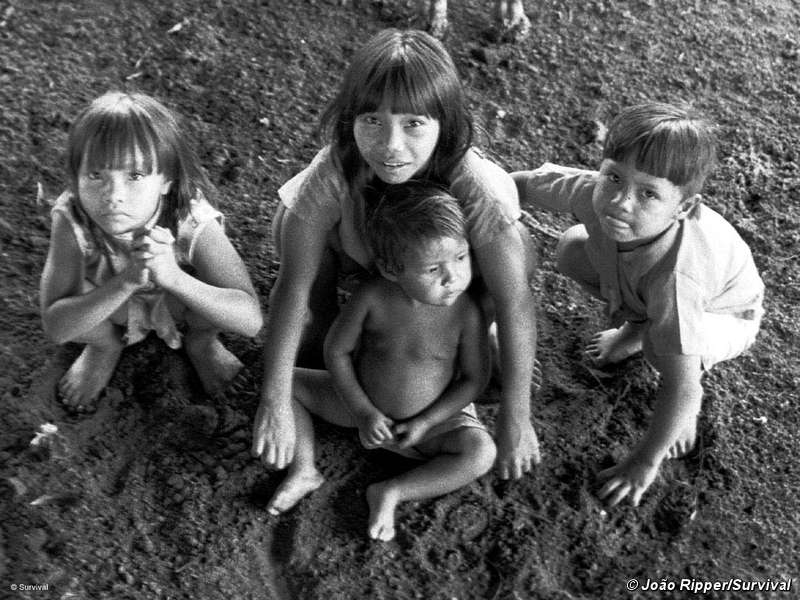
Guarani Children (Photo courtesy of survivalinternational.org)

RIO DE JANEIRO, Brazil – The Brazilian Government is being urged to get involved in a dispute between a group of Guarani Indians and armed gunmen in a clash over the indigenous peoples’ ancestral lands.

Local wealthy farmers and ranchers want the valuable land located in southern Brazil for farming.  They hired the gunmen to intimidate and threaten the indigenous peoples after the Indians returned to their ancestral land.

The hired gunmen have surrounded the lands for over a month, and have cut off the Indians’ access to food, water and health care.  Although the Guarani have pleaded for help, Brazilian authorities have yet to provide the Indians with assistance.  Officials from Brazil’s federal health ministry have reportedly refused to enter the lands citing “security problems.”

Exterior pressures are beginning to mount against the Brazilian government’s failure to act.  Survival,  an international organization that campaigns for the rights of indigenous tribal peoples, has written to the Brazilian authorities demanding immediate police action to lift the siege of the community. 

Survival’s Director, Stephen Corry, said, “[a]nyone unfamiliar with the Guarani’s appalling plight would be staggered that the authorities are prepared to stand by and watch a peaceful and defenseless community being held hostage in this way.”

Additionally, Brazil’s Catholic Bishops’ Conference demanded government intervention to protect the Indians.

The Catholic bishops called for the Brazilian government to facilitate a “rapid, urgent and effective” solution to the violent standstill.  According to the bishops, a solution should include a “definitive demarcation of indigenous lands and an expulsion of ranchers found to be on Guarani territory.”

According to one estimate from a Catholic Church body, as many as 80 gunmen are responsible for keeping the Guarani from coming and going.

Roughly 60,000 Guarani Indians live in Brazil, which constitutes the country’s largest indigenous group.  The Guaranis are struggling economically because authorities have delayed the demarcation of Indian lands, effectively concentrating the Guarani population in areas too small to support them.  Often times, Guarani sects live in overcrowded reserves or in makeshift camps on the side of highways.

For more information, please see:

Catholic Culture – Brazilian Bishops Condemn Violence against Guarani – 24 September 2010

Latin American Herald Tribune – Brazilian Government Urged to Protect Besieged Indians – 22 September 2010

Brazzil Mag – Gunmen in Brazil Trap Indians Cutting off Their Water and Food – 15 September 2010

ICTY Prosecutor Urges Continued Pressure On Serbia To Arrest Mladic

By Christina Berger
Impunity Watch Reporter, Europe


THE HAGUE, Netherlands
– Serge Brammertz, the chief prosecutor for the International Criminal Court for the former Yugoslavia (ICTY), told reporters on Monday that it is vital to keep pressure on Serbia to hunt down former military chief, Ratko Mladic, who is wanted by ICTY for war crimes and genocide. Brammertz is worried about the implications for future war crimes prosecutions and international criminal justice if Mladic is not arrested and forced to stand trial for his crimes before the ICTY finishes its work in three years.

”The non-arrest of Mladic would be the worst signal you could give to all future tribunals,” Brammertz said to members of the Foreign Press Association in The Hague.  ”It would somehow give the signal to perpetrators that you can sit out international justice; that political interest is diminishing over time and that at the end of the day impunity prevails.”

He also stressed that that “those who are politically responsible” must “ensure the incentives are maintained.”  These remarks were geared toward the European Union, urging the EU to put continued pressure on Serbia to arrest Mladic.  Serbia applied to join the EU in December.  In June, Brammertz filed a report with the EU in which he criticized Serbia’s failure to find and arrest Mladic, and the EU then decided to wait before beginning review of Serbia’s application to join.  Serbia’s full compliance with the ICTY is a key condition, but there is a growing sense that Serbia’s bid to join the EU should be moved along as a reward for Serbia’s softening stance concerning Kosovo.

Stefan Fuele, the EU’s Commissioner for Enlargement, said that following the Kosovo resolution ”the time has come for the EU to tackle seriously the application of Serbia to join the European Union.”

Mladic has been indicted for the massacre of 8,000 Muslim men and boys in Srebrenica in July 1995, as well as for the 44-month siege of Sarajevo in which 10,000 people died. He has been on the run since 1995.

For more information, please see:

AFP – UN Court laments failure to arrest Serbia’s Mladic – 20 September 2010

NEW YORK TIMES – Mladic Arrest Vital For War Crimes Courts: Prosecutor – 20 September 2010

NEW YORK TIMES – War Crimes Prosecutor: Keep Pressure on Serbia – 20 September 2010

RADIO FREE EUROPE – Prosecutor: Mladic Arrest Vital For War Crimes Courts – 20 September 2010

Winnipeg Woman Forced into Prostitution

By R. Renee Yaworsky
Impunity Watch Reporter, North America

WINNIPEG, Canada—For the first time in Manitoba, human trafficking charges have been laid after a young aboriginal woman was forced into prostitution.  Police rescued the victim Monday night after she created a disturbance.

Theresa Peebles, a 38-year-old woman, has been charged with forcible confinement, assault and three counts of human trafficking.  According to Jason Michalyshen, a police spokesman, the 21-year-old victim had recently moved to Winnipeg from northern Manitoba and was quickly befriended by Peebles.  The older woman is said to have stolen the victim’s identification and clothing before confining her against her will, beating her, and forcing her to have sex for money.

“We have a [victim] whose human rights were violated to the extreme,” Michalyshen said.

While she was under Peebles’ control, the younger woman was given meals, shelter, alcohol and illegal drugs.  The money that the victim made performing sex acts was taken by Peebles.

Police became aware of the situation after the victim became intoxicated and began screaming from the roof of the duplex where she was being held.  The fire department responded and rescued her with a ladder.

Grand Chief Ron Evans of the Assembly of Manitoba Chiefs is convinced that there are many more cases of forced prostitution in the area.  “It’s probably happening more frequently than we are aware,” he said.  He believes that aboriginal females are especially at-risk of being victimized.

Michalyshen expressed hope that this case will make people realize that human trafficking can be closer to home than people assume.  “In this particular case,” he said, “it becomes very localized.  It’s happening in our own backyard.”

Benjamin Perrin, an expert on human trafficking at the University of British Columbia, said he knows of at least 36 similar cases in Canada.  “We can only hope that the young woman who was exploited is getting the help that she needs,” he said, adding that Canada should institute a national action plan and create more safe houses while focusing on education and prevention.

The section of the Criminal Code against human trafficking was added in 2005 and describes traffickers as those who exploit “another person if they cause the victim to provide labour or service for fear of their safety or the safety of someone known to them.”

For more information, please see:

Toronto Sun-Alleged pimp ‘trafficking in persons’-24 September 2010

Winnipeg Free Press-Human trafficking count laid-24 September 2010

CBC News-Winnipeg woman charged with human trafficking-23 September 2010

Bahrain Threatens Legal Action Against Human Rights Activists

By Eric C. Sigmund
Impunity Watch Reporter, Middle East

MANAMA, Bahrain – Representatives of the Bahrain government reported Thursday that as many as 75 foreign human rights activists will be subject to legal action.  The government charges that these activists received “unauthorized training” from human rights groups in the country.  Officials declared these activists to be persona non grata, meaning “an unwelcome person,” and may seek to expel them from the Kingdom.  This is just the latest move in an intense country-wide security crackdown sponsored by the government in the run up to the parliamentary elections on October 13th. 

Government Cracks Down on Human Rights Activists (Photo Courtesy of Bahrain Human Rights Society)

The government contends that the Bahrain Human Rights Society (BHRS), the country’s first human rights non-governmental organization, unlawfully offered training to human rights activists within the region.  BHRS hosts regional training sessions for those interest in monitoring human rights violations by government actors.  During these sessions, activists are taught how to monitor unlawful detentions and the principles of international law regarding detentions.   In 2009 BHRS conducted training sessions in Kuwait, Saudi Arabia, Oman, Iraq, Jordan, Syria, Yemen and Bahrain.  

Earlier this month, the government took over BHRS in order to quell potential opposition to the country’s leadership.  BHRS members were prohibited from commenting about Thursday’s allegations however, one member told the press that the group had always operated transparently.  Amnesty International has urged the government to rescind its decision to exercise control over BHRS, claiming that it “undermines the basic rights to freedom of expression and association.”  Responding to opposition, Government officials stated that it continues to welcome “all citizens of brotherly and friendly countries” as long as they do not “carry out wrongdoings that (are) detrimental to the Kingdom of Bahrain.”

Critics contend that the government’s recent security operations are designed primarily to disenfranchise the country’s minority Shia population in order to ensure Sunni dominance in the parliament.  International watchdog groups continue to pressure Bahrain to improve its poor human rights record and fear that political conflict may be a catalyst for a human rights crisis.  Just last month over 250 activists were detained by authorities and reports indicate that some detainees may have been tortured.  The government also continues its campaign to shut down media outlets reporting on security crackdowns.   

As the election draws near, one can only wonder if it will reinvigorate Bahrain’s democracy or whether the country will continue to spiral into authoritarian rule.  

To read press releases and statements issued by Amnesty International, Human Rights Watch, the Committee to Protect Journalists and the International Federation for Human Rights click here. 

For more information, please see:

Counterpunch – Constitutional Monarchy or Police State: A Blurred Line in Bahrain – 24 Sept. 2010

Deutsche Presse-Agentur – Bahrain Declares Activists Persona Non Grata – 24 Sept. 2010

Bahrain News Agency – Interior Ministry to Take Action Against Illegal Trainees – 23 Sept. 2010