Police Open Fire on protesters In Kashmir

By David L. Chaplin II
Impunity Watch Reporter, Asia

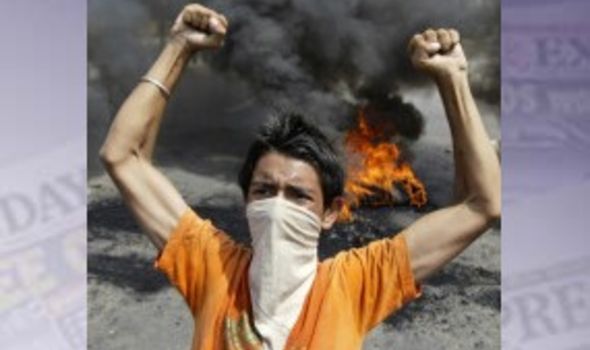
KASHMIR, India – “We want freedom” was the resonating chant as protests in Kashmir turned deadly when troops open fired on hundreds of demonstrators on Sunday, killing one person and wounding at least five.

A defiant protester shouts slogans in Jammu on Monday

Hundreds of people took to the streets, throwing rocks at security forces and surrounding an armored vehicle belonging to paramilitary soldiers, in a protest against the death of Mohammed Rafiq Bangroo, a 25-year-old who died Saturday after being beaten by troops in an earlier demonstration last week.  After the demonstrators tried to light a bunker on fire, the officers fired as an act of self defense, authorities say.

“We exercised maximum restraint.  Our soldiers opened fire only in self-defense after the protesters tried to torch the bunker,” Prabhakar Tripathi, spokesman for the Central Reserve Police Force, told the AP.  Tensions in the Muslim-majority region have been running high since local police accused the military of killing three civilians in April, and officials now say they are clamping down by enforcing a tight curfew and other restrictions.

Despite a decline in violence in Kashmir in recent years, there are fears that militants are trying to regroup in the region.  Hundreds of thousands of Indian troops are based in Kashmir to fight a two decade-old insurgency against Indian rule.

A senior Indian army officer has been killed in a gun battle with separatist militants in Indian-administered Kashmir.  Colonel Neeraj Sood was “leading his troops” when he was gunned down by militants in Lolab area, the army said.  He was the highest ranking officer to be killed by militants in Kashmir in 2010.

It is not clear whether the militants have suffered any casualties in the clashes.

Many know this re-birth of violence comes at the worst time, Al Jazeera’s Prerna Suri reports from Srinagar, said: “The violence couldn’t have come at a worse time for the people of Kashmir.  It’s peak tourist season and families live entirely on tourism.  They say if violence spreads, the only ones to suffer will be them.”

The demonstration swelled after the shots were fired, when hundreds more people poured into the streets, chanting “Indian forces leave Kashmir”.

Anti-India sentiment runs deep in Muslim-majority Kashmir.  Opposition groups have been fighting since 1989 for the Himalayan region’s independence from India or its merger with neighboring Pakistan.

For more information, please see:

Al Jazeera English – Police on Kashmir protestors – 20 June 2010

BBC news – Indian army officer killed in Kashmir clash – 23 June 2010

The Huffington Post – Kashmir Police Open Fire On Protesters – 21 June 2010

Syria Refuses to Release Journalist and Imprisons Activist/Lawyer

By Warren Popp
Impunity Watch Reporter, Middle East


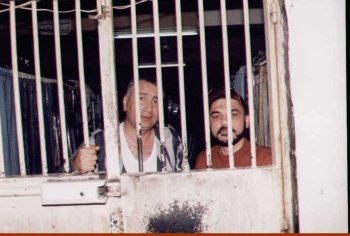
Syria continues to imprison journalists and activists who criticize the government. (Photo Courtesy of Global Voices)

DAMASCUS, Syria – On 16 June, Syrian journalist, Ali al-Abdallah, completed a two and half year prison sentence for “disseminating false information with the aim of harming the state,” for “membership of a secret organisation designed to destabilise the state,” and “inciting ethnic and racial tension.” He was sentenced, along with eleven others, for charges based on their calls for a radical shift in Syrian relations with Lebanon, as demonstrated by their support of the Damascus Declaration, a movement that is calling for peaceful and democratic change in Syria (Al-Abdullah had been elected to the secretariat of the Damascus Declaration Movement shortly before his arrest). However, shortly after he was set to be released, he was informed that new charges were being brought against him, and that he would therefore not be released.

According to the Committee to Protect Journalists, the latest charges accuse al-Abdallah of  “disseminating false information with the aim of harming the state and weakening national feelings,” and with “taking actions, producing writings or speeches not sanctioned by the government that would expose Syria to the danger of hostility, or harm its relationship with a foreign country, or expose Syrians to retaliation against them or their property.” These charges stem from an article al-Abdallah wrote about three months ago, while he was imprisoned in Syria, that was critical of Syria’s ties with Iran, and criticized the religious form of government advocated by Iranian Shiite leaders.

Calls both condemning the detention and calling for the release of al-Abdallah have come from numerous human rights organizations, including Amnesty International, the Committee to Protect Journalists, Human Rights Watch, Reporters Without Borders, and the Syrian Observatory for Human Rights.

On 23 June 2010, the prominent lawyer and head of the Syrian Organisation for Human Rights, Muhannad al-Hassani, was sentenced to a three year prison term under the same laws that were used to convict al-Abdallah and many other journalists and activists. Al-Hassani has represented numerous journalists and activists charged with crimes similar to that of al-Abdallah. According to Amnesty International, Al-Hassani had recently drawn public attention to both unfair trials of political prisoners before the Supreme State Security Court, and to a death that may have been caused by torture and ill treatment while in detention; he has allegedly held meetings with officials from foreign embassies to discuss human rights issues; and he has undertaken efforts to repeal the very law that was used to convict him. He is also the winner of the 2010 Martin Ennals Award, which recognizes the work of human rights defenders

The arrest and conviction has been condemned by numerous human rights organizations, including Amnesty International, Freedom House, Reporters Without Borders, the Syrian Human Rights League, the London-based Syrian Observatory for Human Rights, the Syrian League for the Defence of Human Rights, and the National Organisation of Human Rights in Syria.

The arrest of al-Abdullah, al-Hassani, and other critics of the government are reportedly part of a broader campaign against political opponents that has intensified over the past two years. While several of the other people detained for being part of the Damascus Declaration Movement have recently been released, there are many other journalists and activists who are currently detained in Syria. Riad Seif, a well-known opposition figure who is ill with cancer, continues to be imprisoned despite calls by Western leaders to release him. In addition, the office of the Syrian Centre for Media and Free Expression was closed and placed under seal in September 2009.

Reporters Without Borders notes that Syria was ranked 165th out of 179 countries in their 2009 press freedom index, and that President Bashar Al-Assad is on their Internet Enemies list, as well as their list of “Predators of Press Freedom.”

For more information, please see:

AFP – Syria Jails Award-Winning Lawyer: Rights Group – 23 June 2010.

Amnesty International – Syrian Human Rights Leader Jailed for Three Years – 23 June 2010

BBC – Syria Jails Leading Rights Lawyer – 23 June 2010

Committee to Protect Journalists – Syria Detains Journalist Beyond Sentence – 21 June 2010

Human Rights Watch – Syria: Political Detainee, Sentence Ended, Held on New Charges – 19 June 2010

International Free Expression Exchange – Authorities Refuse to Release Journalist on Completion of Sentence – 18 June 2010

Kaleej Times (U.A.E.) – Syrian Political Prisoner Re-Arrested on Release – 18 June 2010

Radio Netherlands Worldwide – Syrian Political Prisoner Re-Arrested on Release – 18 June 2010

Syrian Human Rights Committee – Detainee Ali al-Abdullah Transferred to SSSC Before Completion of His Sentence – 4 April, 2010

UN Urges Venezuela To Cancel Arrest Warrant For Television Executive

Guillermo Zuloaga Arrested Earlier This Year (Photo Courtesy of Caribbean Net News)

By Patrick Vanderpool
Impunity Watch Reporter, South America

CARACAS, Venezuela – Late last week, Venezuelan officials urged Interpol to arrest Guillermo Zuloaga, president of Globovision.  Globovision is the only Venezuelan television station still openly critical of President Hugo Chavez.  The Venezuelan Government is accusing Zuloaga of illegally storing vehicles with the intent to sell them.

Zuloaga and his son, also named Guillermo, are reported to have left the country and claim that the charges are false.  Rather, the Zuloagas claim that they are being persecuted for political purposes.  The elder Zuloaga owns a car dealership and has stated that the vehicles belong to the business.

Recently, Frank La Rue, a United Nations independent human rights expert, urged Venezuelan authorities to withdraw the warrant against Zuloagas.  La Rue echoed the sentiments of many other human rights activists when he expressed fear that the warrants are a means for the ruling government to silence political decent.  La Rue also expressed fears that the warrant illustrates a broader deterioration of expressive freedom in the country.

La Rue’s message was clear when he stated that “no Government in the world has the right to silence critics or those who oppose the State with criminal proceedings.”

The recent warrants against Zuloagas are not the only acts of intimidation committed against Globovision employees at the hands of the Chavez government.  Starting in 2001, Globovision employees have been privy to threats and harassment because they have freely exercised their expressive rights.  In 2008, the harassment and intimidation led the Inter-American Court of Human Rights to order measures to protect its employees.

The United States has also intervened in the situation out of fear that the warrants are politically motivated.  State Department spokesman Philip Crowley stated that the U.S. is “very concerned” with the warrants and that the warrants are “the latest example of the government of Venezuela’s continuing assault on the freedom of the press.”

Venezuela is a party to Universal Declaration of Human Rights and article 19 of the International Covenant on Civil and Political Rights which guarantees fundamental freedom of expression.  Although the country is bound by the terms of article, the Chavez government has done little to uphold the article’s principles.

Although Le Rue has requested a meeting with the Venezuelan government to fully assess the country’s freedom of expression standards, the request remains unanswered.

For more information, please see:

CNN – Venezuela Asks Interpol To Arrest Openly Critical TV Station’s Owner – 18 June 2010

 UN News Centre – UN Expert Urges Venezuela To Cancel Arrest Warrant Against TV Executive – 17 June 2010

Yahoo News – US Concerned By Arrest Warrant For TV Network Owner in Venezuela – 14 June 2010

Update: Israel Eases Gaza Blockade, Allows Building Supplies into Region

By Alyxandra Stanczak
Impunity Watch Reporter, Middle East

JERUSALEM, Israel – In response to discussion and comments about the Gaza embargo led by British Middle East envoy Tony Blair, and U.S. special envoy to the Middle East George Mitchell, Israeli prime minister Benjamin Netanyahu testified in the foreign affairs and defense committees of the Knesset, Israel’s legislative branch, that the Gaza blockade should restrict fewer critical items. Netanyahu’s testimony came after Arab League prime minister Amr Moussa’s trip to Gaza this past week to meet with Hamas prime minister Ismail Haniyeh.

Building materials and other critical items can now enter Gaza. Photo courtesy of the New York Times.
Building materials and other critical items can now enter Gaza. / Photo courtesy of the New York Times.

Netanyahu indicated last week that he supported increasing the amount and type of items that would no longer be subject to Israel’s blockade of Gaza. The former rules governing Israel’s blockade required all items entering Gaza be on an “allowed items” list. This rule was amended so that items not explicitly on a “banned items” list could be imported into Gaza.

Significantly,  building materials can now be shipped into Gaza.  The region’s infrastructure underwent intense damage during the 2008-09 three week Gaza War.  Roughly five percent of Gaza’s commercial and government buildings were destroyed, resulting in the loss of 189 buildings, including eleven factories and eight warehouses.  Furthermore, 6268 homes are estimated to have been damaged or destroyed during the war. These buildings have, largely, remained unrepaired since 2009 due to the difficulty in attaining necessary repair materials. As a result of the damage to these dwellings and the lack of available material to repair them, it is estimated that roughly 20,000 Gazanas have remained displaced after the war.

The Knesset’s decision to allow building materials into Gaza is the first stage in the process of  rebuilding infrastructure in the war-torn region.  Schools, hospitals, government buildings, and other critical institutions that were severely damaged, hope to begin rebuilding as soon as the materials become available in Gaza.

For more information, please see:

Al Jazeera – Israel to loosen Gaza blockade – 21 June 2010

BBC – Israel outlines changes to Gaza blockade – 21 June 2010

Ha’aretz – Decision to ease Gaza seige weakens Hamas –  21 June 2010

Reuters – U.N. agency calls for full lifting of Gaza blockade – 21 June 2010

United Nations Development Programme – Gaza – One Year After Report – 24 May 2010

Human Rights Watch – Israel: Investigate Unlawful Destruction in the Gaza War – 13 May 2010

Russian Natural Gas Monopoly Raises Prices Again

By Yoohwan Kim
Impunity Watch Reporter, Europe

MOSCOW, Russia – On Monday, June 21 Russia’s state-controlled gas monopoly, Gazprom, started to limit the amount of natural gas deliveries to Belarus and warned that supplies could be reduced by as much as 85 percent during the next couple of days.  Despite talks between the two countries on Monday morning, it is reported the Belarus owes $192 million to Gazprom for gas supplied over the last six months.

Belarus offered to pay their debt through exchange of machinery, equipment, and various other products.  Russian President Dmitry Medvedev rejected Belarus’s offer and stated, “Gazprom cannot accept payment for debt in pies, butter, cheese or other means of payment.”  President Medvedev then ordered Gazprom to start restricting gas deliveries by 15% of daily deliveries starting Monday.  Belarus is a major gas transit country and provides to Central and Western Europe.  The pipelines through Belarus supply about a fifth of Russia’s gas exports westward to Europe, and provides gas to Lithuania, Poland, and Germany.

Russia has been criticized for using their energy supplies as a political weapon.  Belarusian President Aleksandr Lukashenko refused to sign a customs union with Russia and Kazakhstan, which was planned to start July 1.  Belarus had refused to sign off on the customs reunion, in protest of Russian oil tariffs.  The proposed customs union was a Kremlin incentive that was created in 1991, in hope of solidifying a permanent economic alliance with former Soviet republics.

Belarus had previously stated that due to the customs union deal, Russia had provided them with cheap oil prices.  After the former post-Soviet ally refused to sign off on the union, Russia increased the price of gas.  Russia increased the price of gas supplied to Belarus from last year’s rate of $150 per 1,000 cubic meters of gas to $169.20 during the first quarter of 2010.  Russia further raised the price in the second quarter to $184.80.

During a news conference in Minsk, Belarusian first deputy prime minister, Vladimir Semashko, stated, “We will pay – not today perhaps, but possibly within two weeks.  We will find a way.  Maybe we will have to borrow, but we will pay.”

For more information, please see:

BBC News – Belarus ‘To Pay for Russian Gas Debt’ Within Two Weeks – 21 June 2010

The New York Times – Russia Cuts Gas Deliveries to Belarus – 21 June 2010

Radio Free Europe/Radio Liberty – Russia Reduces Gas Deliveries to Belarus Over Debts – 21 June 2010

RIA Novosti – Belarus Warns Europe of Possible Gas Transit Disruptions – 21 June 2010