
U.S. Sponsors Mexican Drug Cartels
By Erica Laster Impunity Watch Reporter, North America

Masked police officers outside of a Ciudad Juarez, Mexico drug rehabilitation center after gunmen killed 17 last September. Photo courtesy of the Wall Street Journal.
MEXICO CITY, Mexico – The above accusation came just two days ago from Mexican President Calderon in a video address to his nation while attending the World Cup. The Washington Post reports that President Calderon indicated Mexico’s deadly drug war stemmed directly from the fact that their neighboring country is “the biggest drug addict in the world,” feeding cartels with billions of dollars which have made them rich and bold. He asked Mexicans to continue to support his effort to rid the country of drugs despite armed resistance from local cartels. Over 23,000 have died since President Calderon declared a war on drugs in 2006.
In the past 5 days, hundreds have fallen victim to the drug war which has resulted in targeted killings of police, drug addicts and young children. This past Tuesday, Mexican police raided a home after acting on a tip in Taxco, a popular tourist town. The Mexican army’s firefight with the suspected drug cartel resulted in the deaths of 14 gunmen. Earlier this week, armed gunmen set a bus on fire to act as a blockade on a major highway, ambushing 12 federal police officers and wounding 8. Thursday, a local drug rehabilitation center in Chihuahua was hit by two dozen armed gunmen. After being thrown to the floor, 19 of its patrons were killed execution style. One teenager was able to call his mother on his cell phone, being heard crying out, “Mommy, they’vecome to kill us!” The victims ages ranged from 16-63. In Mexico, patients at local rehabilitation centers are often low level workers in the drug trade. President Calderon issued another statement Thursday from Johannesburg condemning the gunmen’s “barbaric acts,” the Washington Post reports.
In an effort to terrorize, drug cartels have also been responsible for many kidnappings throughout Mexico. Since 2006, kidnappings have exploded with approximately 2,450 taking place within three years of President Calderon taking office. High ranking officials, wealthy businessmen and ransom experts are among the many casualties. Just eight days after the kidnapping of former presidential candidate Diego Fernandez de Cevallos in May, authorities suspended their investigation pending an alleged willingness to pay ransom by his family. A public outcry ensued, as many believe the government is backtracking on its promise to end the popular tactic by prohibiting ransom payments to criminals.
Just across the border from El Paso in Ciudad Juarez, about eight people are killed each day from drug related violence and almost 1,200 deaths havebeen reported in the city this year alone. Mexican newspapers keep running tallies of the drug related violence’s victims reporting that 85 deaths occurred in a 24 hour period last week, a record high. Experts estimate that anywhere from $10-$25 billion dollars flow from the United States to Mexico as a result of the drug trade.
For More Information Please See:
www.washingtonpost.com/wp-dyn/content/…/AR2010061503174.html
http://online.wsj.com/article/SB10001424052748704463504575300920373347404.html?KEYWORDS=mexico
http://online.wsj.com/article/SB10001424052748703280004575308730570231438.html?KEYWORDS=mexico
Proposed Arizona Law Violates the Constitution
By Ali Sprott-Roen
Impunity Watch Reporter, North America
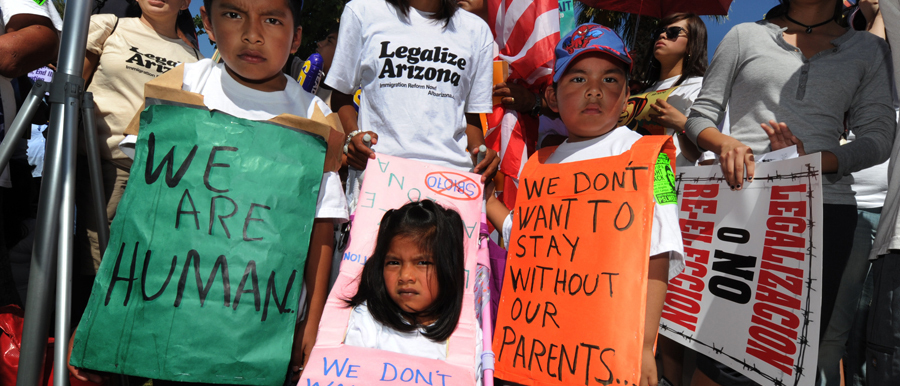
ARIZONA, United States – Arizona State Senator Russell Pearce, who was the force behind the passage of Senate Bill 1070, now intends to propose a law that will deny citizenship to children born in the U.S. to illegal immigrants.
Such children are often called “anchor babies” which is a derogatory term referencing the role of a naturalized child in facilitating the legal immigration of the child’s parents. Pearce has stated his belief that “anchor babies are an unconstitutional declaration of citizenship to those born of non-Americans. It’s wrong, and it’s immoral.”
However, contrary to Pearce’s belief, the 14th amendment to the constitution states that “all persons, born or naturalized in the United States, and subject to the jurisdiction thereof, are citizens of the United States. No state shall make or enforce any law which shall abridge the privileges or immunities of citizens of the United States.”
Despite this fact, Pearce and his fellow Arizona republican representatives will likely introduce legislation this fall that will deny birth certificates to children born in Arizona, and therefore American citizens under the Constitution, to parents who are not legal U.S. citizens.
In addition to violating the 14th Amendment, those who oppose the proposed legislation also say it would increase discrimination and create deeper divides in the community.
The bill is expected to end up in front of the U.S. Supreme court before enactment. In light of the decision in United States v. Wong Kim Ark, which confirmed that individuals born in the U.S. are citizens regardless of their parents’ nationality, constitutional law experts anticipate that federal judges will strike it down as facially unconstitutional.
For more information, please see:
Time – Arizona’s Next Immigration Target: Children of Illegals – 11 June 2010
azcentral.com – Arizona immigration law sponsor Russell Pearce thrusts state into political storm – 6 June 2010
LA Progressive – Arizona Anti-Immigration Senator Going After ‘Anchor Babies’ Next – 25 May 2010
the raw story – Author of Arizona law plans to target immigrants’ children – 12 June 2010
Mediaite – Report: Arizona State Senator to Target ‘Anchor Babies’ Next? – 21 May 2010
Despite Death Threats, Colombian Priest Stands Up For Human Rights

By Patrick Vanderpool
Impunity Watch Reporter, South America
BOGOTA, Colombia – The Colombian Judicial System handed down one of its most severe punishments against a member of the country’s security forces. A retired army colonel was found guilty in the disappearance of 11 people in 1985 and was sentenced to 30 years in prison. The disappearances occurred when soldiers stormed the Palace of Justice to retake it from leftist guerrillas.
This judicial victory is due in large part to Rev. Javier Giraldo, a Colombian Catholic Priest. Rev. Giraldo, who worked tirelessly to uncover previously unknown evidence, assured that the victims’ relatives were heard by journalists and prosecutors. This case is a prime example of the type of work Rev. Giraldo has been pursuing for most of his life.
For the last 30 years, Rev. Giraldo has investigated some of the most egregious human rights violations and has publicly accused who he believes is responsible. In recent years, Rev. Giraldo has been faced with increasing hostility from pro-government activists for his stance on human rights issues. Even Colombian President Alvaro Uribe has criticized the man many call the “Marxist Priest.”
Colombia’s Government, as well as pro-government activists, have been quick to label Rev. Giraldo anti-government and a pawn for the largest guerrilla army. Some have gone as far as to spray-paint death threats on the walls of the Colombian Capitol Building
Despite criticism from pro-government types, many view Rev. Giraldo as a blessing and as an individual who is trying to hold responsible those who committed human rights violations. Gimena Sanchez, a Colombia specialist at the Washington Office on Latin America, described Giraldo as an “incredibly moral figure who is not linked to any armed groups.”
Giraldo, sitting in his office, surrounded by photographs of other priests who were killed for being outspoken, stated that Colombian Government tries to “denounce and delegitimize whoever helps the victims.” The recent victory for the families of those 11 victims is a small success in an ongoing war against human rights violations.
Although the battle is not easy, Giraldo is not prepared to give up the fight because of the criticism he is taking. “I break with a justice system that is absolutely rotten,” Giraldo said. “But I am not saying that I will stop denouncing crimes.”
For more information, please see:
The Washington Post – Priest Faces Criticism For Shining Light on Human Rights Abuses in Colombia – 12 June 2010
Minneapolis Star Tribune – Colombian retired colonel gets 30 years for disappearances in 1985 Palace of Justice takeover – 09 June 2010
IPS – “Death Threats Have Become Routine,” Says Jesuit Priest – 14 May 2010
The Washington Post – Priest Faces – Criticism For Shining Light on Human Rights Abuses in Colombia – 12 June 2010
Minneapolis Star Tribune – Colombian retired colonel gets 30 years for disappearances in 1985 Palace of Justice takeover – 09 June 2010
IPS – “Death Threats Have Become Routine,” Says Jesuit Priest – 14 May 2010
Israeli agent wanted in connection with Hamas murder
By Polly Johnson
Impunity Watch Reporter, Middle East
WARSAW, Poland – Polish authorities have arrested a suspected Israeli agent in connection with the murder of a Hamas leader in Dubai earlier this year.
Germany is now seeking the extradition of Uri Brodsky, suspected in the January assassination of a Hamas commander, identified as Mahmoud al-Mabhouh, one of the founders of the Palestinian group Hamas’ military wing.
Brodsky was allegedly involved in illegally obtaining a German passport, according to a spokesman for the German prosecution, who added that it’s now up to the Poles to decide whether to give Brodsky up to Germany, where he will faces charges of espionage and forgery.
Arrested on June 4 at the Warsaw airport on suspicion that he assisted one of the assassins with obtaining a fraudulent passport, Polish authorities have a month to decide on extradition.
He allegedly worked with Mossad, Israel’s intelligence agency. Israel opposes Poland’s proposed extradition of Brodsky to Germany. However, according to the Polish prosecutor, the extradition is based on a European warrant, which, consistent with European Union standards, leaves Poland with little choice in the decision.
Der Spiegel, a German magazine, reported that the Israeli embassy in Warsaw is urging Poland not to extradite Brodsky to Germany.
His wife also issued a statement urging the authorities to permit Brodsky to be turned over to the Dubai authorities to be tried there.
He will not face charges in connection with the assassination of the Hamas commander, only the espionage and forgery charges.
Officials from Dubai have claimed that Israeli agents are responsible for the January killing and provided the names of two dozen alleged assassins who carried out the plot using fraudulent passports from several different countries, including Britain, the Irish Republic, France, Australia, and Germany. The Dubai police have released surveillance footage showing the alleged Mossad suspects from the hit squad. According to the police, al-Mabhouh was drugged and suffocated.
For more information, please see:
BBC – Israeli wanted over Dubai killing ‘held in Poland’ – 12 June 2010
Al Jazeera – Poland holds alleged Israeli spy – 13 June 2010
The Jerusalem Post – Poles support agent’s extradition – 14 June 2010
Bloomberg Businessweek – Poland May Seek Surrender of Suspected Mossad Agent Tomorrow – 15 June 2010
Examiner – Mossad agent allegedly involved in Hamas killing now to be extradited to Germany – 15 June 2010
Haaretz.com – Poland to extradite alleged Mossad agent to Germany – 15 June 2010