|


|
|
|
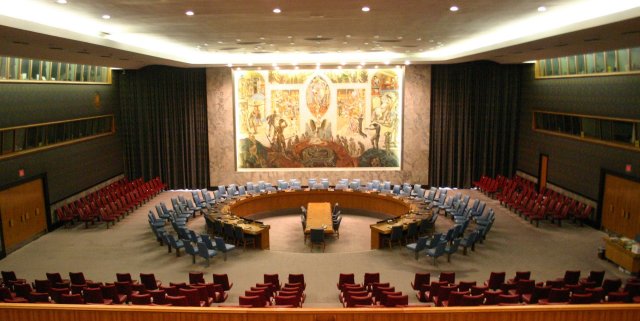
The United Nations Security Council (UNSC) should not ignore or walk away from the alleged use of any prohibited weapon, such as chemicals, as it signals it is permissible to violate the Chemical Weapons Convention (CWC) and erodes international norms related to such weapons. Further, it signals that countries with deep ties to P5 (U.K., U.S., France, Russia, China) are outside the scope of UNSC authority, therefore creating a bigger issue of eroding the international authority of the UNSC and jeopardizing the foundation of international law.
On Tuesday, October 24, 2017, Russia vetoed the resolution extending the mandate of the investigators probing chemical weapons attacks in Syria. [JURIST report] [Meeting Record] Following the chemical attack in 2015, Russia and America created the Joint Investigative Mechanism (JIM) to investigate the presence/use of chemical weapons in Syria, which found 27 active production facilities. In its most recent report late last month, the Organisation for the Prohibition of Chemical Weapons (OPCW) said it had verified the destruction of 25 of the 27 chemical weapons production facilities declared by Syria and continued to prepare an inspection to confirm the current condition of the last two. The vote on the resolution was in advance of the JIM investigative report (presented Thursday October 26). The report sought to identify the party responsible for a deadly April 4 attack in the rebel-controlled town of Khan Sheikhoun in southern Idlib that killed and sickened scores of civilians allegedly using sarin gas. Shortly after that attack, the United States launched an airstrike on a Syrian air base and accused the al-Assad regime of carrying out the gas attack.
This action by Russia is primarily concerned with the sovereignty of Syria and stresses the maxim that you cannot enter a sovereign territory without concrete evidence of wrong doing. Further Russia believes they face possible retaliation by Syria and/or rebel groups present in Syria. Finally, Russia is concerned that there has been a blurring of lines between the conflict against Syria and the conflict against ISIS. Additionally Russia is supporting the regime and has economic ties to Syria. They do not want the US to gain any influence in Syria.
The media and various member states are concerned that the UNSC is impotent in assisting in Syria due to the P5 structure. The UNSC and the UN system are shouldering the blame for little progress in Syria. The broader discussion criticizes the entire UN system as being outdated and ineffective.
The UN is not impotent, as it has facilitated international cooperation on the conflict, resulting in ceasefires, the initial formation of JIM, condemnation of acts, and investigation of potential war crimes. Further, the UN is serving its purpose as a neutral forum for these discussions. Syria has not simply become a battlefield upon which America and Russia are fighting, nor are we seeing a return to interstate war. Therefore, the UN is working as a forum for these issues. Further negotiations need to be based on interests and relationships as nationalistic and realist strategies fail within the cooperative international organizational model.
The UN must continue to negotiate towards extending the investigation in Syria, and the UNSC should never turn away from condemning, investigating, and helping to eliminate the proliferation of chemical weapons. Ceasing any further condemnation or investigation signals to the world that the use of chemical weapons brings no accountability. If there are no ramifications for the use of chemical weapons, the CWC could become irrelevant. All State Parties to the CWC have agreed to disarm by destroying any stockpiles of chemical weapons they may hold, any facilities which produce chemical weapons, and any chemical weapons they abandoned on the territory of other States Parties in the past.
The Convention aims to eliminate an entire category of weapons of mass destruction by prohibiting the development, production, acquisition, stockpiling, retention, transfer or use of chemical weapons by States Parties. States Parties, in turn, must take the steps necessary to enforce that prohibition in respect of persons (natural or legal) within their jurisdiction.
A unique feature of the CWC is its incorporation of the ‘challenge inspection,’ whereby any State Party in doubt about another State Party’s compliance can request the Director-General to send an inspection team. Under the CWC’s ‘challenge inspection’ procedure, States Parties have committed themselves to the principle of ‘anytime, anywhere’ inspections with no right of refusal.
To lose this feature would create an incredibly dangerous world without any oversight into weapons production and use. Losing the global norm that chemical weapons are taboo could reintroduce them to warfare. Also, allowing chemical weapons leaves open the race to innovate biological weapons as well. Do we want to go in this direction in the 21st Century?
An inadequate international response to the use of chemical weapons by the Syrian regime will only increase the risk that the world’s most dangerous, indiscriminate, and inhumane weapons will be used to commit atrocities in the future, erode the integrity of the CWC, and undermine the authority of the Security Council. International peace and security would be undermined.
David M. Crane is the founder of the Syrian Accountability Project and the IamSyria Campaign. He is the Founding Chief Prosecutor of the international war crimes tribunal in West Africa called the Special Court for Sierra Leone and a Professor at Syracuse University College of Law.
Suggested citation: David M. Crane, Gassing International Law, JURIST – Academic Commentary, Nov. 6, 2017, http://jurist.org/forum/2017/10/David-Crane-international-blackmail.php
[Jennifer Trahan is an Associate Clinical Professor at the Center for Global Affairs at New York University.]
The ICC Prosecutor announced last week that she was requesting the ICC Pre-Trial Chamber to authorize the Afghanistan Preliminary Examination moving into the Investigation stage. This would take the ICC’s Afghanistan investigation one step closer to resulting in actual cases.
We have known for quite a while that the Prosecutor was examining the situation in Afghanistan, and her past reports and press releases indicate she has been examining war crimes and crimes against humanity committed by the Taliban, Afghan government forces, and US nationals—US armed forces and CIA.
As Kevin Jon Heller notes, it will be interesting to see the US reaction to this news, yet it should hardly come as a surprise. As he also notes, the Prosecutor has been under pressure to expand her docket beyond the African continent. The US does not have anyone in the post of US War Crimes Ambassador (or head of the Office of Global Criminal Justice), so it is unclear who would lead any US response.
The US has of course one very simple way that it could react to this news, and that is to endorse the rule of law, and itself conduct any investigations into torture or ill-treatment at the hands of US nationals, be they armed forces, CIA, or contractors of either.
Under the principle of complementarity (Rome Statute art. 17), any state can avoid an ICC case proceeding by conducting a good faith investigation and/or prosecution into the same conduct. It has been high time for the US to do this, but the Prosecutor’s announcement illustrates the urgency of the US finally taking this seriously.
As a US national and a supporter of the ICC, I don’t really want to see the US locked in a showdown against the ICC. Yet, past experience (the misnamed American Servicemember Protection Act, bilateral immunity agreements, legislation allowing US forces in invade The Hague to liberate Americans in ICC custody) suggests such a confrontation is quite possible. Such an approach would not well serve either the ICC or the US, as it would amount to mere bully-tactics by the US against an institution, supported by all the US’s key allies, that is committed to ensuring rule of law for the worst crimes of concern to the international community.
Both the ICC and the US have the same interest in adhering to the rule of law, and there is a simple rule-of-law-abiding solution here: the US must undertake to do complementarity. The UK, faced with the possibility of the ICC proceeding against UK nationals for abuses committed in Iraq has been working hard to conduct complementarity; the US should do the same.
Alex Whiting raises the possibility that US conduct might not satisfy the ICC’s fairly high “gravity threshold”; yet, if the Prosecutor also includes certain “black sites” run by the CIA that were located in Rome Statute States Parties, such as Poland, Romania and Lithuania (as her announcement suggests), it is also possible that the gravity threshold will be met. (Her announcement stated, in addition to crimes in Afghanistan, her request for authorization would include “war crimes closely linked to the situation in Afghanistan allegedly committed since 1 July 2002 on the territory of other States Parties to the Rome Statute.”)
We should not lose sight of the fact that the ICC is not aiming this investigation solely towards US nationals, and to the extent the ICC can prosecute the much more extensive crimes committed by the Taliban or other armed groups in Afghanistan, these would be welcome developments. Afghanistan has been plagued by decades of crimes, with those pertaining to US nationals constituting just one subset of what is at issue.
Meanwhile, the US should expeditiously fill the post of US War Crimes Ambassador (head of the Office of Global Criminal Justice), with the office’s initial focus being to finally conduct complementarity to ensure that justice for crimes in Afghanistan is done, and that to the extent US nationals are implicated in wrongdoing, that it is addressed within the US legal system. The US has credible and effective military and civilian investigative capacity and court systems which can and should be utilized.
By: Adam King
Impunity Rights News Reporter, Africa

GENEVA, Switzerland – The Democratic Republic of Congo was recently elected to the United Nations Human Rights Council on October 16, 2017 along with 15 other countries. While Congo was elected by receiving the majority number of votes necessary for election, it received the least amount of votes (150) among the African countries that were in the running. The total amount of votes necessary to be elected to the council is 97. Only 4 African states were running for seats, which is the total allotment for the region. Louis Charbonneau, the Human Rights Watch UN Director, felt the outcome would have been different if the seats up for election had been contested, “[Congo] is fast becoming a pariah state. If there had been competition, it probably would have lost.”
Some of the sharpest criticisms came from Nikki Haley, the United States Ambassador to the UN. Her rebukes questioned the message that was being sent to the rest of the world by electing Congo, who has a controversial history with human rights violations,
“The DR Congo, a country infamous for political suppression, violence against women and children, arbitrary arrest and detention, and unlawful killings and disappearances, has been elected to serve on what is supposed to be the world’s preeminent human rights body… Countries that aggressively violate human rights at home should not be in a position to guard the human rights of others.”
Additionally, Haley saw this move as a tactic that took away from the unified message the council wants to embody to effectively progress its charge as a body,
“We need a unified voice of moral clarity with backbone and integrity to call out abusive governments. This election has once again proven that the Human Rights Council, as presently constituted, is not that voice.”
Haley has even gone as far to suggest that the United States may consider exiting the council if decisions such as these continue to happen.
Congo has been riddled with accusations of human rights violations ranging from the use of child soldiers to allegations of mass killings. According to Deutsche Welle,
“Violence in eastern and central Congo has displaced 1.5 million in the last year and reopened fears of civil war. Conflict in 1996-2003 resulted in millions of deaths and created conditions in which dozens of armed groups emerged.”
Congo was elected to the UNHRC despite a campaign by several countries to keep it from gaining a seat,
“The United States, the United Kingdom and advocacy groups like the Washington-based Human Rights Watch called upon member nations to reject Congo’s candidacy, citing widespread reports that its president Joseph Kabila has used repression and violence to hold onto power after his two-term limit expired on Dec. 19, 2016.”
For more information, please see:
Dhaka Tribune — ‘DR Congo wins seat on UN rights council despite US opposition’ — 17 October 2017
MPN News — ‘Mass Graves Don’t Keep Congolese Off UN Human Rights Council’ — 17 October 2017
The Indian Express — ‘Congo elected to UN Human Rights Council; US criticises move’ — 17 October 2017
Deutsche Welle — ‘DR Congo controversially elected to UN Human Rights Council’ — 16 October 2017
Miami Herald — ‘UN elects Congo to Human Rights Council despite abuses’ — 16 October 2017
Katherine Hewitt
Impunity Watch Reporter, Asia
SRINAGAR, Kashmir – Women in Kashmir are facing an attack of a new type- ‘braid chopping.’ Masked perpetuators attack women and then proceeded to cut their hair. These types of attacks have happened both public spheres as well as private homes. Within the past 2 month over 200 women reported such abuses.
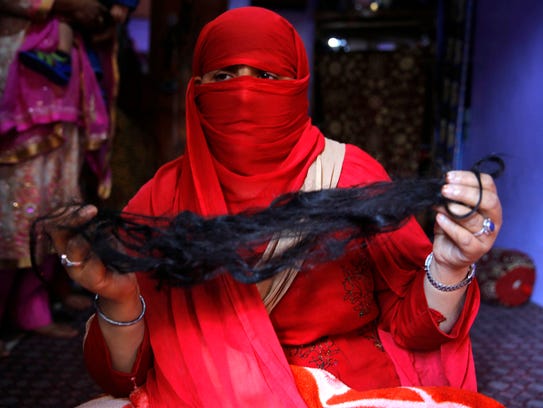
The attackers spray some type of chemical in the women’s faces before chopping their victim’s hair off. Many women are knocked unconscious in the process. The chopped hair is not stolen by the attackers.
Attacks such as these have also been reported in other Indian states such as Uttar Pradesh, Punjab, Rajasthan, and Haryana. Even New Delhi, the capital, has seen similar cases.
Women reported the events to the police. The region’s police say that these incidents are being treated as a crime. There is a $9,000 reward for information on the culprits.
However, they believe that the police are not following up in an appropriate manner. The police response impedes women’s empowerment. Despite there being a high reward for information, many local police do not take the complaints seriously. They accuse of the women of hallucinating or having a history of mental illness. This response breaks down a woman’s credibility as well as not reassuring her of her safety.
Women have begun to gather in the streets to protest. One such demonstration ended in stones thrown at the Indian Police. Vigilante groups have also formed in some villages as a response mechanism. There is a real fear of being accused of being a ‘braid-chopper.’
These attacks cause fear to grow among the female population in Kashmir. Women are afraid to go out in public or be left alone. The fear caused by the attacks takes away the women’s peace of mind and independence.
Additionally, the attacks degrade the women. Kashmir is a typically conservative Muslim territory. Women tend to not cut their hair and keep it covered as doing otherwise is dishonorable.
For more information please see:
Al Jazeera – ‘Braid-chopping sparks fear and unrest in Kashmir – 12 October 2017
The Guardian – ‘Braid Chopping in Kashmir sparks mass panic and mob violence – 11 October 2017