International Center for Transitional Justice: In Focus – Grassroots Truth Telling in the US

ICTJ World Report
October 2017
In Focus ›
Is the United States Ready for a Truth-Telling Process?
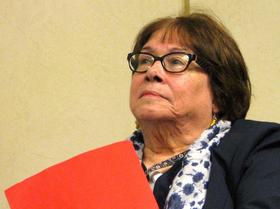
Fania Davis thinks the time has come for a truth-telling process about racial injustice in the United States, and she is working to make it a reality. We sat down with her and her colleague, Jodie Geddes, to discuss their vision for a national process, what they hope it would achieve, and what they have learned from their conversations with local leaders so far.
Read More ›
Publications ›
Justice Mosaics: How Context Shapes Transitional Justice in Fractured Societies ›
Media and Transitional Justice: A Dream of Symbiosis in a Troubled Relationship ›
Other News
To Prevent Enforced Disappearances, Rethink the Justice and Security Equation
With enforced disappearances on the rise, ICTJ President David Tolbert says the path to prevention is clear: the international community must reorder its priorities and change its approach. The disproportionate attention on counterterrorism takes us further away from accountability and prevention, Tolbert writes. He urges the international community to lead the way in unequivocally censoring governments that use enforced disappearance as a political tactic — and ensuring there can be no impunity for this crime.
Read More ›
A Noble Dream: The Tenacious Pursuit of Justice in Guatemala
Bring General Rios Montt and other high ranking members of the military to trial in the Guatemalan courts for genocide? In 1999 it was a noble dream for justice, but one with little apparent possibility of ever coming true. Walk the long path to justice that led to this historic trial.
Read More ›
Upcoming Events ›
October 17 – 22, 2017
22nd Workshop in Budapest: Practices of Memory and Knowledge Production ›
Location: Budapest, Hungary
November 09, 2017
Reckoning with Racial Injustice in the United States ›
Location: NYU School of Law’s Lipton Hall, 110 West Third Street New York, NY 10012
Forward to a Friend
Do you know someone that may be interested in the ICTJ newsletter?
Copyright 2017 International Center for Transitional Justice
Unsubcribe from this newsletter.

Syria Deeply: Our updates on the battles for Deir Ezzor and Raqqa, the cease-fire south of Damascus, and Turkey’s military expansion in northern Syria

Syria Deeply
Oct. 16th, 2017
This Week in Syria.

Welcome to our weekly summary of Syria Deeply’s top coverage of crisis in Syria.

Fight Against ISIS: The battles against ISIS in Deir Ezzor and Raqqa advanced over the weekend as pro-government forces claim to have recaptured al-Mayadeen, and U.S.-backed forces announced their final push against militants in Raqqa city.

Citing Russia’s defense ministry, the Associated Press said on Saturday that Syrian troops fully freed al-Mayadeen, in Deir Ezzor province, from ISIS militants. An unidentified Syrian military source confirmed the advance to Reuters, saying that ISIS suffered a “collapse” in their ranks. The ISIS command structure is believed to be based in the city, which is on the Euphrates River near the border with Iraq.

The advance came after ISIS launched a triple car-bomb attack in eastern Syria on Thursday, killing at least 50 people, including internally displaced civilians and Kurdish security personnel, Reuters said.

On Sunday, U.S.-backed Syrian Democratic Forces (SDF) launched the “final phase” of their battle against ISIS in Raqqa after hundreds of militants surrendered, the SDF said in a statement, adding that the latest push was aimed to drive the few hundred remaining ISIS fighters from their positions inside the city. The announcement came after more than 3,000 civilians and some 275 Syrian ISIS fighters and their families, were evacuated from the city Saturday night under a deal negotiated between local officials from the Raqqa Civil Council and ISIS fighters.

Cease-fire in South Damascus: A cease-fire went into effect at noon on Thursday in a rebel enclave south of Damascus, after three opposition groups agreed to a deal brokered by Russia and Egypt in Cairo.

The exact area covered by the deal remains unclear, but Islamist rebel groups control a pocket of three villages – Yalda, Babila and Beit Sahem – adjacent to ISIS-held territory south of the capital. The three villages have been under total or partial siege since 2013. An estimated 42,500 civilians are still living there.

The Syrian government did not sign the deal. According to Mohammed Alloush, the political leader of Jaish al-Islam, his group is party to the agreement, along with Jaish al-Ababil and Aknaf Bait al-Maqdis, linked to the Palestinian Hamas group.

Turkey Expands In Northern Syria: On Saturday, a new batch of Turkish troops and armored vehicles arrived on the Turkish side of the Syria border ahead of the second phase of deployment in northern Syria, according to Reuters.

Ibrahim al-Idlibi, a military adviser in the Free Syrian Army, told Reuters that “nearly 200 troops are now stationed in areas that separate territory under control of Kurdish groups and opposition groups.” Citing unidentified witnesses, Reuters added that Turkish bulldozers were working “around the clock,” setting up observation posts and digging fortifications.

The Speaker of Syria’s People’s Assembly Hammouda Sabbagh said on Sunday: “The people’s assembly condemns the Turkish flagrant aggression on the Syrian territory in Idlib province, which constitutes a blatant aggression against the sovereignty and territorial integrity of the country and a flagrant violation of international law and norms.”

Read the full summary

f020b569-7455-410e-8ef8-f41b0077a844.png MOST POPULAR

This Week’s Top Articles

cryo2.jpeg?w=185&h=130&fit=crop&q=60&dpr=2

GOVERNMENT & PRO-GOVERNMENT FORCES

Syria Studying Proposal to Amend Nationality Law

The Damascus-based Syrian Law Journal discusses a proposal under review to amend the Syrian Nationality Law and grant Syrian women the right to pass their nationality on to their foreign husbands.

cryo2.jpeg?w=185&h=130&fit=crop&q=60&dpr=2

SOLUTIONS

How Syrian Civil Defense Is Alerting Civilians of Potential Airstrikes

The Syrian Civil Defense has developed a warning system to help civilians evade airstrikes. Powered by a network of spotters, the online platform sends minute-by-minute alerts of potential target zones after a warplane is seen taking off.

973ab3c3-9b8d-4a6d-9ac8-50621f4257fe.png EDITOR’S PICKS

Community Insight

putin-tillerson-meeting-exxonmobil.jpeg?w=90&h=90&fit=crop&q=60&dpr=2

DIPLOMACY & FOREIGN AFFAIRS

Turkey’s Operation in Idlib May Not Bring All-Out War With al-Qaida

6827aefd-79dd-482b-9584-82c275-565c92dc808b2.jpg?w=68&h=68&fit=facearea&facepad=2&corner-radius=100&mask=corners&maskbg=transparent&fm=png32
Hashem Osseiran,  The deputy managing editor of Syria Deeply.

Turkey’s discussions with al-Qaida-linked militants ahead of its deployment in Syria’s Idlib province indicate that a wide-scale offensive against the militant group may not be Ankara’s primary objective, according to Charles Lister of the Middle East Institute.

putin-tillerson-meeting-exxonmobil.jpeg?w=90&h=90&fit=crop&q=60&dpr=2

HUMAN RIGHTS

Despite Impressions, Syrian Violence Still Raging in Some Areas: ICRC

6827aefd-79dd-482b-9584-82c275-565c92dc808b2.jpg?w=68&h=68&fit=facearea&facepad=2&corner-radius=100&mask=corners&maskbg=transparent&fm=png32
Hashem Osseiran,  The deputy managing editor of Syria Deeply.

Syria Deeply spoke with Pawel Krzysiek of the International Committee of the Red Cross about the recent escalation in violence in the country – the worst since the battle for Aleppo in 2016.

putin-tillerson-meeting-exxonmobil.jpeg?w=90&h=90&fit=crop&q=60&dpr=2

DIPLOMACY & FOREIGN AFFAIRS

Deeply Talks: Syria’s Border with Jordan

6827aefd-79dd-482b-9584-82c275-565c92dc808b2.jpg?w=68&h=68&fit=facearea&facepad=2&corner-radius=100&mask=corners&maskbg=transparent&fm=png32
Hashem Osseiran, Alessandria Masi, Kim Bode

As Syrian and Jordanian officials ponder reopening the Nassib border crossing, Syria Deeply talks with Sam Heller of the Century Foundation about the sticking points and possible negotiations.

FIRST LOOK

Upcoming coverage

We are always looking for new writers, experts and journalists covering the crisis in Syria and are interested in writing about a variety of topics. Please send us your ideas, story pitches and any other thoughts about our coverage via email, Twitter or Facebook.

Fate of Catalonia rests on Catalan president’s shoulders

By: Sara Adams
Impunity Watch News Reporter, Europe

Supporters of Catalonia’s independence wave Catalan flags in Barcelona, outside of the Catalan parliament building. Image courtesy of Nakam/Zuma Wire/Rex/Shutterstock.

BARCELONA, Spain – Catalonia has yet to determine whether they have declared independence.

On October 10th, Catalonia’s president, Carles Puigdemont decided the southern region of Spain would not immediately declare independence from its mother country.

The statement came after Mr. Puigdemont signed an official declaration of independence. Soon after, Mr. Puigdemont announced the suspension.

Prime Minister Mariano Rajoy has accused the Catalan president of deliberately confusing the Spanish government.

On October 11th, the government officially stated that the “ball was now firmly back in Puigdemont’s court.”

What the Catalonian government does next will determine whether the Spanish government will strip Catalonia of its autonomy using Article 155 of the federal constitution. If this happens, administrative control over Catalonia will be given to the Spanish government.

The struggles over the past several days have caused some divide within Spain itself.

The Constitution itself was established in the late 1970s after years of an authoritarian regime, where Catalans were severely oppressed by a dictator.

Socialist leader Pedro Sanchez, of Spain’s main opposition leadership, has expressed support for using the Constitution to deprive Catalonia of its autonomy.

The support was in exchange for an agreement to form a commission to change the Constitution.

Both sides of the spectrum argue that the other side is a threat to democracy.

Prime Minister Rajoy accused separatists of “foisting their will on all the people of Catalonia,” indicating that they ignore the Catalans who do not want to secede.

Yet Mr. Puigdemont, Catalonia’s president, sees Catalonia as an autonomous region that has “won the right to be independence” as a result of the vote held on October 1st.

“The people’s will” is to break free from the central government in Madrid, Mr. Puigdemont stated in front of the Catalan parliament in Barcelona.

On the day of the election, the Spanish government sent police troops in to various towns and cities around Catalonia. This led to several clashes between Catalans and police, with hundreds reportedly injured.

The chaos that day has led to the launch of an investigation into the allegations of police brutality. The main question is whether law enforcement used excessive force against people who were peacefully assembling to vote or protest.

If the Spanish government does choose to invoke Article 155, it may cause more civil unrest similar to the kind seen on October 1st.

Meanwhile, Mr. Puigdemont told CNN that he is sending a message of “calmness”, stating, “[w]e are facing a political problem that we need to solve with politics and not with police.”

For more information, please see:

The Guardian – Spanish PM asks Catalonia: have you declared independence or not? – 11 October 2017

The New York Times – Spain Asks Catalonia: Did You Declare Independence or Not? – 11 October 2017

BBC News – Catalonia: Spain takes step towards direct rule – 11 October 2017

The Guardian – Catalonia’s suspended declaration of independence: what happens next? – 11 October 2017

BBC News – Catalonia independence declaration signed and suspended – 10 October 2017

Al-Jazeera – Catalan vote: Claims of Spanish police brutality probed – 3 October 2017


Columbian police open fire on protestors

By: Emily Green
Impunity Watch Reporter, South America

BOGOTA, Colombia — Hundreds of farmers and community members gathered to protest forced eradication of their coca crops when the peaceful demonstration turned into a massacre. As many as fifteen civilians were killed and 50 more were injured at the hands of Colombia’s own security forces.

Police enter Nariño to carry out forced eradication. Image Courtesy of Telesur.

Local reports say anti-narcotics police opened fire into the crowd of protestors on October 5. Between 300 and 1,000 unarmed farmers had gathered in a field of coca requesting to speak with the security forces and stop police from destroying their crop. President Santos has ordered further investigation into the event that occurred in Nariño, the rural area known as a key zone for growing coca.

As the largest producer of coca, a base element of cocaine, Colombia has thousands of farmers who rely on the crop.  The country’s new peace plan provides an opportunity for crop substitution. Over a thousand farmers signed an agreement with the government to participate in this program that will substitute their coca crop for legal ones. In exchange for ripping up their coca, the farmers will receive government investment in their community.

However, most coca farmers around Nariño are not yet included in this program and need their crop to feed their families. Although they intend to participate, anti-narcotics authorities will not wait and are forcing eradication of their crop. This premature eradication destroys their means of livelihood.

Several conflicting reports have been brought blaming different groups for the violence, but human rights organizations and locals of the area assure that it was the police who opened fire on the protesting farmers. They resorted to violence after a peaceful two-week protest in which the farmers refused to participate in coca eradication efforts. Local media reported on several protests in this highly coca dependent area, where about 1,000 locals demanded to be included in the national crop substitution program.

On the other hand, the Colombian government has indirectly blamed guerrilla rebels for inciting the incident. Hundreds of FARC rebels have refused to follow the group’s peace agreement and have formed their own organized crime factions dedicated to drug trafficking. Colombia’s Defense Ministry claims that the rebels threw five-cylinder bombs at members of security forces and the crowd of protestors.

There has been no evidence of this version of events and most witnesses deny it. They report escalating tension between the police and the protestors that resulted in “excessive and irrational action” by the police that was “a clear violation of human rights.”

For more information, please see:

Colombia Reports – Southwest Colombia furious at security forces after ’15 killed’ in massacre – 6 October 2017

Reuters – At Least Six Die During Colombia Protest Over Coca Crop Removal – 6 October 2017

Colombia Reports – Military massacre in southwest Colombia?  At least 8 killed, 18 injured in coca protest – 6 October 2017

Fox News – 4 killed in clashes with Colombia coca growers, eradicators – 6 October 2017

Telesur – Colombians Mobilize Against Police Killing of 8 Campesinos – 5 October 2017