By: Fernando Oliveira
Impunity Watch Reporter, South America
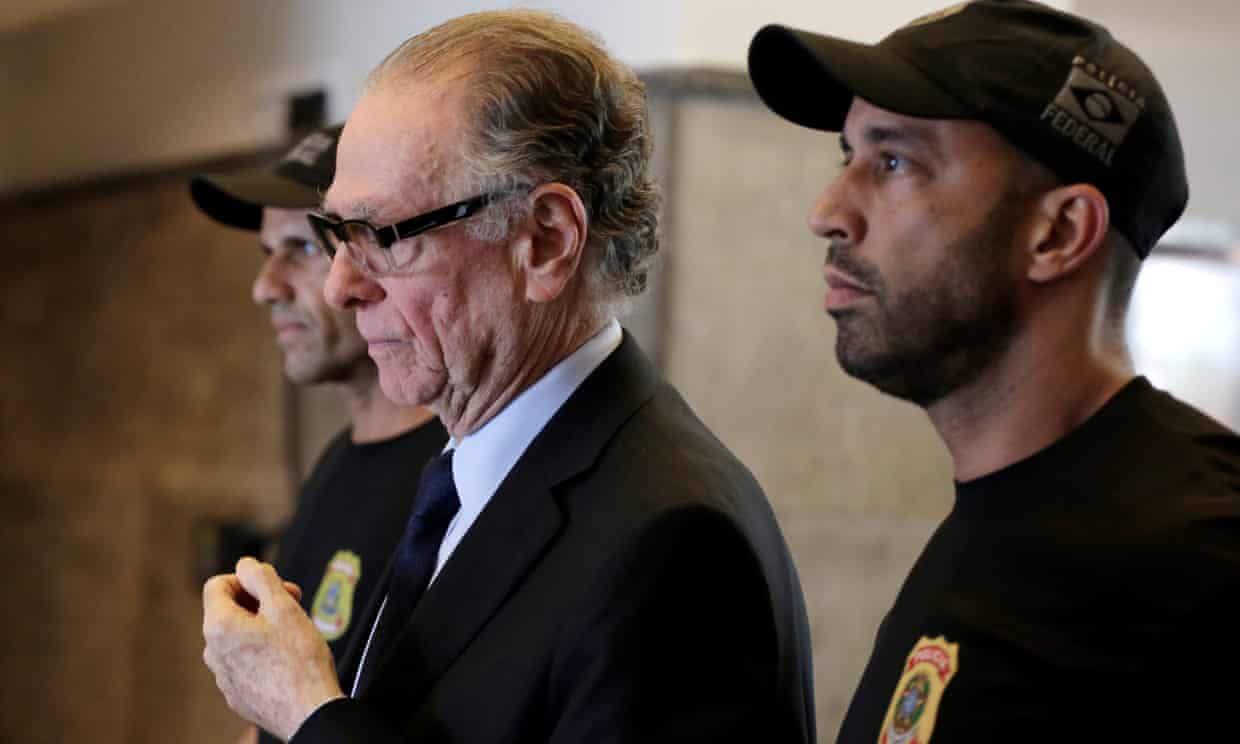
RIO DE JANEIRO, Brazil – On October 5th, 2017, Carlos Arthur Nuzman, the Brazilian Olympic Committee president, and his right-hand man, Leonardo Gryner, the general director of the Rio 2016 Organizing Committee, were arrested by Brazil’s federal police. Both were allegedly involved in a voting-buying scandal that supposedly allowed Rio de Janeiro to host the 2016 Olympic Summer Games.
Brazilian Olympic Committee president Carlos Nuzman is escorted from the federal police headquarters in Rio de Janeiro. Photograph courtesy of Bruno Kelly/Reuters.
According to Brazilian federal prosecutors, Nuzman and Gryner controlled a complex criminal organization which, in 2009, “bought” Lamine Diack’s vote to bring the Olympics to Rio de Janeiro. Indeed, the investigation has found several emails showing that Lamine Diack, a former IOC member from Senegal, received at least $2 million for promising to vote for Rio de Janeiro’s candidacy during the poll held in Copenhagen in October 2009.
Nuzman, who is now 75 years old, was a Brazilian volleyball player who represented the national team from 1962 to 1968. Later on, he became head of the Brazilian Volleyball Confederation, from 1975 until 1995. Since 1995, he has been BOC’s president. According to investigators, in the last 10 years, his assets have grown more than 450%.
Additionally, investigators discovered that Nuzman concealed sixteen 1kg gold bars in a Swiss bank, which led federal prosecutor Fabiana Schneider to declare:
“While Olympic medalists chased their dreams of gold medals, leaders of the Brazilian Olympic Committee stashed their gold in Switzerland.”
The ongoing investigation, called “Unfair Play,” brought evidence that Nuzman and Gryner are involved in corruption, money laundering, and conspiracy.
Nuzman’s lawyer, Nelio Machado claimed that Nuzman’s arrest is wholly unnecessary, and constitutes a vehement flaw, mostly because it is clear that the election of Rio de Janeiro for the 2016 Olympic Games strictly followed the rules.
By Sarah Purtill
Impunity Watch Reporter, North America
WASHINGTON, D.C., U.S. – The Trump Administration has created a loophole for companies and nonprofits when it comes to birth control. The new rule allows for companies and nonprofits to exclude coverage for contraception if the company or nonprofit has a moral or religious objection. Much of the controversy over providing contraception to women centers on its use for family planning. But many medical conditions also require the use of hormonal birth control methods.
The California Attorney General filed a lawsuit on October 6, 2017 challenging the new policy allowing companies to exclude coverage for contraception. The original Obama Care mandate required that employers offer health insurance that covers birth control without a co-pay and with limited exemptions for religions and some companies. Now, employers will not have to file anything with the government to stop offering the birth control coverage; all they have to do is notify their employees of the decision, according to Health and Human Services officials.
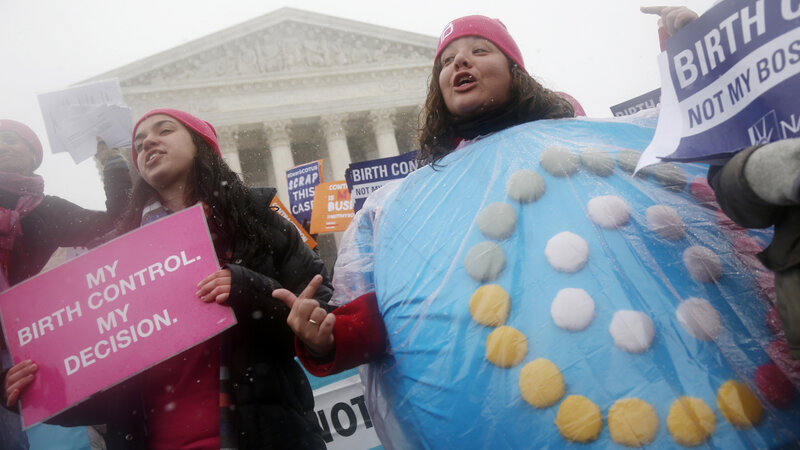
Demonstrators in favor of the birth control provision of the 2015 Affordable Care Act. Photo Courtesy of NPR.
There are many women who use birth control for reasons other than to prevent unwanted pregnancies. Many women take birth control for conditions such as endometriosis or polycystic ovary syndrome. Hormonal birth control can keep these disorders in check. Women who have these conditions have no control over them and often rely on birth control to keep it from worsening or to limit the pain they endure. Sometimes, when these disorders are left untreated, they can lead to heart disease and diabetes.
Many women are angered by this loophole and find it unreasonable. Author and blogger Jennifer Lawson said, “No employer knows me well enough to decide what is or isn’t acceptable for myself, my daughter, or anyone else. And they shouldn’t have to know me well enough because it’s none of their business.”
Those in favor of the changes and officials say that it is to protect religious freedom. Roger Severino, director of the HHS Office of Civil Rights said, “this provides an exemption, and it’s a limited one. We should have space for organizations to live out their religious identity and not face discrimination.” Severino said he expects most companies will continue to provide birth control.
However, some health policy analysts say the new rule creates a huge opening that lets any employer claim an exemption, leaving their female workers to pay the full cost of any birth control out of pocket. The change sets up the fight between advocates of religious freedom and those advocating for women’s rights. The American Civil Liberties Union filed a suit against the Trump Administration on the same day the rule was published, claiming it violated the 14th Amendment’s Equal Protection Clause, which ensures that all people receive equal protection under the law.
PARIS, France – On Tuesday, October 3rd, the French Parliament approved a national counterterrorism security bill, significantly expanding the state’s power to fight terrorism. Activists are calling it a historic threat to civil liberties.
Demonstrators Protest Counterterrorism Bill in France. Photo courtesy of The Washington Post.
The bill was passed in response to a wave of terrorist activity that began in November 2015 when 130 people were killed in attacks in Paris. A state of emergency was declared at the time and has been extended six times. Since then, the number of lives taken by terrorist violence has risen to 239.
The legislation, which was enacted at the behest of President Emmanuel Macron, allows French police to conduct searches and seizures and place suspects under house arrest with little court intervention or supervision. With judicial approval, police will also be able to raid private property, impose restrictions on people’s movements, and use electronic surveillance tags.
Mosques and other places of worship will be shut down if intelligence agencies believe religious leaders are promoting radical ideology or justifying terrorist acts.
Activists are concerned with the abuses that may arise with this legislation and its potential to infringe on civil rights and discriminate against French Muslims, the country’s largest minority.
“A project like this one constitutes a threat to our rights because it replaces facts by suspicion,” said Jacques Toubon, who now serves as the country’s human rights watchdog.
One concern is that the legislation is too vague in its language. Police will be able to exercise the measures described in the bill if they have “serious reasons” to suspect someone is involved in terrorist activity.
Many French citizens support the bill and do not believe that it threatens their liberty. They believe that they are more vulnerable to violence without the measures in place.
Other countries have tightened up security in response to terrorist threats, but the French laws are among the broadest in scope.
The United Nations sent a letter to the French government in late September regarding the “restrictions to fundamental liberties” that would be a consequence of the law.
Other critics of the law point to the fact that since the emergency measures have been put in place in 2015, none of them have prevented terrorist attacks.
Marwan Muhammad, director of the Collective Against Islamophobia in France, an advocacy group that fights discrimination, said that a result of the measures will be that “what was problematic and exceptional will now become problematic and normal.”
By: Karina Johnson
Impunity Watch Reporter, North America
CHARLOTTESVILLE, Virginia — On Saturday night, October 7, a small group of white nationalists led by Richard Spencer held a brief rally at Emancipation Park, near the University of Virginia campus, coincidentally during the university’s bicentennial celebration.
Torch-wielding white nationalists gather around the tarp-covered statue of Robert E. Lee. Photo Courtesy of The New York Times.
Emancipation Park, formerly known as “Lee Park,” is the home of the Robert E. Lee statue that became a focal point during the “Unite the Right” rally in August, where white-nationalist protesters violently decried its removal. One counter-protester was killed by a Nazi sympathizer while dozens of others were injured in various white nationalist attacks.
According to the Charlottesville Police Department, the tiki-torch toting group arrived at Emancipation Park around 7:40 p.m. One speaker announced, “Hello, Charlottesville […] We’re back and we’re going to keep coming back.”
The Washington Post reported that the crowd chanted “You will not erase us,” along with “The South will rise again. Russia is our friend. The South will rise again. Woo-hoo! Wooo.”
The rally lasted around 10 minutes, after which the group boarded a chartered bus and left the city. Police cars followed the bus to ensure the group’s departure.
Charlottesville mayor Mike Signer took to Twitter to condemn the rally and expressed: “Another despicable visit by neo-Nazi cowards. You’re not welcome here! Go home! Meantime we’re looking at all our legal options. Stay tuned.”
After the rally, people gathered outside of the house of the president of the University of Virginia to protest the white nationalists and call for the revocation of Richard Spencer’s diploma from UVA.
Spencer is an alumnus of the University of Virginia and heads the National Policy Institute—a white supremacist think-tank in Virginia. He allegedly called for “peaceful ethnic cleansing” during a conference for American Renaissance in 2013.
This event marks the third rally held by Spencer in Charlottesville this year, and the first rally held since Congress and President Trump signed a resolution on September 12 condemning the white supremacy and violence in response to the ‘Unite the Right’ rally.
By: Adam King Impunity Rights News Reporter, Africa
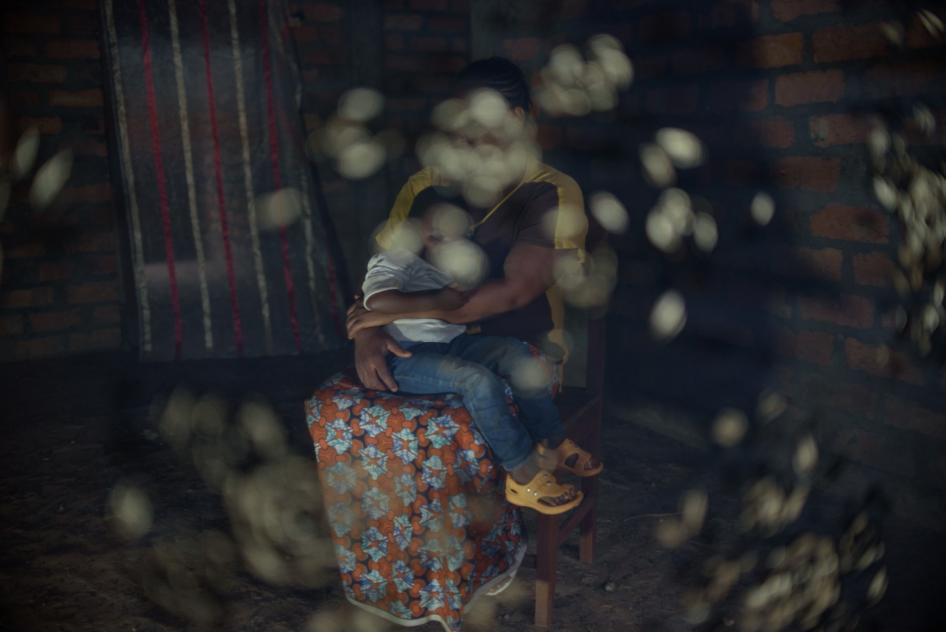
Women and children face fears of sexual violence. Photo courtesy of Human Rights Watch.
DAKAR, Senegal— A recent report by Human Rights watch released on October 5, 2017 details the horrific ordeals of the plight of women in the Central African Republic. Women in the region have been subjected to repeated instances of rape and sexual slavery. The repeated violence is the result of a coup that took place in the country in 2013;
“Thousands have died and a fifth of Central Africans have been uprooted in a conflict that broke out after the mainly Muslim Seleka rebels ousted President Francois Bozize in early 2013, provoking a backlash from Christian anti-balaka militias.”
It’s clear, according to Human Rights researcher Hillary Margalois, that the violence against women is calculated and intentional;
“Armed groups are using rape in a brutal, calculated way to punish and terrorize women and girls…Every day, survivors live with the devastating aftermath of rape, and the knowledg[e] that their attackers are walking free, perhaps holding positions of power, and to date facing no consequences whatsoever.”
This targeting has a directly negative effect on the women involved. Women may not feel as if they have effective recourses against the treatment, which may lead to underreporting of the violations against them, “Due to stigma, under-reporting by survivors, and security-related restrictions on research, the full number of sexual violence incidents by armed groups during the conflict is undoubtedly higher.”
The stigma discussed is not just that of being the victim of rape or sexual exploitation. There are also cultural factors at play that can affect women twice over, social and familial. A woman can be forced to bear shame from the violence against her and be ridiculed by family and community members;
“Stigma and rejection also present significant barriers to women and girls disclosing rape or seeking help. Survivors said their husbands or partners abandoned them, family members blamed them, and community members taunted them publicly after rape…Only 11 of the 296 survivors interviewed said they had tried to initiate a criminal investigation. Those who had informed authorities faced mistreatment including victim-blaming, failure to investigate, and even demands to present their attackers for arrest. Three survivors said that their relatives had been killed, beaten, or threatened with death when they confronted members of an armed group responsible for their rapes.”
The stigma attached to the violence, coupled with shame and ridicule, leave these women with little options to pursue justice. The threat alone of repeated physical violence or even death is enough to deter women from seeking out help. As a result, many of the aftereffects resulting from the violence and rape leave permanent afflictions;
“Women and girls often said they suffered incapacitating physical injury and illness, including HIV, because of rape, as well as suicidal thoughts and loss of livelihoods or access to education. Most had not received post-rape medical or mental health care – including medication to prevent HIV and unwanted pregnancy – due to a lack of medical facilities, the cost of services or transport to facilities, and misconceptions about available services.”
Violence against women in conflict zones is unfortunately a rather frequent occurrence in Africa. Women and children tend to be the most vulnerable and do not have the means to seek effective redress. The United Nations has spent considerable time and resources in identifying and trying to address the problem head-on. There have been regional initiatives that attempt to empower tribunals to conduct investigations into allegations of sexual violence and bring those responsible to justice. The Special Criminal Court (SCC) is backed by close to 20 non-governmental and international human rights organizations. The challenge, however, is to convince surviving victims that pursuing justice is a possibility and that it doesn’t result in further intimidation or violence from the perpetrators.