By: Katherine Hewitt Impunity Watch Reporter, Asia
NAYPYIDAW, Myanmar – Conflict between the Rohingya Muslims and the government of Myanmar have been ongoing for decades. Since 1982, the Rohingya have not been recognized as citizens, but rather illegal immigrants from Bangladesh. They are a minority group that lives in the Northern state of Rakhine.
Rohingya Refugee, Photo Courtesy of Newsweek.
Conflict escalated in mid August after a group of militant Rohingya Muslims known as the Arakan Rohingya Salvation Army or ARSA attacked 30 police posts and an army camp on the 25th of August. In retaliation the Myanmar government conducted operations to root out the militants and terrorists.
The response of the Myanmar military has been on a mass scale that primarily targeted citizens. The Myanmar security forces looted, destroyed, and burned hundreds of Rohingya Villages. Men are shot and burned. Women are raped. Children and women are attacked brutally and killed. One mother reports that Myanmar soldiers threw her month old baby on the ground, killing him instantly. Another found her children beaten dead with a shovel. Around 100,000 Rohingya have been killed in Myanmar in this new wave of violence.
Overall more than 500,00 Rohingya fled to Bangladesh to flee the violence. This migration is in addition to the 87,000 that fled from October 2016 to July 2017.
Myanmar officials deny these events, saying that it is all propaganda against the state. A government representative goes further to say that all allegations brought to the government will be investigated and that state will protect any rape victims.
The UN Secretary-General said in a speech in regards to the violence, “I call on the Myanmar authorities to suspend military action, end the violence, uphold the rule of law and recognize the right of return of all those who have had to leave the country.” The UN High Commissioner for Human rights said the crisis in Myanmar is a “textbook example of ethnic cleansing.”
The Bangladesh Foreign Minister described the violence as genocide. The National commission for Human Rights in Bangladesh is considering compiling a case against Myanmar and the army in an international tribunal.
Syria fighting worst since Aleppo, air strikes deadly: aid agencies
By Stephanie Nebehay/Oct 5, 2017
GENEVA (Reuters) – Syria is in the throes of its worst fighting since the battle for eastern Aleppo last year, with heavy air strikes causing hundreds of civilian casualties, aid agencies said on Thursday.
Hospitals, schools and people fleeing violence have been “targeted by direct air strikes” that may amount to war crimes, the United Nations said, without apportioning blame.
Russia and a U.S.-led coalition are carrying out separate air strikes in Syria ostensibly aimed at defeating Islamic State militants.
“September was the deadliest month of 2017 for civilians with daily reports of attacks on residential areas resulting in hundreds of conflict-related deaths and injuries,” U.N. regional humanitarian coordinator Panos Moumtzis said in a statement.
Air strikes killed dozens this week in Raqqa, where 8,000 people remain trapped, and at least 149 people, mostly women and children, in residential areas of rebel-dominated Idlib province in Syria’s northwest in the last 12 days of September, he said.
Explosions in Damascus killed 20 people and civilian casualties were also reported in rural areas around the Syrian capital and in Hama, Aleppo and Deir al-Zor, Moumtzis said, again without saying who was responsible.
The International Committee of the Red Cross (ICRC) said in a statement that up to 10 hospitals were reported to have been damaged in the past 10 days.
“We have seen a number of hospitals being targeted, we got very worrying reports and converging reports about hospitals, schools, civilian infrastructure being targeted,” Robert Mardini, ICRC regional director for the Middle East, told Reuters in an interview in his Geneva office.
“And of course this is outrageous, unacceptable,” he said, adding that damage to Sham hospital in Idlib alone had cut off half a million people from access to health care.
The ICRC voiced alarm that violence was occurring in many of the “de-escalation” areas including Idlib, rural Hama and eastern Ghouta. “Taken together, these are the worst levels of violence since the battle for Aleppo in 2016,” it said.
“Hundreds of civilians killed is certainly a very conservative figure,” Mardini said. “We see a very strong correlation between the escalation and the intensification in the fighting on one hand and the human cost of this conflict, the attacks on health facilities and civilian infrastructure.”
Syria’s six-year-old civil war pits President Bashar al-Assad’s government supported by Russia and Iran against a myriad number of rebel factions, some Western-backed, and Islamist militant groups.
Military jets believed to be Russian killed at least 60 civilians trying to flee heavy fighting in the oil-rich Deir al-Zor province when their small boats were targeted as they sought to cross the Euphrates River, opposition activists, former residents and a war monitor said late on Wednesday.
The U.S.-led coalition fighting Islamic State in Syria has carried out air strikes that have also caused civilian casualties, which it says it goes to great lengths to avoid.
“The point here is not to point fingers,” Mardini said, declining to identify suspected perpetrators of deadly strikes.
“What should be non-negotiable is the respect for the laws of war, everywhere in Syria. This is absolutely critical today.”
(Additional reporting by Tom Miles; editing by Mark Heinrich)
By: Adam King Impunity Rights News Reporter, Africa
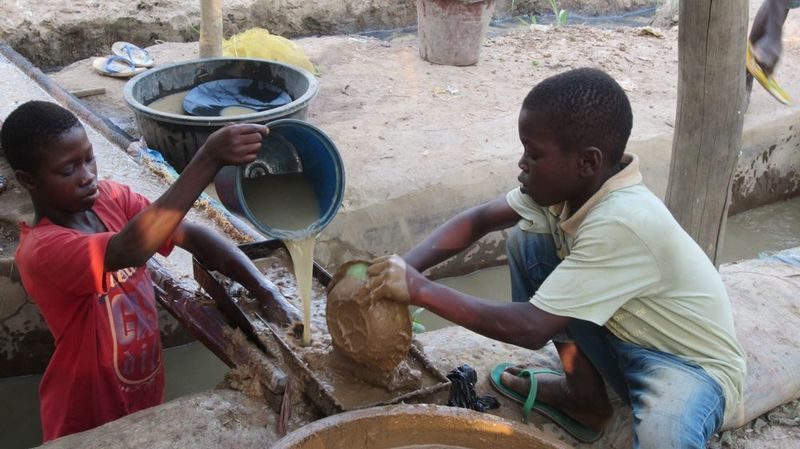
Two boys seperarte gold from ore. Courtesy of Human Rights Watch.
DADOMA, Tanzania — A new UN convention on the trade and use of mercury held its inaugural meeting on September 24, 2017 in Geneva, Switzerland. The treaty, known as the Minamata Convention on Mercury, seeks to cover a wide range of areas related to mercury,
“The treaty holds critical obligations for all 74 State Parties to ban new primary mercury mines while phasing out existing ones and also includes a ban on many common products and processes using mercury, measures to control releases, and a requirement for national plans to reduce mercury in artisanal and small-scale gold mining. In addition, it seeks to reduce trade, promote sound storage of mercury and its disposal, address contaminated sites and reduce exposure from this dangerous neurotoxin.”
The name of the convention is derived from a fishing town in Japan that involved many cases of mercury poisoning. The connection between mercury and African countries is its use in a process used to mine for gold.
Tanzania, Zimbabwe and Mali are but a few African countries that use mercury to separate gold from ore. The mining process that utilizes this method is known as artisanal and small-scale gold mining or ASGM. This process is utilized in rural areas where gold mines are located, but are not central mining hubs. While the process is not as intensive as opposed to larger mining operations, the practice does pose some health risks.
The danger of using mercury in ASGM have short and long term effects on those who come into direct contact with the mercury, “Mercury is a shiny liquid metal that attacks the nervous system. Exposure can result in life-long disability, and is particularly harmful to children. In higher doses, mercury can kill.” Children are often utilized in ASGM, given the relative ease of the process. For some, it is a way for them to earn money to support their families. The reliance on ASGM in rural communities has grown steadily over the years.
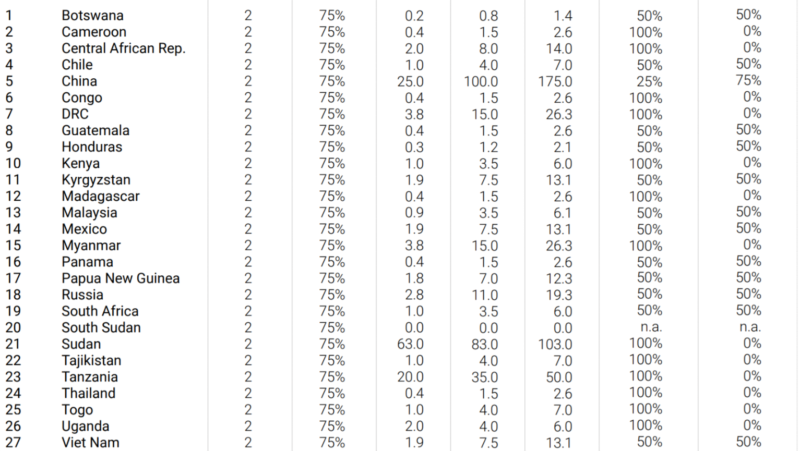
A report released by UN Environment details the amount of reliance on ASGM in Africa and worldwide,“ASGM is now responsible for around 20 per cent (600-650 tonnes per annum) of the world’s primary (mined) gold production. It directly involves an estimated 10-15 million miners, including some 4.5 million women and 1 million children.” While 20% seems to be a small percentage of the overall gold production, the numbers may not tell the entire story. In the same report, statistics detailed the level of inaccuracy regarding the reported figures of ASGM.
Data showing ASGM use by country. Photo courtesy of UN Environment.
The numbers show the wide disparity in the quality of the data reported, which is further explained by some countries who are known to export mercury, but do not necessarily disclose all instances of its export, “Trade between the countries mostly appears to be undocumented. For example, Kenya did not register any exports during 2010-15 period.”
While the convention brings more than 100 countries together to address the issue of mercury use, the convention may face challenges regionally in Africa. ASGM is a source of income for many rural families. Taking a hard stance against ASGM, where mercury is the primary agent for ore separation, could hurt a source of income for rural gold miners.
Beyond the individual considerations, country-level considerations are also relevant. Some of the more wealthier African countries play a role in the mercury trade, “Kenya and South Africa were the main supply hubs for mercury used in ASGM, especially in the Democratic Republic of Congo, Uganda, Tanzania, Zimbabwe, Mozambique and South Africa itself.” Many of the countries rely on gold production as an important source of revenue. Limiting the use and trade of mercury could have an impact on the gold industries in those countries.
“The convention comes with a long checklist of deadlines. Nations must immediately give up building new mercury mines and, within three years, they need to submit a plan of action to come to grips with small-time gold miners. By 2018, they need to have phased out using mercury in the production of acetaldehyde – the process that poisoned Minamata is still in use. By 2020, they need to have begun phasing out products that contain mercury.”
Three years to comply could pose some challenges to countries who have to not only begin phasing out the use of mercury, but also replace the lost revenue streams from ASGM with new ones.
By: Emily Green Impunity Watch Reporter, South America
SANTIAGO, Chile — Four activists for an indigenous group in Chile, the Mapuche, have ended their hunger strike of 118 days. The men starved themselves in protest of their imprisonment and the terrorism charges brought against them.
Protestors in Chile demand justice for Mapuche prisoners. Image Courtesy of Telesur.
After a year and four months of imprisonment with no trial, the strike has come to an end. The Chilean government announced its decision to drop the controversial terrorism charges against these Mapuche prisoners. Alfredo Tralcal, a leader of the indigenous group, and brothers Benito and Pablo Trangol ended their strike as a result. The fourth prisoner, Ariel Trangol agreed to resume a normal diet again the day after his brothers, totaling 118 days on strike.
These prisoners are accused of burning down an evangelical church last year. The church was in a southern region that the Mapuche claim as their ancestral territory. The court brought them up on terrorism charges through a law that dates back to General Augusto Pinochet’s dictatorship from 1973-1990. This law is known to be abusive and a violation of human rights. It authorizes officials to keep suspects in isolation without charges for up to two years, as well as the use of secret witnesses in trial.
In protest of this outdated and highly controversial law, the men endured a hunger strike for over 100 days. According to a medical expert, on September 1st the prisoners had lost 15-22kg and were presenting serious symptoms such as a deterioration of brain function. At one point, one of the four progressed to stop drinking liquids. Reports say that two of the men had to be taken to a hospital because of their weakening condition.
As their relatives watched them deteriorate, they begged the government to allow a common trial and drop the terrorism charges. The government remained steadfast and refused to let them out on house arrest, even though they have not been able to uncover any incriminating evidence since the arrest one year and four months ago.
The government’s refusal led to protests all over Chile. They called for justice for the indigenous Mapuche inmates. In Santiago, the police clashed violently with demonstrators who marched through the streets chanting for “Mapuche dignity.” The police used water cannons to break up the protest.
The Mapuche is Chile’s largest native ethnic group. They have been fighting with the government for two centuries over the land they lost in the 19th century. After battling conquest for 300 years, the Chilean military expanded and overtook their land. They encouraged European immigrants to colonize the area and the Mapuche have been struggling ever since. Today, the Mapuche are the poorest group in the country and suffer from illness, malnutrition, and discrimination.
Mapuche claims on land have resulted in “decades of struggle, leading to violence and death against leaders, as well as women, children, and the elderly by the Chilean state.”
By Sarah Purtill Impunity Watch Reporter, North America
ALBANY, New York – Governor Andrew Cuomo signed a bill into law on September 13th that would help increase the protections against elder abuse. Assemblywoman Donna Lupardo (D-Binghamton) sponsored the bill which is now law. 11 of her fellow Assemblymen co-sponsored the bill. The new law requires state agencies to develop guidelines to help healthcare providers detect cases of elder abuse, self-neglect and maltreatment.
New York Governor Andrew Cuomo signed a new bill into law strengthening the protections against elder abuse. Photo courtesy of Biography.
The Office for the Aging, the Department of Health, and the Office of Children and Family Services will develop the guidelines and will have the guidelines available on their websites. Lupardo said, “We want the Department of Health to be a resource for this information for healthcare professionals, where they can find information on signs and symptoms, screening tools, protocols and referrals for appropriate treatment.” Her hope is that by placing all the information in one place on each website will make the information more accessible.
10% of Americans over age 60 have experienced some form of elder abuse according to the National Council on Aging. Elder abuse has many forms including physical, financial and psychological. According to a 2011 study on elder abuse, for each reported incident of abuse, there are 24 unreported incidences.
The bill before the Assembly had included increased protections against financial abuse as well, but Lupardo said it has been difficult to get all the parties to come to an agreement. The suggestion that had been in the bill was to simplify the forms for power of attorney and to have banks offer the option of opening a convenience account when a customer wants a joint account. Governor Cuomo also recognized the financial abuse of our elders, calling it a “national issue.”
Some of the counties in New York have begun to address the issue on their own. The employees of Otsego County Office for the Aging have undergone regular training on elder abuse and will be attending more in the future. Many employees went to a training on September 26th in conjunction with the New York State Office for the Aging and the Broome County Family Violence Prevention Council. The training focused on financial abuse of seniors. Organizer Denise Shukoff said, “Elder abuse is a public health issue, and health professionals are seeing and recognizing this more and more.”
Advocates of the law say that the goal is to assist healthcare workers build relationships with their patients, detect signs of abuse, and report them to the authorities.