Sudanese Men Sentenced to Death for Killing a U.S. Envoy

By Jennifer M. Haralambides
Impunity Watch Reporter, Africa

KHARTOUM, Sudan –
A Sudanese court has upheld the death sentence of four Islamists who were convicted of killing John Granville, an American Diplomat, along with his Sudanese driver, Abdel Rahman Abbas. .

The two men were shot in the early morning hours on January 1st just after a New Year’s Eve party.  At the time, Granville was working for the U.S. Agency for International Development.

The four men were convicted last year in the Sudanese capital and were sentenced to death by hanging after the court upheld their death sentences.

During the trial, Judge Sayed Ahmend Al-Badry recited quotes from Islamic texts denouncing any killings regardless of if they are Muslims.  After reminding the men that it is a great sin to take another person’s life, he announced his verdict.

Calling Granville an “infidel,” the men said that Muslims should not be executed for killing non-believers.  In June, following their conviction, the men raised their hands and shouted slogans as they walked out of the Sudanese court.

Originally the death sentence was passed in June, although under Sudanese law the family of the murder victim has a few options.  They can either request the death penalty, forgive, or ask for compensation.

On Sunday, the letter from Granville’s mother was read aloud to the court which specified that she wanted the four men to be executed in order to “safeguard the lives of others from those who killed her beloved son.”  There was no option of life imprisonment.

“Her wish was to apply death by retribution and the court accordingly passed death sentence by hanging,” said Granville’s lawyer, Taha Ibrahim.  “It is the legal sentence, it is proper, it is according to the law and it will be executed.”

The convicted men maintain their innocence saying that their videotaped confessions were taken under torturous situations.

For more information, please see:

BBC – Sudanese to Hang Over U.S. Killing – 12 October 2009

VOA – U.S. Diplomat’s Killers to Hang for Murder in Sudan – 12 October 2009

AFP – Slain US Diplomat’s Mother Seeks Sudan Killers’ Death – 11 October 2009

The Washington Post – Sudanese Convicted of U.S. Murder Dismiss Defense – 11 October 2009

China Promises to Protect Press Freedom


By Hyo-Jin Paik
Impunity Watch Reporter, Asia

BEIJING, China– In a speech at a meeting of global media leaders, the World Media Summit, President Hu Jintao promised that China would protect the rights of international news agencies reporting in China.

Along with China’s economic boom, news coverage on China also grew significantly over the years.  China has improved the reporting environment for foreign press in the past six years by loosening the tight control the communist government had over reporters, but Chinese officials continue to censor certain sensitive topics, including coverage of human rights.

Chinese government has stringent control over their media, and journalists are severely restricted as to what they can and cannot report.  All media in China are also owned by the government.

Although the Chinese government eliminated their policy of requiring journalists to obtain permission to travel to cities outside of Beijing or Shanghai, journalists still complain of assault and detainment when traveling in smaller towns and the countryside.  Furthermore, access to government ministers is near impossible, and public officials are often reluctant to go on record.

However, President Hu said, “[China] will continue to make government affairs public, enhance information distribution, safeguard the legitimate rights and interests of foreign news organizations and reporters, and facilitate foreign media coverage in China….”

News Corporation Executive Rupert Murdoch, one of the attendees of the Summit, criticized the Chinese media market for being too “sheltered.”  He urged for more openness saying, “China will ultimately decide its own fate, but unless the digital doors open, opportunities will be lost and potential will not be realized.” 

Murdoch also pointed out that China’s state-run media has hindered growth and development of China’s media industry.  He added that the Chinese government should also address copyright piracy so that Chinese media companies can generate more profits.

This Summit was attended by 300 media representatives from 80 different countries.  Some rights groups have criticized China for hosting this meeting since China has a history of censorship and limiting reporting opportunities for foreign journalists.
For more information, please see:

AP – China pledges to protect foreign media – 9 October 2009

Irish Times – Chinese leader supports rights of media groups – 10 October 2009

WSJ – Murdoch Urges China to Open Up to Media – 8 October 2009

New Report -Thousands of Indian Women Dying in Childbirth


By Megan E. Dodge
Impunity Watch Reporter, Asia

LUCKNOW, India- A report released on October 7, “No Tally of the Anguish: Accountability in Maternal Health Care in India,” reveals that tens of thousands of women and girls in India are dying during pregnancy, childbirth, and the weeks that follow. Human rights activists are concerned with this finding which suggests that government programs that guarantee free obstetric health care are unsuccessful in their efforts.

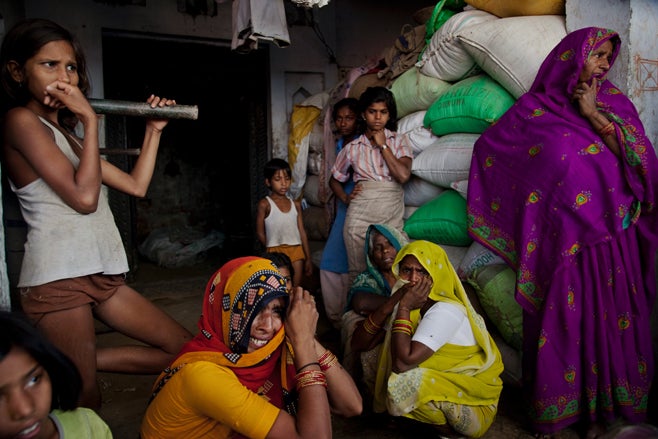
Family mourns death of adolesent girl who died after giving birth. Courtesy of Care2.

The research for the report was conducted between November 2008 and August 2009 by the Human Rights Watch included field research and interviews with victims, families, medical experts, officials and human rights activists in Uttar Pradesh (located in Northern India) and surrounding areas. Researchers reviewed government surveys and reports by local and international nongovernmental organizations. The area was selected because it has one of the highest maternal mortality ratios in India, though government surveys show it is not alone in struggling with these problems, including recordation errors such as statistics indicating the number of women actually dying from pregnancy related complications.

The report includes breakdowns that show how specific cases were failures and the result that occurred. For instance, Kavita K. is tracked in the report and indicates that she developed post-partum complications, that the local community health center was unable to treat her. Testimony from her father, Suraj S. was also included, in which he states that the family tried to bring her to three different governmental hospitals, but none wanted to admit her. The fourth hospital took Kavita in as a patient, but an hour after treatment she died.

While India has created programs such as, the National Rural Health Mission, to improve rural health, with a specific focus on maternal health, the report illustrates the shortcomings and gaps in these governmental sponsored programs. The “concrete service guarantees,” including free care before and during childbirth, in-patient hospital services, comprehensive emergency obstetric care, referral in case of complications, and postnatal care clearly is not reaching the tens of thousands of Indian women and girls still dying from these and related child birthing complications. One of the biggest criticisms is accountability.

2009 Peace Summit Highlights the Cost of War in Colombia

By Sovereign Hager

Impunity Watch Reporter, South America

BOGOTÁ, Colombia – Organizations representing under-served sectors of the Colombian population and a group of thirty-one experts and activists from twenty countries met for a peace summit created by Bogotá’s leftists mayor and Father Francisco de Roux, head of the Jesuit Order in Colombia. Throughout the four day summit, experts made proposals for resolving the current humanitarian crisis and the armed conflict in Colombia.

The summit was created to spawn a “citizens’ movement” for peace, and culminates with the adoption of the “Bogota Manifesto for World Peace” and the presentation of a petition to nominate the indigenous communities from the Sierra Nevada de Santa Marta mountains for a Nobel Peace Prize.  The meeting was held in Colombia because, according to Bogotá Mayor Zaragoza, in Colombia “force needs to be replaced with words and negotiation.”

Colombia has been in a state of civil war for almost fifty years and the day that the Summit began, twenty-six FARC guerrillas were killed in a bomb attack by the air force and the army in the central province of Tolima.  An undetermined number of peasant families were killed trying to flee the attack.

Civilians are often trapped in the crossfire, accused of siding with either side of the conflict and rights organizations estimate that approximately ten percent of the population of Colombia has been displaced by the war. Despite this, Colombia is the largest recipient of U.S. military aid in the americas and the third largest recipient in the world, receiving more than five billion dollars since 2000.

The activities of indigenous “peace communities” were highlighted at the summit. Videos showed the suffering that the people from San José de Apartadó, Tiquisio, Cavida and Toribio had endured over the last two decades. This included “mass murders, displacement, years living in places like stadiums and later the return (to their village) as a peace community, where (they) have faced forced disappearance and harassment.” Peace communities have declared themselves neutral in all armed conflict.

A principle concern among experts and citizens is the proliferation of military power in Colombia and globally occurring alongside situations of extreme poverty. “We have to fight to assure a progressive change from this unbridled, disproportionate military spending to investment in a renewable energy and food production”, said Bogotá Mayor Zaragoza.

Experts recognized American President Barack Obama’s decision to cancel the anti-missile shield project in Europe and to take the lead in nuclear disarmament as a vital step towards peace. However, concern remains over the use of Colombian military bases by U.S. soldiers.

Experts in attendance urged the world to recognize that such steps towards toward peace will facilitate a shift towards sustainable world development, via the United Nations and a multilateral system in which all countries, not only the most powerful, are taken into account.

Mayor Zaragoza stated that, “we will build peace, because it is the greatest legacy that we now have to bequeath to future generations.”

For more information, please see:

IPS: COLOMBIA: Talking About Peace in the Middle of War – 5 October 2009

Pressenza – The World Peace Summit Condemns the “Colossal Military Expenditure Throughout the World – 11 October 2009

La Cumbre Mundial – La Cumbre Mundial de Paz Reúne en Bogotá a Expertos y Activistas de 20 Paises – 30 September 2009

Election Reform Needed in Kenya to Eliminate Post-Election Violence

By Kylie M Tsudama
Impunity Watch Reporter, Africa

NAIROBI, Kenya – Former UN Secretary General Kofi Annan went to Nairobi to assess the status of implementing agreements made during the Kenya National Dialogue and Reconciliation (KNDR) process.  There he met with President Mwai Kibaki and Prime Minister Raila Odinga in Kenya to discuss, in particular, those institutional reforms under Agenda Item Four dealing with land reforms, ending poverty, employment and historical adjustments.

His visit comes as Kenya is facing increased international pressure because of its slow response in implementing agreed reforms.

Both President Kibaki and Prime Minister Odinga signed a power-sharing deal to end last year’s bloodbath.  They have both expressed their commitment to introducing necessary reforms to the country.  Annan said he is encouraged by their commitment.

Annan was instrumental in mediating an end to last year’s violence.  He has said that the country should form a local tribunal to try the suspected perpetrators.  He believes that this would require both a Kenyan court and the International Criminal Court (ICC).  The President and the Prime Minister, however, believe that this would only require the ICC and not a Kenyan court.

While the President and Prime Minister have made progress toward implementing the reforms, Annan said “the pace of the reforms must be accelerated.”

“Kenya cannot afford a recurrence of the crisis and violence that engulfed it after the 2007 elections.  But that is a serious risk if tangible reform is not achieved,” he said.  “Kenyans are concerned that the window of opportunity to deliver reform is rapidly closing.”  He continued, “Kenyans who are normally patient people are beginning to doubt whether their leaders can deliver.”

Violence last year was sparked by accusations that Odinga rigged the election so that Kibaki would win reelection.  What started as political violence turned into tribal killings based on poverty, long-held ethnic hatred, and unresolved land disputes.  It left 1,200 dead and another 350,000 displaced.

“My conversations with Kenyans during the last three days have underscored that there is a crisis of confidence in Kenya’s political leadership,” Annan said.

He believes that of reforms are not quickly implemented the next round of violence would not be committed with spears an machetes as usual but with firearms.  He warns that the 2012 elections are quickly approaching.

“[The nation] cannot afford another cycle of violence,” Annan said.

For more information, please see:

AFP – ‘Serious Risk’ of Fresh Kenya Unrest id no Reforms: Annan – 08 October 2009

The Standard – Follow-up Visit by Chief Mediator Shows Kenya Still on the Radar – 08 October 2009

VOA – Kenya Warned of Future Poll Violence – 08 October 2009

AP – Annan: Kenya Postelection Violence Tribunal Needed – 07 October 2009

Xinhua – Former UN Chief Lauds Talks with Kenyan Leaders – 06 October 2009