By Matthew Sneed Impunity Watch Reporter, The Middle East
Kabul, Afghanistan – On Wednesday, September 6, the United States issued an apology for a recent distribution of “highly offensive” leaflets. Tuesday night, troops dropped the leaflets over homes in the Parwan Province. The leaflet displayed the image of a lion chasing a dog. The lion symbolized the U.S. forces while the white dog represented the Taliban.
The U.S. distributed the leaflet in the Pawran Province. Photo Courtesy of Los Angeles Times.
On the picture were the words “Get your freedom from these terrorist dogs,” and “Help the coalition find these forces and eliminate them.” However, the source of the anger stemmed from the writing on the dog. The writing was meant to be a depiction of the Taliban flag; however, the Taliban prints the Shahada on their flag. The Shahada is the most common prayer in the Muslim faith. It says, “There is no god but God, and Muhammad is his prophet.”
The dog is viewed as an unclean animal and placing the holy saying on an unclean animal sparked outrage in the region. During the sermon on September 8, Muhammad Ayaz Niazi, the imam, criticized the actions of US forces and stated, “You have disrespected the feelings of 1.8 billion Muslims and all they hold sacred,” and added, “Those who have committed this grave crime are trying to test our people, to see if they are dead or alive. We promise to defend our values, defend our religion, defend our soil.”
The leaflets not only angered the community but provoked a deadly response as well. On September 6, a suicide bomber attacked the U.S. military base in Afghanistan. The explosion wounded three U.S. solders, three Afghan soldiers, and killed an Afghan reporter. The Taliban claimed responsibility for the attack the same day. Spokesman Zabihulla Mujahid took to Twitter and said the attack was to “avenge” the leaflets.
This is not the first culturally insensitive action link to U.S. troops. In 2012, troops burned several copies of the Qur’an while destroying damaged books and texts from Bagram airfield library. This resulted in protests the led to the death of several civilians. Troops also have a history of violating other customs such as unleashing dogs on villagers and searching through women’s bedrooms.
In his statement to the press, Major General James Linder, the U.S. special operations commander in Afghanistan, apologized for the leaflets. He stated there was “no excuse for this mistake,” and that he would “make appropriate changes so this never happens again.”
By: Fernando Oliveira
Impunity Watch Reporter, South America
GENEVA, Switzerland – On September 11th, 2017, UN High Commissioner for Human Rights, Zei Ra’ad Hussein, stated that “the world has grown darker and more dangerous.” At his inaugural speech at 36th Session of Human Rights Council, Hussein cited Venezuela and Brazil, among 40 other countries, as countries wherein human rights have been significantly violated.
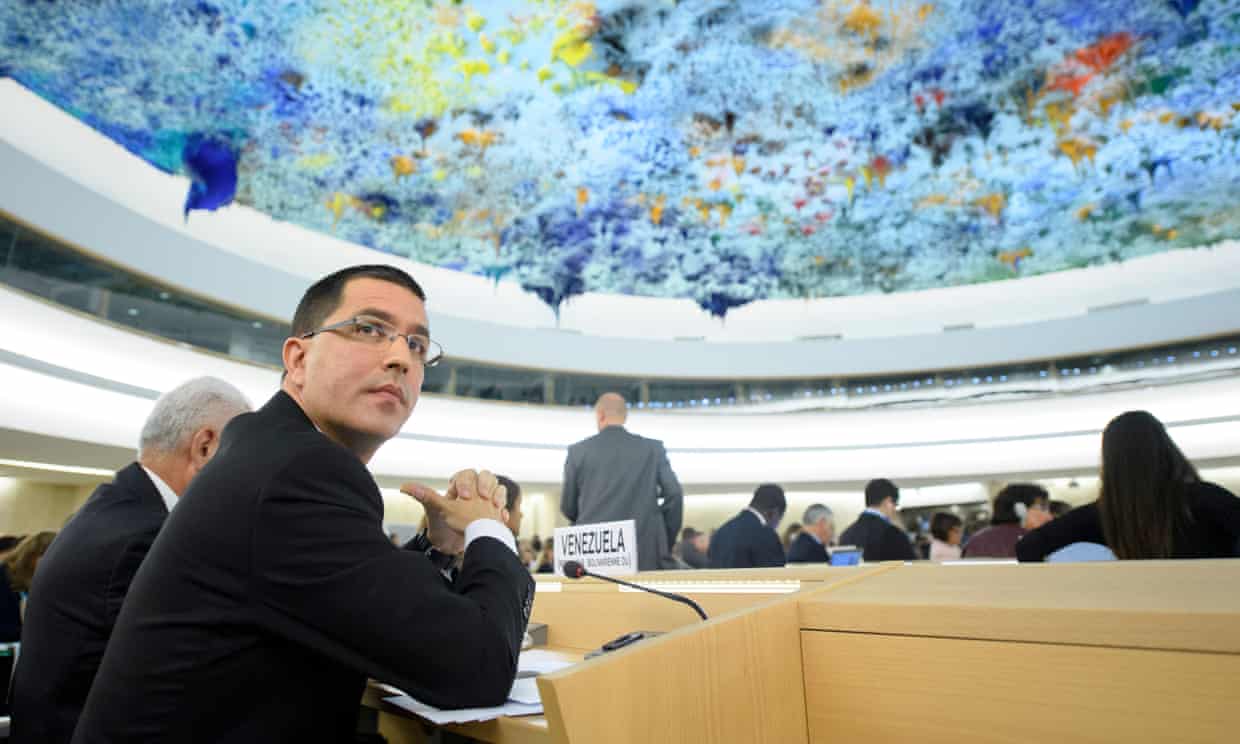
Venezuelan Foreign Minister Jorge Arreaza Montserrat during the opening of the 36th session of the Human Rights Council, at the European headquarters of the United Nations in Geneva on 11 September. Picture courtesy of The Guardian.
Hussein’s statements were based on a wide number of incidents, holding that those two South American countries have been suppressing human rights.
In fact, since former president Hugo Chavez arose 15 years ago, all human rights organizations have expressed concerns about the policies enacted by Venezuela’s government. Massive reports indicate that citizens’ basic rights, such as freedom of speech and peaceful assembly have been abridged. Political imprisonment, ill-treatment of prisoners, and excessive use of force against civilians have been highlighted as well. Furthermore, the executive branch is accused of having frequently attacked public institutions, including the parliament and the supreme court, in order to suppress any kind of reaction from the opposition parties. This long period of misconduct has led the country to an unprecedented financial collapse and launched its people into misery and starvation. Although president Nicolás Maduro has denied all the foregoing charges, the evidences seem to show the reports are right.
Regarding Brazil, despite the undeniable human rights violations, the situation is somehow different. Unlike Venezuela, there are no clear signs of deliberate government attacks against democratic institutions in Brazil. However, the human rights violations are related to a wide swept corruption scheme, which was unveiled by an ongoing investigation, started in 2014, and led by the Brazilian attorney general’s office. The widespread corruption scandal undermined the country’s resources, and carried it to a serious political instability that resulted in former president Dilma Rousseff’s impeachment. According to Brazilian federal prosecutors, billions of dollars have been illegally diverted, and many high authorities and successful entrepreneurs have been arrested due to bribery crimes.
Even the president, Michel Temer, has been criminally indicted before the Supreme Court. It is easy to see how far the systematic corruption has gone in that country, as former president of Brazil, Luiz Inacio Lula da Silva, and the former president of its House of Representatives, Eduardo Cunha, have been criminally convicted of bribery, the first to nine and a half years in prison, and the second to fifteen and a half years, and 4 months in prison. The ongoing government corruption has deprived Brazilians of basic human rights, such as education, health, safe and so forth.
Based on the foregoing facts, Hussein addressed his speech to UN Human Rights Council as follows:
“Last month my Office issued a report on Venezuela, highlighting excessive use of force by security officers, and multiple other human rights violations, in the context of anti-Government protests. There is a very real danger that tensions will further escalate, with the Government crushing democratic institutions and critical voices – including through criminal proceedings against opposition leaders, recourse to arbitrary detentions, excessive use of force, and ill-treatment of detainees, which in some cases amounts to torture. Venezuela is a Member State of this Council, and as such has a particular duty to “uphold the highest standards in the promotion and protection of human rights”, in the words of Resolution 60/251. My investigation suggests the possibility that crimes against humanity may have been committed, which can only be confirmed by a subsequent criminal investigation. While I support the concept of a national Truth and Reconciliation Commission, the current mechanism is inadequate. I therefore urge that it be reconfigured with the support and involvement of the international community. I also urge this Council to establish an international investigation into the human rights violations in Venezuela.
Corruption violates the rights of millions of people across the world, by robbing them of what should be common goods and depriving them of fundamental rights such as health and education or equal access to justice. Recent scandals, including very serious allegations levelled at high-ranking officials in Brazil and Honduras, have revealed how deeply corruption is embedded in all level of governance in many countries in the Americas, often linked to organized crime and drug trafficking. This undermines democratic institutions and erodes public trust. Progress towards uncovering, and prosecuting, corruption at high levels of government is an essential step forward in ensuring respect for the people’s rights, including justice.”
Jordan’s shift in south Syria, the sixth round of Astana talks and the complex battle in Eastern Syria.
Sep. 15th, 2017
Jordan’s shift in south Syria, the sixth round of Astana talks and the complex battle in Eastern Syria.
For Syria Deeply’s ongoing feature, Expert Views, we’re gathering fresh insight and commentary from our expert community. This week, we invite you to share your insights on this topic: What factors contributed to the suddenly closer ties between Jordan and Syria and how did this impact their respective allies?
Southern Syria: Several developments in southern Syria this week have further pointed to a thawing of relations between Amman and Damascus, despite weeks of clashes between Jordan-backed Syrian rebels and pro-Syrian government forces.
The CIA, Saudi Arabia and Jordan allegedly have asked two Free Syrian Army (FSA) affiliates – Usoud al-Sharqiya and Martyr Ahmad Abdo – to surrender their positions, cease all fighting with pro-government forces and retreat to Jordan, Reuters reported.
“We have rejected the request, since if we entered Jordan we would consider it the end … the blood of our martyrs has not dried yet,” Badr al-Din al-Salamah, a senior official in the Usoud al-Sharqiya group, told Reuters.
Following the alleged request, Jordan and Russia’s foreign ministers met in Amman to discuss details of a proposed de-escalation zone in southern Syria.
“The goal is to set up a de-escalation zone in the fastest possible time. Our priority is that our borders are secure and that means that there should be no Daesh nor Nusra nor sectarian militias,” Jordan’s Minister of Foreign Affairs Ayman Safadi said, referring to ISIS and the former name of al-Qaida’s branch in Syria.
According to Reuters, Russian Foreign Minister Sergei Lavrov also brought up the issue of reopening Jordan’s Nasib border crossing with Syria. Jordan’s King Abdullah II said in an interview published on Thursday that the Jordanian border with Syria will open when security conditions in southern Syria improve.
Astana round six: De-escalation zones are the primary focus of the sixth round of Syria talks, ongoing in the Kazakh capital of Astana. The Iran, Russia and Turkey- brokered talks began on Thursday and included representatives of the Syrian government and some rebel factions.
On Friday, Turkey’s state-run news agency claimed that representatives from Moscow, Tehran and Ankara agreed on the borders of a fourth de-escalation zone in Syria’s northeastern Idlib province.
“Officials from Turkey, Russia and Iran have agreed the borders of the zone in the northern province of Idlib and are negotiating over which monitors will be deployed,” the Anadolu news agency reported, citing anonymous Turkish and Russian diplomatic officials.
Turkey’s foreign ministry released a statement later on Friday that said Turkey, Iran and Russia would deploy “observers… at check and observation points in safe zones that form the borders of the de-escalation zone,” Reuters reported.
“The main mission of these observers has been defined as the prevention of clashes between the regime and the opposition forces and any violations of the truce,” the statement added.
As of Friday afternoon, it was still unclear which areas of Idlib would be included. Idlib is the last province in Syria under full rebel control and was one of the four zones proposed in the May de-escalation agreement.
Battle in eastern Syria: The complex battle against the so-called Islamic State continued in eastern Syria, as various warring sides saw respective influxes of fighters.
Over the weekend, the U.S.-backed Syrian Democratic Forces launched a campaign against militants in the oil-rich eastern province of Deir Ezzor. The Kurdish-Arab alliance reached an industrial zone outside Deir Ezzor city, but would not enter, anti-ISIS coalition spokesman said on Thursday.
According to U.S. Army Col. Ryan Dillon, the SDF will focus its operations on areas south of Deir Ezzor city, along the Euphrates River. This will detract from direct confrontation with pro-government forces in the area.
On Monday, reinforcements for Syrian troops and allied fighters arrived in Deir Ezzor, as pro-government forces prepare for “an attack to push Daesh [ISIS] from the city’s eastern neighborhoods,” said Rami Abdulrahman, head of the U..K.-based Syrian Observatory for Human Rights (SOHR). Reinforcements included equipment, vehicles and fighters, he added.
ISIS also saw fighter arrivals in eastern Syria this week. Part of the convoy carrying hundreds of ISIS fighters and their families who were recently evacuated from the Lebanese border, arrived in the town of Mayadin on Wednesday, the New York Times reported.
Russian and international coalition airstrikes reportedly killed more than a hundred people in eastern Syria since Sunday, many of them children, according to the SOHR.
The sale and trade of women in Syria is not a wanton and senseless consequence of war. It is a consequence of a war economy in which nearly all warring parties and even civilians use women to secure profit, weapons, access or leverage in negotiations.
Author Joseph Daher examines the Syrian government’s reconstruction strategy and warns that Assad will use rebuilding to reward foreign allies and consolidate power around a small core of Syrian elite.
Lina Khatib, Lina Khatib is the Head of the Middle East and North Africa Programme at Chatham House.
In Syria, hard evidence no longer drives accountability. The biggest beneficiary has been the Assad regime and its allies, who cannot be blamed for thinking they can get away with anything, says Lina Khatib, head of Chatham House’s Middle East and North Africa Program.
Aron Lund, Aron Lund is a freelance journalist and analyst specializing in Syria and a regular IRIN contributor.
Depending on the stability of the cease-fire, it seemed likely that the Syrian-Jordanian border will reopen sooner or later, writes Aron Lund, senior fellow at the Century Foundation.
FIRST LOOK
Upcoming coverage
We are always looking for new writers, experts and journalists who are covering the crisis in Syria and are interested in writing about a variety of topics. Please send us your ideas, story pitches and any other thoughts about our coverage via email, Twitter or Facebook.
By Sarah Purtill Impunity Watch Reporter, North America
TORONTO, Canada – Canada is known around the world as accepting of immigrants and refugees. Personal stories about the positive experiences immigrants and refugees have in Canada come out every day. Seidu Mohammad, a Ghanaian refugee in Canada is chasing his dream of being a professional soccer player. His team is currently on a winning streak and the pressure is on to keep it going.
Ahmed Hussen prepares for a citizenship ceremony in Toronto. Photo Courtesy of The New York Times
Ahmed Hussen is another refugee who came to Canada from Somalia 25 years ago. He was named immigration czar in January 2017 and is the first refugee to be appointed to the spot. After coming to Canada, he worked to get himself through college and then law school. He proclaimed “everyday generosity of Canadians … helped me each and every step of the way.”
Hussen continues to promote Canada’s open door policy despite pressure to close the border. This pressure stems from the Canadian refugee processing system being overwhelmed by Haitians who have lined up at a ditch in Champlain N.Y. out of fear of deportation from the United States.
But Hussen is not the only one addressing the refugee problem. While Canadian Prime Minister Justin Trudeau personally welcomed a planeload of Syrian refugees arriving in Canada in December of 2015, by September of 2017, it appears that welcome does not apply to Haitian refugees from the United States.
Trudeau claims “for someone to successfully seek asylum it’s not about economic migration. It’s about vulnerability, exposure to torture or death or being stateless people.” The turn away of Haitian refugees disagrees with Trudeau’s statement.
Haitian human rights lawyer Patrice Florvilus believes Canada’s claims that “things have returned to normal” in Haiti is not true. Florvilus believes Canada should grant Haitians refugee status, “if Canada wants to become a real beacon for refugees.”
Haitian refugees are not the only ones having trouble getting into Canada. Syrian refugees who can make it to Canada are usually the “richest and most well-educated members of their society” because they are the ones who are able to pay off human smugglers. The political ramifications here do not bode well for Syria.
Typically, refugees who seek asylum in the geographical vicinity of the country they are escaping from return when the conflict ends. But those who travel across oceans do not come back. This means that when the Syrian conflict ends, the country will see a shortage of doctors, dentists and nurses. Essentially, this system of migration is a lottery for the rich and powerful.
While Canada has done plenty of good for many refugees, it may not have truly earned its reputation as an open and inviting place for refugees and asylum seekers.
By: Max Cohen Impunity Watch News Reporter, South America
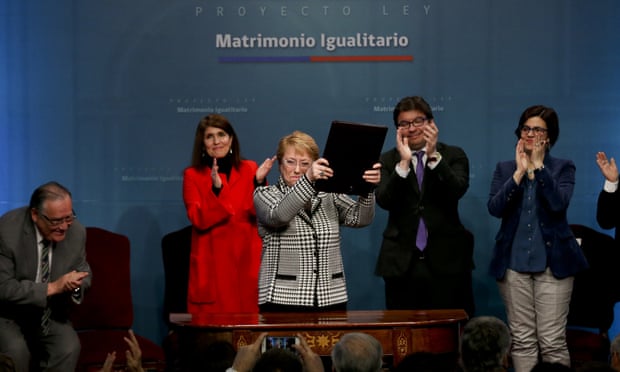
SANTIAGO, Chile – About a week after Chile’s Constitutional Tribunal officially approved a law lessening the country’s restrictions on abortion, President Michelle Bachelet has introduced a bill to legalize gay marriage. Chile previously decriminalized gay sex in 1999 and approved civil unions in 2015. If approved, the measure would redefine the country’s definition of marriage, and expand the rights of gay couples by allowing them to adopt children. It would also recognize the marriages of same sex couples married abroad.
Chilean President Michelle Bachelet holds aloft the portfolio containing the proposal for legislation to legalize same sex marriage. Photo courtesy of Associated Press.
After passage of a bill decriminalizing abortion under certain circumstances, a few legislators requested review of the law before the Constitutional Tribunal claiming that it would violate the Chilean constitution’s guarantee of protection of the unborn. On August 21st, the ten justices voted six to four in favor of the legislation, which replaced a law passed in the last years of the Pinochet dictatorship. Currently, women may now legally get an abortion in the country when the mother’s life is in danger, the fetus is unviable, or when the pregnancy is the result of rape.
On August 28, President Michelle Bachelet signed a proposal to legalize gay marriage in the country, which now goes to the legislature to decide on. In signing the proposal, President Bachelet said, “We can’t let old prejudices be stronger than love.” Though civil unions have been recognized in several South American countries, only Argentina, Uruguay, Brazil, and Columbia have thus far legalized same sex marriage, with the latter two legalizing it through court rulings.
With her term ending in March 2018 though, President Bachelet is unlikely to see the bill passed. One of her potential successors, former president Sebastian Pinera, who polls at the time of writing this article have favored to win the upcoming November election, opposes the bill. In a statement to the BBC, he said, “There should not be discrimination, but at the same time the essence of an institution such as marriage should be respected, which has always been about conserving the human race.” Still though, gay rights activists within the country are celebrating the move as historic.



 MOST POPULAR

 EDITOR’S PICKS