By: Sara Adams
Impunity Watch News Reporter, Europe
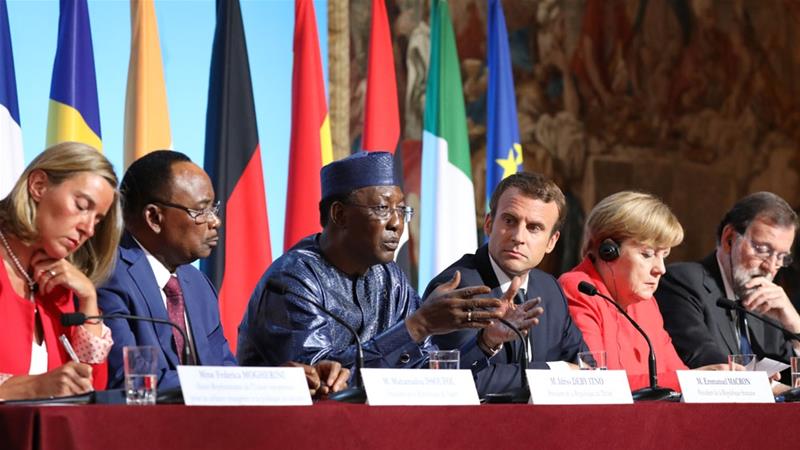
PARIS, France – French President Emanuel Macron played host to several world leaders in Paris on August 28 in a meeting over the migrant crisis.
Present were leaders from four European countries that have faced a heavy influx of migrants from Africa in the past several years.
Germany, France, Italy, and Spain sent their heads of state to Paris for the meeting. Alongside them were the presidents of Niger, Chad, and the head of Libya’s unity government.
President Macron praised Italy for their recent policies on nongovernmental aid rescues off the Libyan coast.
Italy has been working with Libya’s coast guard to reduce the number of illegal migrants coming to their shores.
“[This] is a perfect example of what we are aiming for,” President Macron said.
German Chancellor Angela Merkel called for “urgent” rethinking of the European asylum system to curb the instances of illicit human trafficking across the Mediterranean.
She called for a system of asylum in which there is a defining line between having “legitimate humanitarian needs” and “fleeing poverty”.
Some of the African leaders at the mini-summit disagreed with the Chancellor’s approach. Niger’s President Mahamadou argues that poverty is the driving force behind migration. That driving force, he says, is what leads people into trafficking.
President Mahamadou says that the crux of the issue will always be development. Without more resources, he says, this problem will continue to exist.
Chad’s President Idriss Deby Itno concurred with Niger. He cited “poverty and a lack of education” as the main reasons Africans make the perilous journey to Europe.
Despite instances of disagreement, the nations did come to one policy covenant.
Plans were proposed that would entail migrants seeking asylum to apply for protection while they remain in Africa. Currently, there is no policy in place preventing migrants from coming to the European mainland and subsequently applying for asylum where they land.
President Macron suggested that the European Union pay 60 million euros to Africa in order to help with the process.
This is one of the first times Europe has worked directly with Africa to stem the crisis.
President Macron insists that the only way the migrant crisis can be solved is by coherence between the European Union and the African Union.
“[The issue is a] problem that concerns us all and that cannot be solved without us all,” he said in a statement after the meeting was over.
“This is a challenge for the European Union and the African Union…that [needs to be approached] with solidarity, humanity, and efficiency.”
For more information, please see:
BBC News – Migrant crisis: Macron unveils plans after meeting – 28 August 2017
Al Jazeera – EU, African leaders back new plan over migrant crisis – 28 August 2017
The Guardian – African and European leaders agree action plan on migration crisis – 28 August 2017
The New York Times – European Leaders Look to Africa to Stem Migration – 28 August 2017