Social media gives voice to creative expression in ways that news media could never convey. Photographers may capture destroyed buildings and bloody casualties but through an artist’s eyes you feel the story in a way that is truly personal. Art can be disturbing and healing both in its’ creation and through the experience of the viewer. Artist Moustafa Jacoub of Syria has a profound way of contrasting the humanitarian crises with the universal desire to dream and play.
Whatever your personal interpretation may be, the feelings are universal within each of us.
We experience earthly angst and sublime beauty with a backdrop of sun and stars as our planet floats through time.
We may be refugees from our place of origin, immigrants traveling across eternity, but there is a place within each of us that is home…
In that place we are all connected despite the circumstances of our personal lives.
Compassion is the thread that stitches the seams of our torn reality.
Rise for Syria is a powerful, citizen-driven initiative to alleviate suffering for those who have lost their homes and are traumatized by the war. Even the smallest amount of generosity will go a long way to helping people heal and rebuild their lives!
NAYPYIDAW, Myanmar – Myanmar’s government stated that it will not allow members of the United Nations to enter the country to investigate potential human rights violations against Rohingya Muslims.
Aung San Suu Kyi, Myanmar’s leader, led the National League for Democracy party to a majority win in 2015. Photo courtesy of Reuters.
The United Nations Human Rights Council report which was prepared in February stated that thousands of civilians are getting killed and raped by Myanmar’s soldiers. Then in March, three legal experts and human rights advocates were appointed by the UN Human Rights Council to lead the operation to investigate the alleged violations.
Myanmar’s leader, Aung San Suu Kyi, denied the Council’s request to investigate in May and stated that it is not in keeping “with what is actually happening on the ground.” She further denied “ethnic cleansing” of Rohingya Muslims and stated that “ethnic cleansing is too strong an expression to use for what is happening.” The government has previously denied human rights violations by stating that it was “propaganda.”
Aung San Suu Kyi has been condemned for failing to protect more than 1 million Rohingya Muslims in Rakhine. Historically, Myanmar has not recognized Rohingya Muslims as an ethnic group and treated them as illegal immigrants from Bangladesh. The Rohingya Muslim minority suffers from discrimination in Buddhist-majority Myanmar. In 2012, around 140,000 – mostly Rohingya – were forced to leave their homes.
Myanmar officials maintains that a domestic investigation is being conducted under the leadership of the former lieutenant general and Vice President, Myint Swe. He has stated that the United Nations fact-finding mission will not contribute to their current internal investigation.
By: Max Cohen
Impunity Watch Reporter, South America
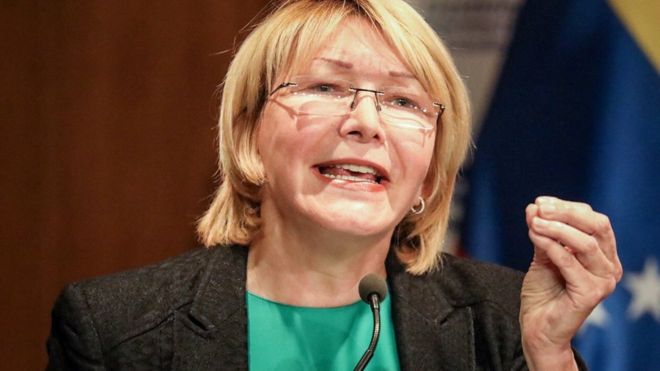
CARACAS, Venezuela – On June 28th the Venezuelan Supreme Court, controlled by Maduro loyalists, froze the assets of Attorney General Luisa Ortega Diaz and have banned her from leaving the country. The United Nations expressed concern over this act, and urged the Venezuelan government to abide by the rule of law and allow for peaceful protests. Attorney General Diaz stood against Maduro’s government in March when the Supreme Court attempted to strip the opposition controlled Congress of its powers. She has also recently accused Maduro’s government of committing “state terrorism” based on the response of authorities to antigovernment protests. Her court hearing is currently scheduled for July 4th. Attorney General Diaz has also asked the Inter-American Commission for Human Rights for protection.
Luisa Ortega Diaz who has recently become a critic of the Maduro government, and was barred from travel by the Venezuelan Supreme Court. Photo courtesy of BBC.
The Supreme Court of Venezuela has also attempted to strip Attorney General Diaz’s powers by giving Tarek William Saab, a Maduro loyalist and ombudsman, the ability to conduct criminal investigations. Diaz has rejected the ruling, claiming that it gives the power to investigate human rights abuses to the abusers themselves.
A day after this, Attorney General Diaz’s office officially charged Antonio Benavides, the former head of Venezuela’s National Guard, with human rights abuses after months of protests have left approximately 80 people dead. Ortega’s office has claimed that abuses by police are responsible for 23 of those deaths. Benavides was removed from his post last week, but since then he has been reassigned as head of Venezuela’s Capital District government. He was also one of seven individuals sanctioned in 2015 by then US President Barack Obama for human rights abuses.
Approximately one year ago, an American named Josh Holt was arrested in Venezuela on weapons charges. Although, because he hasn’t been given any preliminary hearings makes US officials doubt the reasons behind his detention. Holt had traveled to Venezuela to marry Thamara Candelo, a woman he had met online while practicing his Spanish. Currently, all that’s known is that he’s being held in a prison run by Venezuela’s intelligence police. Maduro has blamed the United States for the protests within his country, although whether this is the reasoning remains to be seen.
War Crimes Prosecution Watch is a bi-weekly e-newsletter that compiles official documents and articles from major news sources detailing and analyzing salient issues pertaining to the investigation and prosecution of war crimes throughout the world. To subscribe, please email warcrimeswatch@pilpg.org and type “subscribe” in the subject line.
Opinions expressed in the articles herein represent the views of their authors and are not necessarily those of the War Crimes Prosecution Watch staff, the Case Western Reserve University School of Law or Public International Law & Policy Group.
—
You received this message because you are subscribed to the Google Groups “warcrimeswatch – War Crimes Prosecution Watch” group.
To unsubscribe from this group and stop receiving emails from it, send an email to warcrimeswatch+unsubscribe@case.edu
Battle against ISIS, end of CIA aid to rebels and a new offensive on the Syrian-Lebanese border
Jul. 24th, 2017
Welcome to our weekly summary of Syria Deeply’s top coverage of crisis in Syria.
Battle against ISIS: Pro-government forces and U.S.-backed forces intensified their advance against the so-called Islamic State group near Raqqa.
The Syrian army and allied militias seized the al-Daylaa oil field alongside the Zamla gas field in a desert region of southwestern Raqqa province on Monday. Over the weekend, pro-government forces took control of the Wahab, al-Fahd, Dbaysan, al-Qseer, Abu al-Qatat and Abu Qatash oil fields and several other villages in the same area.
The Syrian Democratic Forces (SDF) clashed with ISIS fighters in central Raqqa and in the southwestern neighborhood of Yarmouk earlier this week.
At least 30 civilians were killed in airstrikes on ISIS-held areas this week: 15 were killed in coalition airstrikes in the village of Zour Shimr, near Raqqa, and another 15 people were killed by what Syrian opposition activists claimed was a Russian warplane in the eastern village of Ayash.
Some 200,000 people are in Raqqa province, many of them in urgent need of food deliveries and humanitarian aid. Last week, the World Food Programme (WFP) was able to make food deliveries to Mansoura and other rural areas north of Raqqa for the first time in three years, after the opening of a land route that connects Aleppo to Hasakah
Trump ends CIA aid to Syrian rebels: President Donald Trump has ended the covert CIA program that provided arms and training to Syrian rebel groups. The move, news of which broke on Wednesday, is an apparent “signal to Putin that the administration wants to improve ties to Russia,” a U.S. official told Reuters.
According to the New York Times, the decision to end the program came more than a month ago and revealed that ousting President Bashar al-Assad was no longer a U.S. priority.
Hezbollah, Syrian army launch border offensive: Hezbollah and the Syrian army launched a joint offensive against militant groups holed up in a rugged mountainous section of the Lebanese-Syrian frontier late Thursday night.
Some 3,000 militants, including al-Qaida-linked insurgents and members of the so-called Islamic State group, are said to be holed up in the outskirts of the Lebanese border town of Arsal, which has been buffeted by the war in Syria since 2011.
The Damascus suburb of Barzeh, once a thorn in the side of the Syrian government, has been under full government control for less than two months. Syria Deeply takes a look at the current situation in the neighborhood through the eyes of its remaining residents.
Kurdish political officials in Syria are taking an increasingly anti-Iranian and pro-Saudi Arabia stance amid the rising tensions between Washington, Tehran and their proxies, and the rift between Qatar and Saudi Arabia, writes journalist Wladimir van Wilgenburg.
A battle on the outskirts of a Lebanese border town will have significant implications on the Syrian refugee population in Lebanon and may boost Hezbollah’s capabilities in Syria as it moves to secure a section of the Lebanese frontier, writes Kareem Chehayeb.
Due to U.S.-led military operations to counter its finances, the so-called Islamic State is not only changing its military tactics but also adapting its economic practices, writes Chatham House fellow Haid Haid.
Kim Bode, Community Editor of Syria Deeply and Refugees Deeply
The Syrian Youth Empowerment initiative guides high-school students in Syria through the U.S. college application process. Its cofounder George Batah explains the importance of Syrians winning scholarships to study in the U.S.
FIRST LOOK
Upcoming coverage
We are always looking for new writers, experts and journalists who are covering the crisis in Syria and are interested in writing about a variety of topics. Please send us your ideas, story pitches and any other thoughts about our coverage via email, Twitter or Facebook.



 MOST POPULAR


 EDITOR’S PICKS


