Two Men Face Caning for Gay Sex in Indonesia

By: Nicole Hoerold
Impunity Watch Reporter, Asia

Human Rights watch has called on the Indonesian government to immediately and unconditionally release two men detained in Aceh province under a local ordinance that criminalizes homosexuality. On March 28, 2017, unidentified vigilantes forcibly entered a home and brought two men therein to the police on allegations of homosexual relations. The two men have been detained under Islamic Sharia law in Banda Aceh, the capital of the province.
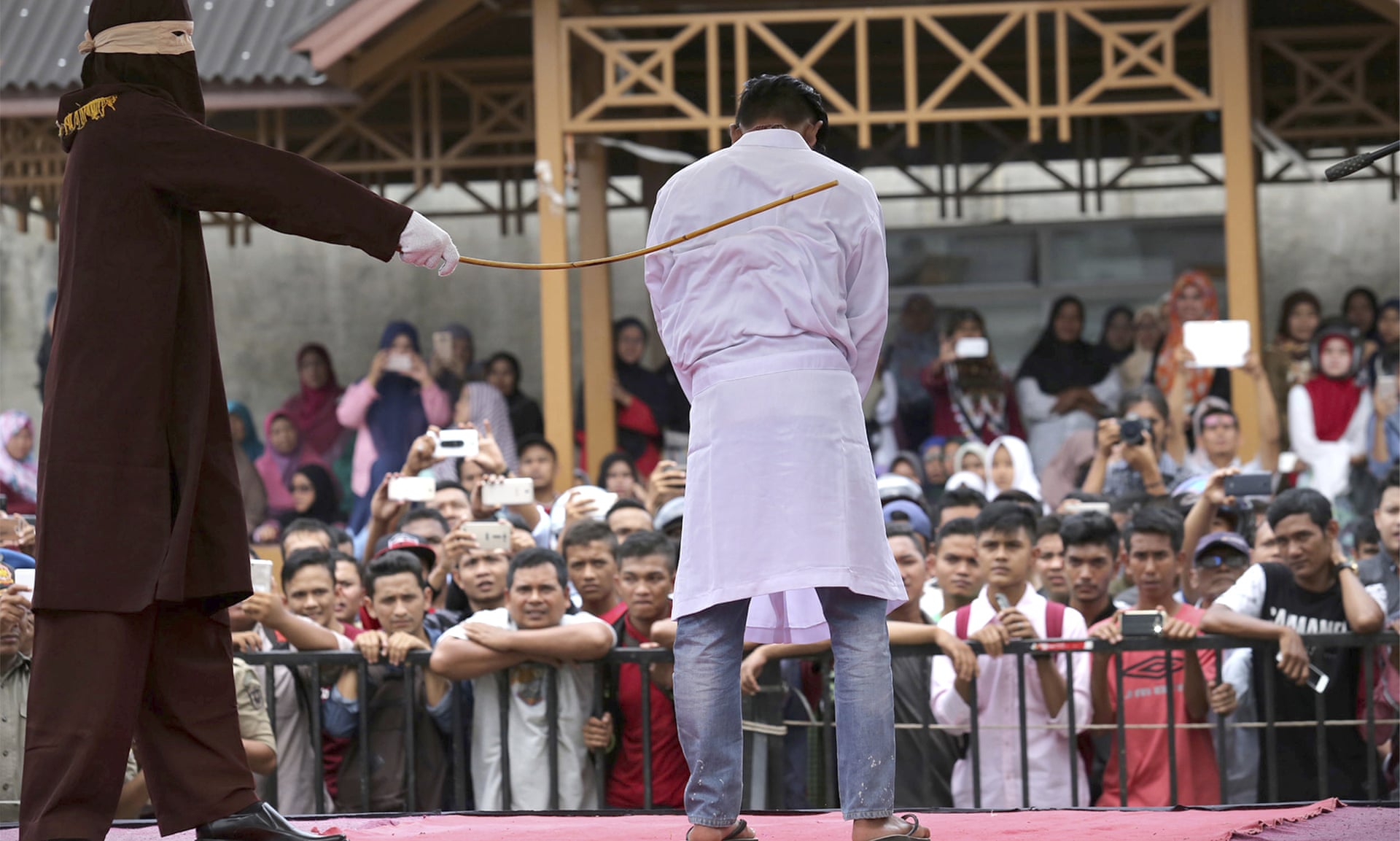
A Sharia law official whips a man convicted of adultery with a cane in Banda Aceh, Indonesia in March 2017. Photo courtesy of AP.

The chief investigator at the facility indicated that both men have confessed to being gay and have been detained for sentencing. Under Islamic Criminal Code, the two men face up to 100 lashes for their behavior. This form of punishment constitutes torture under international human rights law.

Aceh’s Sharia law has been vehemently enforced, and the province’s police have previously detained lesbian, gay, transgender, and bisexual people. In October 2015, Sharia police arrested two teenage girls on suspicion of being lesbians for embracing in public. Aceh’s parliament has gradually adopted stringent Sharia-inspired ordinances that criminalize activity like a woman’s failure to wear a hijab, gambling, alcohol, and extramarital sexual relations, all of which can be legally enforced against non-Muslims.

Aceh is the only one of Indonesia’s 34 provinces that may adopt bylaws derived from Sharia law. Under Indonesian federal law, the national home affairs minister has the authority to review and repeal such local bylaws. However, in June 2016, the Minister backtracked on his announced commitment to abolish any forms of Sharia law in the county.

Though international media and human rights organizations are speaking out against the government on this issue, Indonesian officials have yet to act on the matter.

For more information, please see:

Human Rights Watch – Indonesia: Release Gay Men at Risk of Torture – 9 April, 2017

ABC News – 2 men in Indonesia’s Aceh province face caning for gay sex – 8 April, 2017

The Guardian – Indonesia: gay men facing 100 lashes for having sex – 11 April, 2017

Deutsche Welle – Two men may get 100 lashes after gay sex in Indonesia – 8 April, 2017 
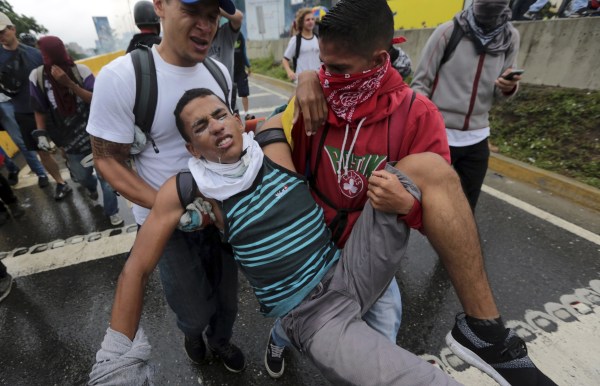
Venezuela’s Protests Turn Deadly

By Cintia Garcia

Impunity Watch Reporter, South America

 Caracas, Venezuela—Venezuela has had over three weeks of anti-government protests and it is turning deadly. Last week, a fifth person has died from their injuries sustained at the protests. Among the dead is a thirteen-year old boy who was shot and killed.

Demonstrators in Venezuela have been met with tear gas. (Photo Courtesy of NBC News)

Venezuelan officials have confirmed the death of Miguel Colmenares, 36, who was shot during a protest in the city of Barquisimeto. Mr. Colmenares is the fifth person to die that week. The public prosecutor’s office has announced it will investigate his death. At the same protest in Barquisimeto, thirty-two-year-old protester, Gruseny Calderon, was killed when he was injured by rubber bullets that pierced his lung and liver. Additionally, two college students were shot and killed. One was killed on April 6th and the other on April 11th. Lastly, the thirteen-year-old boy that was killed, was identified as Brayan Principal—he was shot in the abdomen.

In addition to the deaths, Jose Manuel Olivares, an opposition legislator, stated that “police fired tear gas ‘point-blank’ at demonstrators in the state of Vargas.” Olivares continued his statement, “If they think they will scare us that way they are wrong. We will stay in the street!” Because of the use of tear gas, many protesters have prepared themselves with goggles, rags, and gas masks.

Thousands of opposition protesters have poured into the streets of Venezuela. As a result, dozens of protesters have been injured and over 100 have been arrested this past week. The opposition has planned all of the protests with the aim of diluting the power of government security forces. Although most of the protests have occurred in middle class neighborhoods, slums that have historically supported former president Hugo Chavez have held and joined the protests.

Venezuela is currently undergoing a food and medicine shortage, as well as, an unprecedented humanitarian crisis.

For more information, please see:

Al Jazeera—Fifth Person Dies in Protests Against Nicolas Maduro—14 April 2017.

NBC News—Venezuela: 5 Dead as Anti-Government Protests Intensify—14 April 2017.

BBC—Venezuela Protests: Teenage Protester in Barquisimeto killed—13 April 2017.

Telesur—What Everybody Needs to Know About Venezuela Protest Deaths—13 April 2017.

Airbnb Host Denies Asian-American Guest Service Based on Race

By Sarah Lafen
Impunity Watch Desk Reporter, North America

WASHINGTON D.C., United States — An Airbnb host in California was banned from the company after cancelling a guest’s reservation at the last minute based on the guest’s race.  Dyne Suh, a 25-year old law student at the University of California, Los Angeles, recently posted pictures to her Facebook account earlier this week that showed a message conversation with an Airbnb host who refused to rent to her because of she was Asian.

A portion of the conversation between Suh and the Airbnb host (Photo Courtesy of The Huffington Post)

Suh and her fiancé booked an Airbnb residence in Big Bear Lake, California for February 2017.  After conversing with the host about adding two additional guests, Suh messaged the host to inform her that the group was close to the residence when the host started “spewing racism.”

One message from the host read “I wouldn’t rent to u if u were the last person on earth,” and another “One word says it all: Asian.”  Suh told the host that she would report the comments to Airbnb, and the host responded “It’s why we have Trump.”  The host also said that she would “not allow this country to be told what to do by foreigners.”

Suh has participated in anti-Trump events in the past, however asserts that this incident was unprovoked.  She said that for her to “now have someone say something racist to [her] and say it’s because of Trump, it was [her] fears coming true.”  Suh believes that people who previously held these beliefs now feel “emboldened” to speak them.  She commented that “[n]o matter how well [she] treat[s] others, if you’re Asian you’re less than human, and people can treat you like trash.”

A spokesperson for Airbnb told reporters that the host has been permanently removed from the company.  Airbnb also wrote in an email that “[that] behavior is abhorrent and unacceptable.”  Last year, Airbnb conducted a comprehensive review of the company and found that “minorities struggle more than others to book a listing.”  This finding caused the company to implement a new policy which requires all hosts to treat all guests “with respect.”  The new policy explains that “no matter who you are, where you are from, or where you travel, you should be able to belong in the Airbnb community.”


For more information, please see:

Fortune — Airbnb Banned a Host who Reportedly Cancelled a Guest’s Reservation over her Race — 8 April 2017

NY Daily News — California Airbnb Host Banned for Naming President Trump as Reason to Refuse Asian-American Guest — 8 April 2017

The Telegraph News — Airbnb Host Cancels Asian Woman’s Reservation at the Last Minute, Telling her: ‘It’s Why we Have Trump’ — 8 April 2017

KTLA — Riverside Woman Denied Lodging on Airbnb During Big Bear Snow Storm Because of her Race — 7 April 2017

Syrian Evacuations Postponed after Suicide Bomb

by Yesim Usluca
Impunity Watch Reporter, Middle East

DAMASCUS, Syria — Over 3,000 Syrian civilians were scheduled to be evacuated from four areas on Sunday, April 16th, as part of a “population transfer[.]” Despite a suicide bomb that killed over 100 people on Saturday, the evacuation has been postponed due to unknown reasons.

Among those killed in the suicide bombing were at least sixty-eight children (Photo courtesy of the Washington Post)

On Saturday, April 15th, several buses evacuated over 5,000 residents from the northern towns of Fuaa and Kafraya. As the buses were waiting at a bus depot transit point in Rashidin, a rebel-held town west of Aleppo, several suicide car bombs were detonated. The Syrian Observatory for Human Rights stated that the explosions killed nearly 126 people, including at least sixty-eight children, and injured hundreds more. A majority of the deceased, 109 out of 126, were evacuees. The remainder were aid workers and rebels tasked with guarding the evacuation convoy. The rights group further stated that a nearby gas station was also affected by the blast, which led to an increase in the number of victims.

The attack was apparently carried out with a pick-up truck, and nothing but its shell and engine block remained after the detonations. The explosions left “[b]ody parts and the belongings of evacuees[,]” such as clothing, dishes “and even televisions[,]” scattered throughout the attack site. Images released of the site showed bodies “lying alongside buses, some of which were charred and others gutted from the blast.” A young girl who had been wounded in the bombing lost four of her siblings. She stated that a man in the pick-up truck approached children “who had been deprived of food for years[,]” and told them to “come and eat potato chips.” She stated that the explosion happened shortly after several children had gathered, and that some were “torn [] to pieces.”

The suicide bombings have not yet been claimed by any party. One of the rebel groups, Ahrar al-Sham, which negotiated the evacuation deal, has denied any involvement. The Syrian government blamed the attacks on “terrorists[,]” which has been the “catch-all term for its opponents.”

The suicide bombings drew immediate international protest. The United Nations Aid Chief, Mr. Stephen O’Brien, condemned the bombing. He released a statement in which he characterized those responsible for carrying out the attacks as “monstrous and cowardly[,]” and indicated that they portrayed a “shameless disregard for human life.” Pope Francis urged “an end to the war in Syria[.]” The Executive Director of UNICEF, Mr. Anthony Lake, stated that a new “horror” has emerged after six years of war in Syria, one which must “break the heart of anyone who has one.”

Despite the agreement to evacuate residents, Sunday’s scheduled transfers were halted after the explosions. The head of the Syrian Observatory for Human Rights, Mr. Rami Abdurrahman, stated that the evacuations were delayed because “permission” had not been given for it to proceed. An opposition activist, Mr. Hussam Mahmoud, stated that it was postponed due to “logistical reasons.” No announcement has been made as to whether the transfers were delayed out of fear of recurring bombings.

The evacuations, which were not being overseen by the United Nations, involves residents of the towns of Fuaa, Kafraya, Madaya and Zabadani. All four towns have been under siege for several years. The unaffected buses from the explosion site resumed their trip a few hours after the bombing and reached their destinations.

For more information, please see:

The Washington Post—Mass evacuation in Syria postponed after blast kill 68 kids—16 April 2017

The Guardian—’Sixty-eight children among dead’ of suicide bombing attack in Syria—16 April 2017

ABC News—Over 100 killed during Syria’s troubled population transfer—15 April 2017

The Independent—At least ’68 children among dead’ in Syria bomb attack—16 April 2017

Global Centre for the Responsibility to Protect: Atrocity Alert

Atrocity Alert, No. 51, 19 April 2017 No Images? Click here  


Atrocity Alert is a weekly publication by the Global Centre for the Responsibility to Protect highlighting and updating situations where populations are at risk of, or are enduring, mass atrocity crimes.


Syria

On 14 April at least 126 people, including over 60 children, were killed in an attack targeting a convoy of evacuees from the besieged pro-government towns of Fouah and Kefraya. No one has claimed responsibility for the car bomb at a checkpoint in Rashidin where a handover of evacuees was due to take place. In an 18 April Press Statement the UN Security Council (UNSC) labeled the attack an act of terrorism. The government, and many Syrian opposition organizations, have condemned the attack.

The evacuees were being transferred under a local ceasefire agreement whereby the mainly Shia residents of Fouah and Kefraya, who have been besieged by opposition forces, would be evacuated in return for safe passage for residents from the mainly pro-opposition towns of Madaya and Zabadani. It was estimated that more than 30,000 people would be relocated during the exchange.

Any local ceasefire agreements reached between the Syrian government and opposition parties that result in the involuntary transfer of civilian populations constitute a violation of International Humanitarian Law (IHL). However, in response to the war crime at Rashidin, the UNSC should demand UN access in order to monitor any voluntary evacuations and ensure the well-being of civilians. The UNSC previously demanded similar access for UN monitors to eastern Aleppo via Resolution 2328.

The attack on evacuees in Syria came two days after Russia vetoed a UNSC draft resolution that would have condemned the 4 April sarin gas attack in Khan Shaykhun and obligated the Syrian government to comply with recommendations of the Organization for the Prohibition of Chemical Weapons Joint Investigation Mechanism. The 12 April vote marked Russia’s eighth veto of a draft resolution regarding the situation in Syria since the conflict began in 2011. Bolivia also voted against the draft resolution, while China, Ethiopia and Kazakhstan abstained. Ten UNSC members voted in favor of the resolution. By vetoing an impartial international investigation into the deadly attack at Khan Shaykhun, Russia has weakened the global prohibition of chemical weapons under international law.


Photo credit: Reuters Media


UN Photo/Manuel Elias


Democratic Republic of the Congo

The UN has discovered 17 additional mass graves in the Kasai Central Province of the Democratic Republic of the Congo (DRC), bringing the total number documented in the Kasai region since January to 40. As noted in Atrocity Alert of 29 March, violence between security forces and the Kamuina Nsapu militia poses an escalating risk to civilians in the region, with more than 400 people killed since last August.

The UN’s Joint Human Rights Office in the DRC (UNJHRO) and UN Police investigated the latest mass graves, which were reportedly dug by members of the DRC’s armed forces (FARDC) after clashing with presumed militia members between 26-28 March. At least 74 people, including 30 children, were killed during the fighting. During the same week, FARDC soldiers reportedly shot dead 40 people, including 11 children, during door-to-door searches for militia members in Kananga.

It is essential that the DRC government conducts credible investigations into these killings and takes expeditious action to diffuse the conflict in the Kasai region. The government should also actively cooperate with UNJHRO investigators and facilitate their access to all mass grave sites. Any members of the FARDC proven to have participated in unlawful killings should be held accountable, regardless of their rank.


Photo Credit: Aaron Ross, Reuters


Connect With Us


Global Centre for the Responsibility to Protect
Ralph Bunche Institute for International Studies
The Graduate Center, CUNY
365 Fifth Avenue, Suite 5203
New York, NY 10016, USA

Phone: +1 212-817-1929
info@globalr2p.org

Copyright © 2017 Global Centre for the Responsibility to Protect
All rights reserved.

 
Preferences  |  Unsubscribe