TAIPEI, Taiwan – Taiwan has joined Hong Kong as one of the first Asian country to outlaw the sale of dog and cat meat for human consumption. Parliament passed legislation on April 11 to outlaw the consumption, purchase, and possession of dog and cat meat. The fine for violating the law can get as steep at 8,170 U.S. dollars.
Dogs wait to be slaughtered in cages for sale as food in Vietnam. Photo courtesy of Reuters.
The legislation is a direct response to the growing social pressure calling for improvements in animal welfare and increased protections against animal cruelty. The new legislation includes a provision raising the penalty for killing or abusing animals to a maximum of two years in jail and a fine of NT$2 million in Taiwanese currency.
Similar legislation had already been passed in Taiwan in 2001, which like the new legislation, prohibited the slaughter of pets and the sale of that meat. The 2001 legislation, however, failed to include a penalty for violations of the law. The new law includes strict provisions on the care and treatment of animals, as well as minimum and maximum fines and jail sentences for those found guilty of violating the law.
Rights activists are thrilled at the new measure, calling the new legislation a momentous step in the right direction for ensuring stronger animal protections. In the past, these activists argue, legislation has been too lenient on individuals accused of animal cruelty. The new law aligns to a greater global social movement for increased animal rights and protections. However, some activists warn that this measure is not enough to ensure the safety and well-being of other animals, as the legislation applies strictly to cats and dogs.
LUSAKA, Zambia–Zambia opposition leader Hakainde Hichilema has been charged with treason after interfering with the presidential motorcade. Hichilema was traveling in a convoy near the President Edgar Lungu’s motorcade. Hichilema’s motorcade refused to move for President Lungu’s convoy and President Lungu’s convoy subsequently tried to overtake Hichilema’s motorcade. Zambian police claim that Hichilema endangered the life of the President by refusing to pull over.
Zambia opposition leader Hakainde Hichilema. (Photo Courtesy of Al Jazeera)
In Zambia, treason is a severe offense and the accused cannot be released on bail. The charge also carries a minimum sentence of 15 years in prison. Police chief Kakoma Kanjanga made a statement regarding Hichilema’s arrest. “It has been established that the opposition leader disobeyed police orders to clear the way, thereby putting the life of the head of state in danger. We have today jointly charged and arrested Mr Hichilema and five others with treason.” Kanjanga continued by stating “I wish to reiterate that the actions by the opposition leader were unreasonable, reckless and criminal. Therefore members of the public are being warned that as police we are not going to watch such kind of behavior by any person, irrespective of their status,” he added.
Hichilema narrowly lost the Zambian presidency to President Lungu last year. Many in Hichilema’s party, the United Party for National Development (UPND), do not see Lungu as the legitimate president of Zambia. Tensions are rising between parties as the details of Hichilema’s arrest are reported. Armed police raided Hichilema’s home during the night of Tuesday April 11th. Hichilema was subsequently arrested and detained.
War Crimes Prosecution Watch is a bi-weekly e-newsletter that compiles official documents and articles from major news sources detailing and analyzing salient issues pertaining to the investigation and prosecution of war crimes throughout the world. To subscribe, please email warcrimeswatch@pilpg.org and type “subscribe” in the subject line.
Opinions expressed in the articles herein represent the views of their authors and are not necessarily those of the War Crimes Prosecution Watch staff, the Case Western Reserve University School of Law or Public International Law & Policy Group.
—
You received this message because you are subscribed to the Google Groups “warcrimeswatch – War Crimes Prosecution Watch” group.
To unsubscribe from this group and stop receiving emails from it, send an email to warcrimeswatch+unsubscribe@case.edu.
by Yesim Usluca Impunity Watch Reporter, Middle East
CAIRO, Egypt — On Palm Sunday, April 10th, the Islamic State (“ISIS”) carried out two suicide attacks at Coptic Christian churches in Egypt, injuring and killing over 100 people. Following the attacks, on Sunday evening, Egyptian president Abdel-Fattah el-Sissi declared a three-month state of emergency.
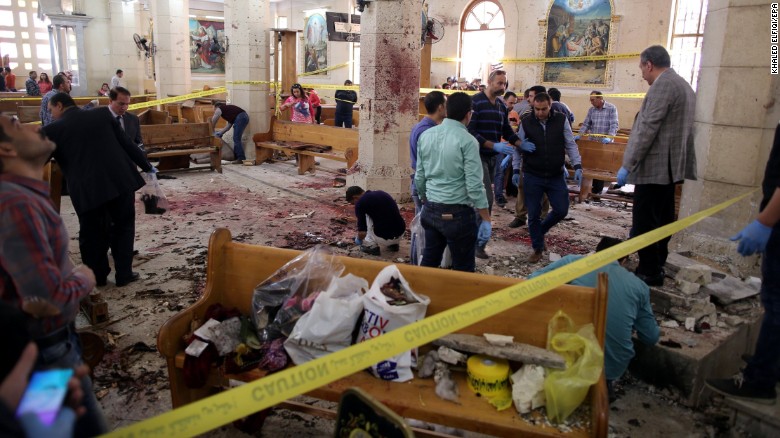
The suicide bombers detonated explosive devices at two churches in the towns of Tanta and Alexandria (Photo courtesy of CNN)
The suicide attacks, which were carried out merely hours apart, were responsible for the deaths of at least forty-four people, and injured at least 126 more. These attacks marked the “single deadliest day for Christians in decades” and were the worst since thirty people had died in a bombing at a church in December.
The bombings took place in the cities of Tanta and Alexandria. The first bomb, which exploded in Tanta at St. George’s Church, killed at least twenty-seven people and wounded seventy-eight. A civilian who rushed to the scene of the bombing, Mr. Maged Saleh, cried out “[w]here is the government? There is no government!”
The first explosion led to “horrific” scenes, and reportedly “destroyed” the church. A state-run news agency reported that an explosive device had been planted under a seat in the main prayer hall. The bombs reportedly “overturn[ed] pews, shatter[ed] windows and stain[ed] the whitewashed walls with blood.” Media reports from the site depicted “lifeless, bloody bodies covered with papers.” Several doors had been blown off, and women were shown as “wail[ing] outside.” A survivor who had been attending the Palm Sunday mass with his brother noted that smoke filled the area, leading to complete darkness.
A nearby resident, Ms. Susan Mikhail, stated that the explosion shook her building. “violently[.]” She reported that many of the deacons, who were the first to run out of the church, had “blood on their white robes[.]” Ms. Mikhail added that those who had been seriously injured were rescued by other survivors and carried out to private cars to be taken to the hospital.
The second bomb, which was detonated at St. Mark’s Cathedral in Alexandria, killed a minimum of eighteen civilians and four police officers, and injured forty-eight. A man who had reportedly been wearing an explosive belt was stopped from entering the church by two police officers. The bomb was detonated shortly thereafter near the gate of the church. An Egyptian blogger, Maged Butter, reported that there were bloodstains 100 meters away from the explosion. He added that women were “crying and looking for their loved ones[.]” A nearby witness stated that there were “bodies and body parts everywhere[,]” and added that he “saw a man put together what was left of his son in a bag.”
ISIS has claimed responsibility for the attacks, leading to escalating fear that the extremists are shifting their focus to civilians, and particularly on the Christian minority in Egypt: the Coptics. The group released a statement in which it provided the names of the suicide bombers, and stated that it “vow[s]” to continue its attacks against Christians.
BANGKOK, Thailand – The controversy surrounding the death of teenage activist Chaiyaphum Pasae, who was shot and killed by Thai soldiers during a drug raid, continues to grow. Conflicting accounts of what happened leading up to Pasae’s death are adding to the uproar warning of intimidation and manipulation by Thailand’s military.
Chaiyaphum Pasae, ethnic rights activist, was shot and killed by the Thai military on March 17, 2017. Photo courtesy of FrontLineHRD.
Accoring to the military, Pasae was travelling in a car when he was stopped at a routine checkpoint. While the car was being searched for drugs, the military says, Pasae ran from the scene and into a nearby jungle. He was about to throw a hand grenade when one soldier intervened and shot Pasae in self defense. Eye witnesses, however, report a very different unfolding of events. Eye witnesses are claiming that the group of soldiers physically assaulted Pasae at the checkpoint, and as he attempted to escape, he was shot by one of the soldiers.
Human rights organizations have long warned of the lack of protections for activists in Thailand. The United Nations warned that groups like human rights defenders, women, and other vulnerable groups are most susceptible to such abuses. The UN report notes that hundreds of individuals have been jailed since the 2014 military coup for exercising their right to freedom of expression and assembly.
In early March, the Thai military took a small but significant step in ending government intimidation by dropping frivolous defamation suits against three prominent activists. In 2016, rights lawyers Somchai Homlaor, Pornpen Khongkachonkie, and Anchana Heemmina published a report citing 54 cases of alleged military abuse and torture of prisoners in military custody. The Thai Internal Security Operations Command responded by filing a criminal complaint against the lawyers, accusing them of defamation and breaches of the Computer Crimes Act.
Thailand has a long way to go when ensuring the equal protection of human rights, and human rights organizations will continue to keep an eye on the government and its actions.