Situation in Congo Worsens as Aids Workers and Police Killed

By Samantha Netzband 

Impunity Watch, Africa Desk Reporter

KINSHASA, Democratic Republic of Congo– Violence has increased in the Kasai region of the Congo as more than 40 police officers were decapitated.  The police officers are said to have been fighting with regional militia known as Kamuina Nsapu.  The Kamuina Nsapu are also said to be responsible for the recent deaths of an American and Swedish aid worker.

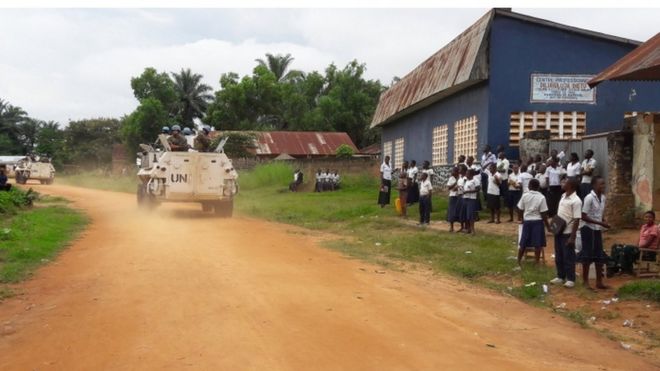
UN vehicle in Tshimbulu, Kasai province, 20 March 2017
The United Nations Mission in Kasai. (Photo Courtesy of BBC Africa)

The situation in the Congo has worsened since the beginning of the year with violence escalating to include the death of two humanitarian aid workers: American Michael Sharp and Swede Zaida Catalan.  Secretary General Antonio Guterres spoke after the two aids workers death “Michael and Zaida lost their lives seeking to understand the causes of conflict and insecurity in the DRC in order to help bring peace to the country and its people. We will honor their memory by continuing to support the invaluable work of the Group of Experts and the whole UN family in the DRC.”

The United Nations has continued its work in the country despite the increase in violence and has helped to uncover ten mass graves and seven other mass burial sites.  Since last October over 400 have been killed in the country and over 200,000 displaced.  This has only contributed to the many other humanitarian crisis’ that the United Nations is dealing with in Africa and around the world.  The United Nations has said that as of this year they are dealing with the largest humanitarian crisis since World War II.

For more information, please see: 

ABC News – Congolese militia decapitates more than 40 police: Officials- 25 March 2017

BBC Africa – Militia fighters decapitate 40 police officers in DR Congo – 25 March 2017

New York Times – Congolese Militia Beheads Dozens of Police Officers – 25 March 2017

Washington Post – Congolese rebels behead 42 police officers in dramatic escalation of conflict – 26 March 2017 


Syrian Town Hit With Suspected Chemical Attack, Killing and Injuring Hundreds

by Yesim Usluca
Impunity Watch Reporter, Middle East

DAMASCUS, Syria — On Tuesday, April 4th, a suspected chemical attack on the Syrian town of Khan Sheikhoun in the province of Idlib killed and injured hundreds of civilians, including several children.

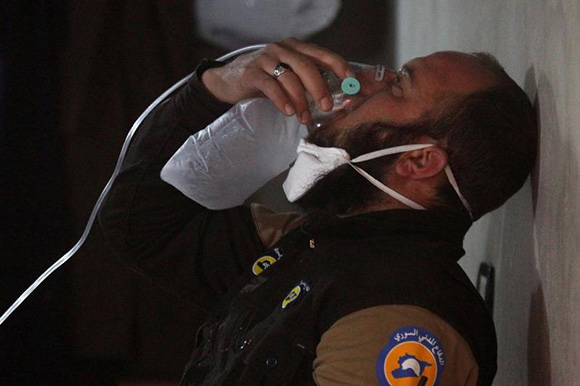
Among those killed in the attack were several children (Photo courtesy of the New York Times)

A photographer for a Media Center in Idlib, Mr. Hussein Kayal, stated that he was woken up by the sound of a bomb blast at approximately 6:30 a.m. Upon rushing to the attack site, he noted that there had been no smell. He indicated that he walked around the town and saw “entire families inside their homes, lying on the floor, eyes wide open and unable to move.” He further added that “[t]heir pupils were constricted.” A Syrian man reported that residents were still in their beds at the time the warplanes struck as it was still early in the morning. He stated that he lost his niece, his niece’s husband and their one-year old daughter in the attack.

The head of a Syrian ambulance service, Mr. Mohammed Rasoul, stated that emergency responders found “people choking in the streets.” He noted that the situation is “very bad” and that most of the civilians suffering as a result of the attack were children. Footage released from the site showed EMTs attempting to intubate an unconscious male “stripped down to his underwear[,]” as well as a young girl “foaming at the mouth[.]”

A local media activist, Mr. Mohammed Hassoun, stated that there were eighteen critical cases. He added that the injured civilians arrived unconscious, “had seizures,” and “bled from the nose and mouth” after receiving oxygen treatment. Mr. Hassoun noted that the doctors suspect the chemical agent was made up of more than one gas as chlorine is not known to cause convulsions of the type suffered by those injured in the attack.

International news sources reported that a hospital in the immediate vicinity of the affected area was struck with missiles soon after the suspected chemical attack. A local doctor who received three victims stated that they all had “narrow, pinpoint pupils that did not respond to light.” Breathing difficulties, pinpoint pupils and foaming at the mouth are all symptoms typically associated with exposure to toxic gas. A media activist for the Aleppo Media Center, Mr. Mohammed Alshagel, reported that the hospital had been filled with injured men, women and children, along with a strong smell of chlorine. He stated that the injured individuals had “heavy choking symptoms” and that some had died minutes after arriving at the hospital. Mr. Alshagel added that the hospital had been attacked shortly after he left.

The Syrian Observatory for Human Rights stated that fifty-eight civilians, including eleven children, had been killed in the suspected chemical attack. The rights group later stated that the death toll was expected to rise, whereas the Syrian medical relief group, UOSSM, stated that over 100 civilians had lost their lives, and at least 500 more had been injured.

The attack immediately sparked international outrage. The United States released a statement denouncing the attack as “reprehensible.” France called upon the United Nations Security Council to convene a special meeting. The Foreign Minister of the United Kingdom, Mr. Boris Johnson, stated he was “horrified” by the attack and added that it carried all of the “hallmarks” of chemical weapons previously used by the Syrian regime. The Prime Minister of Turkey, Mr. Recep Tayyip Erdogan, indicated that the attack was “inhuman [and] unacceptable[.]” Amnesty International called upon authorities to “urgently investigate[]” the “alarming” attack.

For more information, please see:

Fox News—At least 100 dead in suspected chemical attack in Syria, hospital reportedly hit—4 April 2017

ABC News—White House blames Obama admin for suspected Syria chemical attack—4 April 2017

USA Today—’Reprehensible’: Kids among victims of suspected chemical attack in Syria—4 April 2017

BBC News—Syria conflict: ‘Chemical attack’ in Idlib kills 58—4 April 2017

NBC News—Syria Gas Attack Reportedly Kills Dozens in Idlib Province—4 April 2017

CNN—Syria gas attack reportedly kills dozens, including children—4 April 2017

Human Rights Watch: URGENT SYRIA UPDATE

Syria: Chemicals sicken hundreds. Dozens are dead.
Syria Update: Chemicals Kill Dozens
Dear David,

I’m sure you’ve heard the news. Dozens of children, women, and men were killed this week from exposure to toxic chemicals in Khan Sheikhoun, a town controlled by armed groups fighting Syrian government forces in northern Syria.

Since then we have been reaching out to speak with victims, their relatives, first responders, and medical personnel to find out exactly what happened. The human toll is devastating.

This morning we reached a young mother who told us that she was sleeping on the first floor of their house with her family when they suddenly heard a loud explosion and the windows blew open. She told us:

“It felt like the air had weight. It got harder to breathe and tears were running down our faces and our eyes were burning. My son, who is one year and ten months, was running around. I couldn’t see because of the tears. He was screaming ‘Mom! Dad!’”
She and her husband and their son survived, but she shared with us the names of 19 of their family members and relatives who died.

Our contacts on the ground are saying that Syrian government planes dropped the chemicals. There are still many unanswered questions. But we won’t stop until we get to the truth.

After six years of conflict — with hundreds of thousands dead and millions displaced — chemical attacks have become a regular occurrence in Syria, despite being prohibited by international law. Our researchers have exposed to the world that Syrian government forces have carried out chemical attacks on numerous occasions, as has the Islamic State.

If this is indeed a large-scale chemical attack, it would be one of the deadliest in the Syrian conflict.

Human Rights Watch is calling on the United Nations Security Council—including Russia and China—to condemn this latest attack, demand that Syria fully cooperate with investigators, and support steps to hold those responsible for these atrocities to account.

As this urgent crisis continues to unfold, we will keep you informed and alert you on ways to take action.

Thank you for standing with us.

Ole Solvang
Deputy Director, Emergencies Division
Human Rights Watch
@olesolvang

Justice for Sergei Magnitsky: Crane 1 of 1 Canadian Parliament Formally Recommends the Canadian Government Adopt Magnitsky Sanctions Against Human Rights Violators

Canadian Parliament Formally Recommends the Canadian Government Adopt Magnitsky Sanctions Against Human Rights Violators

6 April 2017 – Today, the Canadian Parliament’s Standing Committee on Foreign Affairs has issued a formal recommendation to the Canadian government to update the existing sanctions legislation with the Magnitsky sanctions against human rights violators.

In their recommendation, the Committee said: “In honour of Sergei Magnitsky, the Government of Canada should amend the Special Economic Measures Act to expand the scope under which sanctions measures can be enacted, including in cases of gross human rights violations.”

The Magnitsky recommendations include:
1) Freezing assets of human rights violators,
2) Banning their entry to Canada,
3) Publishing a list of people and entities subject to these sanctions, and
4) Conducting an annual review of the Canadian government’s enforcement of the legislation.

The recommendation was inspired by the case of Sergei Magnitsky in Russia, but has been expanded to apply to human rights violators globally.

The Committee concluded:

“While originally focused on addressing the human rights situation in Russia, catalysed by the tragic case of Sergei Magnitsky, this movement now calls for the application of sanctions against human rights violators globally, and was instrumental in the passing of the Global Magnitsky Human Rights Accountability Act in the U.S.”

The report by Canada’s Foreign Affairs Committee cites William Browder, leader of the global Magnitsky Justice Campaign:

“Effectively, with a Magnitsky act, whether it be a Russian act specifically or a global act, it would give people some hope that in Canada, the United States, and other places, people do care.”

The Canadian Magnitsky Recommendation is a result of a five-month review of the sanctions regime conducted in the Canada’s House of Commons.

“The Committee heard compelling testimony from a number of highly-respected human rights activists regarding how sanctions can be a potentially valuable tool in the promotion and protection of human rights. They recommended that Canada expand the legislative authority under which the government can impose sanctions against human rights violators,” says the Foreign Affairs Committee report.

The report by the Foreign Affairs Committee quotes Zhanna Nemtsova, founder of the Boris Nemtsov Foundation for Freedom, named after her father, a Russian pro-democracy advocate who was murdered in 2015, saying:

“These are not sanctions against a country or even a government. These are sanctions against specific individuals responsible for corruption and for abusing human rights.”

The Standing Committee on Foreign Affairs was tasked with the review of the sanctions regime on 14 April 2016 by the Canada’s House of Commons.

The Committee held the review from October 2016, by conducting 13 hearings where different experts testified on the legislation. The committee assessed related policy issues from government officials, academics, researchers, stakeholders and practitioners.

Today, the Committee published its final report recommending the Government adopts the Magnitsky sanctions.

As part of its recommendations, the Foreign Affairs Committee called for the Government to publish a list of sanctioned persons:

“The Government of Canada should produce and maintain a comprehensive, public and easily accessible list of all individuals and entities targeted by Canadian sanctions containing all information necessary to assist with the proper identification of those listed.”

The Foreign Affairs Committee also recommended that the Government publishes an annual report on the implementation of the sanctions regime.

“The Government of Canada should amend the Special Economic Measures Act to require the production of an annual report by the Minister of Foreign Affairs, to be tabled in each House of Parliament within six months of the fiscal year-end, which would detail the objectives of all orders and regulations made pursuant to that Act and actions taken for their implementation.”

The next step is for the Canadian government to consider the parliament’s recommendation and draft legislation.

For more information, please contact:

Justice for Sergei Magnitsky
+44 207 440 1777
e-mail: info@lawandorderinrussia.org
www.lawandorderinrussia.org
billbrowder.com
Twitter.com/Billbrowder