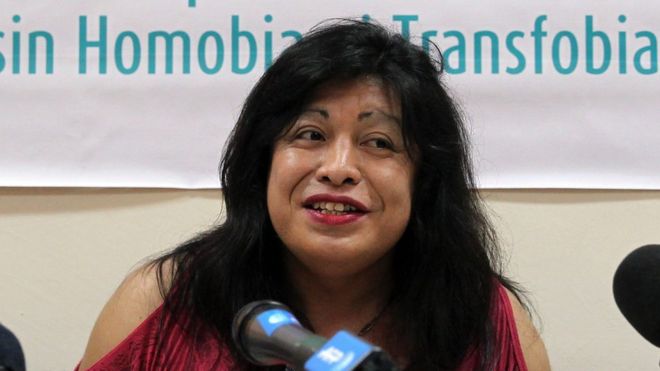
Buenos Aires, Argentina—The Judicial System of Argentina has decided to send Diana Sacayán’s murder case to trial. Diana Sacayán was an activist and transgender leader murdered in 2015.
Diana Sacayán, trans gender activist was murdered in 2015. (Photo Courtesy of BBC)
Diana Sacayán was murdered by Gabriel David Marino and Felix Alberto Ruiz. They stabbed Ms. Sacayán in her apartment in Buenos Aires thirteen times, and her body showed signs of violence. Both Mr. Marino and Mr. Ruiz are accused of aggravated murder and gender violence. The same weekend Ms. Sacayán was murdered, she was set to participate in the National Women’s Conference. Ms. Sacayán was the leader of the International Association of Lesbians, Gays, and Bisexuals, as well as the leader of the Antidiscrimination Liberation Movement. Upon her death, both the president of Argentina and Amnesty International expressed their concern over the murder. Amnesty International Director of Argentina, Mariela Belski, stated, “A dark cloud has set over Argentina’s trans community, unless this latest wave of murders is effectively investigated and those responsible are taken to justice, a message will be sent that attacking trans women is actually ok.”
Prosecutor, Matías Di Lello, and prosecutor of crimes against women, Mariela Labozzeta, submitted the request for trial. They believe there is sufficient evidence that the murder of Ms. Sacayán should be treated as a hate crime and femicide.
The same month Ms. Sacayán was murdered, two other transgender women, Marcela Chocobar and Coty Olmos, were also murdered. The wave of murders within the transgender community is not the first of its kind. Latin America accounts for a significant percentage of all transgender deaths in the world. Statistics from January 2008 and December 2014 demonstrated that seventy-eight percent of the 1,731 reported murders of transgender and gender-diverse people occurred in Latin America.
Mass Atrocities, Refugees and US President Trump’s Travel Ban
On 27 January US President Donald J. Trump issued an executive order banning all refugees, migrants and visitors from seven Muslim-majority countries – Libya, Iran, Iraq, Sudan, Syria, Somalia and Yemen. The discriminatory ban also halts the United States refugee program for an initial period of 120 days, preventing the resettlement of people who are fleeing war and persecution in countries where atrocities are occurring or have previously taken place. The ban includes previously vetted refugees who have survived genocide in Iraq, war crimes in Yemen, or crimes against humanity in Syria.
For years the United States has been the world’s top resettlement country for refugees, accepting nearly 85,000 refugees in 2016 alone. Resettlement programs allow long-term refugees to get out of temporary camps, where they have often spent years, and start to rebuild their lives with access to similar civil rights as those enjoyed by nationals. Refugees can not apply for resettlement, nor choose a country to resettle in, but are selected for eligibility by the UN. Refugees who are selected for potential resettlement to the United States are then scrupulously vetted by eight Federal Agencies, six different security databases, and subjected to rigorous background checks, interviews and biometric testing. For this reason, the process of refugee resettlement takes several years.
UNHCR facilitated the resettlement of more than 140,000 people in 2016, more than half of whom were from Syria. The majority of refugees entering the United States in 2016 were resettled after fleeing persecution and/or conflict the Democratic Republic of the Congo (16,370), Syria (12,587), Myanmar (12,347) and Iraq (9,880).
Raising concern for the thousands of refugees affected by President Trump’s ban, the UN High Commissioner for Refugees has noted that, “refugees should receive equal treatment for protection and assistance, and opportunities for resettlement, regardless of their religion, nationality or race.”
For background regarding the threat of atrocities facing populations from countries affected by President Trump’s ban, click on the maps.
UNHCR provides additional statistics regarding refugee resettlement in the United States here.
War Crimes Prosecution Watch is a bi-weekly e-newsletter that compiles official documents and articles from major news sources detailing and analyzing salient issues pertaining to the investigation and prosecution of war crimes throughout the world. To subscribe, please email warcrimeswatch@pilpg.org and type “subscribe” in the subject line.
Opinions expressed in the articles herein represent the views of their authors and are not necessarily those of the War Crimes Prosecution Watch staff, the Case Western Reserve University School of Law or Public International Law & Policy Group.
JURIST Guest Columnist David M. Crane of the Syracuse University College of Law discusses some alarming similarities between the early days of the Trump administration and the rise to power of Adolf Hitler…
How did a great country with a strong and respected place in the world, a center for culture and tolerance, elect a man who would plunge the world into what a commentator called “a place of anguish and fear”? This is a question many historians and policy makers asked themselves about Germany in the 1930’s.
The manner in which Adolf Hitler came to power initially was legitimate and within the constitutional bounds of German law. An obscure former corporal in the German army, he ran for the highest political office in his country on a platform of nationalism, essentially declaring it time to make “Germany great again.” Stung by the humiliating terms of the Versailles Treaty, Germany retreated inward burdened by reparations and eventual economic depression; this liberal democracy struggled to redefine itself in a post-WWI world. Hitler’s speeches declared that Germany could be a great country again, with a strong people, who could move forward to reclaim their historic place in Europe. All this rang true to a defeated people.
Hitler’s rhetoric in those days formed the murky beginnings of a far darker political dynamic, but the German people — Dem Deuctshevolk — shop workers, shopkeepers and farmers, looked beyond this darker theme and focused on a more promising future in a proud and assertive Germany. As he ran for Chancellor, Hitler focused on the economic issues of the time, promising to restore the German economy and bring back jobs. “German business first” was what a German citizen liked to hear.
Adolf Hitler became Chancellor of Germany in 1933, barely more than eight years after he was released from a Bavarian prison for the Beer Hall Putsch. The first year of his rise to power was a heady time where money poured into infrastructure and rebuilding the German army, in blatant violation of the Versailles Treaty. The concept of a people’s car, a Volkswagen, became a reality to be driven on the world’s first interstate road system, called the autobahn. German citizens saw jobs, better pay, and a brighter future.
Then the nibbling at Germany’s democratic principles began, subtle at first, but picked up over the next few years, and by the time of the 1936 Olympics in Berlin, led to a state policy to shift power from the people to one person, a Fuehrer. Backed by the Reichstag, new laws were passed shifting the power to a single executive. Additionally, as this happened, Adolf Hitler began to raise the stakes against perceived enemies of the state by using fear to cause the German people to give away their freedoms one at a time to fight the threat — Bolsheviks, Slavs, and Jews. Claiming a conspiracy to keep Germany weak, various minorities were singled out as a threat to the country and its people. It was this existential threat from within and outside the country that Hitler built upon a fear so much so that the citizens of Germany turned to their leader, their Fuehrer, to protect them.
The intellectual elite of Germany and much of the middle class at first stood back, amused, embarrassed, disbelieving that this proud nation of culture, of tolerance, of openness would elect this small little man who ranted and raved about a great German nation, a Reich that would last a thousand years. They could not believe that he would last long politically and stood aside in the early years thinking that the political system in place would cause his demise. By the time they realized the shift of almost complete power to one man had actually happened, it was too late. They had only one choice: swear allegiance or leave. Some left when they still could, but most stayed and accepted their national fate.
I have faced down dictators most of my professional life. To understand my adversary I have studied the twentieth century’s dictators, how they came to power, their psyche, and their methods of destroying their own citizens. There are patterns, similarities, regarding despots, dictators, and thugs who rise to and hold power in their countries. Their track record is horrific with the destruction of over 95 million human beings at the hands of these dictators in the last century.
Understanding the similar conduct of largely ordinary men rising to absolute power can help us in many ways: from investigating and prosecuting them for violations of domestic and international crimes, identifying those politicians or political movements trending toward despotism, to prevention and counter measures to blunt their move to power. Liberal democracies today need to understand the past, the present trends, to protect our futures. The consideration of these traits are instructive today in the United States and elsewhere.
So what are those similarities among despots and dictators? First in a country where a dictator comes to power, there is an anger towards the establishment, a long term disappointment and lack of trust in their government.They use this loss of faith in the centralized government to start building a political base to gain power. Dictators want to “drain the swamp,” to clean house, to start over.
Second, the rising dictator uses fear to shift that frustration away from their policies to what is called “a boogey man.” Dictators for a century all used a “boogey man” to focus their citizenry away from their absolute power to a threat outside the country. The Three Pashas in Turkey blamed the Christian Armenians for the loss of the Ottoman Empire; Adolf Hitler blamed the Jews for weakening Germany; Joseph Stalin and Mao Tse-tung focused on Western capitalism; and the Ayatollah of Iran blamed the Great Satan of America for their economic problems. Outsiders who were different, who had a different religion became an internal and external threat and were either accounted for and interned or deported. Those who sought admission to their country were banned for who or what they were.
Third, dictators view the press as their enemy and initially seek to limit press access to their regimes, then ban or control the press entirely. They consider the press an enemy of the state and take appropriate action. The liberal press is blamed for factual distortions. The dictator declares they are not using real facts and fashion their own truths, what you would call today “alternative facts.” Joseph Goebbels stated that “if you lie to the people long enough, they will believe it as the truth.” In a dictatorship the truth is the first casualty.
Fourth, a dictator surrounds himself (yes, they are all men) with only those people who tell him what he wants to hear, not what he needs to hear. The truth becomes dangerous to the government and to those who know it. The dictator does not want to know the truth, they fear the truth and those who work with and for the dictator fear knowing and telling them the truth. They could lose their influence, power, jobs, even their lives, as well as their family’s lives if they are truthful. It’s a downward paranoid spiral.
Fifth, the dictators of the twentieth century also suffered from some type of psychological disease or defect. From paranoia, schizophrenia, depression, and narcissism these men slipped farther and farther away from reality the longer they stayed in power. A perfect illustration is when Joseph Stalin fell dying on the floor in his bedroom and laid there for fourteen hours, the doctors and handlers were too afraid to declare him dead in fear of the repercussions of even saying, let alone knowing that he had died.
Sixth, dictators over time consider the law only as a guide, to be broken, modified, or ignored. The longer in power the more they feel they are above the law and take action according to their own whims. A political cult develops around them. They become above all men. Society is what the dictator says it is. The national identity becomes the dictator. Where once government workers or members of the armed forces swore allegiance to the law, they now must swear allegiance to the dictator himself without question. The refusal to do so is expulsion or death.
In the United States we now have a President who fits several of these traits and has acted accordingly — all within two short weeks as President. The surprising thing is how easily he has been able to do this without any institutional resistance. America is not used to someone of this caliber. We sit back stunned, cowed, or in quiet glee as this new President begins to “make America great again.” Is he becoming America’s first “dictator”? This remains to be seen.
Our only counter to this “new type” of President is the Constitution of the United States. The founders of this nation contemplated a Trump and put in the necessary checks and balances to ensure that America did not create a king or dictator. The power was reserved to the people, us; and all those elected answer to that people, not the other way around. The other two branches of government will be critical to our republic with this power grabbing new President. They must do their constitutional duty and pay heed to the law and to the people to counter his seeking absolute power.
Another point, the recent singling out of Muslims seeking entry into our country from several countries appears to be, and is touted to be, a national security issue protecting our country. Beware when our federal government tells you the reason they are doing something “in the name of national security.” The results were: “The Red Scare,” Japanese internment camps, McCarthyism, unauthorized medical testing, the electronic surveillance program, torture, secret camps, and Guantanamo, to name a few. It is easier to govern a people when they are afraid. Fear is the life blood of a dictator. Singling out a people to blame because they are different and can possibly cause us harm, hoping to play upon our fears is just a first step to despotism.
In times of real or perceived crisis we must hold tight to our Constitution, not push it away as a hindrance to making our country safe. Thomas Jefferson throughout his life looked to the people to keep the United States on track, our leaders honest, and our focus on the rule of law. Even in the Declaration of Independence he hinted that it is the people who shape that government and have the right and the obligation to change that government should it challenge our constitutional rights.
It is heartening to see people in the United States and around the worldwho arestanding up to the new President’s policies. Make no mistake, we have a man in power who manifests the traits of a dictator. A citizenry who raise the banner of the rule of law holding our elected officials accountable to our Constitution, and not to a man, will eventually cause the Trump administration to reign in their policies or face legal consequences. If we do not, I fear for America. Remember Germany…
David M. Crane is a Professor of Law at the Syracuse University College of Law. He is the former Chief Prosecutor, Special Court for Sierra Leone, 2002-2005. He is also the founder of Impunity Watch, the Syrian Accountability Project and the IamSyria Campaign.
Suggest citation: David M. Crane, First It’s the Muslims: An Evolution to a Dictatorship, JURIST – Academic Commentary, Feb. 3, 2017, http://jurist.org/forum/2017/02/David-Crane-evolution-to-dictatorship.php