Talks in The Gambia Fail as President Jammeh Still Refuses to Step Down

By Samantha Netzband

Impunity Watch, Africa Desk Reporter

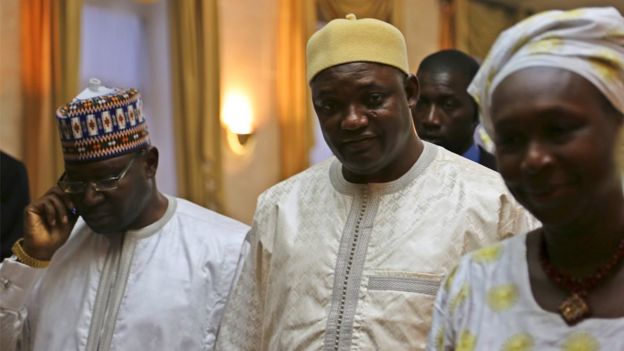
BANJUL, The Gambia–The Gambia’s President-Elect Adama Barrow has left the Gambia for Mali as talks failed, and President Yahya Jammeh refused to relinquish power.  President-Elect Barrow will meet with West African leaders at a summit in Mali.  West African leaders as well as the African Union are calling for a smooth transition of power in The Gambia.  The African Union has publicly stated that they will not recognize President Jammeh as the legitimate leader of The Gambia should he continue to refuse to step down on Thursday, the day that President-Elect Barrow is set to take office.

Gambian President Yahya Jammeh welcoming Nigeria's leader, Muhammadu Buhari, to Banjul

President Yahya Jammeh welcomes Nigerian leader Muhammadu Buhari, to the failed talks that took place late Friday in The Gambia. (Photo Courtesy of BBC Africa)

As talks failed in The Gambia, The Special Representative of the Secretary-General and the head of the UN Office for West Africa and the Sahel (UNOWAS), Mohamed Ibn Chambas, addressed the Security Council stating that although the region has seen democratic progress there is still political uncertainty in some states.  The Gambia is one of the West African nations that may face difficulty having a peaceful transition of power since President Jammeh has refused to accept the election results.  The Security Council thanked Chambas for his remarks and decided to remain seized in the matter.

President Jammeh is rejecting election results that are viewed as legitimate by many African nations.  President-Elect Barrow won the presidency by a large majority.  President-Elect Barrow will focus a large amount of his time at the Mali summit seeking help from West African leaders.  After the Mali summit West African leaders may ask Chambas, the Special Representative of the Secretary-General, to ask the Security Council to deploy troops to The Gambia in the event that President Jammeh does not step down.

For more information, please see: 

BBC Africa – Gambia dispute: African Union ‘will not recognise’ President Jammeh – 13 January 2017

BBC Africa – Gambia talks fail as president refuses to step down – 14 January 2017

UN News Centre – Amid progress in West Africa and the Sahel, UN envoy warns of region’s political challenges – 13 January 2017

Yahoo News – Gambian crisis takes centre stage at Mali summit – 14 January 2017

Egypt Criticizes Condemning Statements Made by EU and U.K. for Freezing Assets of Human Rights Activists

by Yesim Usluca
Impunity Watch Reporter, Middle East

CAIRO, Egypt — On January 11th, an Egyptian court approved freezing the assets of three prominent human rights activists in connection with the ongoing case in which NGOs are accused of receiving foreign funds in an attempt to destabilize the country.

Ms. Hassan is one of the many human rights activists who have had their assets frozen (Photo courtesy of The Guardian)

In its holding, the court froze the assets of prominent human rights activists Mozn Hassan, director of the Nazra for Feminist Studies, Mohammed Zaree, head of the Arab Penal Reform Organization, and Atef Hafez, director of the Arab Organization for Judicial Reform, as well as five other rights activists. Hassan spoke out against the decision, and stated this was the “first time in history [in which] a feminist or women’s rights organization” had its assets frozen.

The case against Hassan and her organization had been initiated in March 2016, and led to widespread criticism from women’s rights groups. 43 organizations had condemned the investigation decision, and declared that the country should “acknowledge the important and pivotal work” undertaken by Hassan in the “advancement of women’s rights [and] provision of support services for survivors of sexual violence[.]”

President Sisi has long defended the country’s dedication to human rights by indicating that Egypt “should not be judged by Western standards.” The European Union (EU), however, criticized the Egyptian court’s decision to freeze assets. In its statement, the EU indicated that the “decision continues a worrying trend of restricting space for civil society to operate in Egypt.” The British Foreign Office Minister also issued a statement declaring his concern over the decision, while urging the country to “lift restrictions on civil society organizations, and allow them to operate freely in line with the constitution.”

In response, the Egyptian Foreign Ministry’s “sharply worded statement” accused both countries of “double standards,” while “telling them to mind their own business.” The statement further declared that the comments made by the EU and UK “amounted to flagrant interference in the country’s affairs.”

For more information, please see:

Haaretz—Egyptian Court Approves Freezing Assets of Three Human Rights Activists—11 January 2017

The Guardian—Egypt court ruling upholds decision to freeze assets of women’s rights activists—12 January 2017

Albawaba—EU condemns Egypt for freezing NGO directors’ assets—13 January 2017)

ABC News—Egypt Slams EU, UK for Criticizing Ruling on Activists—14 January 2017

Ahram Online—Egypt says EU and UK statements on NGO asset freeze shows ‘double standard’—14 January 2017


Russia Decriminalizes Forms of Domestic Violence

By Sarah Lafen

Impunity Watch Desk Reporter, Europe

MOSCOW, Russia — The Duma recently passed a bill which would decriminalize some forms of domestic violence.  The bill, also known as the “slapping law,” would eliminate criminal punishments for first offenses, or attacks that occur only once a year in which a woman or child is not “seriously” injured, and does not require hospital treatment or sick leave from work.

Conservative MP Yelena Mizulina is spearheading and sponsoring the domestic violence bill (Photo Courtesy of CNN)

Under the bill, the punishment for domestic violence offenders would be limited to a fine or community service, while subsequent offenses can still be considered criminal.  The bill passed its first reading at the Duma with a nearly-unanimous 368 out of 370 votes in its favor.

Supporters of the bill claim that current domestic violence penalties are “anti-family” and are a “baseless intervention into family affairs.”  The bill was proposed by conservative MP Yelena Mizulina, who is the head of the Duma Committee on Family, Women, and Children’s Affairs.  Mizulina believes that offenders should not be jailed and deemed a criminal “for a slap” or a “scratch.”  According to Mizulina, “battery carried out towards family members should be an administrative offense.”

Those in favor of the bill cite tradition of parental authority as its source.  Mizulina and her fellow supporters believe that because traditional Russian family values are built on the parents’ authority, laws should reflect those values and traditions.

Women’s rights group claim that the bill will leave domestic abuse victims even more vulnerable than they already are.  Olga Yurkova, executive director of Syostri – a recovery center for sexual assault victims – explained to reporters that the proposed “decriminilisation will worsen the situation” of women tolerating domestic violence but not bringing it to public light.

Women’s rights activist Alena Popova has started a petition which demands the Duma pass a completely new law dealing with domestic violence, which has received over 174,000 signatures.  Journalist Olga Bobrova argued that while domestic violence might not leave a physical mark on the victim’s body, such actions still transform “her life into a living hell.”  Bobrova also explained that “domestic violence is a normal way of life” in Russia.

Activists recently handed out stories of abuse victims outside of the Duma to spread word of the cause.


For more information, please see:

The Huffington Post — Russia Moves to Decriminalize Several Cases of Domestic Violence — 14 January 2017

CNN — Russia Prepares to Decriminalize Some Domestic Violence — 13 January 2017

BBC — Russia: Anger at Move to Soften Domestic Violence Law — 12 January 2017

Mic — Russia’s Proposal to Decriminalize Domestic Violence Earns a Sweeping Parliamentary Victory — 12 January 2017

Somali Town Bans Lavish Wedding Spending

By Samantha Netzband 

Impunity Watch, Africa Desk Reporter

MOGADISHU, Somalia– Beled Hawa, a town in western Somalia, has banned lavish weddings.  Leaders are growing concerned that the large, lengthy, and costly ceremonies are slowing down marriage rates.  Leaders hope this measure will help increase marriages and therefore reduce migration from the area.

somali-wedding.jpg

A wedding of Somali migrants in Wellington, New Zealand. (Photo Courtesy of The Independent)

There are many different types of restrictions.  First, is the limit on spending for gifts.  For new household furnishings for the couple, no more than $600 can be spent.  Then, there is a restriction on bride price, which still exists in Somalia.  Brides can be purchased for no more than $150.  Finally,  there are restrictions on the actual ceremony and reception.  No wedding receptions are to be held in hotels, and no more than three goats may be slaughtered to feed guests.

Although none of the new restrictions are aimed at it, Somali wedding celebrations can go on for weeks and leaders hope these restrictions may help curb that.  It is not unusual for a groom to spend $5,000 on a wedding, and some women were refusing to get married if they did not get lavish expensive weddings.  Beled Hawa’s commissioner told BBC that “Islamic teachings indicated that getting married should be cheap.”

For more information, please see: 

BBC Africa – Somali town bans lavish wedding spending – 13 January 2017

The Independent – Somali town bans expensive weddings in bid to reduce migration – 13 January 2017

XOGDOON News – Somali town bans lavish wedding spending – 14 January 2017

WB News – Somali town bans lavish wedding spending – 13 January 2017

Venezuelan Government Releases Political Prisoners

By Cintia Garcia

Impunity Watch Reporter, South America

 CARACAS, VENEZUELA—The Venezuelan government released several political prisoners from the Helicoide prison. Among the political prisoners released included former opposition presidential candidate. The release of the prisoners comes as talks mediated by the Vatican continue between the Venezuelan government and the opposition.

Francisco Marquez shares his experience as a Venezuelan political prisoner.
Francisco Marquez shares his experience as a Venezuelan political prisoner. (Photo Courtesy of NBC News)

The political prisoners released included former 2006 opposition presidential candidate Manuel Rosales who was detained and imprisoned in October 2015 for illicit enrichment upon his return from exile in Peru. He is the leader of the Venezuelan political party “A New Era.” Mr. Rosales will continue in house arrest until trial. In addition to his release five other activists belonging to the opposition were released. The prisoners included, Nixón Leal, Yeimi Varela, Skarlyn Duarte, Gerardo Carrero and Ángel Contrera who were all detained during a violent barricade protest in 2014. The released prisoners will not be able to leave Venezuela and will report to a parole officer. Furthermore, opposition journalist and owner of Venezuelan media outlet “6 to Poder”, Leocenis García was released after being detained in 2013 for tax fraud, money laundering, and tax evasion.

Their release comes after the opposition demanded the Venezuelan government to release political prisoners. The opposition claimed that they will not attend the following mediation talks on January 13 until 100 political prisoners are released and a new board to the government-controlled electoral council is put in place. Alfredo Romero, executive director of Foro Penal, a group that defends jailed activist stated, “Without a doubt, Venezuela is living a deep social crisis and these releases in some way are an escape valve that takes some pressure, especially international, off Maduro. But it is important to remember that in 2016 there 55 people jailed and only 43 released.”

Most recently, ex- Venezuelan Prisoner, Francisco Marquez, was released in October 2016 after being detained on his way to obtain signatures for the recall referendum against president Maduro. He stated that “people need to know that Venezuela is a country that systematically tortures its political and common prisoners.” He recounted his time in prison, although he was never tortured, he recounted the torture of other prisoners.

For more information, please see:

NBC News—Ex-Venezuela Political Prisoner Still Raining Voice for Others’ Freedom—06 January 2017.

Venezuela Analysis—Former Opposition Presidential Candidate Freed in Venezuela—02 January 2017.

USA Today—Venezuela Frees Jailed Activists, Ex-Presidential Candidate—31 December 2016.