Anti-Gay Protesters March in Paris

By Sarah Lafen

Impunity Watch Desk Reporter, Europe

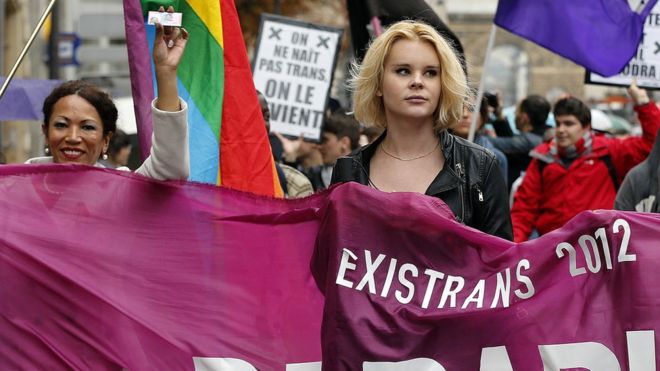
PARIS, France — Thousands of protestors marched in Paris on Sunday to demonstrate their opposition to same-sex marriage laws.  Police estimated the crowd to be at approximately 24,000, however organizers of the event estimated the turnout to be about 200,000.  The protest was led by the anti-gay marriage movement “Manif Pour Tous,” which translates to “Protest for Everyone.”  Participants waved French flags and wore the movement’s colors – blue and pink.  Some brought signs which read “All together for the family” and “In 2017, I’ll vote for the family.”

Tens of thousands of protestors gathered on the streets in Paris on Sunday to protest same-sex marriage laws (Photo Courtesy of DW)

In 2013, France’s socialist government legalized same-sex marriage in a movement they called “Marriage for All.”  The protestors on Sunday hoped to put pressure on right-winged politicians, who are about to take part in a presidential primary in November, to repeal the law if elected.  One 29-year old protestor stated that he wanted a “return to the principles of Christian civilization in terms of family, institutions and work.”  Manif Pour Tous also opposes surrogate pregnancies, assisted reproduction technology, and adoption by same-sex couples.

One hundred gay rights activists staged their own demonstration in opposition to the anti-gay marriage protest to “respond to the hate propagated by Manif Pour Tous.”  At the demonstration, same-sex couples kissed at the city’s central Place de la Republique.  The protest was also briefly interrupted when 13 people were arrested following a protest by six topless women from the activist group Femen.  Some of the women had the phrase “Hate is not a family value” written across their chests.

Former French President and 2017 presidential hopeful Nicolas Sarkozy stated that he would not repeal the law if he were to return to the presidency.  Sarkozy believes that “France has many other important issues to deal with such as security, terrorism and unemployment, rather than recreate conditions for another hysterical debate.”

Manif Pour Tous last orchestrated a large demonstration in 2013 against the Marriage for All law, claiming to have gathered 1.4 million people in the streets of Paris.

So far, none of the leading presidential candidates from the right-wing party have said they intend to repeal the same-sex marriage law if elected.


For more information, please see:

DW — Tens of Thousands Protest Against Gay Marriage in Paris — 16 October 2016

France 24 — Anti-Gay Marriage Protesters Return to Streets of Paris — 16 October 2016

Reuters — French Anti-Gay Marriage Protesters March to Revive Issue Before Polls — 16 October 2016

Yahoo — Anti-Gay Marriage Protesters Return to French Streets — 16 October 2016

Syrian Network for Human Rights: Detailed Account of One Month of Syrian-Russian Attacks on the Neighborhoods of Eastern Aleppo

I. Introduction
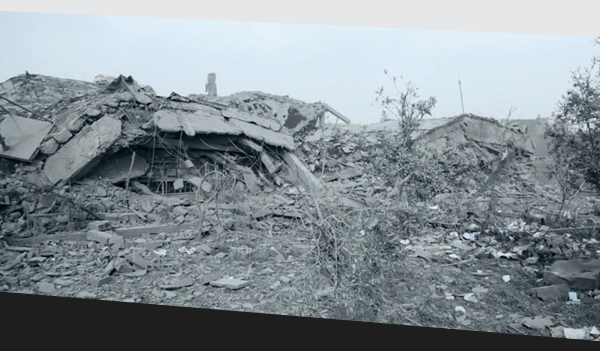
This is the third report that documents the most notable violations of human rights by the Syrian and Russian regimes in the neighborhoods of Eastern Aleppo after the second Cessation of Hostilities statement ended on Monday 19 September 2016 where government and Russian forces have escalated their indiscriminate attacks and military operations throughout Syria and especially in the neighborhoods of eastern Aleppo which will be the focus of this report. This report documents the most notable violations in eastern Aleppo’s neighborhoods which amount to crimes against humanity and war crimes over the course of one month since the second Cessation of Hostilities statement came to an end.
Website
Facebook
Google Plus
Twitter
YouTube
Instagram
RSS
Email

Global Centre for the Responsibility to Protect: Atrocity Alert: Iraq, Central African Republic, Philippines and Yemen

Atrocity Alert, No. 27

No Images? Click here

Atrocity Alert is a weekly publication by the Global Centre for the Responsibility to Protect highlighting and updating situations where populations are at risk of, or are enduring, mass atrocity crimes.

Iraq

On 17 October the Iraqi government announced the launch of a long-anticipated offensive to liberate Mosul from the so-called Islamic State of Iraq and the Levant (ISIL). Iraqi forces, supported by a United States-led anti-ISIL coalition and Kurdish Peshmerga, have been attacking ISIL targets with the aim of seizing back control of Iraq’s second-largest city. The UN has warned that the offensive may affect as many as 1.5 million civilians in Mosul, up to 1 million of whom may be displaced and may require emergency humanitarian assistance. During the first days of the offensive there have been reports of ISIL fighters using civilians as human shields. On 19 October the Popular Mobilization Force, a Shia paramilitary group, announced it would join the offensive. While retaking Fallujah from ISIL earlier this year, Shia militias reportedly targeted Sunni civilians fleeing the city for abduction and killing, possibly amounting to war crimes. It is essential that all parties participating in the battle for Mosul take effective measures to ensure the protection of civilians.

Central African Republic

Despite a period of relative stability following the establishment of a new government during April 2016, populations in Central African Republic remain at risk of mass atrocity crimes as various rebel groups continue to fight each other as well as attack civilians, humanitarian workers and UN peacekeepers. The risk is particularly acute in Kaga-Bandoro where attacks perpetrated by ex-Séléka on 12 October, and the ensuing defense by the UN Mission in CAR (MINUSCA), resulted in at least 30 people killed and several thousand civilians displaced. Since September humanitarian agencies have been forced to withdraw from Kaga-Bandoro and surrounding villages as a result of ex-Séléka looting and targeted attacks on humanitarian workers. While MINUSCA was able to eventually repel the Kaga-Bandoro attackers, it must do more to anticipate threats to vulnerable populations and forcibly disarm armed groups.

Philippines

Since taking office on 30 June 2016, Philippines’ President Rodrigo Duterte has implemented a violent campaign against millions of civilians suspected of either dealing or using illegal drugs. President Duterte has been accused of inciting vigilante groups to attack drug dealers and encouraging police to carry out extrajudicial killings. An estimated 3,800 civilians have been killed so far this year. President Duterte has responded to international condemnation of his policies with derision. The widespread extrajudicial execution of suspected drug users or traffickers may amount to potential crimes against humanity.

Linus G. Escandor II/PRI

Yemen

UN Special Envoy to Yemen, Ismail Ould Cheikh Ahmed, announced on 17 October that all Yemeni parties have committed to a 72-hour cessation of hostilities as of 19 October at 23:59 Yemeni time. The Special Envoy will negotiate an extension of the cessation if the first 72-hour period is respected. Violence between Houthi rebels and various pro-government forces, as well as sustained Saudi-led coalition airstrikes, have resulted in more than 4,125 civilians killed since March 2015. More than 3 million Yemenis have been displaced by the conflict while an estimated 82 percent of the population require humanitarian assistance. It is essential that all parties to the conflict respect the proposed cessation of hostilities, and allow unhindered humanitarian access. All parties to the conflict must immediately cease indiscriminate attacks on civilians and return to credible peace talks.

UN Photo/JC McIlwaine

Connect With Us

Syria Justice and Accountability Centre: A Look Back on Russia’s First Year in the Syrian Conflict

SJAC Update | October 19, 2016
“President Bashar al-Assad of Syria and President Vladimir Putin of Russia met in Moscow to discuss the military operations in Syria.” Source: Wikimedia Commons

A Look Back on Russia’s First Year in the Syrian Conflict

September 30, 2016 marked the first anniversary of Russia’s direct military involvement in the Syrian conflict. Although many onlookers initially believed that recent attempts to broker peace would succeed due to Russia’s leverage over the Syrian government, this has not turned out to be the case. Instead, Russia has disrupted the peace process by actively contradicting its verbal commitments for peace in Syria and supporting President Bashar al-Assad’s actions militarily as well as politically through the UN Security Council. The following includes a sampling of five actions by Russia that have been obstacles to peace:

1. Russia has encouraged and proliferated attacks on civilians

International humanitarian law (IHL) is the guiding framework for actions taken during warfare, including the treatment of civilians and those no longer participating in hostilities. Prior to direct Russian intervention, the Syrian government was already accused of committing numerous IHL violations, such as the targeting of hospitals and civilian populations, the forced displacement of civilians, and the use of chemical weapons. Instead of holding the Syrian government to a higher standard, Russia has instead increased the severity of Syria’s violations. Almost immediately after Russia entered the conflict in October 2015, for example, its air strikes targeted six medical facilities, and since then human rights groups have claimed the health crisis has worsened due to the continued destruction of health facilities. Moreover, Russia has been supporting Syria’s tactic of systematic forced displacement, such as advocating for humanitarian corridors to pressure civilians in eastern Aleppo to leave the area or be subject to attacks.

READ MORE
The Syria Justice and Accountability Centre (SJAC) is a Syrian-led and multilaterally supported nonprofit that envisions a Syria where people live in a state defined by justice, respect for human rights, and rule of law. SJAC collects, analyzes, and preserves human rights law violations by all parties in the conflict — creating a central repository to strengthen accountability and support transitional justice and peace-building efforts. SJAC also conducts research to better understand Syrian opinions and perspectives, provides expertise and resources, conducts awareness-raising activities, and contributes to the development of locally appropriate transitional justice and accountability mechanisms. Contact us at info@syriaaccountability.org.

IntLawGrrls: Is There a Linkage Between Gender-Based Atrocity Crimes and Sexual Assault?

Is There a Linkage Between Gender-Based Atrocity Crimes and Sexual Assault?
October 19, 2016
By Jennifer Trahan
in IntLawGrrls
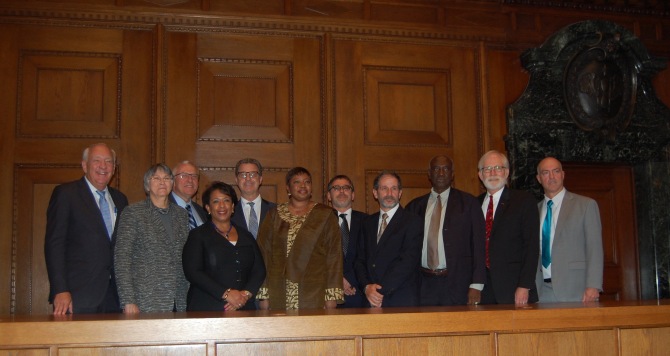
Over the last two decades, there has been exponential growth in the capacity at the international level to prosecute atrocity crimes, particularly through international and hybrid tribunals, including, prosecutions of rape and other forms of sexual and gender-based violence.  In light of these strides which advance the rule of law, particularly, international criminal law, and bring at least a measure of accountability for some of the worst atrocities of the last two decades, is it permissible for a public figure who aspires to leadership to brag about (and allegedly commit) sexual assault?   Are atrocity crimes and sexual assault delinked concepts, or part and parcel of the same phenomenon?
Unlike the prosecutions after World War II before the International Military Tribunal at Nuremberg and before the International Military Tribunal for the Far East in Tokyo, where sexual violence crimes were virtually ignored, today, international and hybrid criminal tribunals prosecute these crimes.  Through groundbreaking jurisprudence of the International Criminal Tribunal for Rwanda, the judges recognized that rape can be a form of genocide.  And, through groundbreaking cases at the International Criminal Tribunal for the former Yugoslavia, the judges recognized that rape can also be a war crime and a crime against humanity.  That tribunal also brought important focus on the use of rape, for example, through prosecutions of perpetrators at a particularly notorious “rape camp,” in Foca.  Other (often horrific) forms of sexual violence that do not constitute “rape” per se, were prosecuted as “other inhumane acts,” which is a crime against humanity.  This work of the Yugoslav and Rwanda Tribunals is today being carried forward by the International Criminal Court, where, for instance, the recent conviction of Jean-Pierre Bemba, included command responsibility convictions for rape, as both a war crime and crime against humanity, committed in the Central African Republic.
Why has there been such pervasive use of gender-based violence, and why does it continue unabated today (in places, for instances, such as Syria, against the Yazidis)?  (It was also part of the genocide in Darfur, and the 1988 genocide by Iraqi forces against the Kurds.)  A few observations can be offered.
First, through a long period of history, rape was seen as similar to plunder, something to which the victors were entitled, as spoils of war.  While the laws of war now clearly forbid such behavior, it is not clear whether that linkage has been entirely severed.
Second, atrocity crimes, including crimes of sexual violence, are made easier to commit through dehumanization of “the other.”  Thus, in both Rwanda and Bosnia, the “other” ethnic group was portrayed as both the enemy (collectively) and as something less than human.  Thus, for example, in Rwanda, the Hutu, in the planning of and during the genocide, termed the Tutsi as Inyenzi, or “cockroaches.”  Had the enemy been seen as individual, it would have been harder to commit the crimes.  Through dehumanization and the stoking of fear, nationalistic leaders in the former Yugoslavia, and leaders in Rwanda (aided by an incendiary media), convinced people to commit horrific crimes, including gender-based violence crimes.
Third, there also appears a linkage between gender-based violence crimes and the unequal position of women in society pre-atrocity.  If women had been seen as equally valued members of society, would situations have deteriorated so precipitously into the use of gender-based violence?  Is there something about the mindset of men who treat women as unequal to begin with, and, historically, centuries of unequal treatment, that in times of armed conflict, can morph into the commission of mass gender-based atrocity crimes?
Fourth, when mass atrocity crimes occur, particularly gender-based violence crimes, another precept that has eroded is the humanity of the perpetrator to see the victim as an individual.  If human rights are respected in a society, and the rule of law works (complaints can be filed and courts are able to operate fairly), then one hopes never to reach these horrific depths of depravity.
Why is all this relevant today?  Because there is a linkage between the mind-set of one Presidential candidate’s bragging about sexual assault (and the accusers who say he committed it) and the mind-set that can devolve, particularly in war-time, into larger-scale sexual and gender-based violence.
We are fortunate in the U.S. not to have suffered atrocity crimes on our soil, at least for a long time, and, generally, U.S. courts (both civilian and military) work well, and the rule of law is, by and large, respected.  So, we do not witness in our country sexual violence crimes that rise to the level of genocide, war crimes or crimes against humanity.
Yet, at heart, bragging about sexual assault objectifies and depersonalizes the victims, and more broadly denies that women deserve a respected and equal place in society, where their rights are fully respected.  Is it so different from the devaluation and dehumanization of women that occurs when sexually-based atrocity crimes occur?  Yes—don’t get me wrong—there is a vast magnitude of difference between what happened in Bosnia and Rwanda, and sexual assault in the U.S. during peacetime, but the conduct belongs on the same spectrum.
It is important to acknowledge this linkage, and condemn sexual assault, wherever and whenever it occurs, whether against men, women, or children, in peace-time or in war.  It is equally unacceptable to brag about what constitutes a crime, and the problem is only compounded when the speaker fails to comprehend the magnitude of the issue.  This isn’t just “locker-room banter,” and suggesting it is also devalues all the men who don’t use such “banter” in a “locker-room.”
The U.S., in the new Administration, needs to continue to exercise moral leadership in the field of atrocity crimes prosecutions, as it did in spearheading the Nuremberg prosecutions and supporting the creation of the Yugoslav and Rwanda Tribunals. It needs to have a leader at its helm who can credibly do so.