With Election Postponed, Violence in Kinshasa Leaves at Least 17 Dead

By Samantha Netzband

Impunity Watch Reporter, Africa

KINSHASA, Democratic Republic of Congo-17 are dead after violent clashes in the capital of the Democratic Republic of Congo.  Violence broke out after current President Joseph Kabila said the government would be postponing the country’s Presidential election.  The election, which was originally scheduled for later this year, will now be held in mid 2017.
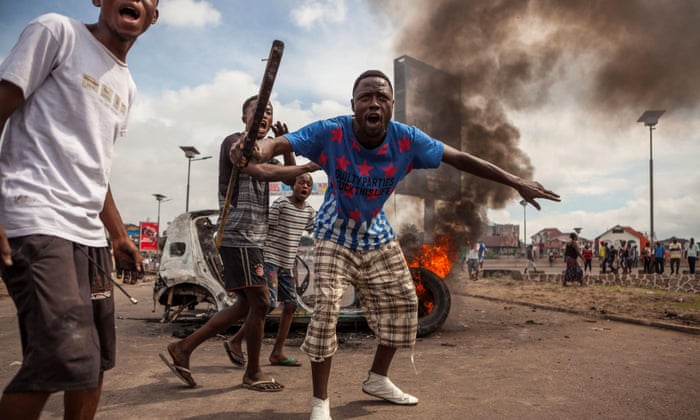
Protesters yell in front of a burning car during a demonstration in Kinshasa. (Photo Courtesy of The Guardian.

Opposition leaders are frustrated with the President, claiming that he is trying to stay in office even though the country’s constitution does not allow a President to be in office for three terms.  President Kabila and other government officials are claiming that this is not the case.  The government says that there are not enough resources to hold a fair election and the postponement is only to ensure a fair transition.

The United States and other observers are considering sanctions against the Congolese government if elections are not held as planned later this year. Barnabe Kikaya Bin Karubi, Congo’s Chief Diplomatic Adviser,  is currently in the United States pleading with United States officials to not sanction the Congo’s government.

“There are two resolutions that were pending in the House to impose sanctions on Congolese officials,” Kikaya said previously. “My mission is to plead with American officials and to prove to them that sanctions are not a solution to help us resolve our problems.”

The toll of the delayed election is already being seen at home.  Three police officers and fourteen protesters have been reported dead.  A police officer was burned in retaliation for shooting at protesters, and one opposition leader says he saw 25 protesters gunned down by security forces.  While the government reports the death toll as 17, other reports have marked the number as closer to 50.

For more information, please see:

CNBC Africa – Clashes in Kinshasa leave 17 dead – 20 September 2016

Digital Congo – Balance insurgency opposition: Evariste Boshab announces a provisional toll of 17 dead – 20 September 2016

The Guardian – Clashes in Kinshasa leave 50 dead, say DRC opposition groups – 20 September 2016

UN News Centre – DR Congo: Ban condemns deadly clashes between protestors and security forces in capital – 19 September 2016

Global Centre for the Responsibility to Protect: R2P in Focus: UN General Assembly Eighth Informal Interactive Dialogue on R2P

R2P in Focus, No. 6

R2P in Focus

R2P in Focus is a monthly publication from the Global Centre for the Responsibility to Protect designed to highlight recent events and political developments concerning the Responsibility to Protect (R2P).

8th UN General Assembly Informal Interactive Dialogue on R2P 

UN Photo/Cia Pak

On 6 September the President of the 70th UN General Assembly, H.E. Mr. Mogens Lykketoft, convened the eighth informal interactive dialogue on R2P. This year’s dialogue was focused on the last report of UN Secretary-General Ban Ki-moon on R2P: “Mobilizing collective action: The next decade of the responsibility to protect.” In his opening remarks, UN Deputy Secretary-General Jan Eliasson said R2P was a signature achievement of the UN and that “the time has now come to seriously counter and confront crisis and potential crisis situations. There are millions of people looking to the UN for help in a time of dire need, conflict and distress. In the name of humanity and in the spirit of the UN Charter, we must not fail them.”

A panel of experts, including the UN Special Adviser on the Prevention of Genocide, Mr. Adama Dieng, and two former Special Advisers on R2P, Dr. Edward Luck and Dr. Jennifer Welsh, presented their perspectives on the Secretary-General’s report. During the debate, 68 member states and the European Union delivered statements on behalf of 93 countries. For the third year in a row, the UN Group of Friends of R2P delivered a statement at the event. Additionally, the Global Centre for the Responsibility to Protect was among four civil society organizations to deliver statements.

Member states used the dialogue as an opportunity to reflect upon remaining obstacles to mobilizing consistent and timely action to prevent or halt atrocities. Some member states spoke about how to improve the UN’s response in the face of atrocities, including through supporting the ACT Code of Conduct and the French/Mexican Initiative on the veto, strengthening peacekeeping through the Kigali Principles, and encouraging regular briefings to the UN Security Council by the UN Office on the Prevention of Genocide and R2P. Participants also discussed countering violent extremism and accountability for mass atrocity crimes.

For more information, including statements and video footage, see our Overview of the 8th Annual Informal Interactive Dialogue on R2P.

UN Peacekeeping Defence Ministeria l

On 8 September over 80 UN troop contributing countries gathered in London for the annual UN Peacekeeping Defence Ministerial. Many states made pledges to bolster their troop, police and financial contributions. The outcome document focused on the “Three Ps” of peacekeeping: planning, pledges and performance. During the meeting participants addressed the need for peacekeepers to deliver on their mandated responsibilities, particularly with regard to civilian protection, noting the “best practices set out in the Kigali Principles.”

UNGA Calendar Highlights

The annual general debate of the 71st UN General Assembly will take place from 20 to 26 September. The Global Centre is co-hosting and participating in a variety of events during this important time.

Monday, 19 September 2016

The governments of the United Kingdom, Belgium and Iraq will co-host an event on fighting impunity for victims of Da’esh. The Global Centre’s Executive Director, Dr. Simon Adams, will be moderating the event.

Tuesday, 20 September 2016

The Holy See and the UN Office on the Prevention of Genocide and R2P will co-host an event with the Global Centre on the role of religious leaders in preventing mass atrocities. This event is open to the public and will take place from 3:00 to 4:30 PM in UN Headquarters Conference Room 2.

Wednesday, 21 September 2016

The governments of the Netherlands, Italy and Rwanda, in coordination with the Global Centre, will co-host the 9th Annual Ministerial Roundtable on the Responsibility to Protect. The discussion will focus on the Kigali Principles on the Protection of Civilians.

Thursday, 22 September 2016

The governments of Liechtenstein, Mexico and Costa Rica, in partnership with the Global Centre, will co-host an event on preventing mass atrocities and advancing UN Security Council reform.

For information on all #UNGA events and statements that are R2P-related, follow @GCR2P on Twitter.

Connect with us

Syria Deeply Weekly Update: Cease-fires and Sectarianism in Syria

The most important updates on the war in Syria.
View this email in your browser

WEEKLY UPDATE
September 17, 2016

Dear Readers,Welcome to the weekly Syria Deeply newsletter. We’ve rounded up the most important stories and developments about Syria and the Syrians in order to bring you valuable news and analysis. But first, here is a brief overview of what happened this week:The cease-fire brokered by the United States and Russia came into effect, just as the Syrian Observatory for Human Rights (SOHR) announced a higher death toll for the six-year-long Syrian conflict. The U.K.-based observatory has documented the deaths of 301,781 civilians and fighters, but placed the actual death toll at approximately 430,000 since 2011.Under the terms of the cease-fire agreement, all parties involved in the conflict must cease hostilities and access must be granted for humanitarian aid deliveries. If successful, the current agreement would lead to increased military cooperation in Syria between the U.S. and Russia.Fighting declined significantly since the start of the truce but did not completely stop. On Thursday at least 23 civilians, including nine children and two women, were reported to have been killed in airstrikes on the largely ISIS-controlled city of al-Mayadin in Deir Ezzor province. An additional 30 people were injured in the airstrikes, at least one of which reportedly hit a shelter for displaced families, according to the SOHR.The cease-fire did not include the so-called Islamic State and the former al-Qaida affiliate Jabhat Fatah al-Sham, so Thursday’s airstrikes did not constitute a violation of the deal.Moscow is using its influence to ensure the Syrian government upholds the cease-fire, Dmitry Peskov, a spokesman for Russian President Vladimir Putin, said on Friday. He added that Russia expects the U.S. to use its own sway with rebel groups to maintain the cessation of hostilities.Five days into the cease-fire, however, humanitarian aid has yet to enter Syria. Jens Laerke, spokesman for the United Nations Office for the Coordination of Humanitarian Affairs (OCHA) said the U.N. is “waiting for assurances that conditions are safe enough” for the aid convoys to cross the border from Turkey. The humanitarian agency is also awaiting proper entry permits from the Syrian government. Some 40 trucks in two separate humanitarian convoys are waiting to enter Aleppo, Syria’s largest city, with enough supplies to feed some 80,000 people for one month.

All eyes will be on these aid convoys in the coming days at the United Nations General Assembly session in New York, including a summit on refugees and migrants on Monday. A top priority at the meeting of international leaders will be Syria, specifically the role of the U.N. role in getting much-needed aid into the countrys hard-to-reach and besieged areas.“Major countries with influence have a duty to use their influence and seize this latest opportunity to pursue a political solution to end this catastrophic conflict,” U.N. Secretary-General Ban Ki-moon said.

Weekly Highlights:

Long Read: Game of Shrines and the Road to Darayya

As the Syrian government and its allied militias evacuate mostly Sunni populations from rebel-held areas, sectarian narratives are filling the vacuum.

In this photo released on the official Facebook page of the Syrian Presidency, Syrian President Bashar Assad, prays the dawn Eid al-Adha prayers at the Saad ibn Muaaz Mosque in Daraya, a blockaded Damascus suburb, Syria, Monday, Sept. 12, 2016. Syrian Presidency via Facebook

Syrian Refugees Save to Make Hajj Pilgrimage

Thanks to growing employment opportunities, more Syrian refugee families in Jordan have been able to save enough money to make the hajj pilgrimage to Mecca this year.

Ahmed Albaker, a Syrian refugee living in Jordan’s Zaatari camp, opens his Quran to quote a passage. Lora Moftah

Experts Weigh In on U.S.-Russia Agreement for Syria

Atlantic Council experts Frederic C. Hof and Faysal Itani discuss the potential outcomes of the cease-fire deal negotiated between the U.S. and Russia, highlighting that the plan’s success hinges on removing civilians from danger.

U.S. Secretary of State John Kerry, left, and Russian Foreign Minister Sergey Lavrov walk in to their meeting room in Geneva, Switzerland, on Friday, September 9, to discuss the crisis in Syria. Kevin Lamarque/Pool Photos via AP

Additional Reading:

For new reporting and analysis every weekday, visit www.newsdeeply.com/syria.
You can reach our team with any comments or suggestions at info@newsdeeply.org.

Top image: Civilians leaving the town of Suran, in Hama province, Syria, Thursday Sept. 1, 2016, after suspected government warplanes carried out several airstrikes in the area. Syria Press Center via AP

Become A Fan
Follow Us

Global Centre for the Responsibility to Protect: R2P Monitor, Issue 29, 15 September 2016

15 September 2016

R2P Monitor, Issue 29

Dear colleague,

I would like to draw your attention to the latest issue of our publication, R2P Monitor.

R2P Monitor is a bimonthly bulletin applying the Responsibility to Protect lens to populations at risk of mass atrocities around the world. Issue 29 looks at developments in Syria, Iraq, Yemen, Sudan, Burma/Myanmar, Democratic Republic of the Congo, Nigeria, South Sudan and Burundi. To read R2P Monitor please access the document via the following link: R2P Monitor, Issue 29.

Issue 29 also includes an insert regarding states that have endorsed the Kigali Principles on the Protection of Civilians. For more information on the Kigali Principles, see: Peacekeeping and the Kigali Principles.

I hope you will find this edition a useful tool as we work together to prevent and halt mass atrocity crimes.

Dr Simon Adams
Executive Director

Ralph Bunche Institute for
International Studies
The Graduate Center, CUNY
365 Fifth Avenue, Suite 5203
New York, NY 10016-4309, USA
Unsubscribe from this list
Update subscription preferences
Forward to a friend
Copyright © 2016 Global Centre for the Responsibility to Protect, All rights reserved.
You are subscribed to e-mail updates from the Global Centre for the Responsibility to Protect.

ICTJ: In Focus: Duterte’s Extrajudicial Killings in the Philippines

ICTJ ICTJ In Focus 60
September 2016

In Focus

Divider

Duterte’s ‘War on Drugs’ Brings Dictatorship Methods Back to the PhilippinesDuterte’s ‘War on Drugs’ Brings Dictatorship Methods Back to the PhilippinesIn less than two months since the inauguration of Rodrigo Duterte as president of the Philippines some 1,900 people have been killed at the hands of the police and death squads for suspected drug dealing or drug addiction. These unlawful murders echo the pattern of widespread and systematic extrajudicial killings that the country suffered under dictator Ferdinand Marcos.

Read More…

ICTJ on Facebook ICTJ on Twitter ICTJ on YouTube ICTJ Podcast
Subscribe
SUBSCRIBE
Like ICTJ | In Focus: Duterte's Extrajudicial Killings in the Philippines on Facebook
Forward to a Friend
Do you know someone that may be interested in the ICTJ newsletter?
Forward this Email
View Newsletter Archive

Other News

Divider

In South Africa, Education as Redress Has Seen Mixed ResultsIn South Africa, Education as Redress Has Seen Mixed ResultsCan education help right the wrongs of the past, especially when the majority of the population was affected by those wrongs? Teboho Moja examines that question in the context of South Africa, where efforts to reform a discriminatory educational system and redress its consequences have been met with mixed results.

Read More…

Colombia’s Chance to Fulfill its Historic Obligations to the DisappearedColombia’s Chance to Fulfill its Historic Obligations to the DisappearedThousands have disappeared during Colombia’s 50-year armed conflict. As the government and FARC agree to a new peace deal, they have agreed to the creation of a special unit that will search for, locate and identify the disappeared. What do victims expect from this new body?

Read More…

Divider

Publications

Divider

The Case for Action on Transitional Justice and DisplacementAs many European countries were beginning to emerge from the depths of the financial problems caused by the 2008 global crash, a new crisis emerged threatening to envelop the continent: the displacement of huge numbers of people fleeing humanitarian disasters in the Middle East and Africa and a slew of related political, financial, and security problems.

Education and Transitional Justice: Opportunities and Challenges for PeacebuildingThis report, part of a joint research project by ICTJ and UNICEF on the intersections of education, transitional justice, and peacebuilding, explores how a transitional justice framework can help to identify educational deficits relating to the logic of past conflict and/or repression and inform the reconstruction of the education sector.

More Publications

Upcoming Events

October 01, 2016

70th Anniversary of the Verdicts of the International Military Tribunal Location:Nuremberg, Germany View Details

October 19, 2016

Dealing with the Past in Northern Ireland: the Victims’ Perspective Location:Ulster University View Details

More Events
Copyright 2011 International Center for Transitional Justice Unsubcribe from this newsletter.