|
||||||||||||||||||||||
|
||||||||||||||||||||||
|
||||||||||||||||||||||
|
Syria Deeply: Weekly Update: Disturbed Alliances and Regional Interventions
|
||||||||||||||||||||
|
||||||||||||||||||||
|
Daily Mail: ISIS laid at least 13,000 landmines as it fled Syrian town of Manbij
ISIS laid at least 13,000 landmines as it fled Syrian town of Manbij – packing fridges, fruit baskets and even KETTLES with explosives
- Manbij in northern Syria was re-captured from ISIS on 12 August
- Thousands of people fled the city after offensive by Democratic Forces
- But troops combing the city have discovered thousands of mines
- Mines were left on known battle lines but also in civilian areas
43
View comments
ISIS laid at least 13,000 landmines as it fled the Syrian town of Manbij – packing fridges, fruit baskets and even kettles with explosives.
The mines were discovered as the Syrian Democratic Forces, an Arab-Kurdish force backed by the US, combed the city after expelling most of the terror group’s troops last week.
Ahmed Mohammed, an activist from Manbij who now lives in Turkey, said that the mines were not only placed on known battle lines but were also planted inside unexpected objects in civilian areas.
Scroll down for video
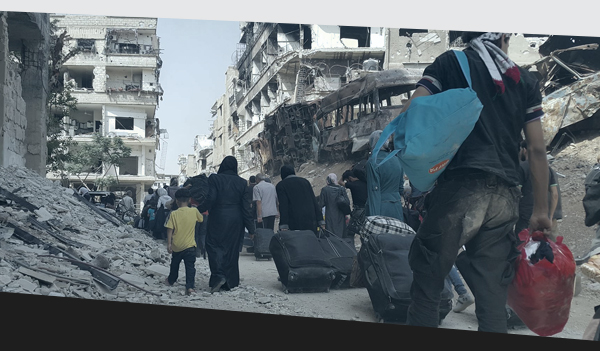
ISIS laid at least 13,000 landmines as it fled the Syrian town of Manbij – packing fridges, fruit baskets and even Kettles with explosives. Pictured: Mothers flee the town
‘Mines were found inside a garlic and onion basket, a staircase, and even normal-looking rocks across the fields,’ he told Global Voices.
He added that the mines were either Russian explosives or improvised devices.
‘Most of the mines are handmade, few are Russian mines, and the majority are landmines.
‘Others are distributed throughout houses: in doors and entrances, refrigerators, cooking utensils and even teapots. They were even behind wall paintings and inside shops.’
Hundreds of people fled Manbij after the Arab-Kurdish army drove ISIS away from the area
Sherfan Darwish, the Syrian Democratic Forces’s spokesman, said that ‘everything’ had been mined as part of a common tactic to slow enemies’ progress and inflict casualties.
‘ISIS has mined everything—refrigerators, house appliances, tea kettles, everything,’ he told the Financial Times.
Images of a mine disguised as a cup have been shared on Twitter by the account Syria with No Mines.
ISIS previously held the city of Manbij for two-and-a-half years since seizing it in January 2014.
Its troops were expelled after a major offensive in northern Syria by the SDF on 12 August.
Mothers were spotted smiling and in tears as they were moved to safety by the SDF
Read more: http://www.dailymail.co.uk/news/article-3760383/ISIS-laid-13-000-landmines-fled-Syrian-town-Manbij-packing-fridges-fruit-baskets-KETTLES-explosives.html#ixzz4KjB5DLFR
Follow us: @MailOnline on Twitter | DailyMail on Facebook
Appeal Against Israeli Force-Feeding Law Rejected
by Yesim Usluca
Impunity Watch Reporter, Middle East
JERUSALEM, Israel — On Sunday, September 11th, the Israel Supreme Court rejected the Israeli Medical Association’s appeal on the force-feeding law that had been passed in July 2015.

Through the appeal, the Israel Supreme Court authorized force-feeding prisoners who are on a hunger strike. The court held that the law is constitutional and “legal under Israeli and international law.” The judges stated that saving lives “remain a priority” as the state is “responsible for the lives of its prisoners.”
The Assembly of Palestinian Doctors in Europe issued a statement declaring that the force-feeding law amounts to a “legitimization of murder.” The Assembly asserted that the law violates the World Medical Association’s Declaration of Malta 1991, which states “forcible feeding is never ethically acceptable.” It further stated that force-feeding violates the 1975 World Medical Association Declaration of Tokyo, which provides that “force-feeding is a crime and form of torture.” The statement further drew attention to the potential risk of death involved with force-feeding, noting that several Palestinian prisoners had lost their lives as a result of this practice. The Assembly also urged international health institutions and human rights organizations, such as the United Nations, Red Cross, and Doctors Without Borders, to condemn the decision and pressure the government to repeal the law.
In recent years, numerous Palestinians initiated collective and individual hunger strikes. Some obtained an early release while others secured better incarceration conditions provided that they end their strike.
In July 2015, Israeli legislators voted to allow the force-feeding of hunger striking prisoners. The reasoning behind this legislation was to prevent Palestinian detainees from using fasting as a means of securing an early release from prison. Mr. Yoel Hadar, a legal adviser to the Ministry of Public Security, had stated that force-feeding would only be used in extreme cases and that Israeli doctors would not be compelled to comply. The law requires the prison commissioner to request the court’s permission to force-feed a prisoner “if a doctor recommends doing so,” and if there is an “imminent danger of severe deterioration in the prisoner’s health.” The law further stipulates that prison officials are allowed to use “reasonable force.”
Upon its passage, several human rights organizations had condemned the law. Palestinian prisoner rights activists declared that the law robbed detainees of their only means to protest incarceration. The Israeli Medical Association identified the move as “torture,” stating that force-feeding could not be accomplished without endangering the prisoner and causing suffering. United Nations officials also condemned the law, declaring that hunger strikes were a “non- violent form of protest used by individuals who have exhausted other forms of protest to highlight the seriousness of their situations.” The Ministry had stated that the decision was based on humanitarian concerns of preventing prisoners from harming themselves and pressuring Israeli authorities.
For more information, please see:
Middle East Eye — Israel court rejects appeal on force-feeding hunger strikers — 12 September 2016
AlJazeera — Israel rejects appeal against force-feeding prisoners — 11 September 2016
Palestine News Network — Israeli force-feeding law incitement to murder — 14 September 2016
The New York Times — Israel Allows Hunger-Striking Prisoners to Be Force-Fed — 30 July 2015
US Prisoners Launch a Nation-wide Strike in Protest of “Prison Slavery”
by Portia K. Skenandore-Wheelock
Impunity Watch Reporter, North America
UNITED STATES — On Friday prisoners in 40 prisons in at least 24 states went on a coordinated strike, refusing to do their assigned jobs, and are demanding an “end to prison slavery.” This is one of the largest prison strikes attempted in decades. The date of the start of the strike coincides with the 45th anniversary of the 1971 Attica prison uprising. The Industrial Workers of the World’s Incarcerated Workers Organizing Committee (IWOC) and the Free Alabama Movement organized and announced the strike in a statement, “Slavery is alive and well in the prison system, but by the end of this year, it won’t be anymore. This call goes directly to the slaves themselves.”

As state budgets have been cut the over 2 million prisoners in the United States have been a source of cheap, and in some states free, labor. New work programs have prisoners repairing public plumbing, doing underwater welding, cleaning up roadkill, and maintaining public spaces. Prisoners’ jobs also go beyond public works and services. Corporations, such as Starbucks, Wal-Mart, Victoria’s Secret, McDonald’s, IBM, and AT&T, have tapped into prison labor by making deals with both private and public prisons. Prisoner laborers make 12 to 40 cents per hour yet the annual dollar value of their work output is estimated to run in the billions. “We want people to understand the economics of the prison system. It’s not about crime and punishment. It’s about money,” says Melvin Brooks-Ray, founder of the Free Alabama Movement and an inmate for 17 years.
Since labor law does not consider prisoners employees, they are not allowed to unionize. IWOC is trying to change that and encourages prisoners to join without charging union dues. IWOC’s site says, “You cannot change this situation through a grievance process that doesn’t work…or through courts that are clearly against you…or through petitions to lawmakers who don’t care about you because you don’t vote…or through hunger strikes against prison officials who want you to starve…or through letters to newspapers who have ignored this situation for decades.”
Prisoners in different states have other demands beyond fair wages for their work, such as an end to long-term solitary confinement policies, poor healthcare, poor quality of food, violent attacks, overcrowding, fairer parole policies, and reinstating educational courses for high school diplomas. “Different prisoners have different goals and aims, it’s looking like it’s going to be a state-by-state thing,” said Brianna Peril, co-chair of IWOC and a former prisoner. In response to these non-violent strikes, many prisons are engaging in lockdowns and barring prisoners’ access to communication.
For further information, please see:
Wired – How to Organize the Largest US Prison Strike Ever…From Inside Prison – 9 September 2016


Turkey sends tanks across border into Syria: Ankara launches…
Russia tells the United Nations it will support a 48-hour…