Migrants Aid in Rescue Efforts in Wake of Italian Earthquake

By Sarah Lafen

Impunity Watch Desk Reporter, Europe

ROME, Italy — In the wake of Wednesday’s earthquake in Italy, thousands of migrant refugees currently hoping to gain asylum in Italy flocked to the sites most affected by the quake to aid in rescue efforts.  These refugees hail from multiple countries, including Senegal, Niger, and Burkina Fasso, and arrived in Italy via boats run by human traffickers.   In Calabria, a group of over 70 refugee asylum seekers pooled their daily allowance money of two euros ($2.30) to donate to earthquake survivors.

A volunteer prepares food after the earthquake in Amatrice, Italy (Photo Courtesy of Reuters)

In the Italian town Arquata del Tronto, one West African migrant named Abdullai told reporters that while he was scared of the earthquake at first, he soon realized that the survivors of the quake needed his help as much as possible.  Abdullai and 16 other migrant workers spent a day weeding, cleaning, and preparing an area to be used as an emergency operations center.  Another group of 20 Muslim migrants used gardening tools to prepare the grounds for tents to be set up, and cleared a field for a helicopter landing space.  While taking a break from their physical labor, the migrants all knelt and prayed together.

According to Letizia Bellabarba, a coordinator of a charity that hosts asylum seekers, the refugees came up with the idea to aid in rescue efforts themselves.  Bellabarba says that the refugees “said that Italy welcomed and helped them, and it was now their turn to help Italians.”  Approximately 50 asylum seekers associated with the charity came forward to help, were split up into groups of 15-20 per day, and were given assignments through Italy’s Civil Protection Department.

The outreach and assistance of these asylum seekers does not quash the anti-immigration movement in Europe, however.  Amidst the tragedy surrounding the earthquake, a priest in Boissano, Father Cesare Donati, expressed his anti-immigration stance through a Facebook post saying “it is now time to put the victims into housing and send the migrants to the tents…”  A lumberjack who was left homeless by the earthquake said that while he is grateful for the help of the migrants, he is worried they are using up resources that should be going to the victims of the quake instead.

For more information, please see:

The Huffington Post — The Refugees Who Helped Survivors of Italy’s Earthquake Know What it Means to Suffer — 28 August 2016

NPR — Migrants Help in Relief Effort After Deadly Earthquake in Italy — 28 August 2016

The Huffington Post — Refugees in Italy Donate Money and Help Clean up After Earthquake — 26 August 2016

Reuters — African Migrants go to Italian Quake Zone to Help Survivors — 26 August 2016

United Nations Foreign Aid Workers Gang Raped by South Sudanese Soldiers

By Samantha Netzband 

Impunity Watch Reporter, Africa 

JUBA, South Sudan– Foreign aid workers were gang raped by South Sudanese soldiers in the bathroom of a hotel in Juba.  The attack that happened on July 11th is being called a turning point for foreign aid workers in the country that was considered safe until the attack.  Calls for help were made to a United Nations compound that was nearby, but there was no response.

The Terrain Hotel where the foreign aid workers were hiding before they were attacked.  (Photo Courtesy of NPR)

“The soldiers just came to the bathroom where all the girls were hiding and they just picked us out of the bathroom one by one,” says one women who was at the hotel.  Despite the violence from the civil war this unusual attack has created shock waves in the humanitarian aid community.  Some organizations are evacuating their staff while others are reducing their activities in the area.

The United Nations were not the only one’s who did not show up to save the aid workers.  The trapped aid workers also called the United States Embassy and private security firms.  The reported reason for their failure was the fact that the streets were too dangerous from clashes that were happening outside the hotel.

The aid workers were eventually rescued, but only after 5 of them had been raped for hours.  Many civilians have also reported being raped in South Sudan.  Some of these civilians were raped while under United Nations Peacekeepers watch.  The international attention brought to the gang rape of aid workers may force change that works to prevent the further spread of sexual and gender based violence in South Sudan.  While the gang rapes were happening, over 300 people were killed during 4 days of fighting.

For more information, please see: 

New York Times Live – Shock in South Sudan as foregin aid workers gang raped by soldiers – 24 August 2016

News Deeply – Aid Worker Attacks Expose Ongoing Assault of Women in South Sudan – 24 August 2016 

NPR – Gang Rape of Aid Workers In South Sudan Is A Turning Point – 23 August 2016

The Colombian Government and FARC Reach Peace Deal

By Cintia Garcia

Impunity Watch Reporter, South America

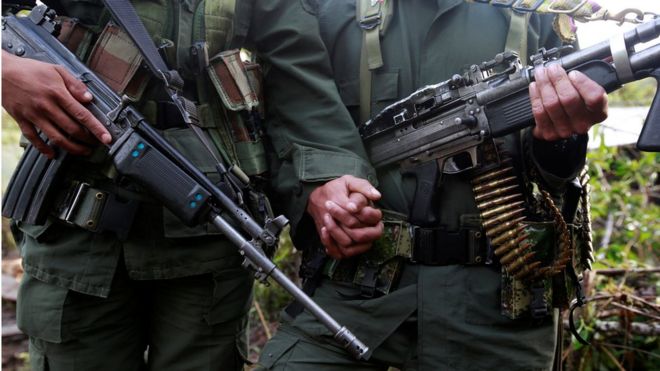
BOGOTA, COLOMBIA—The FARC and the Colombian government announced the end of the longest guerilla war in the Americas on Wednesday August 24 in Havana, Cuba. After four years of negotiations, both parties have reached a deal outlining the timeframe in which the FARC will turn in their arms and reintegrate into society.

The Farc will put down their arms after 52 years of war. (Picture Courtesy of BBC)

The negotiation team released a 297-page document detailing the accords. The deal calls upon the FARC to end their drug trafficking activities. It also calls on the government to develop the rural impoverished communities of Colombia. Additionally, the deal allows FARC to reintegrate into Colombian politics by becoming a left-wing political party that will have the governments protection. The deal gives certain FARC members amnesty, and they will not be able to be indicted for war crimes.   The FARC will also hand in their weapons in a transfer to the UN monitors— though a date for the transfer has not been established.

Although the parties have agreed on the details of the peace accords, the people of Colombia will vote to approve the deal in a referendum that will be held on October 2. President Juan Manuel Santos stated, “It’s in your hands, of all Colombians, to decide with your vote to support this historic accord that puts an end to this long conflict between the children of the same nation.” The FARC will meet in mid-September to ratify the accord.

Hundreds gathered in Bogota to watch the broadcasting of the peace accords and to celebrate the end of a chapter. As President Juan Manuel Santos announced, “Today begins the end of the suffering, the pain and the tragedy of war…Let’s open the door together to a new stage in our history.” The ceasefire will officially commence on Sunday at midnight when both the FARC and the government will announce at the same time a definitive ceasefire.

For the past fifty-two years Colombia has experienced an intrastate conflict that has displaced millions and killed 260,000 victims. FARC was created in the 1960s on Marxist beliefs demanding land and social reform.

 For more information, please see:

New York Times—Colombia and FARC Reach Deal to End the Americas’ Longest War—24 August 2016.

NPR—FARC Rebels, Colombian Government Sign Historic Peace Treaty—25 August 2016.

Colombian Reports—FARC Peace Deal to be Signed in 2nd Half of September, ahead of Vote—26 August 2016.

BBC—Colombia Peace Deal: FARC to Announce Ceasefire on Sunday—27 August 2016.

International Outrage Over Executions of 36 Islamic State Fighters

by Yesim Usluca
Impunity Watch Reporter, Middle East

BAGHDAD, Iraq —  In June 2014, Islamic State (ISIS) forces took over Camp Speicher, located just north of Tikrit. Upon assuming control, ISIS militants executed approximately 1,700 Shia army recruits who had fled the Camp. The families of those lost have been demanding justice since these killings.

Iraqi forensic team writes on the body bag of remains belonging to Shia soldiers from Camp Speicher (Photo Courtesy of Human Rights Watch)

In July 2015, the Iraqi government held a group trial for the individuals accused of taking part in the executions. The defendants alleged that they were tortured into confessing their role in the killings, and that these confessions were the basis upon which the cases against them were built. The militants were ultimately convicted and sentenced to death at the close of the proceedings. Despite the higher court’s overturning of the verdict, the lower court still convicted several men in a group hearing that lasted only one day. The defendants were denied a second appeal, and several death sentences were issued.

On August 17, 2016, Iraq’s President approved the execution of 36 individuals who were convicted of taking part in the Speicher massacre. These soldiers were hanged on Sunday, August 21 by the Iraqi government.

Several international organizations, such as the United Nations and Amnesty International, have issued statements raising concerns about the hearings and subsequent executions.

The United Nations issued a report in April 2016 stating it found the hearings to lack “international fair trial standards.” The report further noted that the defendants were not provided effective means for a defense at trial and that the Iraqi government failed to fully investigate the allegations of coerced confessions. Amnesty International’s senior crisis response advisor stated that the execution of the 36 militants resulted from an erroneous judicial process that did not meet the standards of international law.

Amnesty International reported that the Iraqi government had received threats of retaliation from militia leaders if the executions were not carried out. Subsequently, in August 2016, the United Nations expressed concern over Iraq’s efforts to speed up militant executions, which could potentially lead to the death of innocent individuals.

Iraq’s Justice Minister dismissed all of these concerns on the grounds that each case “was reviewed in detail” before being delivered to the President for approval of the death sentence.

For more information, please see:

Middle East Monitor — Iraq executions are part of political and sectarian agenda, claim human rights groups — 23 August 2016

Los Angeles Times — Iraq executes 36 men convicted in massacre carried out by Islamic State — 21 August 2016

Reuters — Iraq hangs 36 people sentenced to death for killing of troops in 2014 — 22 August 2016

Human Rights Watch — Executions in Iraq Not Real Justice for Speicher Massacre — 23 August 2016

Al Arabiya English — Rights groups condemn executions over Iraq massacre — 24 August 2016

Burkini Ban Strictly Enforced in French Towns

By Sarah Lafen

Impunity Watch Desk Reporter, Europe

PARIS, France — Burkinis, the full-body bathing suit worn by Muslim women, have been banned by over 15 towns in France, mainly at popular tourist locations on the French Riviera.  The bans do not mention the burkini specifically, however refer to clothing that will be respectful of the principle of secularism.  Authorities cite recent terrorist attacks, such as the ones in Nice and Paris, when justifying the need to keep the public order implications of religious clothing at bay.

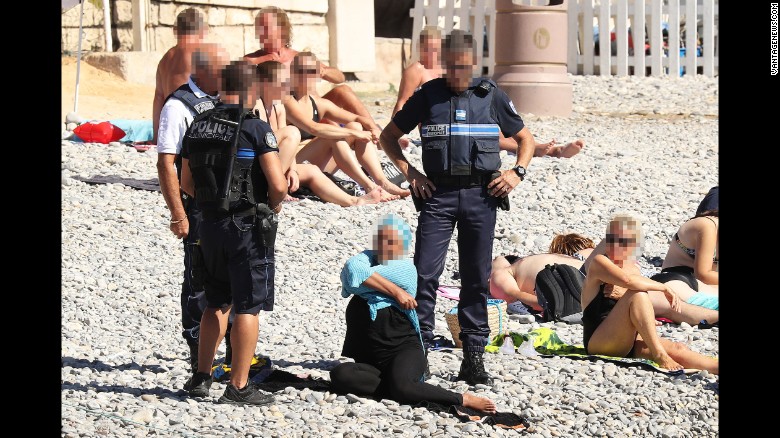
A woman removes her tunic on a beach in Nice as police enforce the burkini ban (Photo Courtesy of CNN)

France is home to Europe’s largest Muslim population.  However, some mayors of the towns considering the burkini ban admit to never having seen one on their local beaches.  Some of the mayors justify the ban by citing the maintenance of public hygiene and “good morals.”

The bans are raising concerns regarding whether the proliferation of bans on the swimwear is a sign of France’s demand for conformity with the non-Muslim community, or whether the bans are an authentic, affirmative absence of government involvement in religious affairs.  Recent opinion polls reflect the support that many French citizens have for the ban, however many Muslims living in France have expressed that they feel they are being “unfairly targeted.”

This past week, images emerged depicting French police allegedly enforcing the ban on a beach in Nice.  Multiple armed police officers stood around a woman as she removed her long-sleeved tunic, and one officer appeared to write her a fine once she was finished.  Siam, the 34 year old mother who was approached by police regarding her clothing, states that she had been sitting on the beach in leggings, the tunic, and a headscarf when she was fined.  Siam also told the press that she had no intention of swimming.  Nice authorities say the enforcement of the ban is a “necessity” after the terrorist attack in Bastille in July.  Muslim activist group Collective against Islamophobia claim that within the last two weeks, 16 Muslim women have been fined for their attire at beaches in the south of France, however none of those 16 were wearing an actual burkini.

French Prime Minister Manuel Valls supports the ban and those mayors who are enforcing it, calling the burkini an “affirmation of political Islam in the public space,” and considers them to be a part of a “policical project” to enslave women.  On the other hand, French education minister Najat Vallaud-Belkacem, warns that the increase in burkini bans lets “loose” verbal racism.


For more information, please see:

BBC — France Burkini Ban: Mayors Urged to Heed Court’s Ruling — 27 August 2016

CNN — Burkini Ban: Police in Nice Force Woman to Remove Part of Clothing — 25 August 2016

The Guardian — France’s Burkini Ban Row Divides Government as Court Mulls Legality — 25 August 2016

BBC — France ‘Burkini Ban’: Images of Police on Beach Fuel Debate — 24 August 2016