France Bans Foreign Funding for Mosques

By Sarah Lafen

Impunity Watch Desk Reporter, Europe

PARIS, France —  In the wake of several major terrorist attacks within the past year and a half, France is taking measures to de-radicalize certain mosques in hopes of de-radicalizing its Muslim community.  After the attacks in Nice last month, French Prime Minister Manuel Valls called for a ban on foreign funding of mosques for an indefinite period of time.  Places of worship in France cannot legally receive state funding, leaving the only source of potential funding to outside donations often from foreign sources.

Muslim worshipers attend prayer at a mosque in Normandy, France following a terrorist attack at a church in the area (Photo Courtesy of The Washington Post)

The French government has shut down 20 mosques since December, all of which preached Salafism – a strict, Sunni interpretation of Islam.  France is home to approximately 1500 mosques, only 120 of which are apparently associated with Salafism.

French Interior Minister Bernard Cazenueve explained that the mosques that would be shut down are those which are “facilitating radical preachers.”  Cazenueve also stated that France will continue to expel figures linked to radical Islam from the country.

In order to supplement the lack of foreign funding, the French Council of Muslim Faith (CFCM) announced that there will be a foundation established to help finance mosques in France.  CFCM leader Anouar Kbibech stated that the majority of Muslims in France practice an open, tolerant version of Islam, and fully respect the laws of the republic.  Cazenueve supports the proposed foundation, and hopes it is launched by October.  Some have suggested that the foundation raises money by taxing halal food, however this idea is controversial due to the discrepancies regarding what actually constitutes a halal food.

Marwan Muhammad, director of the Collective Against Islamophobia in France, considers these movements to be suggestive of the notion that all mosques are involved in some sort of terrorism.  Muhammad sees these actions as a “way of problematizing Muslims once again.”

France is home to the European Union’s largest Muslim community.  Valls emphasizes the need for France to “invent a new relationship with Islam” by developing a “kinder, gentler form of Islam” by limiting foreign influences over the religion.


For more information, please see:

The Guardian — France Plans Mosque Funding Foundation to Stop Radicalisation from Abroad — 1 August 2016

Gatestone Institute International Policy Council — France Working to De-Radicalize its Mosques — 10 August 2016

The Irish Catholic — France Closes 20 Radical Mosques — 11 August 2016
The Washington Post — To Curb Radicalism, France Targets Foreign Funding for Mosques — 14 August 2016

30 Killed in the Democratic Republic of Congo by Ugandan Rebels

By Samantha Netzband

Impunity Watch Reporter, Africa

KINSHASA, Democratic Republic of Congo—  30 civilians were killed by the Ugandan extremest group the Allied Defense Forces (ADF) in Beni, Eastern Democratic Republic of Congo.  The civilians were killed in the Rwangoma neighborhood of Beni which sits in an area of the Democratic Republic of Congo that has seen an increase of civilian murders since 2014.

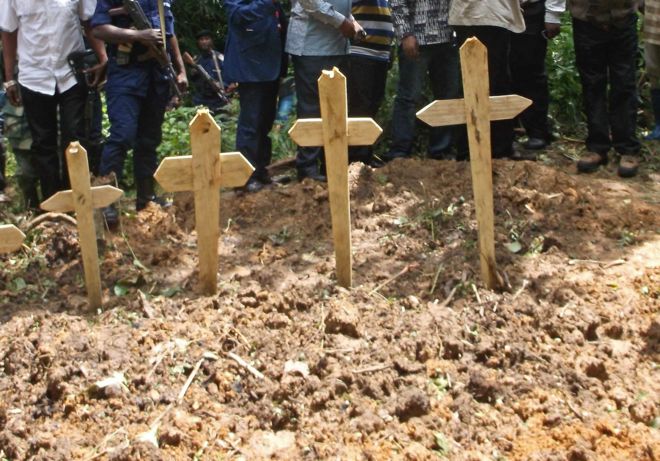
Burial for victims of suspected rebel attack in eastern DR Congo, Apri 2015

Crosses at the site of the killing of 30 civilians.  (Photo Courtesy of BBC)

The killings are in response to increased military activity in the area.  The ADF has been involved in a number of illegal acts including drug smuggling and civilian killings.  They along with other militant groups are active around Beni and the rest of Eastern Democratic Republic of Congo because of the areas proximity to the vast Virunga National Park.

Locals came out to protest after the latest killings.  Human rights activist Jackson Kasereka said that residents were burning tires in the street in protest.

For further information, please see: 

Africa News – Suspected Uganda militia over 30 people in Eastern DR Congo – 14 August 2016

BBC – DR Congo rebels blamed for 30 civilian deaths – 14 August 2016

France 24 – About 30 civilains have been killed in a massacre in an area of eastern Democratic Republic of Congo that has been shaken by violence since 2014, the army said Sunday – 14 August 2016

Yahoo – DR Congo ‘massacre’ leaves 36 dead in troubled east – 14 August 2016

Iranian Nuclear Scientist Executed for Espionage

by Zachary Lucas
Impunity Watch Reporter, Middle East

TEHRAN, Iran — An Iranian nuclear scientist was executed after being tried and convicted of espionage and treason. Iranian officials say the scientist gave “vital information” to the United States.

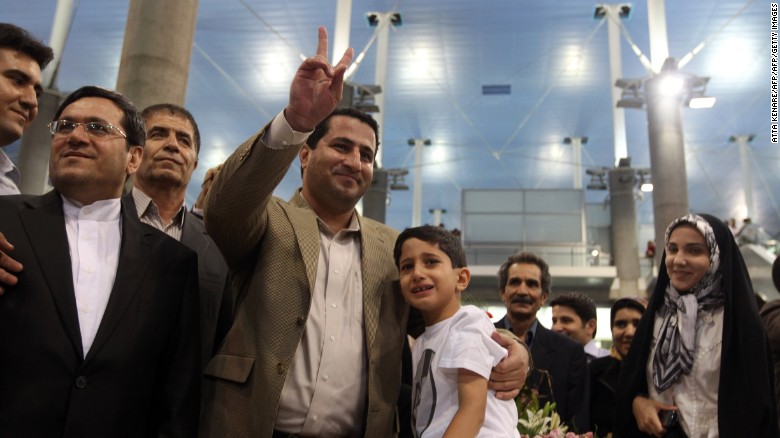
Amiri Returned to Iran in 2010 (Photo Courtesy of CNN)

Iranian nuclear scientist, Shahram Amiri, was executed after being in custody for six years by Iranian officials. Iranian judiciary officials stated that Amiri was hung after he gave state secrets away to the United States. Deputy Chief Justice of Iran, Gholam-Hossein Mohseni-Eje’i, said Amiri provided top secret information to the “number one sworn enemy, America.” Amiri’s execution came years after his conviction as it was being reviewed by the highest court in Iran. The court stated they reviewed the case with “extreme care.”

In 2009, Amiri vanished while on a religious pilgrimage to Saudia Arabia. A year later, Amiri turned up in the United States. Iranian officials accused the United States of abducting Amiri while the United States claimed Amiri had defected to undermine Iran’s nuclear program. Amiri, while in the United States, claimed he was kidnapped by the Central Intelligence Agency and later sought asylum at the Pakistani Embassy where he asked to be brought home.

Initially when Amiri returned, he was given a hero’s welcome which was extensively covered in the Iranian media. Amiri claimed he faced “psychological warfare” while in the United States. United States officials state he gave up information voluntarily. Shortly after his return, he was arrested by Iranian officials accused of espionage and treason. There were reports that, while in custody, Amiri was subjected to torture.

Amiri’s mother has stated that her son was unfairly tried and was innocent. Amiri’s mother along with watch groups question the closed-door trial of Amiri. Amiri’s mother claims that he was not given proper representation and was never allowed to talk with his lawyer. Iranian judicary officials have provided no comments concerning the way the trial was handled.

For more information, please see:

BBC — Iranian nuclear scientist Shahram Amiri executed for treason — 7 August 2016

CNN — Iran: Nuclear scientist executed for spying for ‘Great Satan’ U.S. — 8 August 2016

Guardian — Iran executes nuclear scientist who returned to country from US — 7 August 2016

Reuters — Executed Iranian nuclear scientist unfairly tried, said he was innocent: mother — 9 August 2016

Washington Post — Iran says it executed a nuclear scientist for spying — 7 August 2016

Women Raped in Camp in South Sudan While U.N. Peacekeepers Allegedly Standby

By Samantha Netzband

Impunity Watch Reporter, Africa

JUBA, South Sudan –Dozens of women have been sexually assaulted by government soldiers at a United Nations camp in South Sudan. The camp has over 30,000 displaced persons. Those attacked were Nuer women who had sought shelter from the continued fighting in South Sudan.  Many have been injured and two women have died from their injuries.

Young girls carry luggage in an United Nations Mission in South Sudan (UNMISS) IDP camp on June 20, 2014 in Juba. According to UNMISS spokesperson Ariane Quinter, the UNMISS will be closing the IDP (Internaly Displaced Persons) site and relocating them to a new site in Jebel Area due to the congestion at the current site in Tomping. June 20 marks the World refugee day, according to statistics over 1.3 million people have been displaced from their homes due to the current conflict. AFP PHOTO / CHARLES LOMODONG (Photo credit should read CHARLES LOMODONG/AFP/Getty Images)

Young girls at the UN Camp in Juba, South Sudan.  (Photo Courtesy of the New York Times)

It is reported that many United Nations Peacekeepers witnessed the attacks and did nothing to stop them.  Both the South Sudanese government and the United Nations did not deny the assaults that happened; and, Chantal Persaud, a spokesman for the United Nations in South Sudan, said there was at least one incident where United Nations Peacekeepers stood by and watched.  South Sudanese soldiers were allowing the women to leave the camp to gather food and perform other tasks and then attacking the women when they returned to the camp.  The rapes included gang rapes of underage women of more than 10 men each.  The assaults may also be racially motivated many of the soldiers who are assaulting the Neur women are members of the Dinka ethnic group which is diametrically opposed of the Neur group.

The United Nations has now made a statement saying that if the United Nations Peacekeepers stood by and watched as the women were assaulted there will be severe consequences.  United Nations Peacekeepers are deployed to protect civilians and are even allowed to use lethal force if necessary.  The United Nations has increase security in the camp in order to prevent further attacks from happening.

For more information, please see: 

All Africa – South Sudan: Report: Soldiers Raped Women Outside UN Camp – 28 July 2016

Breitbart – South Sudan: Soldiers Rape UN Camp Girls by the Dozen While Peacekeepers Watch – 27 July 2016

New Europe – Dozens Raped near UN Camp in South Sudan – 28 July 2016

New York Times –  Dozens of women have reportedly been assaulted and raped at U.N. camp in South Sudan – 28 July 2016

Syria Justice and Accountability Centre: The SJAC Weekly Update

Rebels driving food trucks from Idlib into eastern Aleppo after breaking the siege on August 6
Photo Credit: Khaled Salameh

Rebels’ Gains are the UN’s Losses in Aleppo

Leave or starve” is how the Syrian opposition described Russia’s proposal to create humanitarian corridors in Aleppo to allow civilians to flee ahead of increased airstrikes. By the end of July, Assad government forces, with support from Russia, successfully surrounded rebel-held areas in eastern Aleppo, besieging about 300,000 residents. The United Nations (UN) estimated that food and medical supplies in these areas would only last between one to three weeks with dire humanitarian consequences. The ultimatum — to either remain and endure air bombardments and starvation or escape to the western side of the province under government control — amounted to forced displacement which is prohibited under international humanitarian law. Before the corridors could take effect, however, a coalition of rebels including Ahrar al-Sham, Jeysh al-Fateh, and Jabhat Fateh al-Sham (formerly Jabhat al-Nusra) broke the siege, bringing in trucks of food supplies. Despite the relief that these food trucks brought to civilians in the area, it is difficult to overlook the fact that the so-called liberators have been accused of committing numerous human rights violations in the past. The symbolism of aid reaching besieged areas through these fighters instead of the UN has negatively impacted the UN’s image among Syrians and could jeopardize the peace process.

Before the siege ended, the Russian and Syrian governments issued a statement to the UN, announcing the establishment of four humanitarian corridors, three for civilians and one for armed rebel fighters. Despite the Syrian government’s guarantees of safety, Aleppo residents dubbed them “death corridors” because they feared the government would target anyone who tried to utilize the corridors through airstrikes or arrests. The Syrian opposition even compared Syria’s strategy to Grozny, where Russia dropped leaflets  to inform Chechen civilians of humanitarian corridors, briefly allowing people to flee, only to then bombard and flatten the city.

READ MORE
The Syria Justice and Accountability Centre (SJAC) is a Syrian-led and multilaterally supported nonprofit that envisions a Syria where people live in a state defined by justice, respect for human rights, and rule of law. SJAC collects, analyzes, and preserves human rights law violations by all parties in the conflict — creating a central repository to strengthen accountability and support transitional justice and peace-building efforts. SJAC also conducts research to better understand Syrian opinions and perspectives, provides expertise and resources, conducts awareness-raising activities, and contributes to the development of locally appropriate transitional justice and accountability mechanisms. Contact us at info@syriaaccountability.org.