German Music Festival Targeted by Suicide Bomber

By Sarah Lafen

Impunity Watch Desk Reporter, Europe

BERLIN, Germany —  A 27-year old Syrian detonated an explosive backpack near the entrance to a music festival in the German town Ansbach on July 25, killing himself and injuring 15 people with injuries ranging from serious to non-life threatening.  Bavarian Interior Minister Joachim Herrmann stated that the backpack explosive device contained nails and screws, a measure indicative of an attempt to inflict widespread damage onto others. The bomber was rejected entry to the festival because he did not have a ticket to the event, and was seen lingering around the outside seating area of a wine restaurant around 10pm right before the bomb was detonated.

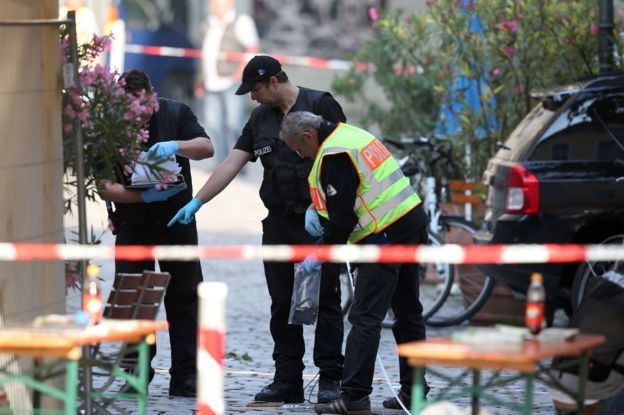
Police inspect the area near the wine bar in Ansbach where the bomb was detonated (Photo Courtesy of BBC)

The suicide bomber left behind a video on his cell phone pledging his allegiance to ISIS, and stated that the attack was revenge against Germans because they “obstruct Islam”.  Upon searching the bomber’s room after the attack, police also found bomb-making materials, as well as computer images and film clips linked to ISIS.  The bomber arrived in Germany in 2014 and applied for asylum, however found out two weeks ago that his application as denied, and he would have been deported to Bulgaria within 30 days of the denial.  Within the past two years, he had been in trouble with local authorities for drug-related offenses, and was under psychiatric observation following two previous suicide attempts.

This attack occurs in the midst of widespread criticism of Chancellor Angela Merkel’s lenient immigration policy.  This past week alone, Germany has been the target of several violent attacks linked to ISIS, including a shooting rampage at a shopping mall in Munich and an ax attack on a train in Wurzburg.

Despite its loose immigration policy, Germany has been taking steps over the past couple of months to tighten security regarding asylum seekers in hopes of limiting the number of refugees who enter the country.  A newly proposed law would help speed up the application process for refugees, quickening the deportation process for those who are denied asylum.  Berlin has been in the process of negotiating a deal with Turkey to take back their citizens who are denied asylum in Germany.  These efforts seem to be successful, as the number of refugees arriving in Germany has fallen dramatically over the past year.


For more information, please see:

CNN — Ansbach Bomber in Germany Pledged Allegiance to ISIS Leader — 26 July 2016

DW — As Attacks Rattle Germany, Chancellor Merkel Finds Herself in the Spotlight — 25 July 2016

NBC — 12 Injured, Bomber Killed Outside German Music Festival — 25 July 2016

New York Times — Suicide Bomber in Ansbach, Germany, Pledged Loyalty to ISIS, Officials Say — 25 July 2016

Reuters — Bavarian Bomber Pledged Allegiance to Islamic State: Minister — 25 July 2016

El Salvador’s Supreme Court Declares Amnesty Law Unconstitutional

By Portia K. Skenandore-Wheelock
Impunity Watch Reporter, North America

SAN SALVADOR, El Salvador — The Constitutional Chamber of El Salvador’s Supreme Court has found articles 1 and 4 of the 1993 Amnesty Law unconstitutional. These articles extended amnesty to certain people and crimes committed during El Salvador’s civil war beyond international law, violating the fundamental rights for the victim’s of genocide and crimes against humanity. In a 4 to 1 vote the judges ruled that provisions in the law contradict the right to moral reparations, “Crimes against humanity don’t have statute of limitations according to international law.” Without the Amnesty Law the government can now investigate, prosecute, sanction, and remedy severe human rights violations.

According to the UN Truth Commission the Salvadorian army committed massacres in villages that were suspected of supporting guerrillas. Over 75,000 El Salvadorians were raped, tortured, killed or disappeared between 1980 and 1992, during the country’s civil war. The report listed names of those responsible for these human rights violations and found that the Salvadoran army and paramilitary groups committed 85 percent of these crimes and the Farabundo Marti National Liberation Front (FMLN) committed about five percent.

A part of the peace agreement between the Salvadoran government and the FMLN included a clause called the Law of National Reconciliation which granted amnesty to both parties. However, in accordance with international law those that were listed in the UN report were excluded from being granted amnesty. Both sides signed the law in 1992 but it was quickly superseded by the 1993 Amnesty Law passed by the Salvadoran Legislative Assembly, which granted amnesty to all of those who committed human rights violations. The Amnesty Law has since been protested by grassroots efforts, NGOs, and international bodies such as the Center for Justice and Accountability and the Spanish Association for Human Rights, Amnesty International, and the Inter-American Commission on Human Rights of Organization of American States.


The Constitutional Chamber of El Salvador’s Supreme Court declares parts of the 1993 Amnesty Law unconstitutional. (Photo courtesy of PanAm Post)

Many are celebrating the court’s ruling, such as Erika Guevara-Rosas, Americas Director at Amnesty International, “Today is an historic day for human rights in El Salvador. By turning its back on a law that has done nothing but let criminals get away with serious human rights violations for decades, the country is finally dealing with its tragic past. El Salvador must waste no time and bring all those suspected of criminal responsibility for the tens of thousands of unlawful killings and enforced disappearances that were committed during the internal armed conflict to justice. Victims should not be made to wait for justice, truth and reparation for a second longer.” But others are concerned that the decision is empty without strong and impartial institutions to investigate war crimes and start prosecutions.

Politicians are especially reluctant to revisit human rights violations during the civil war since many of them were involved in the conflict and had previously enjoyed protection from prosecution with the Amnesty Law. As a guerrilla leader during the war, even President Salvador Sanchez Ceren is among many of the country’s leaders that could be investigated, prompting political divide and opportunity with upcoming elections.

El Salvador’s attorney general, Douglas Melendez, says the government will abide by the Supreme Court’s ruling. But until a prosecution unit is established to investigate these war crimes, justice for the victims’ families will continue to be on hold.


For more information, please see:

Amnesty International – El Salvador Rejects Amnesty Law in Historic Ruling – 14 July 2016

Council on Hemispheric Affairs – El Salvador’s 1993 Amnesty Law Overturned: Implications for Colombia – 25 July 2016

New York Times – Seeking Justice in El Salvador – 22 July 2016

PANAM Post – El Salvador’s War Criminals Lose Legal Immunity – 18 July 2016

PILPG – War Crimes Prosecution Watch Volume 11, Issue 10

150 Arrested at Mixed-Gender Party in Iran

by Zachary Lucas
Impunity Watch Reporter, Middle East

TEHRAN, Iran — Authorities in Iran have arrested over 150 young men and women at a mixed-gender birthday party in Tehran. Police vow to keep a close watch on locations where such illegal parties might take place as they step up enforcement over the summer.

Iranian Laws Requires Women to Wear Traditional Islamic Garb (Photo Courtesy of Daily Mail)

After receiving a tip-off from local residents in Tehran, police raided a garden next to an illegal music recording studio. The Iranian police arrested over 150 young men and women that were at the party. Since the arrests were made, Iranian officials have not stated whether those arrested are still in custody or will have charges brought against them.

Authorities commented that some of the women were “half-naked” or not wearing the traditional Islamic garb that is required under Iranian law. They also said that people at the party were “mingling.” Following the incident, Iranian police said they will continue to closely monitor locations, such as gardens, that might host such gatherings. Before the summer started, about 7,000 plain-clothes officers were hired to help crackdown these type of gatherings and other examples of “immorality.”

Mixed-gender parties are illegal in Iran. Penalties for violating theses “morality” laws could potentially be lashes or prison time. Iranian laws also bans women from wearing anything other than the traditional Islamic garb which, under Iranian law, means headscarves and long coats. Iranian law also bans the possession and consumption of alcohol.

Iranian authorities’ crackdown on “immorality” has risen over the past few months as social attitude towards these laws has worsened, especially among younger Iranians who see it as an invasion of privacy. In Qazvin province, 35 students were detained and flogged following a similar party. Recently in May, 70 students at a mixed gender party were detained and flogged.

The “morality” police, as they are sometimes called, also enforce other violations such as loose-fitting headscarves, tight overcoats, and “glamorous” hairstyles for men. Authorities are also removing illegal satellite dishes on houses. The police are also known to stop people from walking their dogs.

These laws were introduced after the 1979 Islamic Revolution that ousted the pro-western government. President Hassan Rouhani, a moderate, has opposed these type of crackdowns and argued for more social freedom among Iranians. The police and judiciary, however, act independent of his authority and answer to Ayatollah Ali Khamenei, the Supreme Leader of Iran. The Supreme Leader in Iran holds more power and authority than the President. Despite this, many have argued President Rouhani should do more to enhance freedoms.

For more information, please see:

Daily Mail — Iranian police arrest 150 boys and girls for attending birthday party in latest raid to crack down on youngsters attending mixed-gender events — 25 July 2016

Guardian — Up to 150 men and women detained at party in Iran — 26 July 2016

Middle East Eye — 150 people arrested at mixed-gender party in Tehran — 28 July 2016

NBC News — Iran Arrests 150 People at Mixed-Gender Party: Report — 27 July 2016

Syrian Network for Human Rights: The Killing of 1557 Civilians in July 2016

Including 1008 Civilians at the Hands of the Syrian and Russian regimes
I. Introduction
The report includes only the death toll of civilians that were killed by the main six influential parties in Syria:
– Government forces (Army, Security, local militias, Shiite foreign militias)
– Russian forces
– Self-management forces (consisting primarily of the Democratic Union Party forces, a branch for the Kurdistan Workers’ Party)
– Extremist Islamic groups
– Armed opposition factions
– International coalition forces
– Unidentified groups
Website
Facebook
Google Plus
Twitter
YouTube
Instagram
RSS
Email