Sixth Annual Meeting of the Global Network of R2P Focal Points

The Governments of the Republic of Korea and the Democratic Republic of Timor-Leste co-hosted the sixth annual meeting of the Global Network of R2P Focal Points in Seoul, Republic of Korea, from 20 to 22 June in association with the Global Centre for the Responsibility to Protect. This was the first meeting of the Global Network to take place in the Asia-Pacific region.

The meeting brought together senior government officials from more than 50 countries as well as representatives from the European Union and United Nations, including the UN Secretary-General’s Special Adviser on the Prevention of Genocide, Mr. Adama Dieng. During the meeting UN Secretary- General Ban Ki-moon and the Assistant High Commissioner for Protection at the UN Refugee Agency, Volker Turk, also addressed the R2P Focal Points via video message.

Opening the meeting on 20 June, H.E. Mr. Choi Jong-moon, Deputy Minister of Foreign Affairs of the Republic of Korea remarked that, “our task should be to transform R2P from a vital principle into visible practice. I hope that this meeting will be an opportunity to harness the collective wisdom of the Focal Points in our search for meaningful, practical ways to provide protection to people at risk.”

During the three-day meeting participants discussed practical measures they can undertake as Focal Points towards implementing the responsibility to protect at the national, regional and international levels. R2P Focal Points shared best practices from projects they are currently engaged in, including providing inter-ministerial guidance to policy makers on atrocity prevention, and making links between human rights protection, early warning and R2P.

More than a quarter of the UN membership participates in the Global Network, with 53 states and the European Union having appointed a senior government official to serve as a R2P Focal Point. Dr. Simon Adams, Executive Director of the Global Centre for the Responsibility to Protect, noted that, “at a time when 65 million people are displaced by war, persecution and conflict, we need this Global Network more than ever. These 53 governments and the European Union constitute an important community of commitment dedicated to working together to prevent mass atrocities and protect the vulnerable.”

Reflecting upon the importance his country places on atrocity prevention and post-conflict reconciliation, H.E. Mr. Hernani Coelho da Silva, Minister of Foreign Affairs and Cooperation of the Democratic Republic of Timor-Leste, announced during the opening ceremony that his government has appointed an R2P Focal Point.

The meeting concluded with the R2P Focal Point from the State of Qatar announcing that his country will be hosting the seventh annual meeting of the Global Network in Doha in 2017.

http://www.globalr2p.org/media/files/statement-on-the-6th-annual-meeting-of-the-global-network-of-r2p-focal-points.pdf
Bahrain Strips Top Cleric of Citizenship

by Zachary Lucas
Impunity Watch Reporter, Middle East

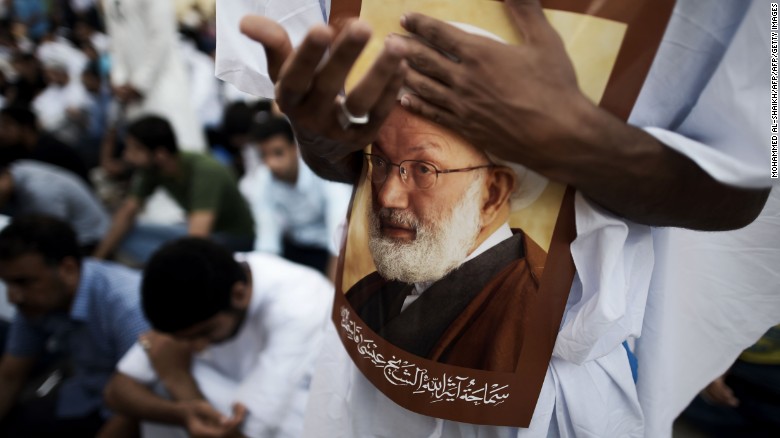
MANAMA, Bahrain — The Kingdom of Bahrain stripped top Shiite Cleric, Sheikh Isa Qassim, of citizenship on Tuesday. Iran has issued a statement saying the revocation of leadership could lead to an overthrow of the government.

Supporters Protest Sheikh Isa Qassim’s Loss of Citizenship (Photo Courtesy of CNN)

The government of Bahrain stripped Qassim of his citizenship, stating he helped to divide the country. The Bahrain News Agency said Qassim helped create “an extremist sectarian environment and worked on dividing the society.” The government also stated that Qassim formed groups that were loyal to foreign religious groups and governments, purportedly in reference to Iran.

Following Qassim’s revocation of citizenship, hundreds of Bahraini protesters have gathered outside the cleric’s home to support him. The protesters denied the allegations against the cleric. Clashes between the protesters and police have been sporadic following the sit-in outside the cleric’s house. The Bahraini government has warned that legal action will be taken against those who incite “security disturbances.”

The Iranian government warned Bahrain that these actions could lead to an overthrow of the government. Iranian General Qassem Soleimani, warned that this could set the” whole region on fire” and lead to armed resistance against the government.

This is one of a string of actions taken by the Bahraini government against the opposition groups in the country. Earlier in the week a Bahraini court suspended the main Shiite opposition party, al-Wefaq, along with freezing its assets. The government also more than doubled a prison sentence  for Al-Wefaq’s secretary-general, Sheikh Ali Salman. In response to the government crackdown on the opposition, more protests and violence have emerged including a gasoline bomb that killed a police officer.

Human rights organizations are concerned about human rights violations by the Sunni ruled Bahraini government and actions against the majority Shiite population. Brian Dooley, the director of the Washington-based group Human Rights First, said, “the targeting of the theological side of things, I think, is particularly worrying.”

In 2011, Bahrain saw mass protests during the Arab Spring as predominantly Shiite protesters argued for more political and civil liberties. During the protests, Qassim supported the protesters in their cause. The government along with help from Saudi Arabia and the United Arab Emirates crushed the protests.

For more information, please see:

BBC – Iran general warns Bahrain after Shia cleric stripped of citizenship – 20 June 2016

CNN – Iran: Bahrain’s leadership could fall over cleric’s treatment – 21 June 2016

Reuters – Bahrain summons senior Shi’ite clerics for questioning: lawyer – 23 June 2016

ABC News – Rally Outside Shiite Sheikh’s Home Reflects Bahrain Unrest – 23 June 2016

Historic Ceasefire Between Colombia and Farc

By Cintia Garcia

Impunity Watch Reporter, South America

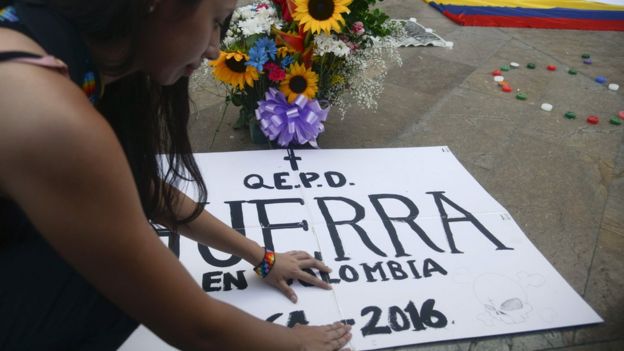
BOGOTA, Colombia— A historical bilateral ceasefire was signed on Thursday June 25th between the Revolutionary Armed Forces of Colombia (Farc) and the Colombian state. After 52 years of fighting both parties have agreed to put down their arms—a step closer to final peace accords.

Colombians in Bogota celebrate the end of war. (Photo Courtesy of BBC)

According to BBC, Farc leader Rodrigo Londono proclaimed, “let this be the last day of the war.” Although Farc previously committed to a unilateral ceasefire a year ago and the government has ceased its actions against Farc, this ceasefire officially puts an end to civil war.  At the signing on Thursday both parties agreed that FARC will put its arms down within 180 days of the final peace agreements, transition programs will be in place for the 7,000 FARC members which includes 23 temporary zones and 8 camps, civilians will not be allowed to enter FARC camps, and the United Nations will monitor and receive the weapons.

Although the details of the ceasefire implementation need to be approved, the signing on Thursday in Havana, Cuba is one step closer to closing a bloody chapter in Colombian history. Approximately 220,00 people were killed due to the conflict and millions have been displaced as a result. The civil war is one of the longest wars in history. Many Colombians poured out to the capital in Colombia to see this historic day as a nation. For many like Graciela Pataquiva, a retired school teacher has never seen peace, “I’m 76 and have lived this war all my life—I never thought the time would come when these characters would sign peace.”

FARC is the largest most powerful non-military organization in the western hemisphere. The organization was created in 1964 by farm workers and land workers against socio-economic inequalities, which the state responded against. FARC has had an estimated 20,000 fighters including children soldiers. Over the past few years FARC has lost funding, reduced in numbers, and lost key leaders which made this a pinnacle time to reach peace agreements.

For more information, please see:

BBC – Who Are the FARC? – 23 June 2016

NPR – Farc Reberls, Colombian Government Sign Cease-Fire Deal – 23 June 2016

REUTERS – Tears of joy as Rebels Sign Ceasefire With Colombian Government – 23 June 2016

BBC – Colombia Farc: Celebrations After Ceasefire Ends Five Decades of War – 24 June 2016

The Economist – Peace, at Last, in Colombia – 25 June 2016


PILPG: War Crimes Prosecution Watch Volume 11, Issue 8 – June 27, 2016

Case School of Law Logo

FREDERICK K. COX
INTERNATIONAL LAW CENTER

Founder/Advisor
Michael P. Scharf

War Crimes Prosecution Watch

Volume 11 – Issue 8
June 27, 2016

PILPG Logo

Editor-in-Chief
Kevin J. Vogel

Technical Editor-in-Chief
Jeradon Z. Mura

Managing Editors
Dustin Narcisse
Victoria Sarant

War Crimes Prosecution Watch is a bi-weekly e-newsletter that compiles official documents and articles from major news sources detailing and analyzing salient issues pertaining to the investigation and prosecution of war crimes throughout the world. To subscribe, please email warcrimeswatch@pilpg.org and type “subscribe” in the subject line.

Opinions expressed in the articles herein represent the views of their authors and are not necessarily those of the War Crimes Prosecution Watch staff, the Case Western Reserve University School of Law or Public International Law & Policy Group.

 AFRICA

Central African Republic

Sudan & South Sudan

Democratic Republic of the Congo

WEST AFRICA

Côte d’Ivoire (Ivory Coast)

Lake Chad Region — Chad, Nigeria, Niger, and Cameroon

Mali

EAST AFRICA

Uganda

Kenya

Rwanda (International Criminal Tribunal for Rwanda)

NORTH AFRICA

Libya

EUROPE

Court of Bosnia & Herzegovina, War Crimes Chamber

International Criminal Tribunal for the Former Yugoslavia

Domestic Prosecutions In The Former Yugoslavia

MIDDLE EAST AND ASIA

Extraordinary Chambers in the Courts of Cambodia

Iraq

Syria

Islamic State of Iraq and the Levant

Special Tribunal for Lebanon

Bangladesh International Crimes Tribunal

War Crimes Investigations in Burma

AMERICAS

North & Central America

South America

TOPICS

Truth and Reconciliation Commission

Terrorism

Piracy

Gender-Based Violence

Commentary and Perspectives