Dutch Woman Arrested in Qatar After Reporting Rape

by Zachary Lucas
Impunity Watch Reporter, Middle East

DOHA, Qatar – – A Dutch woman was arrested after making a rape claim to local authorities in Qatar following her alleged rape. The woman has been held since mid-March and could face charges of having sex outside of marriage.

Dutch Woman Was Arrested After Alleging Rape in Doha (Photo Courtesy of BBC)

A Dutch woman, who’s identity has not been revealed and was referred to as “Laura” by the Dutch foreign ministry, was on holiday in Doha when the incident occurred. Laura was having drinks at a bar in a hotel with friends. After one of the drinks Laura stated she felt “unwell.” She woke up the next morning in an unfamiliar apartment and realized she had been sexually assaulted.

Laura immediately reported the incident to local authorities and was subsequently arrested. She has been detained by Qatari authorities since mid-March and could face charges of adultery and alcohol-related offenses. Laura’s attorney, Brian Lokollo, says that no charges have been officially filed and that she will appear before a judge on June 13. The alleged assailant has also been arrested and denies the rape allegations. He stated that the sex was consensual and that she had asked for money. Laura denies those accusations.

Adultery, or having sex outside of marriage, is a crime in Qatar like many other Gulf Arab nations. Under Qatar’s Penal Code, “anyone who copulates with a female above sixteen without compulsion, duress or ruse is convicted to no more than seven years in prison. The same penalty is also imposed on the female for her consent.”

Qatar’s former justice minister, Najeeb al-Nauimi, says to convince a judge her defense will have to prove that there were “no voluntary actions” between her and the alleged assailant. Even evidence that would suggests she walked next to the alleged assailant might give a judge doubt to the actions not being voluntary. Signs of force would need to be proven.

There have been similar incidents in the Gulf Arab region. In 2013, a Norwegian woman reported a rape in the United Arab Emirates and was subsequently arrested, charged, and convicted of indecent behavior, perjury and alcohol consumption. She received a sentence of 16 months, but was later pardoned and returned home.

For more information, please see:

Aljazeera-Qatar: Dutch Woman Who Alleged Rape to Appear in Court-12 June 2016

BBC-Dutch Woman Arrested in Qatar After Making Rape Claim -11 June 2016

CNN -Dutch Woman Jailed in Qatar After Reporting Rape May Face Charges – 12 June 2016

The Guardian-Dutch Woman Arrested in Qatar After Reporting Rape to Appear in Court-12 June 2016

Violent Riots Ensue in the Midst of the Euro 2016 Football Tournament

By Sarah Lafen
Impunity Watch Desk Reporter, Europe

PARIS, France — This past week at the Euro 2016 championship football tournament in Marseille, France, English and Russian fans engaged in violent fights at a match between the two countries.  After the match ended in a tied 1-1 score, Russian fans jumped over the barriers separating the two nations’ fans and swarmed the section where the British fans sat.  Some Russians were equipped with fireworks and flares which were subsequently set off within the stadium.  Witnesses stated that some attackers wore mouth guards and fighting gloves during the brawls.

Russian fans smuggled fireworks and flares in to the match (Photo Courtesy of BBC)

According to Marseille’s emergency services, over 30 people were injured in the riots, including three police officers.  As a result of the riots, multiple head wounds were sustained, a significant amount of blood was shed, one man was knocked unconscious, and another suffered a heart attack.  Police used tear gas to break up the riots.

In anticipation of potential violent outbursts, France took extra security measures to prevent riots of this exact nature.  The Minister of Interior denied 3,000 people entry to the country, based on lists of people banned from stadiums in different countries, on suspicions they would bring disruption to the national order of France.  Bars in the Vieux-Port area of Marseille closed hours earlier than they normally do.

The Union of European Football Association (UEFA) has threatened to disqualify both England and Russia if these violent riots continue.  UEFA has already begun taking disciplinary actions against the Russian Football Union, charging them with crowd disturbances, racist behavior, and for the use of fireworks within a stadium.  A decision in regards to the sanctions will be made within a few days, once all evidence has been considered.

Both England and Russia have condemned the fighting.  Russia displayed its support for the launch of an investigation into their participation in the riots, and the United Kingdom Government has offered to send British police to the England’s next match against Wales in Lens, France.  Federation of International Football Associations (FIFA), the governing body of the sport, has also condemned the violence.  FIFA released a statement calling the riots “wholly unacceptable.”

So far, 17 people have been arrested in connection with the riots.

For more information, please see:

BBC — Euro 2016: England and Russia Given Disqualification Warning — 12 June 2016

CNN — Euro 2016: Dozens Injured as Crowds of Rival Fans Brawl — 12 June 2016

CNN — Euro 2016: Russia, England Threatened with Disqualification Over Violence — 12 June 2016

The Guardian — Euro 2016: England and Russia Fans Clash Before and After Match — 12 June 2016

The Guardian — England and Russia Could be Thrown out of Euro 2016 if There is More Violence — 12 June 2016

NY Times — Russia and England Fans Clash Repeatedly at European Championships — 11 June 2016


A Call to end Sexual Violence

By Cintia Garcia

Impunity Watch Reporter, South America

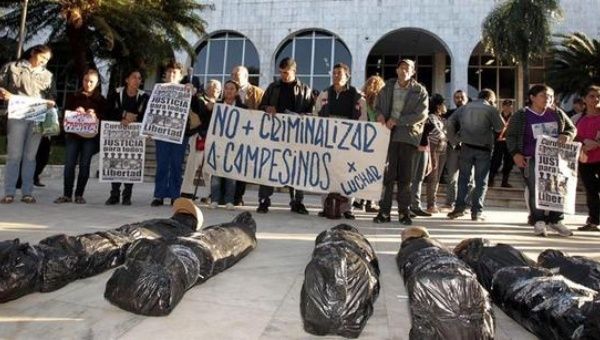
BRASILIA, Brazil—The alleged gang rape of a 16-year-old girl from a Favela in Brazil has stirred numerous protests. Thousands of protesters have poured to the streets of Brazil condemning the alleged rape, causing individuals and groups to stand up against gender violence and the “machismo” attitude against women in Brazil.

A protester in Sao Paulo. (Photo Courtesy of The Guardian)

In Rio De Janeiro, about 2,000 individuals chanted and held signs against rape with slogans such as “No means No.” In Sao Paulo, hundreds gathered for a simultaneous protest. The protesters’ goal is to end gender violence and to call upon the government to act. The alleged rape of the 16-year-old girl has highlighted the deeply rooted acceptance of violence against women in Brazil. Crimes against women have been dismissed by the public. Brazil has the fifth highest rate of femicide. Studies have shown that 7.5% to 10% of women in Brazil will report an incident of sexual violence. Protest coordinators want to let women know they do not have to be silent but to report the crime.

Coincidentally, in Argentina, protests against gender violence have also taken place. Thousands gathered in the streets of Buenos Aires to voice their condemnation of the alleged rape of the 16-year-old girl in Brazil and of the killing of three 12-year-old girls in Argentina. The slogan for the protest was “Not one less.” In Argentina, 275 gender based killings occurred last year. In 30% of the cases the attacker was a current partner of the victim, and an ex-partner in 49% of cases. Social media is proving to be an outline for victims of crime and to raise awareness through out Latin America.

A short video of the alleged gang rape of the 16-year-old girl in Brazil surfaced on twitter. It showed 30 to 33 men boasting about the rape. She was naked, drugged and semi-unconscious in the video. The video received hundreds of likes and blamed the girl for the rape. The girl in a statement stated that she had gone to her boyfriends and woke up the next day in a different location surrounded by men raping her. The family of the girl allege her boyfriend was behind the rape in order to punish her. Some arrests have been made since the video became public, but police continue to search for the rest of the men involved.

For more information, please see:

CNN—Brazilian Teen Speaks out About Brutal Gang Rape—30 May 2016

CNN—2 men Arrested, 4 Sought in Brazilian Gang Rape, Government Says—31 May 2016

The Guardian—Brazil and Argentina Unite in Protest Against Culture of Sexual Violence—3 June 2016

Fox Latino— Thousands March in Argentina to Protest Violent Attacks on Women—4 June 2016

SBS—Thousands Protest at Brazil Rape Culture—4 June 2016

Syria Justice and Accountability Centre: Decentralization, Federalism, or none of the above? An analysis of possible governance options in post-conflict Syria

SJAC Update | June 1, 2016
The Kurdish Democratic Union Party and its allies announce the establishment of a federal system in northern Syria in country’s north. Source: AL MAYADEEN Youtube Channel

Decentralization, Federalism, or none of the above?
An analysis of possible governance options in post-conflict Syria

In March 2016, Syrian Kurds claimed the creation of a de-facto federal region in the Kurdish-controlled areas of northern Syria, uniting three Kurdish-led autonomous areas (Jazira, Kobani and Afrin) under one federal region, Rojava. The Syrian Kurdish Democratic Party (PYD) and allied Arab and Assyrian groups issued a statement which emphasized that despite the federal region’s autonomy, it will remain a part of Syria. Kurdish leaders defended the declaration, saying that the communities in question have a“legitimate right” to autonomy and that the declaration is a blueprint for a future decentralized Syrian state. However, the Kurdish declaration received significant backlash from multiple sides, including the PYD’s international supporters, the Syrian government (which said the declaration had no legal basis), and the Syrian opposition. Some Syrians view federalism as a dirty word and a poor option for Syria, given the failures of the Iraqi experience. As discussions about the new constitution and governance structure progress, Syrians must decide how decentralized their state will be which will first require a better understanding of the different options.

Governance structures may range from highly centralized to highly decentralized systems. Decentralization generally refers to the transfer of authority from a central government to other entities such as provinces, municipalities, or even private institutions. A decentralized government is any government in which a state’s political, administrative, and/or fiscal actions can be made by subdivisions that exist under the central government.Successful decentralized systems tend to combine technical expertise from the central government with local-level knowledge from subdivisions in order to provide services more effectively than what one level of government could accomplish on its own.

READ MORE
The Syria Justice and Accountability Centre (SJAC) is a Syrian-led and multilaterally supported nonprofit that envisions a Syria where people live in a state defined by justice, respect for human rights, and rule of law. SJAC collects, analyzes, and preserves human rights law violations by all parties in the conflict — creating a central repository to strengthen accountability and support transitional justice and peace-building efforts. SJAC also conducts research to better understand Syrian opinions and perspectives, provides expertise and resources, conducts awareness-raising activities, and contributes to the development of locally appropriate transitional justice and accountability mechanisms. Contact us at info@syriaaccountability.org.

Justice for Sergei Magnitsky: Hermitage Seeks Money Laundering Investigation In Estonia Into Deputy Mayor of Moscow in Magnitsky Case

1 June 2016 – Hermitage Capital Management has filed a criminal complaint with the Estonian General Prosecutor seeking an investigation of funds received by an Estonian company, Transgroup Invest AS, which was 50% owned by Maxim Liksutov, who is currently deputy Mayor of Moscow.


In 2012, Transgroup Invest AS received US$336,153 from Zibar Management Inc, an offshore company registered in BVI and used by the Klyuev Organized Crime Group to launder proceeds from the US$230 million fraud uncovered by Sergei Magnitsky.


The funds were wired to Transgroup Invest AS from account of Zibar Management Inc with Cypriot branch of FBME, which had its licence revoked by the Central Bank in December 2015.


Zibar Management‘s nominal director, British citizen, Andrew Moray Stuart, served as director of hundreds other companies, including 214 BVI companies, 36 UK companies, 43 Irish and 4 New Zealand companies. While the company was dormant in BVI, it wired from its Cypriot account hundred thousands of dollars, including over $300,000 to Maxim Liksutov’s company in Estonia.


According to investigation of Panama Papers by German newspaper Süddeutsche Zeitung and Russian Novaya Gazeta, Maxim Liksutov had a 50% share in Transgroup Invest, registered in Estonia prior to becoming deputy mayor of Moscow. Several months after the receipt of funds from Zibar Management, Maxim Liksutov transferred his share in Transgroup Invest to his wife, Tatiana, who he soon divorced.


Maxim Liksutov was ranked 157 in the Forbes Russia rich list in 2013, with an estimated fortune of $650 million. In the Moscow City government, Maxim Liksutov is in charge of transportation.


Previously, it was reported that a son of the Transportation Minister and Vice Premier of the Moscow Region Denis Katsyv is facing Swiss and US money laundering investigations into his Cypriot company, Prevezon Holdings, which is alleged to have received proceeds of the US$230 million fraud. His father Petr Katsyv, currently Vice President of Russian state monopoly, Russian Railways, was ranked 65 in the Forbes list of Russia’s richest officials.


A cellist Sergei Roldugin, a close friend of Vladimir Putin, was recently identified as 

yet another recipient of funds connected to the US$230 million fraud into his corporate Swiss account, according to “Panama Papers” investigation.


Sergei Magnitsky, Hermitage’s lawyer who uncovered the US$230 million fraud and testified about the complicity of Russian officials in it, was falsely arrested, detained for 358 days without trial, tortured and killed in Russian police custody at the age of 37.


The unprecedented events of this case are described in the New-York Times best-seller “Red Notice. How I Became Putin’s No 1 Enemy by William Browder, leader of the global Magnitsky justice movement, and in a series of justice campaign videos on Youtube channel “Russian Untouchables.”


For more information, please contact:


Justice for Sergei Magnitsky

+44 207 440 1777

e-mail: info@lawandorderinrussia.org

www.lawandorderinrussia.org

billbrowder.com

twitter.com/Billbrowder