|
||||||||||||||||
|
||||||||||||||||
|


Refugees Flock to Europe as Migrant Boats Capsize in Mediterranean
By Sarah Lafen
Impunity Watch Desk Reporter, Europe
ROME, Italy –This past week, more than 14,000 refugee migrants from Libya were rescued from the Mediterranean Sea by European forces. At least 65 migrants have died in shipwrecks associated with these rescue missions. Spanish and Irish vessels, Spanish planes, Luxembourgian planes, and the Italian navy have all contributed to the rescue of these refugee migrants.
Warmer spring weather has led to a surge in migrants attempting the journey from the North African coast to Europe’s borders. The crossing between Italy and Libya is now the main route used by migrants since a deal between the European Union (EU) and Turkey has decreased the number of migrants from entering Greece via the Aegean Sea. Under the deal, all new “irregular” migrants crossing from Turkey to Greece must be returned to Turkey. Turkey must also take all measures necessary to prevent any newly developed land or sea routes accessible to migrants from Turkey to the EU.
Many European nations have voiced reluctance to take in migrant refugees. Some rescued migrants are taken to Porto Empedocle on the Sicilian coast, and some are placed in Sicilian and Greek shelters. However, not all refugees will be granted asylum in the EU once they arrive. Most rescued migrants are asked to leave the EU within seven days of their arrival. To prevent the potential massive influx of asylum seekers, some have suggested sending these migrants straight back to Libya despite its currently being a war-zone. Austria has gone so far as to change its laws to prevent migrants from applying for asylum at their border. Germany has recently revealed plans to add Morocco and Tunisia to its list of “safe countries” which would prevent migrants from those countries to qualify for asylum in Germany.
These migrants pay hundreds of thousands of dollars to make this journey to Europe, and travel from a wide variety of countries including Morocco, Tunisia, Syria, Iraq, Somalia, Eritrea, and Sudan.
For further information, please see:
CNN — 700+ Migrants Missing or Feared Dead in Mediterranean Shipwrecks — 30 May 2016
The Irish Times — Migrant Crisis: Shipwrecks ‘kill up to 700’ UN Agency Says — 29 May 2016
The Guardian — Dozens Feared Dead as Migrant Boat Capsizes in Mediterranean — 28 May 2016
BBC — Migrant Crisis: Many Feared Dead in Shipwreck off Libya — 26 May 2016
European Commission — EU-Turkey Agreement: Questions and Answers — 19 March 2016
Boko Haram says They are Willing to Negotiate the Release of the Chibok Girls
By: Samantha Netzband
Impunity Watch Reporter, Africa
ABUJA, Nigeria—It has been over two years since the abduction of 219 girls from the Chibok school in Nigeria. Islamic extremist group Boko Haram is responsible for the abduction. Boko Haram has killed at least 2,600 people in Nigeria, but they are looking to make a deal with the government for the release of the girls.
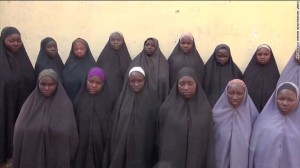
Screenshot taken from a video showing some of the Chibok girls alive. (Photo Courtesy of CNN)
Amir Muhammad Abdullahi, who is reportedly second-in-command of Boko Haram, has said that only a third of the original number of girls abducted remain captive. The Nigerian government has had success in securing the return of 11,595 people between February and April of this year.
One Chibok girl was recently released in what the government is perceiving as a sign of good faith from the members of Boko Haram. She was found in the Sambisa forest reserve with a suspected member of Boko Haram. The girl reported that only 6 of the captive girls have died, rather than the larger number claimed by Abdullahi. The girl believes that they may be located in the Sambisa forest reserve where she was found. The Sambisa forest reserve is a large forest located near the border of Cameroon.
Reports of a second Chibok girl release turned out to be false. The head of Chibok Abducted Girls Parents group said the second girl was not one of the abducted girls. The second girl is said to have been abducted from her home in Madagali. She was returned along with 96 other citizens who had been abducted from their homes and held hostage.
Abdullahi says that no one is winning the battle that Boko Haram has waged with Nigeria.
For further information please see:
Pulse – Insurgents reportedly call for truce to release Chibok girls – 22 May 2016
All Africa – Nigerian Army Confirms Rescue of Another Chibok School Girl – 20 May 2016
Justice for Sergei Magnitsky: White House Rejects Crude Attempt to Repeal Magnitsky Sanctions
31 May 2016 – The White House has reaffirmed its commitment to the US Magnitsky Act in a strongly-worded response to a petition posted on the White House website in April 2016 by an anonymous “R.T.” calling for the repeal of the US Magnitsky Act.
“More than six years after his [Magnitsky’s] death, we remain disturbed by the impunity for this and other violent crimes against activists, journalists, and the political opposition. We are also concerned by the growing atmosphere of intimidation toward those who work to uncover corruption or human rights violations in the Russian Federation,” said the White House in its statement in response to the petition.
The White House reiterated its position on the Magnitsky Act expressed earlier by the U.S. State Department:
“The Administration intends to carry out and fully implement the Magnitsky Act. It reflects our support for human rights and that those responsible for human rights abuses should be held to account…That’s what the act says; that’s what we intend to do.”
The White House said that individuals added to the U.S. Magnitsky sanctions list in February 2016 “play significant roles in the repressive machinery of Russia’s law enforcement systems,” and their inclusion was effected “after extensive research, including consultations with Russian and/or international civil society.”
“Efforts to implement the Magnitsky Act have so far resulted in a significant list of individuals responsible for Magnitsky’s death and subsequent cover-up, as well as others responsible for gross human rights violations. The list promotes accountability for their actions,” said the White House in its online response to the petition.
The anti-Magnitsky petition was a latest in a series of propaganda and intimidation attempts by the Russian government and its proxies since the beginning of the year to overturn the Magnitsky Act in the US and prevent its passage in Canada and Europe.
These initiatives were launched by Russian Foreign Affairs Minister Sergei Lavrov at a January 2016 press conference where he alluded to new developments in the Magnitsky case. Since then, the Russians set up an anti-Magnitsky Act NGO in Delaware called the Human Rights Accountability Global Initiative Foundation. This newNGO is being represented by Natalia Veselnitskaya, the Russian lawyer for alleged money launderer Denis Katsyv, whose companies are suspected by the US Justice Department and the Swiss General Prosecutor of receiving proceeds from the US$230 million crime Sergei Magnitsky had uncovered.
Another anti-Magnitsky initiative included two anti-Magnitsky propaganda films. The first one was aired in April 2016 in Russian language on the main pro-Kremlin Russian TV station. It claimed the discovery of a CIA plot to murder Sergei Magnitsky in Moscow detention in order to blame his death on the Russian authorities. To authenticate the purported CIA plot, the Russians forged CIA documents and retained Andrew Fulton, a former UK diplomat, who now chairs GPW, a private spy firm in London, to sign a report “verifying” the Russian-produced documents as genuine CIA documents.
The second anti-Magnitsky propaganda film was produced for a Western audience by filmmaker Andrei Nekrasov, who claims Sergei Magnitsky was not beaten in custody and was not a whistleblower despite publicly available evidence to the contrary. Nerkasov’s film bases its assertions on statements from ex-Russian Interior Ministry officers Karpov and Lapshov, both sanctioned by the US Government for their role in the Magnitsky case.
U.S. President Obama signed the Sergei Magnitsky Rule of Law Accountability Act of 2012 into law on December 14, 2012. In February 2016, U.S. Secretary of State John Kerry submitted to Congress the third annual report outlining the U.S. Government’s actions to implement the Magnitsky Act, and a new list of persons added to the Magnitsky sanctions list.
“Despite widely-publicized, compelling evidence of criminal conduct resulting in Sergei Magnitsky’s detention, abuse, and death, Russian authorities have failed to bring to justice those responsible. This law [Magnitsky Act] holds Russians accountable for their roles in the Magnitsky case or their responsibility for certain gross violations of human rights,” said the White House in its statement.
For further information please contact:
Justice for Sergei Magnitsky
+44 207 440 1777
e-mail: info@lawandorderinrussia.org
https://twitter.com/Billbrowder
White House online response to the petition
ABC News: Hissene Habre: Chadian ex-dictator found guilty of war crimes, sentenced to life in prison
A special court in Senegal has sentenced former Chadian dictator Hissene Habre to life in prison for war crimes, crimes against humanity, and a litany of other charges including rape.
Key points:
- Hissene Hibre’s crimes include forced slavery, kidnapping and rape
- The verdict caps a 16-year battle by victims and campaigners
- The conviction ‘sends a powerful message’ to other despots, lawyers say
The verdict brings a long-awaited day of reckoningto up to 40,000 people kidnapped, raped and tortured under his rule as president of Chad from 1982 to 1990.
“Hissene Habre, this court finds you guilty of crimes against humanity, rape, forced slavery, and kidnapping,” as well as war crimes, said Gberdao Gustave Kam, president of the special court.
“The court condemns you to life in prison.”
The court also heard that Habre had raped a woman named Khadija Hassan Zidane on several occasions.
Upon hearing the verdict, Habre raised his arms into the air, shouting “Down with France-afrique!” referring to the term used for France’s continuing influence on its former colonies.
The verdict caps a 16-year battle by victims and rights campaigners to bring the former strongman to justice in Senegal, where he fled after being toppled in a 1990 coup in the central African nation.
“The feeling is one of complete satisfaction,” said Clement Abaifouta, president of the Habre survivors association known by the acronym AVCRHH.
The case was heard at the Extraordinary African Chambers (CAE) — a special tribunal set up by the African Union under a deal with Senegal.
It is the first time a country has prosecuted a former leader of another nation for rights abuses.
‘Verdict sends a powerful message’
Reed Brody, a lawyer for Human Rights Watch who has spent the last 15 years working with victims to bring Habre to justice, said the conviction was “a huge victory for Chadian victims” and a warning to other despots.
His victims waited over 26 years for this moment… #hissenehabre sentenced to life in prison. https://twitter.com/reedbrody/status/737242467347599360 …

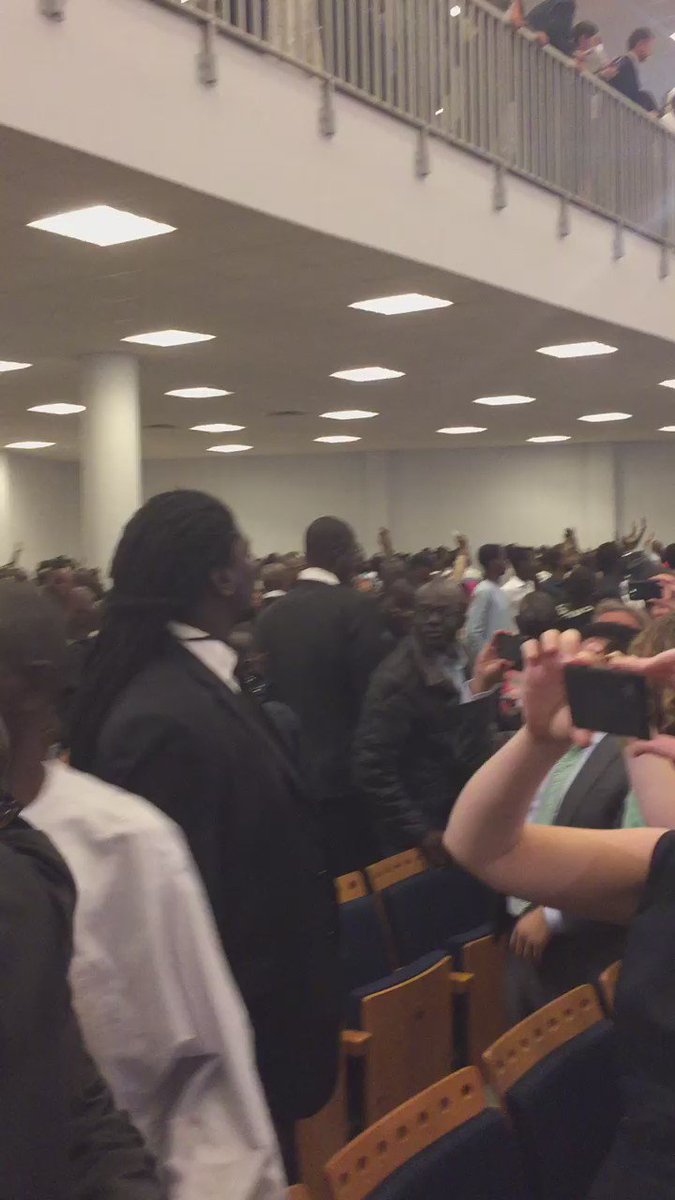
“This verdict sends a powerful message that the days when tyrants could brutalise their people, pillage their treasury and escape abroad to a life of luxury are coming to an end,” Mr Reed said in a statement on Monday.
Known as a skilled desert warrior who often wore combat fatigues to fit the role, Habre fled to Senegal after his 1990 ouster by Chad’s current President Idriss Deby.
Witnesses recounted the horror of life in Chad’s prisons, describing in graphic detail abusive and often deadly punishments inflicted by Habre’s feared secret police, the Documentation and Security Directorate (DDS).
Victims were subject to electric shocks and waterboarding while some had gas sprayed in their eyes or spice rubbed into their genitals, the court heard.
Habre’s defence team unsuccessfully sought to cast doubt on the prosecution argument that their client was an all-knowing, all-powerful head of the DDS, suggesting he may have been unaware of abuses on the ground.
For more than 20 years, the former dictator lived freely in an upmarket Dakar suburb with his wife and children, swapping his military garb for white robes and a cap.
He declined to address the court throughout the 10-month trial, refusing to recognise its authority.
“What we have seen today is not justice. It is a crime against Africa,” said Mahamat Togoi, part of a Habre supporters group.
“It’s the dirty work of mercenaries in the pay of France-afrique.”
But Mahamat Moussa, a former detainee, had said a guilty verdict would provide solace to many families left without answers 25 years after Habre left office.
“A verdict proportionate with the crimes committed by Habre will allow many families to properly mourn and offer some comfort from the suffering we former prisoners endured,” he said.
AFP/Reuters