Colombia Investigating Disappearances at Notorious Prison

By Kaitlyn Degnan
Impunity Watch Reporter, South America

BOGOTA, Colombia — The Colombian government has launched an investigation into disappearances in Colombian prisons between 1999 and 2001. The investigation is focusing on La Modelo prison in Bogota. The dismembered remains of at least 100 persons were found in the sewer system of the prison.
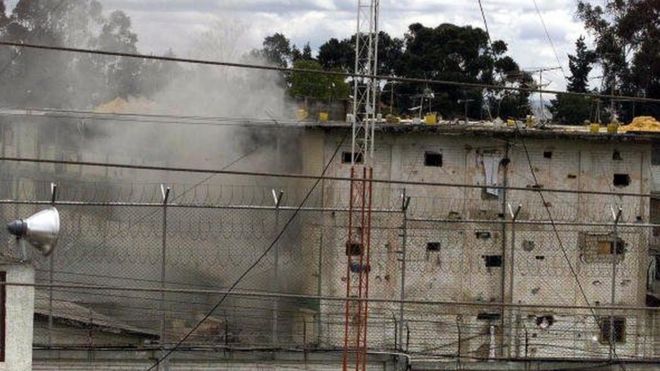
La Modelo prison in Bogota, Colombia (photo courtesy of BBC). 

La Modela is one of Colombia’s biggest prisons, and significantly overcrowded. During the period in question, the prison was divided and controlled by left-wing and right-wing paramilitary groups. Allegedly, faction leaders bribed prison officials to look the other way while they maintained control over their part of the prison. The paramilitaries allegedly patrolled their so-called “territory” armed with grenades and automatic weapons.

Rumors of disappearances in the prison have spread since the dismembered remains of an inmate was found stuffed in a drain in 2000. He had disappeared eight days earlier. The next day, 17 inmates disappeared during a fight between different factions. Their remains were never found.

Investigators believe that there may be more remains hidden in the sewer systems of other prisons throughout Colombia.

The investigation was prompted by the prosecution of paramilitary leaders Mario Jaimes Mejía, called “El Panadero” (“the Baker”) and Alejandro Cárdenas Orozco. The two face charges of kidnapping, torture, and rape in the attack of Jineth Bedoya. Bedoya, a journalist, was one of the first to bring attention to the disappearances at the prison, after she noticed the numbers of inmates and visitors to La Modelo that went missing.

In 2000, Bedoya was abducted while visiting La Modelo (for the purpose of interviewing El Panadero). She was taken to the countryside where she was tortured and raped. The perpetrators left her tied up in a rubbish pile ten hours later.

Bedoya says she is “grateful for the actions being taken today, but it should’ve happened years ago. El Panadero’s testimony taken more than 15 years ago, his version of the story, which is completely false, was endorsed by a prosecutor (with the Colombian attorney general’s office) and that allowed for the process to stall and the case to remain in impunity.” Bedoya sued the Colombian government in the Inter-American Commission on Human Rights for “unwillingness to do justice in her case.”

Finding the truth of the disappearances at La Modelo, according to Bedoya, is “a debt that ht estate owes not only to Jineth Bedoya but the hundreds of victims of La Modelo Prison and the paramilitary forces.”

The current prosecutor, Caterina Heyck announced in a press conference on February 17th that El Panadero had confessed to ordering the attack on Bedoya, and that Cárdenas had admitted to being one of her abductors. She has also requested that the two men not qualify for lighter sentences under the Justice and Peace Law. The law allows former paramilitary members to receive lighter sentences for laying down arms and confessing to their crimes.

For more information, please see:

Reuters – Scores of dismembered bodies found in Colombian jails – 17 February 2016 

BBC – Colombia probes disappearances from Bogota prison – 18 February 2016

CNN – Remains of at least 100 may have been tossed into sewers under prison – 18 February 2016

Latin Post – Colombian Jails Have Secrets That Can Give Your Nightmares – 18 February 2016

Mirror – Gruesome mystery as body parts of 100 prisoners and visitors found in sewer – 18 February 2016

Time – 100 Dismembered Bodies Found Beneath Colombian Prison – 19 February 2016 
Vice News – Colombia is Investigating Whether 100 Bodies Were Stuffed in a Prison Sewer – 19 February 2016


Syria Justice and Accountability Centre: Documenting Attacks on Medical Facilities in Syria

On February 15, a UN spokesperson reported that at least 50 people were killed in missile attacks that struck four hospitals in the provinces of Aleppo and Idlib and a school used to shelter internally displaced people in northern Syria. According to many activists and observers, Russian warplanes were responsible for the attacks. The medical organization Medecins Sans Frointeres (MSF) ran one of the hospitals that was targeted. MSF’s Head of Mission said that the incident appeared to be “a deliberate attack on a health structure” and “leaves the local population of around 40,000 people without access to medical services in an active zone of conflict.”

Attacks on medical facilities in Syria have been ongoing since 2012. According to the UN High Commissioner for Human Rights, such attacks (the majority of which are committed by Syrian government forces) intentionally deny medical assistance to those who have been wounded as a result of the war. According to the UN, these continued attacks against Syrian civilians constitute a violation of international humanitarian law that could amount to war crimes. The UN statements are significant because they highlight that the attacks on medical facilities and the denial of basic health care to Syrian civilians constitutes a troubling and consistent trend which breaches international law.

Article 18 of the Fourth Geneva Convention bans deliberate attacks on civilian hospitals. As the International Committee of the Red Cross (ICRC) explains, Article 18 requires military forces “to take special precautions to spare hospitals as far as is humanly possible” when conducting operations. The Rome Statute, which grants the International Criminal Court jurisdiction over serious violations of the Geneva Conventions, explicitly describes intentional attacks against civilian populations and hospitals as types of war crimes.

High quality documentation is crucial to holding perpetrators of attacks on medical facilities accountable. The ICRC provides several considerations that can help human rights defenders refine their strategies when documenting attacks on hospitals. For example, the ICRC states that structures with exterior medical symbols  and markings (such as the red cross or red crescent symbols) should not be attacked. Thus, documenters can collect information, pictures, and interviews that help establish that the structure was clearly marked and that the perpetrator knew or should have known of the structure’s medical functions. Another consideration is whether the civilian hospital was far from military objectives and was not being used for military purposes. Documenters can collect interviews and facts to establish the distance between legitimate military targets and the hospital as well as the civilian rather than military use of the facility for treating the sick and wounded.

However, the urban nature of modern warfare, particularly in the Syrian context, presents serious challenges  to documenting these types of attacks. Fighting is primarily taking place in populated cities and towns where the line between civilian and military is largely blurred. Moreover, the Syrian government has not been adhering to the principles of the Geneva Conventions or the  ICRC guidelines while it wages war. Rather, the government and its allies appear to deliberately target hospitals as a policy to incite fear and intimidate civilians and humanitarian aid workers. Thus, many hospitals intentionally avoid using medical symbols and operate “underground” in order to avoid such attacks. As a result, human rights defenders may not be able to easily demonstrate that the perpetrators knew or should have known that the structure was a medical facility at the time of the attack.

Future transitional justice mechanisms should dedicate special attention to addressing the complex issue of hospital destruction and damage since 2011. In addition to allowing for criminal prosecutions, the post-conflict government or transitional body should rebuild medical infrastructure and prioritize the provision of health care to victims that need treatment for their long-term physical and psychological injuries. Additionally, steps can be taken to memorialize the efforts of Syrian and international health care workers who risked their lives to treat and aid the sick and wounded in their time of need. Without a concerted effort to holistically address the issue, the widespread destruction of hospitals will have devastating impacts for Syrians and their ability to access adequate healthcare for many years after the end of the conflict.

For more information and to provide feedback, please email SJAC at info@syriaaccountability.org.

Missiles Strike Four Hospitals in Syria

By Brittani Howell

Impunity Watch Reporter, The Middle East

DAMASCUS, Syria – Nearly 50 civilians were killed on Monday, as four hospital facilities were struck by missiles. The United Nations stated that the airstrikes were a blatant violation of international law.

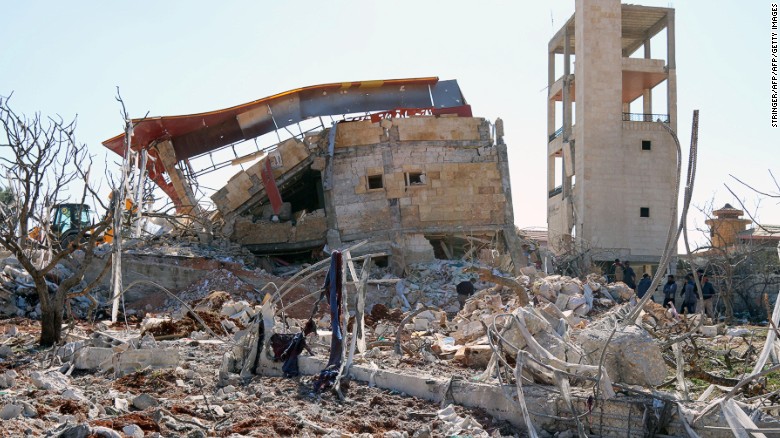
The remains of the Doctors Without Borders Hospital in Maraat al-Numan. (Photo courtesy of CNN)

In the town of Azaz, near the Turkish border, fourteen people were killed and another 30 were wounded, as airstrikes struck a school and the children’s hospital. Local news footage showed ambulances unloading children on stretches at the Kilis State hospital.

The Turkish Prime Minister Ahmet Davutoglu accused Russia of conducting the airstrikes that hit the hospital and school, killing children. Turkey’s foreign minister called it an “obvious war crime.” Russia denied responsibility for the attacks, stating that their country does not bomb indiscriminately and does not target civilians. The United States State Department, however, claimed the Syrian regime for the attacks.

Unicef, the United Nations children’s agency, stated, “We at Unicef are appalled by reports of attacks against four medical facilities in Syria – two of which were supported by Unicef.” It continued, “One is a child and maternal hospital where children were reportedly killed and scores evacuated.” “Apart from compelling considerations of diplomacy and obligations under international humanitarian law, let us remember that these victims are children,” Unicef continued.

Another attack occurred on Monday at Maarat al-Numan, in the Idlib province, as a Doctors Without Borders hospital was struck by missiles four times within minutes. According to Doctors Without Borders, seven people were killed with another 8 people missing and presumed dead. Of those killed, five were patients, one was a caretaker, and one was a hospital guard. The eight unaccounted for are staff members, patients also may be missing, however it is not clear how many.

Massimilian Rebaudengo, Doctors Without Borders’ head of mission, stated, “This appears to be a deliberate attack on a health structure, and we condemn this attack in the strongest terms possible.” He continued, “The destruction of the hospital leaves the local population of around 40,000 people without access to medical services in an active zone of conflict.”

Doctors Without Borders claimed that the Syrian government was responsible for the airstrikes in the Idlib province. The Syrian ambassador to Russia accused the United States led coalition for the attacks in Idlib. The United States stated that the coalition did not conduct any military operations in the area.

Riad Hijab, the head of the high negotiations committee, stated on Sunday, “Everyday, hundreds of Syrians die from airstrikes and artillery bombardment, poison gas, cluster bombs, torture, starvation, cold and drowning.” He continued, “The Syrian people continue to live in terror and in utter despair after the international community failed to prevent even the gravest violations committed against them.”

According to Physicians for Human Rights, 697 health care workers have been killed in 336 attacks on medical sites over the course of the Syrian conflict. The vast majority of attacks are carried out by the Syrian government and its allies according to Physicians for Human Rights.

For more information, please see:

CNN – Syria: At least 22 Killed in Strikes Against 2 Hospitals, Sources Say – 16 February 2016

Reuters – Missiles in Syria Kill 50 as Schools, Hospitals Hit; Turkey Accuses Russia – 16 February 2016

Al-Jazeera America – Deadly Airstrikes Destroy Three Hospitals, School in Syria – 15 February 2016

The Guardian – Airstrikes Hit Two Syrian Hospitals, with Turkey Condemning ‘Obvious War Crimes’ – 15 February 2016

The New York Times – Syrian Hospitals Hit as Battlefield Grows More Chaotic – 15 February 2016

War Crimes Prosecution Watch Volume 10, Issue 25 – February 22, 2016

War Crimes Prosecution Watch is a bi-weekly e-newsletter that compiles official documents and articles from major news sources detailing and analyzing salient issues pertaining to the investigation and prosecution of war crimes throughout the world. To subscribe, please email warcrimeswatch@pilpg.org and type “subscribe” in the subject line.

Opinions expressed in the articles herein represent the views of their authors and are not necessarily those of the War Crimes Prosecution Watch staff, the Case Western Reserve University School of Law or Public International Law & Policy Group.

Contents

INTERNATIONAL CRIMINAL COURT

Central African Republic & Uganda

Darfur, Sudan

Democratic Republic of the Congo

Kenya

Libya

Cote d’Ivoire (Ivory Coast)

AFRICA

International Criminal Tribunal for Rwanda

Mali

Chad

Nigeria

EUROPE

Court of Bosnia & Herzegovina, War Crimes Chamber

International Criminal Tribunal for the Former Yugoslavia

Domestic Prosecutions In The Former Yugoslavia

MIDDLE EAST AND ASIA

Extraordinary Chambers in the Courts of Cambodia

Syria

Islamic State of Iraq and the Levant

Special Tribunal for Lebanon

Bangladesh International Crimes Tribunal

War Crimes Investigations in Burma

TOPICS

Terrorism

Gender-Based Violence

REPORTS

UN Reports

NGO Reports

WORTH READING

Worth Reading

Truth and Reconciliation Commission

Commentary and Perspectives