Myanmar’s First Freely Elected Parliament Instated

By Christine Khamis

Impunity Watch Reporter, Asia

Myanmar’s new freely elected parliament opened this week, signifying an official end to almost fifty years of military rule in the country.

Aung San Suu Kyi, leader of Myanmar’s National League for Democracy Party, arrives at the opening of Myanmar’s new parliament on Monday. (Photo courtesy of the New York Times)

In November 2015, Aung San Suu Kyi, leader of Myanmar’s National League for Democracy Party (NLD), led her party to win a majority of the parliamentary seats against the leader of the then-ruling military party, Thein Sein. Mr. Thein Sein, who during his presidency worked to move toward a civilian run government, gave a speech last week promoting Myanmar’s democratic transition.

The military’s influence in Myanmar’s government is not completely eliminated, however, as military members retain one-quarter of the parliamentary seats. Members of the new parliament have also chosen U Ti Khun Myat as deputy speaker, despite his belonging to the military-backed Union Solidarity Development Party (USDP). Lawyer U Win Myint, part of the NLD, will serve as speaker.

At least 110 out of the 390 NLD members in the new parliament are prior political prisoners. Ms. Suu Kyi herself was placed under house arrest after her party won Myanmar’s national election in 1990, with the military annulling the results and refusing to hand over power. She remained under house arrest for almost two decades.

Mr. Thein Sein’s duties as president will end in March, but Ms. Suu Kyi is unable to take his place due to a constitutional provision prohibiting those with foreign family members from becoming the president. Both of Ms. Suu Kyi’s sons have British citizenship, as did her husband before his death in 1999. Ms. Suu Kyi has, however, been elected as the chairman of the upper house of the new parliament

There are several other individuals being considered for the presidency, including lawmaker Daw Su Su Lwin and former military commander U Tin Oo. The new parliament will select the next president among three official vice president nominees later this month.

Among the challenges that the new parliament will face are highly prevalent poverty rates, environmental and economic troubles, and continuing violence against the Rohingya, a Muslim ethnic group often persecuted by Myanmar’s Buddhist majority.


For more information, please see:

Bloomberg – Myanmar Parliament Elects Suu Kyi Ally as Upper House Chairman – 3 February 2016

The New York Times – First Freely Elected Parliament After Decades of Military Rule Opens in Myanmar – 1 February 2016

NPR – Aung San Suu Kyi’s Party Takes Control of Myanmar’s Parliament – 1 February 2016

Voice of America – Myanmar Parliament Sworn In; Next President Unknown – 1 February 2016


Syria Justice and Accountabiliy Centre- Syria: Key Demands for Lasting Peace

04/February/2016

To:      The Syrian negotiating parties

The International Syria Support Group (ISSG)

The United Nations Special Envoy to Syria Staffan de Mistura and his team


We, the signatories to this letter, are Syrian organizations working on human rights documentation, accountability, and transitional justice in Syria. We reiterate our commitment to the principles of justice, comprehensive accountability, and absolute support for all victims in Syria and their rightful demands for remedy and justice. As such, we propose the following minimum demands — fully aware that the demands of the Syrian people for freedom and justice go beyond what we set out in this letter — which we believe are necessary and cannot be overlooked in the transition period or in any deal that aims to establish peace and stability in Syria. These demands are addressed to the Syrian negotiating parties, to the special UN envoy Staffan de Mistura and his team, and to the States and institutions within the ISSG sponsoring the negotiating process:


  1. On the issue of detainees:

a. Allow immediate and unconditional access for any independent, impartial, and neutral organization that enjoys international credibility to inspect and visit all prisons and detention facilities in Syria, including informal centers run by Syrian government security services or armed opposition factions; and, issue a full and official list of prisoners’ names to determine the persons still held in custody by all parties to the conflict, in preparation for creating a catalog of missing persons who do not appear on any prisoner list.

b. The parties to the conflict shall release all individuals arbitrarily detained on political, ideological, religious or sectarian grounds within six months after the start of the peace negotiations. This will act as an initial confidence-building measure to comprehensively resolving the issue of detainees in Syria.


  1. On the issue of fact-finding:

The transition body formed as a result of the negotiations shall establish a national independent commission of inquiry, composed of a combination of respected international figures and independent, credible Syrian figures who represent all political, ethnic, religious, and sectarian backgrounds in Syria but who were not involved in either the fighting or the political process. The commission shall be sponsored by the United Nations, enjoy the support of the States and stakeholders sponsoring the negotiations, and be entrusted with the task of documenting war crimes, serious violations of international human rights law, and crimes against humanity committed by all parties to the conflict in Syria following the 2011 uprising. The commission shall be composed of committees with the power to make recommendations on issues such as the establishment of a national mechanism for opening mass graves and exhuming and identifying bodies and delivering them to families. The Commission shall be granted full access to all regions of Syria within the control of the negotiating parties, as well as access to examine all official records and interview witnesses and security officials. The Committee shall submit an initial report to the Syrian people and the United Nations within the first year of the signing of the peace agreement in Syria.


  1. On the issue of reform:

Obligate the negotiating parties, under the auspices and with the support of the States and stakeholders sponsoring the negotiations, to make fundamental and urgent changes in the leadership of the Syrian security services, including replacing the leaders and key personnel of Syria’s security forces and provincial and municipal security branches. These replacements shall be made within six months after the signing of the peace agreement. The parties shall not consider as replacements those who participated in international criminal law or gross human rights violations during the conflict.

The replacement of security leaders shall be the initial step in a comprehensive plan for institutional reform, which the parties will develop within the first 18 months after signing the peace agreement. The plan shall include judicial reforms, security apparatus reforms and restructuring, and a program for disarmament and reintegration of all militias in areas under the control of the negotiating parties.


  1. On the issue of property restitution:

Establish and oversee clear mechanisms to facilitate the return of refugees and displaced persons and to restore their property or the value thereof, including damaged real estate and buildings, even if the owners left Syria or delay their return. This includes properties located in areas which the government and the opposition cooperated to evacuate populations on sectarian or ethnic bases. This mechanism shall give special consideration to the most vulnerable groups in Syrian society, such as women and children. This mechanism shall be placed under the clear supervision of the United Nations or an ad hoc committee that reports to the United Nations.


  1. On the issue of reparations:

Create a national reparations program for both individual and collective reparations to all civilians affected by the conflict. Reparations shall include nonmonetary assistance for individuals located throughout Syria, such as necessary medical and psychological support for victims of military operations and psychological support and rehabilitation for children and people with special needs, with a particular focus on sexual violence and abuses based on gender which women and girls have suffered. The United Nations, the sponsoring States and stakeholders, and the negotiating parties shall commit to providing financial resources as well as political cover and security protection for the program.

We are ready to meet with you through our representatives at any time and we invite you to discuss any and all of the aforementioned points in more detail.

The undersigned organizations, listed in alphabetical order:

  1. Assyrian Human Rights Network
  2. Baytna Syria
  3. Free Independent Judiciary Council
  4. Human Rights Organization in Syria – Maf
  5. Justice For Life Observatory in Deir al-Zour
  6. Kawakbi Center for Human Rights
  7. Kawakbi Human Rights Organizations
  8. Syria Justice & Accountability Center (SJAC)
  9. Syrian Center for Human Rights Studies
  10. Syrian Center for Statistics and Research
  11. Syrian Commission for Transitional Justice
  12. Syrian Center for Political and Strategic Studies
  13. Syrian Institute for Justice
  14. Syrian League for Citizenship
  15. Syrian Network for Human Rights
  16. The Day After
  17. The Free Syrian Lawyer’s Aggregation
  18. Violations Documentation Center (VDC)
Australia High Court Upholds Offshore Detention For Asylum Seekers

By Samuel Miller
Impunity Watch Desk Reporter, North America and Oceania

CANBERRA, Australia — The Australian High Court on Wednesday dismissed a claim that detention of asylum seekers offshore on Nauru violated the Australian constitution, and upheld its policy to hold refugees at processing centers on the island. In a decision announced in Canberra, the court found the Commonwealth’s conduct was authorized by law and by Section 61 of the Constitution.

Protesters Gather Outside Canberra Wednesday. (Photo Courtesy of IB Times)

The ruling paves the way for more than 250 people, including 37 babies, to be deported to a detention camp on the island.

The plaintiff in the case, a Bangladeshi woman identified only as M68, entered Australia seeking asylum and was classified as an unauthorized maritime arrival before being sent to Nauru. She was returned to Australia due to medical problems, where she gave birth to a child and filed the case to avoid being taken back to Nauru.

But Australia’s High Court ruled that the woman’s detention on Nauru was not unlawful as it had been authorized under Australian migration laws, and that the offshore processing deal with Nauru was valid under the constitution. The Guardian reported that six out of seven judges ruled in the favor of holding the refugees in the offshore processing centers, and ruled that the Australian government detaining the woman was authorized by law.

Chief Justice Robert French wrote, “The detention in custody of an alien, for the purpose of their removal from Australia, did not infringe upon the Constitution because the authority, limited to that purpose, was neither punitive in character nor part of the judicial power of the Commonwealth.”

The detention center on Nauru houses about 500 people and has been widely criticized by the United Nations and human rights agencies for harsh conditions and reports of systemic child abuse.

Daniel Webb, director of legal advocacy at the Human Rights Law Center, decried the judgment of the court.

“It is fundamentally wrong to condemn these people to a life in limbo on a tiny island. The stroke of a pen is all that it would take our prime minister or our immigration minister to do the decent thing and let these families stay,” said Webb.

The United Nations Children’s Fund condemned the decision and said, according to the International Business Times, that the ruling “has no bearing on Australia’s moral responsibility or its obligations to protect the rights of children in accordance with international human rights law. It is unreasonable for the Australian government to shift responsibility for this group of children and families with complex needs to a developing state in the region.”

Prime Minister Malcolm Turnbull defended the ruling, saying, “Our commitment today is simply this: the people smugglers will not prevail over our sovereignty. Our borders are secure. The line has to be drawn somewhere and it is drawn at our border.”

Children born in Australia to non-citizens or parents without legal residency are not entitled to citizenship until after their 10th birthday, and then only if they have lived most of their lives in Australia.

The government has given undertakings that it will give at least 72 hours’ notice before removing any of the asylum seekers involved in the case from Australia.


For more information, please see:

BBC News — Australia’s offshore asylum policy ruled legal by High Court – 3 February 2016

DW — Asylum seeker ruling ‘clears way for deportation of Australia-born babies’ – 3 February 2016

IB Times — Australia Slammed For Upholding Policy Of Detaining Refugees On Nauru Island – 3 February 2016

Times of India — Court rules Australia can send asylum seekers to Nauru – 3 February 2016

Reuters — Australian asylum ruling paves way for deportation of infants – 2 February 2016

The Guardian — High court upholds Australia’s right to detain asylum seekers offshore – 2 February 2016

Guatemalan Soldiers Stand Trial For Human Rights Violations

By Samuel Miller
Impunity Watch Desk Reporter, North America and Oceania

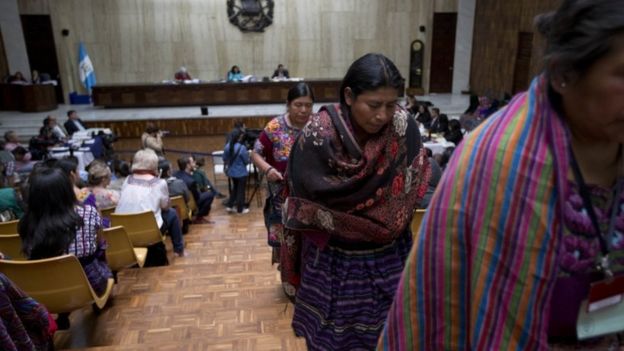
GUATEMALA CITY, Guatemala — A trial has begun in Guatemala of two ex-military officers for human rights abuses against indigenous women during the country’s long armed civil conflict. The trial marks the first time in history that sexual slavery will be prosecuted as a war crime in the country where it is alleged to have taken place.

Victims Leave the Guatemalan Courtroom. (Photo Courtesy of BBC News)

The two former military officers are facing charges of murder, rape and sexual abuse, domestic servitude and kidnapping, according to the Guatemalan attorney general’s office.

Prosecutors accuse Esteelmer Reyes, a 59-year-old retired colonel, of authorizing and consenting for soldiers under his command to exercise sexual violence and inhuman, cruel and degrading treatment against Maya-Q’eqchi’ women. Reyes suggested the trial is a political show to make it appear as if Guatemala’s government is doing justice.

“Within the Guatemalan army, during the 36 years of the civil war that we fought, there was not a single murderer. This is all a farce,” the ex-military commander said.

Prosecutor Hilda Pineda, however, said the former military commanders, in an effort to submit the local population to their will, authorized and consented to systematic acts of sexual abuse and inhumane, cruel and humiliating treatment against the victims and other women.

Guatemala’s civil war lasted 36 years. According to the United Nations, five out of every six victims of human rights violations were Mayan. The surviving women, now in their seventies and eighties, testified that the soldiers raped them and burned their houses down after their husbands were killed.

The women said they were then forced to report to the military base in Sepur Zarco in rotating shifts every three days, to cook and clean for the soldiers. The shifts lasted 10 months between 1982 and 1983, a period during which the women say they were still being raped. Some women were reportedly held on bondage for six years until the military base closed in 1988.

María Domínguez, a government advocate for the protection of indigenous women’s rights, said the importance of this case goes beyond the 11 women in this case.

“When you speak about the rape of women during the armed conflict, you’re talking about Guatemala’s history. Their human rights were violated, and this is something that it’s still happening every day. This is a landmark trial for the Guatemalan justice system,” said Domínguez.

This week’s trial against the two former army officials will be the first time that a case involving sexual slavery committed during an armed conflict will be heard in a domestic court.

For more information, please see:

BBC News — Guatemala military sexual violence trial starts – 2 February 2016

CNN — Guatemala tries 2 ex-military officers in sexual abuse of women in civil war – 2 February 2016

Latin Correspondent — Two former Guatemalan army officials face trial for sexual slavery – 2 February 2016

Latin Dispatch — Landmark Sexual Slavery Trial Begins in Guatemala – 2 February 2016

Latin One — Guatemalan Soldiers to Stand Trial for Civil War Sexual Slavery Charges – 2 February 2016

Tico Times — Two ex-soldiers tried in Guatemala for sex slavery, murder – 2 February 2016