The Hague to Host Kosovo War Crimes Court

by Shelby Vcelka

Impunity Watch Desk Reporter, Europe

AMSTERDAM, The Netherlands–

The Dutch government announced on Friday morning that a special court is being set up at The Hague to try war crimes committed during the 1999-2000 war in Kosovo. The conflict set in opposition the Serbian forces against Albanian rebels, with members of the guerrilla Kosovo Liberation Front (KLF) committing alleged atrocities against political opponents and ethnic minorities. The European Union has mandated the trials to facilitate the country’s integration within the EU system.


The Kosovo Relocated Specialist Judicial Institution will be hosted at The Hague, pictured above. (Photo courtesy of Balkans Insight).

Although the trials will be conducted in the Netherlands at The Hague, the court will actually be a national court of Kosovo, with international judges applying Kosovo’s criminal laws. It will retain its nature as a court that administers justice outside Kosovo, rather than becoming an international tribunal.

The court was moved outside the jurisdiction of Kosovo due to the sensitive nature of trying war crimes within Kosovo. Many of those who oppose the creation of the court see it as an “insult” to those who fought against Serbian national forces.

“Possible suspects may be seen by sections of Kosovan society as freedom fighters, and witnesses may feel threatened in Kosovo,” hence the reason for cases to be heard abroad. So we are pleased to be able to offer the court a home. It is important for justice to be done,” Dutch Foreign Minister Bert Koenders said.

An EU task force that investigated the alleged war crimes said there was sufficient evidence to prosecute many senior members of the KLA on charges for unlawful killings, abductions, illegal detention camps, sexual violence, and desecration of religious buildings.

The governments of both Kosovo and the Netherlands have agreed to the arrangements for the court, but the parliaments of each country have yet to approve the measures. The costs for the court will be paid through EU funding.

Kosovo Relocated Specialist Judicial Institution will join other war crimes courts in The Hague, including the International Criminal Tribunal for the Former Yugoslavia. The court is expected to begin operating later this year.

For more information, please see–

Balkan Insight– The Hague to Host New Kosovo War Court— 15 January 2016

BBC– Kosovo war crimes court to try KLA suspects in The Hague— 15 January 2016

Expatica– New court to open in The Hague to try Kosovo war crimes— 15 January 2016

Wall Street Journal– Netherlands to Host Kosovo War Crimes Court— 15 January 2016

Chinese Human Rights Lawyer and Husband Arrested for Subversion

By Christine Khamis

Impunity Watch Reporter, Asia


BEIJING, China –

Human rights lawyer Wang Yu and her husband were arrested this week based on charges of political subversion. Ms. Wang and her husband, Bao Longjun, were held in detention for six months before they were formally arrested. Members of their law firm were also detained.

Ms. Wang during an interview in Beijing in April 2015. (Photo courtesy of The New York Times)

The couple and other members of their law firm, Beijing Fengui Law Firm, were held in “designated residential surveillance” starting in July 2015. Designated residential surveillance allows authorities to place detainees in solitary confinement in secret locations for time periods lasting up to six months. The month after their release, Ms. Wang and Mr. Bao, along with others from their firm, were arrested and charged with subversion.

Ms. Wang has not been permitted to meet with her lawyer, Li Yuhan, since her detainment. According to Ms. Li, police denied her requests to meet with Ms. Wang seven times during the detainment.

Ms. Wang is charged with subversion of state power and “causing a disturbance”, while Mr. Bao is charged with inciting subversion of state power. Their charges could mean sentences ranging from 15 years to life in prison. Because the Communist Party controls China’s courts, the couple will likely be convicted at trial.

Ms. Wang has defended other human rights activists, including free speech advocate Wu Gan, women’s rights activist Li Tingting, and activist Cao Shunli. She has also represented Uighur scholar and alleged separatist Illham Tohti and victims of sexual harassment, forced evictions, and illegal jails.

Critics of the Communist Party often face subversion charges. Chinese authorities have also increasingly cracked down on human rights activists and lawyers since President Xi Jinping came into power in 2013. More than 130 lawyers were detained in July 2015 after they were accused of starting protests outside of courtrooms.

Chinese authorities also detained a Swedish man, Peter Jespin Dahlin, earlier this month based on suspicion of state subversion. Mr. Dahlin is a co-founder of the China Urgent Action Working Group, an organization that assists lawyers in providing services to victims of human rights violations.


For more information, please see:

Jurist – Prominent China Human Rights Lawyer Arrested for Political Subversion – 14 January 2016

The New York Times – China Arrests Rights Lawyer and Her Husband on Subversion Charges – 13 January 2016

Reuters – China Arrests Most Prominent Woman Rights Lawyer for Subversion – 13 January 2016

Voice of America – US Concerned About China Rights After Lawyers’ Arrest – 13 January 2016

Syria Deeply: ‘Traders of Death’: Exploiting Starvation in Madaya

Dear Readers,

Welcome to the weekly Syria Deeply newsletter. We’ve rounded up the most important stories and developments about Syria and the Syrians in order to bring you valuable news and analysis.

‘Traders of Death’: Exploiting Starvation in Madaya

Residents in the government-besieged town of Madaya are starving. Many have resorted to eating leaves, insects and pets to feed themselves. Some are now also accusing army officers and traders who have sneaked much-needed food past the blockade of capitalizing on the desperation of the hungry.

The Underground Route Out of Besieged Ghouta

While residents in Madaya may have no way out, other areas under government siege are finding creative ways to carry on. In Eastern Ghouta, a well-known rebel-held area in rural Damascus, rebel groups are allowing residents to access their network of tunnels to escape or to get provisions.

Breaking the Siege: Q&A with The Syria Campaign

Hundreds of thousands of people are living under siege in Syria, where starvation is being used as a weapon of war. Syria Deeply spoke with James Sadri, director of The Syria Campaign, to learn more about the prevalence of siege tactics in Syria, the perpetrators and the charges of U.N. failure to help end the sieges.

More Recent Stories to Look Out for at Syria Deeply

Ten Areas Under Siege by Government and Opposition

Find our new reporting and analysis every weekday at www.syriadeeply.org.
You can reach our team with any comments or suggestions at
info@newsdeeply.org.

Venezuela’s new National Assembly to Pursue Amnesty

By Kaitlyn Degnan
Impunity Watch Reporter, South America

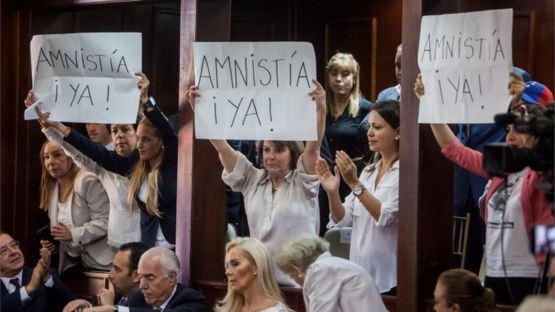
CARACAS, Venezuela — Venezuela’s National Assembly has proposed an Amnesty Law which would provide reprieve and release political prisoners. The move is the Assembly’s first following the swearing-in of Venezuela’s first non-Socialist majority Assembly in fifteen years. The prioritization of pursuing amnesty for Venezuela’s political prisoners was one of the democratic coalition’s main campaigning points.

Lilian Tintori, Mitzi Capriles and Patricia Ceballos call for amnesty. Each woman’s husband is an Opposition figure arrested and imprisoned by the Maduro government.

The proposed legislation has been met with both praise and skepticism. While the National Assembly is eager to free a number of Opposition prisoners, there is concern that the drafted Amnesty Law will not be effective.

The Venezuelan Penal Forum (FPV) has introduced two alternatives for the Assembly to choose from. First, the Assembly can enact and Amnesty Law, which would require approval from Socialist President Nicolas Maduro. The second option is the issuance of a Legislative Decree, which does not need the go-ahead from Maduro.

A further issue is the role of the judiciary – under Venezuelan law, only a court may ultimately order the releases. Some fear that a judge may refuse to comply, as there has long been concerns regarding governmental influence in the judiciary in Venezuela.

Maduro’s government has staunchly opposed the proposed legislation, calling it “absurd.” Former National Assembly Speaker Diosdado Cabello (who lost his position in the last election cycle) expressed concern that the law could provide amnesty for gang leaders and other criminals. The executive director of the FPV, Alfredo Romero, says that such fears are unfounded, as the proposed legislation includes safeguards against such events.


For more information, please see:

BBC – Venezuela: Opposition-controlled National Assembly sworn in – 5 January 2016

Vice News – There was a Lot of Yelling During the First Session of Venezuela’s New Congress – 5 January 2016

PanAm Post – Experts Warn Amnesty Law May Fail to Free Venezuela’s Political Prisoners – 11 January 2016 

TeleSur – Venezuelan Right Discusses Amnesty for Coup, Violence Plotters – 11 January 2016

Presna Latina – Opposition Project on Amnesty Condemned in Venezuela – 12 January 2016

Indonesian Capital Rocked By Deadly Terrorist Attack

By Samuel Miller
Impunity Watch Reporter, North America and Oceania

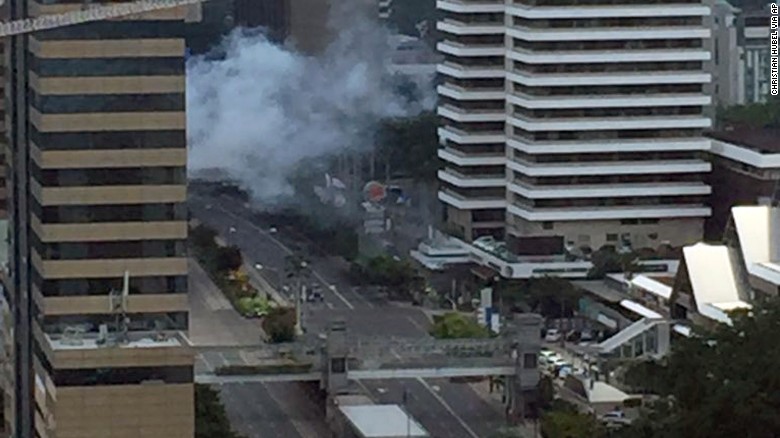
JAKARTA, Indonesia — At least six people are reported dead in a suspected series of bombings and gunfire outside the Sarinah department store on Jalan M.H. Thamrin in Central Jakarta on Thursday. Islamic State (“IS”) said it was behind the attack, the first time the radical group has targeted the world’s most populous Muslim nation.

An Explosion Rocks Downtown Jakarta, Indonesia. (Photo Courtesy of CNN)

Security forces battled militants for hours in a major business and shopping district.

The mayhem began with a suicide blast at a Starbucks while gunmen outside opened fire, killing a Canadian man, said Jakarta’s police chief, Maj. Gen. Tito Karnavian. Moments later, two suicide bombers struck a traffic police post, killing themselves and an Indonesian man.

Security forces later put the streets on lock-down, including areas near the U.S. and French embassies and other diplomatic sites. At the Starbucks, six hand-crafted explosive devices were found stashed.

“So we think … their plan was to attack people and follow it up with a larger explosion when more people gathered,” said Charilyan. “But thank God it didn’t happen.”

IS released a statement online claiming the attacks, which it said were carried out by soldiers of the Caliphate, targeting citizens of the Crusader coalition against the group. “A group of soldiers of the caliphate in Indonesia targeted a gathering from the crusader alliance that fights the Islamic State in Jakarta,” the group said in a statement.

Several explosive devices were planted, while four militants attacked with guns and explosive belts, the jihadist group said in a statement. According to IS, 15 people were killed in the attack, a claim that contradicts the Indonesian government’s official death toll of seven people.

Mr. Karnavian also blamed the terrorist group and singled out a militant named Bahrun Naim, who he said plotted the attack to assert himself among various figures competing to lead ISIS in Southeast Asia.

The Jakarta carnage, in an area frequented by foreigners, came 6,000 miles from and two days after ISIS boasted about a suicide bombing in the heart of Istanbul. CNN security analyst Bob Baer likened the Jakarta attack to the November 13 Paris massacre, in which terrorists linked to ISIS struck several locations at the same time.

A spokesman for Indonesia’s national police, Maj. Gen. Anton Charilyan, issued a statement concerning the assailant’s plans. “So we think … their plan was to attack people and follow it up with a larger explosion when more people gathered,” said Charilyan.

“But thank God it didn’t happen.”

For more information, please see:

BBC News – Jakarta attacks: Islamic State says it was responsible – 14 January 2016

CNN – Jakarta attacks: Deadly blasts, shootout hit Indonesian capital – 14 January 2016

Jakarta Globe – BREAKING: Six Reported Dead as Explosions, Gunfire Rock Central Jakarta – 14 January 2016

Reuters – Islamic State claims Jakarta attack, targets Indonesia for first time – 14 January 2016

Russia Today – Suspected ISIS attacks in Jakarta – 14 January 2016

Washington Post – Militants strike Jakarta, killing 2 as authorities probe Islamic State reach into Asia – 14 January 2016

NY Times – Jakarta Attack Kills at Least 2, Indonesian Officials Say – 14 January 2016